Monday, September 29, 2014

Book 158, Austria: Elfriede Jelinek’s "The Piano Teacher"

Kind of tricky to track down this book – the National Library had only one English-language copy in stock, and it was checked out. (Oddly enough, the Mandarin and Malay translations were still available.)

Had to go down to my old stomping grounds of NTU to check out the copies they had on reserve there as compulsory syllabus readings, in between Thomas Mann’s Death In Venice and WG Sebald’s... something or other.
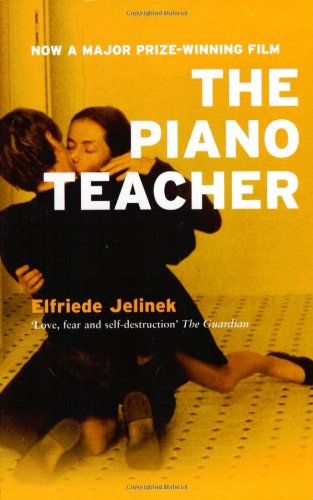

And damn. Now I know why the censor-happy National Library won’t keep multiple copies in stock. Never mind that this is a work by a Nobel Prize Laureate, the greatest Austrian writer of her generation; a work made into a landmark critically acclaimed work of Franco-Austrian cinema.

The truth is, this book is sick, in the best way possible. Oh, the perspective’s technically third person, but it goes under your skin… It begins with a portrait of the twisted relationship between the 36-ish-year-old piano teacher Erika Kohut and her Mother; they live together in a tiny flat and the Mother refuses Erika any luxuries whatsoever, flying into a rage when she spends money on a dress to make herself look pretty, pretty girls are sluts, etc., all she wants to do is keep Erika as her tool to earn enough money for her old age so they can live together in a bigger condo, and all this good-for-nothing daughter does is waste her pay on frivolities…

So we hate the mother, and we’re rooting for Erika, and even more so when we learn that Erika was groomed to be a great concert pianist from her girlhood, her mother and her grandmother consumed by dreams of fame and success that brought them to Vienna, the city of music. But somehow Erika screwed up a critical recital and has had to live her life as an angry repressed spinster piano teacher at the Vienna Conservatory…

…and it turns out she’s kind of an awful person as well, deliberately kicking or pinching people in crowded trolleybuses, stalking through the Turkish district to look at girlie peepshows or Prater fairgrounds to catch couples doing it in the grass (there’s some horrible things said about Turks and Yugoslavs in the process; hope that’s the character speaking and not the author)…

… and there’s a young, blond, athlete of a piano student named Walter Klemmer, and he’s hot for her, and she’s hot for him, but he’s asserting his god-given male entitlement and worship of his own 7-inch cock on the world, flirting with every young girl, and she won’t do with that, and so she hurts other people, she hurts herself especially, she hurts her mother too, and she hurts Klemmer, in a series of psycho nonconsensual BDSM sequences in the conservatory toilets, broom closets and her mother’s sacred bedroom…

In a way, it’s a feminist’s nightmare: a woman writing about women who are hysterical, steely in public but desiring domination and punishment in private, women who are wildly weak. Women like the heroines of Greek tragedies. Xiao bitches, as Singaporeans would say.

And it is written so damn well. Aiyah, I’ll just leave it at that. Wonder how on earth I can learn from this prose style. (Rather pleased that NTU students are reading it… how does it change their lives?)


View Around the World in 80 Books!!! in a larger map

Representative quote: Erika holds Walter Klemmer at arm's length. She pulls out his dick, which he has already slated for deployment. It only needs the finishing touch, for it is already prepared. Relieved that Erika has taken over this difficult task, Klemmer tries to push his tach down all the way. Now Erika has to resist him with her entire weight so she can remain upright. She holds Klemmer's genital at arm's length while he fumbles about randomly in her vagina. She lets him know that is he doens't stop, she'll leave. She softly repeats her threat several times, because her suddenly superior will has a hard time getting through to him and his rutting fury. His mind seems fogbound with angry intentions. He hesitates. Wondering whether he's misunderstood something. Neither in the history of music nor anywhere else is the suitor simply barred from events. This woman has not a spark of submission. Erika starts kneading the red root between her fingers. She demands a privilege, but refuses to grant it to the man. He must go no further with her.

Next book: Imre Kertész's Fateless, from Hungary.

Sunday, September 21, 2014

Book 157, Liechtenstein: "Liechtenstein: A Modern History" by David Beattie

Sometimes doing this blog is more of a ritual than anything else...

 So, Liechtenstein. Principality of 35,000 people. How many writers amongst them? One prominent one, in fact: Prince Hans Adam II himself, who's scribbled out a rather well regarded text called The State in the Third Millennium.

In retrospect, I should've ordered myself an ebook version, because what I ended up with instead was dry dry book on history and constitutional law and economy:


Was there anything worth remembering from my couple of hours skimming through this book? Well:

a Roman soldier’s helmet has been discovered on Liechtenstein's territory, bearing his name (not mentioned) but not, alas, his legion,

 during the Middle Age witch-hunts, out of a population of 3,000 people in the principality, 300 were tortured and executed,

 the many Jewish immigrants involved in the banking industry fled before WW2, which was a shame because they would have been pretty safe. Liechtenstein never capitulated to the Nazis, remaining resolutely neutral, avoiding an Anschluss (Hitler once grumbled that he never wanted to hear words Liechtenstein and Switzerland again “because the people there hate me") and a Nazi putsch,

 after the war, Communist Czechoslovakia insisted that the Liechtenstein royal family were Germans and had to hand over their land in their territory, when in fact they were only kinda culturally German the way many German Czechs like Kafka were,

 during the 1968 referendum, separate votes were held amongst men and women to decide whether or not to allow women’s suffrage. Most men – and most women - voted against it. (This kind of direct democracy is quite feasible in such a small country.)

it's naturally hard to figure out what holds the country together culturally (a third of the residents are non-citizens, though they're mostly Germans and Austrians), but a lot of it's the royal family,

• also, the country's "economic miracle" is thanks not only to banking (the author was very forgiving of the whole tax avoidance and money laundering thing), but also to high industrialisation - they had an early hydroelectric dam, plus manufacturing bases for false teeth.

Yeah, I think that's about it. Most of the book was really fawning over the princes - and yeah, that's all of them on the cover, from Karl I who bought the area in 1608 to Hans Adam who's still there right now. The author's a former British ambassador to Switzerland and Liechtenstein. Maybe he had a crush of Hans, who is quite the silver fox.

There was also a bit about the Princes' extensive art collection, which has been on show at the Met and Singapore (he once sold a Franz Hals to help with state finances, not that there's any public debt now). And in fact I was thinking of reading one of these art catalogues for this entry, but I felt, well, it's kinda awkward when the princes and the art aren't actually housed in Liechtenstein itself.

For a nice fun intro to this country, I'd recommend the chapter on the microstate from George Mikes's Switzerland for Beginners. Not that reading it was a total bore - interesting resonances for a Singaporean to read about this weird little mega-rich nation's survival, prosperity and uncertain future.


View Around the World in 80 Books!!! in a larger map

Representative quote:
“In 2006 the Pinricpality of Liechtenstein will commemorate the 200th anniversary of its full state sovereignty. It is younger than the USA but older than the modern states of Belgium, Greece, Italy, Germany and many others. In the heart of Europe, it is the diversity of Europe. Its people, its traditions, its institutions and its economy give it much to hope for. Amid their justified celebration of the past and heir optimistic anticipation of the future, many Liechtensteiners will reflect on the much-quoted words of Peter Kaiser, their first historian, the country’s representative at the German National Assembly in Frankfrut in 1848-1849 and one of those who defined Liechtenstein identity:

'If we understand our advantage correctly, we may present ourselves as a small nation that endangers nobody but commands respect from all. Life is short; but an honourable name remains and serves down to the latest posterity for an example and for emulation.'”

Next book: Elfriede Jelinek's The Piano Teacher, from Austria.


Saturday, September 13, 2014

Starry Island/Singapore Writers Festival 2014

I haven't even been to the library to pick out my Liechtenstein book yet, so I'm just going to use this space to advertise two things:

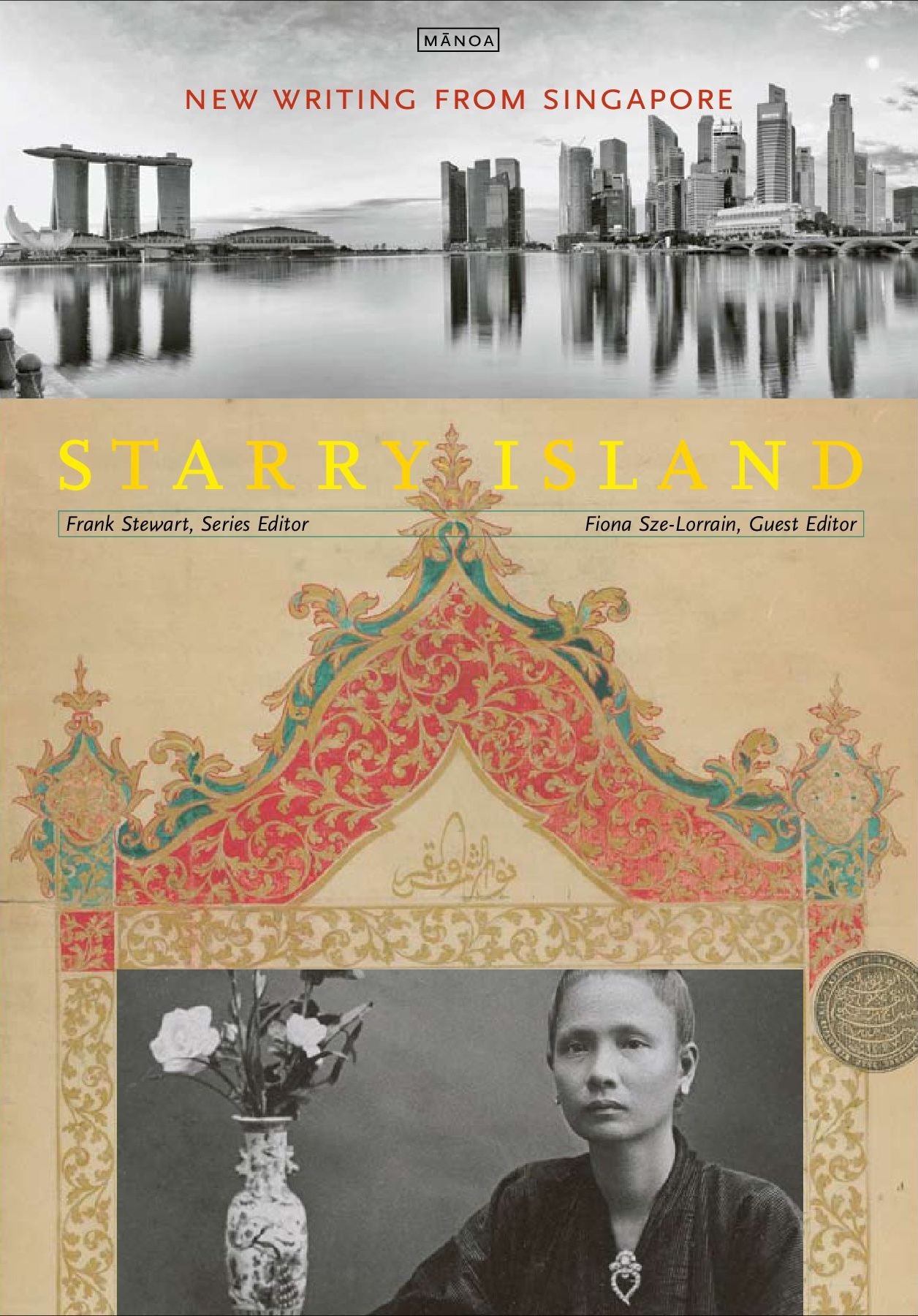
1) I've got a story in Starry Island: New Writing from Singapore, an imprint of the University of Hawaii Asia-Pacific literary journal Manoa. My contribution is a tale called Lion City, which may be one of my best.


2) I'm gonna be a featured writer in the Singapore Writers Festival 2014. I feel weird about this because a number of my friends are boycotting the event, since it's co-organised by the National Library Board (of recent book-pulping fame).

What's even more absurd is that I'm in very few events - one 7pm panel discussion on 1 November called All Art Is Quite Useless (hasn't that been discussed to the death already?) and the book launch of Loud Mouth Volume 1 on 3 November at 8:30pm. I've been in more events during years when I wasn't a featured writer!

Of course, as promised, at my events I shall rail against the establishment for censorship. Hopefully, everyone else will too.

PS. The Royal House of Monaco is still MIA. I think I'll have to pay the bloody fine. Zut alors.

Friday, September 5, 2014

Book 156, Switzerland: "Heidi" by Johanna Spyri

I've spent a month in Switzerland before, so I've read some of its literature - Friedrich Durenmatt's The Visit and The Physicists and Max Frisch's Homo Faber, for instance. Yet I hadn't, until now, read the most clichéd work of Swiss literature in existence:


Ah, Heidi. I got an illustrated Kindle version off Project Gutenberg. No idea if it was the best translation, but a lot of modern translations seem to be adaptations for younger readers.

And honestly, I can see why they'd target younger readers. The tale is soppy as all hell - Heidi is just five when she enters the scene, and she's all sweetness and light and innocent virtue, never once selfish or rebellious the way actual children are.

She's an orphan: her dad died in a logging accident and her mum died of grief as a result, and her cousin Deta is dumping her on their cranky old grandfather 'cos she's got herself a decent-paying job as a maid in Frankfurt. Never mind that her grandfather, the Alm-Uncle, is famously cranky and solitary and lives all alone in the cold mountains with only his two goats, and everyone in the village thinks she's committing reckless child neglect by placing her in his hands.

But ah, little Heidi is a miracle-worker! She charms the Alm-Uncle into loving her, and is utterly content with only having goat milk and cheese and bread for food and sleeping on a bale of hay, and spends all her days hanging out with Peter, the 11 year-old goatherd, playing with the goats and marvelling at the beauty of the sunrise and sunset and the flowers and the grass and the pines and the everything that you'd think a little Swiss village girl would just see as part of the landscape.

But then we've got the big conflict: Deta returns and asks her to come to Frankfurt to become a friend to Clara, an 8 year-old invalid daughter of the rich Mr Sesseman. The story thus turns into a narrative contrasting the oppressiveness of the German cityscape with the glory of the Swiss countryside.

You see, Heidi creates a huge ruckus in the household with her innocent country ways - she offers to take in an entire litter of kittens from a guy who guards a clock tower, at one point, and freaks out her governess with the surfeit of meowing kittens overflowing from her pockets. But she wins over Clara and Sebastian the butler and rich Mr Sesseman, because she's so pure of heart.

But Frankfurt's all wrong for her, and she gets skinny and sickly and starts sleepwalking, so Mr Sesseman sends her back to the Alps, and eventually sends Clara as well for a holiday. And Clara's so invigorated by the fresh mountain air and the goats' milk and the flowers that she actually starts walking again. Seriously, now.

So yes, it's a sappy story. But it was a pleasure to read - even knowing the ending, I was amused at the exact manner in which the miracle was executed, and how gradually, and how almost believably it came about. And it's fun to enjoy things ironically. Nonetheless, I've a few questions that bug me:

1) Isn't this all a little exploitative? I mean, we're romanticising the lives of the poor here. And their relationship with the rich is one of utter harmony - the Sessemans fall over their feet in their eagerness to bestow gifts unto Heidi's community, and are thanked for it. It's not a problem that some of our characters go barefoot and some ride around on silk cushions, apparently...

2) The levels of Christianity are too damn high. The only good things Heidi gets out of her stay in Frankfurt are the ability to read, and a new understanding of prayer and the ways of God, with which she's able to convince her bitter old grandfather to start going to church again. Really, the preaching is laid on pretty damn thick - not sure how much they preserve this in today's versions.

3) Is Peter an asshole? I wanted to declare him one as I read the story and watched him get rabidly jealous of anyone who became friends with Heidi, because he wanted to be her bestest and only friend aside from the goats - he has a habit of shaking his little fists at the sky, and even pushes Clara's wheelchair down the mountain at the end (without her in it, mind). So he is an incredible brat compared to our heroine. But then he's human - he's the one who actually acts the way a poor kid should act in the presence of the 19th century über-rich, which is to get mad and get smashing.

And a couple of factoids. First, the sequels to this book - Heidi Grows Up and Heidi's Children - weren't written by Johanna Spyri but by her translator. And second, Heidi isn't even her real name. It's Adelheid, which is an actual Christian name, whereof Heidi is a corruption, confusing the proper folks in Frankfurt no end.


View Around the World in 80 Books!!! in a larger map


Representative quote: 
"Grandmama told me that God would make everything much better than I could ever dream. I shall always pray from now on, the way grandmama taught me. When God does not give me something I pray for, I shall always remember how everything worked out for the best this time. W'll pray every day, grandfather, won't we, for otherwise God might forget us."

"And if somebody should forget to do it?" murmured the old man.

"Oh, he'll get on badly, for God will forget him , too. If he is unhappy and wretched, people don't pity him, for they will say: 'he went away from God, and now the Lord, who alone can help him, has no pity on him.'"

Next book: Johann Kraftner's Princely treasures from the House of Liechtenstein, from Liechtenstein.

Thursday, August 28, 2014

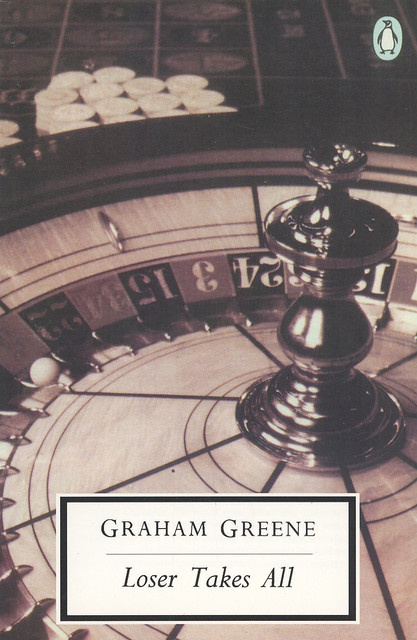
Book 155, Monaco: "Loser Takes All" by Graham Greene

Guess what? I decided that I *would not* let a second month go by wherein I'd only read one book for this blog. So I hitched a ride with my dad over to Jurong East Regional Library, and lo and behold, procured this:


It's a novella about Bertram, a 40 year-old London assistant manager of accounting and a bit of a loser - except that he's about to marry a sweet 20 year-old girl named Cary at a quiet church ceremony. Then, through the off-handed magnanimity of the major shareholder in his company, he ends up having the ceremony in Monte Carlo, Monaco - but when they're stranded at the hotel without the cash to pay their way any further, what can they do? Gamble their way into millions, that's what! And encounter all the ups and downs of riches while that takes place.

Now, I've only read one other Graham Greene novel, The Quiet American, which happens to have been published in 1955, the very same year this came out. And I can't help but be struck by the similarities between the two. Both feature:

1. A middle-aged, unremarkable first-person protagonist who is British and male,

2. and who also happens to be with an innocent 20 year-old (in The Quiet American, her name's Phuong) who appears bubble-headed and flighty but is in reality utterly devoted and surprisingly canny about the ways of life,

3. although there's an awful middle-aged woman involved - in The Quiet American it's Fowler's existing wife who won't grant him a divorce so he can remarry; in Loser Takes All it's Bertram's cheating sexpot of a deceased wife, plus a lady he picks up in the casino just to make Cary feel jealous.

4. Oh yes, and there's a handsome young man around who makes the protagonist jealous (the eponymous quiet American in The Quiet American; a young gambler named Philippe in Loser Takes All), but who does not deserve the girl, dammit.

5. And there's also machinations of power in the background - it's the Vietnam War in The Quiet American; it's the battles for money and power amongst the shareholders in Loser Takes All.

6. Plus, they both take place in exotic locations most Brit readers could only dream of visiting - Monaco! Vietnam! Not so much unlike an Ian Fleming novel after all. (Although it is remarkable that Loser Takes All was published a year before Grace Kelly's wedding to Prince Rainier - hence, it's set in the dowdy days of Monaco, before its great glamorisation.)

Of course, the two books are different, in substantial ways. First off, this one's just a novella, 110 pages long in fairly large print. And second, while The Quiet American is about the corruption of war and imperialism and all, Loser Takes All is about the corruption of wealth and greed - the money spoils everything, and Cary's the only one who can see that clearly.

And yes, this was a hell of a fun read. Probably useful for my writing, too. Although I do still feel bad about losing my copy of The Ruling House of Monaco. Will have to cough up some cash for that.


View Around the World in 80 Books!!! in a larger map


Representative quote: There are so many faces in streets and bars and buses and stores that remind one of Original Sin, so few that carry permanently the sign of Original Innocence. Cary's face was like that - she would always until old age look at the world with the eyes of a child. She was never bored: every day was a new day: every grief was eternal and every joy would last for ever. 'Terrible' was her favourite adjective - it wasn't in her mouth a cliché - there was terror in her pleasures, her fears, her anxieties, her laughter - the terror of surprise, of seeing something for the first time. 

Next book: Johanna Spyri's Heidi, from Switzerland.

Wednesday, August 27, 2014

Gah! I've gone and lost my book!

I was reading this yesterday on the train:


Later I checked my bag for it and found it was gone. I think I mislaid it somewhere in Bugis Junction. Am quite pissed because it was full of juicy gossip about the late Princess Grace of Monaco and her ridiculously wealthy and privileged and dysfunctional family, plus the absurd casino-driven dictatorship where they make their home.

It also happens to be a National Library book, and their last copy. Ah, but I shouldn't feel bad for them. Plus, I've noticed they've started monitoring our borrowing record and using it to recommend books to others online. Creepy.

Tuesday, August 19, 2014

Further IndigNation events!

I'm in Singapore now! And since I haven't picked up my Monaco book from NLB, so I'm gonna promote a few more literary events at IndigNation!

For starters, this Sunday we're having a queer feminist performance poetry event!


Mass Hysteria: Relapsed
Sunday August 24
3pm and 7pm
The Arts House, Play Den

Attention: Health Notice

Mass Hysteria has spread beyond detention and secondary school graduation. There are no expiry dates, no LUGs, but some spectres continue to haunt.

Shrugging off uniforms and habits, the queerdos set their sights on the world outside, to re-act and negotiate the hysterical and the historical, great tropes and expectations, memory and homophobic violence, nightmarish dyke drama and the life cycles of lezbo love.

Come quantify the insanity. Come queer the jealousy. Just come.

*********************************************
Featuring words and performances by:
Ad Maulod, Germaine Yeo, Mrylyn Tn, Rak Shakalaka, Sage Lee,Stephanie Dogfoot, Vanessa Victoria and music by: Illi Syaznie

Organizers:
AMOK Collective and Sayoni

Also, our closing event: A Minor ContraDiction!


A Minor ContraDiction:  Indignation SG 2014 Closing Night
Saturday August 30

7:30pm
The Reading Room

To bring Indignation to a close, take a peek into the future of Singapore’s queer literary community as present you with a night of readings and performances by some of Singapore’s most dynamic emerging LGBTQ voices. Raw. funny, honest, angry and hopeful, these young writers will show you what it means and how it feels to grow up queer in 21st century Singapore.

Organizers:
Ng Yi-Sheng, Stephanie Dogfoot, Vanessa Victoria, Eugene Tan