Showing posts with label eastern europe. Show all posts

Thursday, May 18, 2017

Book 170, Bulgaria: "The Physics of Sorrow" by Georgi Gospodinov

I had a few options for Bulgaria: the 1981 Nobel Prize-winning Elias Canetti (who didn't write about Bulgaria much, as far as I could tell); or Ivan Vazov, whose 1888 novel Under the Yoke is considered the greatest classic of Bulgarian literature.

However, I ultimately decided on someone more current, who also happened to be stocked in the National Library of Singapore: the poet Georgi Gosponidov. Surely, I thought, reading a book of poetry could be speedily done, putting me back on track for my round-the-world trek.

Alas, the book the library had 283 pages. And it's experimental. Is it a novel or a memoir or both? I dunno.


What I do know is that it's good. Gospodinov looks back at his life—he was born in 1968, stayed in village basements as a child because his dad earned too little on his veterinarian's salary, and witnessed as a young man the fall of Communist Bulgaria and the birth of a new globalised, capitalist nation—and he tries to find in his biography, his father's biography, his grandfather's biography, a meaning for the loneliness and sorrow that have haunted him all his life.

And in that basement he finds the Minotaur. A myth of the Greeks—who are of course neighbours to the Bulgarians—and who was not just a monster but also an abandoned child, a freak left to wander through a darkened labyrinth. He latches on to his grandfather's memory of a funfair full of sideshows in 1925, including (fictionally?) a young, abused Minotaur; he sees innocence in that vegetarian head and his lustful mother Pasiphaë who forsook him and the pages of classical authors who never once gave him words or empathy.

(Empathy is key to all this: he claims that as a child he immediately would go into spells where he would empathise so much with characters in stories, with voices, with animals, that he would tunnel into their lives and it would always be a long time before he could find his way back to his own body. Catatonic. Stopped happening when he was a teenager, which he regrets: not growing up and healing, but growing old and losing a special gift, a faculty of the imagination.)

His life's related in a nonlinear fashion, shifting from his meeting with his grandfather's Hungarian lover from World War II to his memories of burying time capsules and playing cowboys and Indians in the 1980s with the neighbourhood kids (did you know the East Germans made Westerns, but always made out the Indians to be the good guys?) and how the nostalgia for that has faded today, and his own flight from Bulgaria in 1995 after his countrymen attacked him for writing an op-ed about them being, according to a survey, the saddest place in the world, and wandering through the obscure cities of Europe, writers' festival after festival, his daughter being born, and himself growing older and foreseeing his death through his father's death...

Life as a labyrinth. And himself either the Minotaur or Theseus, determined to slay the monster.

It's strange how a writer's story of success ends up being one of sorrow as well (true to the title he considers the physics of it all, the infinite possibilities of the universe, God as a boson or a neutrino). And we've seen this strange way what's externally a good life is summed up with regret in VS Naipaul's A House for Mr Biswas, but the strangeness of this all seems uniquely Eastern European, a thing of Kafka or Gogol or Herta Müller.

The Eastern Europeans really have had an inheritance of the bizarre. I wish to learn from them. But alas, this is the last book from the region we'll be doing.

On to Southern Europe next!


Representative quote: It hurts right here, something down on the left, maybe it's my appendix.
Stop with the self-diagnoses, if you please. The appendix is on the right. There's nothing that could be hurting there on the left.
What do you mean nothing?
Just that. There's nothing there.
Well, it's precisely that nothing that's hurting me.

Next book: Hesiod's Theogony and Works and Days, from Greece.

Thursday, April 13, 2017

Book 169, Romania: "The Land of Green Plums", by Herta Müller

I'm feeling a little bad for choosing this work. Yes, Herta Müller is a Nobel Prize winner who was born in Romania, and yes, The Land of Green Plums is set in that country, describing the experience of state surveillance and paranoia under the regime of the Communist dictator Nicolae Ceausescu.


However, the story doesn't represent the experiences of the average Romanian, but that of the Banat Swabians, i.e. the German minority. These guys were scapegoated in society, due to the role of Germany during World War Two—sometimes almost rightfully: the protagonist (and Müller herself!) had fathers who had loyally served in the SS.

And yet they were also privileged in a sense: Germany was an important political and cultural power, which they could (and did) escape to as refugees. Even ordinary Romanians wanted to learn German. So they had a double consciousness, rather like the Chinese or Jewish diaspora across the world.

The book itself is quite wonderful: it's a dreamlike, poetic vision of a nightmarish world, narrated from the viewpoint of Müller (it's partly autobiographical, and the protagonist is never named). She's a student in an academy where her wayward classmate Lola hangs herself—or is she murdered by the Secret Police? (That theme of suicide and/or political murder will return.)

She befriends three other boys, also Swabians: Edgar, Georg and Kurt, and they find themselves questioned and persecuted by the authorities, hiding their poems, writing letters in code to each other as they enter the working world, in factories and offices and schools across Romania. How they're losing their souls, losing their minds as they're questioned by the insidious Captain Pjele.

Their mothers write to them from their villages, where their bones are aching, chiding them for getting on the wrong side of the political system, reminding them of their suffering. Their other friends may or may not be informants or traitors. They find themselves fired, or so depressed they can't work, so they have to fake illnesses—not so difficult to do, since you can bribe doctors in the dysfunctional Communist economy.

It's a wrenching, Kafkaesque view of another world—and it's pretty damn strange to read, when under late capitalism, I have friends who are advocating a return to Communism as the ideology that will save us all. The Communist states of Eastern Europe and East Asia are bad examples, they say. A true Communist state has never existed yet, but that doesn't mean we shouldn't keep trying.

But then again, even today, in Singapore and Malaysia and Trump's USA, me and my friends rightfully fear persecution for our activism. I watched 1987: Untracing the Conspiracy recently, and afterwards I had to ask my boyfriend what should I do if the authorities took me in and cowed me with threats that they would harm him?

And how strange that Kafka was able to inspire an image of dystopia in Eastern Europe, even before the Communist revolutions took hold. Back when it was all a beautiful utopian dream that we thought might work.


Representative quote: 
As I wandered, I didn't only see the demented and their dried-up belongings. I also saw the guards walking up and down the streets. Young men with yellowish teeth standing guard at the entrances of big buildings, outside shops, on squares, at tramstops, in the scruffy park, in front of the dormitories, in bodegas, outside the station. Their suits fitted them badly; they were either too loose or too tight. They knew where the plum trees were in every precinct they policed. They even took roundabout routes to pass by the plum trees. The boughs drooped. The guards filled their pockets with green plums. They picked them fast, their pockets bulged. One picking was supposed to last them a long time. After they had filled their jacket pockets, they quickly left the trees behind. Plumsucker was a term of abuse. Upstarts, opportunists, sycophants and people who stepped over dead bodies were called that. The dictator was called a plumsucker too.

The young men walked up and down and reached their hands inside their jacket pockets. They took the plums out a fistful at a time, to attract attention less often. Only when their mouths were full could they close their fists. 

Because they always took so many plums at once, one or two always fell on the ground or rolled down their sleeves while they ate. The guards kicked the plums that fell on the ground into the grass, like little balls. They fished the other plums from the crooks of their elbows and stuffed them into their already bulging cheeks.

I saw the foam on their teeth and thought: You can't eat green plums, the pits are still soft, and you'll swallow your death.

Next book: The Physics of Sorrow, by Georgi Gospodinov, from Bulgaria.

Tuesday, February 28, 2017

Book 168, Transnistria: "Siberian Education" by Nicolai Lilin

Yup, we're doing another contested nation: Transnistria, aka the Pridnestrovian Moldavian Republic! The UN claims it's part of Moldova, and only three other contested states recognise it: Abkhazia, South Ossetia and Nagorno-Karabakh. (Lord knows if I'll be able to find literature from or about those nations.)

But you know what? I'm hella glad I tried to find an author from this country that doesn't even send delegates to Miss Universe, because Siberian Education is pretty damn amazing.


It's a memoir (with admitted creative licence) written by a young writer who grew up in the organised criminal society of Bender, descended from gangsters and other outcasts deported to Siberia during the Soviet Union. He describes its intricate culture, with all its codes of honour and formality about guns and crucifixes and taboos against speaking directly to cops and its own effing criminal language—a culture which makes rival gangs, such as the oft-maligned Black Seed, seem like barbarians in comparison.

There’s several chapters to this story, detailing the gifting of his ceremonial pike (switchblade) at the age of six, his harrowing journey into enemy territory on his thirteenth birthday, a stint in a filthy juvenile detention facility, a teenage mission into other neighbourhoods to destroy the perpetrators of the rape of a neurodivergent girl (he claims that his society always respected the crazy and disabled as God’s children)—and it’s not in strict chronological order because he keeps diverging into other memories and family legends and folktales before returning to the main thread, Arabian Nights style, so that the whole thing’s a series of nested matryoshka-style tales. It’s really incredibly well told.

…In fact, the whole thing may be a little too incredible, full stop. He does come across as a bit of an all-star Mary Sue, an excellent fighter with a natural brain for poetry and archaic religious Russian, not to mention his phenomenal skills as a tattoo artist (which are legit; Lilin runs a tattoo parlour IRL). And Donald Rayfield, a professor of Russian and Georgian, straight-up calls the whole thing "a fantasist's ravings". Huge factual holes are being found in Lilin's sequel to this book, Free Fall: A Sniper's Story, about his military service in Chechnya—and the odd thing is, Lilin replies to most of these objections with an admission that he made most of it up for literary effect.

So how much of the core of these tales is true? Maybe not much—he wrote these tales in Italy, in the Italian language, far from his hometown, and he says that the Moldovan invasion's destroyed the society he documented. So there aren't that many people around who can directly contradict him.

And told up—upon further Googling, I've discovered that the book was never translated into Russian (although it was into about 40 other languages) and has been dismissed by a Russian journalist as a hoax. And even after that hullabaloo,  a 2013 film was made. Now I'm starting to wonder if Lilin actually is Transnistrian.

Ah well, it's still a hell of a book. If nothing else, it's a tale of what happens on the fringes of Russian culture, making it clear that the former Soviet Union was never as united as it seemed, with huge rivalries between those from the western, Moscow and St Petersburg-dominated side and Georgians, Armenians, Ukrainians and—of course—the Siberians. Makes you wonder about that upcoming superhero movie, Guardians, with heroes from different former republics, including a bear-man from Siberia. Would they all really have been friends?


Representative quote: "And now tell me why we should trust those who have spent their whole lives killing our brothers, locking us up in prison, torturing us and treating us as if we didn't belong to the human race? How is it possible, tell me, to trust those who live thanks to our deaths? Cops are different from the rest of humanity, because they have an innate desire to serve, to have an employer. They don't understand anything about freedom, and they're scared of free men."

Next book: Herta Müller's The Land of Green Plums, from Romania.

Wednesday, January 11, 2017

Book 167, Moldova: "Bessarabian Nights" by Stella Brinzeanu

Happy New Year! And yes, I'm still chugging along slowly with my reading program. This one was tricky: there's not a lot of Moldovan literature translated into English. Most of what I found on offer at the library were books about the sex trafficking of Moldovans, which is of course an urgent issue to discuss but also seems kind of voyeuristic and creepy when explored from a foreigner's point of view...

Luckily, I managed to find a Kindle book about sex trafficking of Moldovans by an actual Moldovan...


And you know what? It's really not very well written. The English is hella awkward, and I don't know if there was even a proofreader involved. I'm kind of shocked to discover that the author describes herself as a writer, rather than just a well-meaning citizen who wanted to share the problems of her nation.

The flip side of the coin is that the book is a very compelling portrait of Moldova itself. It's got three young women as main characters: Doina, Larisa and the ill-fated Ksenia, who plans to be an artist but is trafficked abroad to Italy by her no-good-boyfriend Boris.

These girls are from country villages but educated enough to work in Western Europe, joining the huge migrant work force that emerged when Communism collapsed. And besides the horrors of sexual slavery, there's a detailed depiction of all that being Moldovan entails: growing up amidst rustic poverty, machismo and alcoholism, selling lice as folk medicine (inspired by Roma folk), a village witch who's really just a charlatan, the growing religious conservatism, a skilled diaspora reduced by their government's financial incompetence to manual labour in Italy and the UK...

Also the strange problems of identity—the main trio, like the population, are a mix of the different races that make up the nation, Roma and Romanian and Russian. The Moldovan national language is, in effect, Romanian, in spite of all their valiant desires to be known as a separate country.

And though these women are depicted as the talented tenth who can rise above the problems of their people, starting overseas companies and newsletters to unite the diaspora, the ending is hella depressing. Brinzeanu evidently doesn't feel it's honest—or in the character of a Moldovan—to project an optimistic future, where good triumphs over evil and maybe someone who's been rescued from sexual slavery can actually be a survivor.

I don't want to give away too many details, but suffice to say that there is actually a worthwhile story in these pages. This author just needs an editor and a few redrafts. As most of us do, you know.


Representative quote: "The tragedy is that we are a starved nation. We are starved for food and like you say, Ichim, we are starved for assets too, slaving away blindly without a vision whatsoever beyond the immediate betterment of our material situation."

"We work so hard and despite it all, we are still poor — the poorest people in Europe, according to some sources," the surgeon-labourer hastened to add.

Next book: Nicolai Lilin's Siberian Education, from Transnistria. (That's right, it's another unrecognised state!)

Saturday, November 26, 2016

Book 166, Ukraine: "The Collected Tales of Nikolai Gogol"

I'm still here!!!

Yeah, I've been terrible about keeping this blog. But I'm still reading furiously (as you'll see from my Instagram tag), and about a week ago I got round to finishing this:


Gogol was ethnically Russian. He wrote in Russian and enjoyed literary success in St Petersburg, Russia. Most of his best-known stories are set in Russia, too, such as The Diary of a Madman, The Portrait and The Nose.

Yet he was born and raised in Ukraine, and that's what he drew on when he published his first short story collections, Evenings on a Farm Near Dikanka and Mirgorod. In Richard Pevear's preface, he explains that these stories are exotica, in many ways, following a fashion of the times for stories of "Little Russia", a part of Ukraine which was then being Russianised. They're not super-accurate: Gogol often claims stories he dreamt up himself are old folktales, and he had to write back to his mother for all those luscious ethnographic details which he'd failed to note when he was actually resident in Ukraine. Nevertheless, these yarns of Cossacks and witches and ancient curses and fat landowners have nonetheless been embraced by Ukrainians as part of their heritage—as is Gogol himself to this day.

And damn, this stuff is fun. Some of it is straight up Gothic horror, like The Terrible Vengeance and Viy (which has been turned into a movie recently!), though there are also comic supernatural tales with blessed fools like The Night Before Christmas and Austenesque minor nobility stories like Old World Landowners and The Story of How Ivan Ivanovich Quarreled with ivan Nikiforovich. Tall tales of the outback, the margins of the empire where anything can happen.

And what's fascinating to me is how, as a 19th century writer, Gogol straddles both genre horror and surreal modernist slipstream—the The Nose and The Overcoat presage Kafka in their portrayal of how the dehumanisation of big city life can only be expressed through stories of the impossible. Meanwhile, the ravings of insane clerks and artists in "Diary of a Madman", "The Portrait" and Nevsky Prospekt feel like the miracles of the margins, transposed into modern settings that can only medicalise them...

And I love it, since I'm trying to write magical realism in a first world country, drawing on our third world roots of folk horror. I'll end with a quote from "Viy".


Representative quote:
He paused for a minute. In the middle, as ever, stood the motionless coffin of the terrible witch. "I won't be afraid, by God, I won't be afraid!" he said, and, again drawing a circle around himself, he began recalling all his incantations. The silence was dreadful; the candles flickered, pouring light all over the church. The philosopher turned one page, then another, and noticed that he was not reading what was in the book at all. In fear he crossed himself and began to sing. This cheered him somewhat: the reading went ahead, and pages flashed by one after another. Suddenly... amidst the silence... the iron lid of the coffin burst with a crack and the dead body rose. It was still more horrible than the first time. Its teeth clacked horribly, row against row; its lips twitched convulsively, and, with wild shrieks, incantations came rushing out. Wind whirled through the church, icons fell to the floor, broken glass dropped from the windows. The doors, tore from their hinges, and a numberless host of monsters flew into God's church. A terrible noise of wings and scratching claws filled the whole church. Everything flew and rushed about, seeking the philosopher everywhere.

Next book: Bessarabian Nights, by Stela Brinzeanu, from Moldova.

Sunday, June 26, 2016

Book 165, Chechnya: "I Am a Chechen!" by German Sadulaev

I know Chechnya isn't a recognised state by any international bodies. But while Russia and the UN don't recognise self-determination, that's no reason I shouldn't.

And anyway, this book is amazeballs.


Interesting fact: German Sadulaev didn't even mention the Chechens in his first book, Radio Fuck. And why should he have? He was a lawyer in St Petersburg, writing in his first language, Russian. He passed as Russian; indeed, his mother's ethnically Russian.

But he was born in Shali, a village in Chechnya. And he only escaped the violence there because he'd gone off to study in Leningrad at the age of 16. From a distance, he watched his idyllic hometown descend into war and chaos, brought on by the onslaught of heartless Russian bombers...

It's hard what to make of the text, actually. The first few chunks are written as dreamlike memoirs, clearly using autobiographical material, but with tonnes of magical realism thrown in: he claims all these portents of madmen and bleeding cattle that foretold the destruction; empathises with the agony of the swallows who saw their nests bombed to bits (the souls of unborn children, according to Chechen tradition), associates the race of the Chechens with the kshatriyas who were expelled from India in the age of the Upanishads... yet always returning to the detail of the "I" whose biography corresponds with that of his own: half-Chechen, half-Russian, suffering from the survivor's guilt and the weight of traditional machismo that prevents him from weeping out his pain.

And as the book progresses, we get more into the realm of fiction: in "When the Tanks Awoke", he confesses to the common childhood fantasy of having a twin, which eventually develops into a tale of himself as two boys, Zelik and Dinka, one with a Russian father and a Chechen mother, one with a Chechen father and a Russian mother, playmates and rivals who eventually end up facing one another on the battlefield. Later, clear fictions: "Victory Day", about an old Chechen World War II Soviet soldier who beats up a Neo-Nazi in Lithuania; "Snuff", about a phantom lover in New Orleans.

But always the sadness, always the sense of exile, always the sense of a kingdom lost—not just the Shali of his childhood, but the Soviet Union that he grew up proud to be part of.

It's strange to be reading this as Chechen literature, really. He's from Chechnya but not part of it, able to separate himself from the horrors of the war. But his family has suffered through it, been nearly killed by the sniper fire; he's had to demand that Russian flight crew allow his paralysed sister the right to stay on a plane because Russians have only read the state media that claim only terrorists have been attacked, when in reality, it's everyone, all the innocents, all those who once believed they were one people.


Representative quote: In the combat report from the front I heard that during the battle of Urus-Martan the Shali tank regiment had been eliminated. An enemy formation. When Russians die, they talk of 'losses', or even say they've 'fallen'. When Chechens die, they describe them as 'eliminated'. Because Chechens are the enemy. I too am Chechen: the enemy. And when I die, they'll describe me as 'eliminated'.

Next book: The Collected Tales of Nikolai Gogol, from Ukraine.

Saturday, June 18, 2016

Book 164, Russia: "War and Peace", by Leo Tolstoy

Guess what? I'm reviving my blog after a year and a half of inactivity! Because I've finally finished this bloody tome.


(I've decided on a new format for the pictures, btw—instead of just covers, I'm using the Instagram images I've posted at #yishreads. New year, new apps, y'know?)

Why did it take me so long to finish this? Hard to say. Part of it is that it moves really really slowly, so slowly that one forgets names and attributes and events.  It's hard to really feel like one's making progress, though the division into fifteen separate books and an epilogue helps—there's little dramas that begin and finish within an individual book.

There's no obvious main character either, which is why I suspect it would've been easier to get through Anna Karenina. The closest thing we've got is the innocent Pierre, who starts off as an impoverished illegitimate twenty-something.

Then he inherits money and a title, becomes a fat, cuckolded aristocrat who's scorned by all good society (and can't even exercise his well-intentioned reforms on his peasants without them suffering for it). And then the French invade, and he sees the city of Moscow collapse utterly, and he fails so utterly in his foolhardy attempt to assassinate Napoleon that the French see him as a loyal friend, but then he tries to save a girl from rape and gets captured as a prisoner-of-war and is marched through the steppes in deadly bitter frost before finally coming back into his title and comfort in the end, a better man for his suffering...

That's about the only plot I can hold onto. There's loads of other characters, but the only one I've got a strong impression of is Natasha, a foolish girl who plans to elope with a scoundrel but is saved when someone tells her he's already married. Pierre buys his silence. It sounds like a trivial little tale, but it's pretty vivid.

And you can tell from the contrast of these tales that this literally is a book about war and peace—it's got the horrors of a war diary (there are intense descriptions of the battlefield, limbs being torn off and everything), and the very next chapter may well be princesses in palaces worrying about gossip and respectability, and each is treated with equal importance. It's Pride and Prejudice meets Saving Private Ryan, I tell you.

We've seen some of this before in Walter Scott's Waverley, but that was a romance. This is a beast of a different nature—also a historical novel, but with a philosophy based on the randomness of history rather than some great narrative of the rise and fall of Scottish culture. Tolstoy has whole chapters of theory mixed in with the fiction, pointing out the folly of historians for telling the story of history as led by Great Men, or by the ideas of the intellectuals of the time, when really, in battles, everyone's just scrabbling around with no idea what they're doing, and every individual person's exercising his or her own will all the time.

He even punctures the popular myth of Muscovites burning their own city rather than letting the French have it by pointing out that any city with wooden houses, if left unattended in a battle, is going to be in danger of a mass conflagration. Not a romantic at all.

I think you can tell that I am fond of this book. It's nuts that it's so long and so disperse, but it does have great ideas and great moments embedded into it. Was it worth the time? I don't know. At least when I boasted about having finished this text, folks got that it was a big deal. More obscure texts just don't register.

Honestly, however, another reason this took a long time is because I borrowed the book from the library and kept having to return it, then switched over to the Kindle edition (which felt even more interminable, since you can't see the pages moving), only discovering a month or so ago that I actually had a copy on the shelves of my house....

And part of it was because once you stop trying to finish a book every week, you kind of enjoy being open to loads of other reading options, and going back to your original goal is kind of a chore. So I'm no longer going to force myself to read one book every week. I'll just update this site whenever I please.


Representative quote: "People speak of misfortune and suffering," remarked Pierre, "but if at this moment I were asked, 'Would you rather be what you were before you were taken prisoner, or go through all this again?' then for heaven's sake let me have captivity and horseflesh! We imagine that when we are thrown out of our usual ruts all is lost, but it is only then that what is new and good begins. There is much, much before us."

Next book: German Sadulaev's I Am a Chechen!, from Chechnya.

Wednesday, December 10, 2014

Book 163, Belarus: "King Stakh's Wild Hunt" by Uladizimir Karatkevich

Somehow the National Library never processed my request for Nancy Richler's Your Mouth Is Lovely, which left me stranded in terms of Belarusian lit. (Richler is Canadian, anyway, and the story might take place in Russian Siberia. :/)

My options included Nechama Tec's Defiance, a non-fiction work about a Jewish resistance army during World War Two (available in the library) and Vladimir Kozlov's Number Ten: A Novella In Translation (available for 99 cents on Kindle).

Luckily, I managed to Google up a free pdf of this:


And I'm glad I chose it. I knew from the description it was gonna be kinda up my alley: a bit of a fantasy thriller about a modern man facing down the phantom of a cursed king, riding for eternity. But in fact, the background's a little more complex than that.

This book was written only in 1964, but it's a Gothic novel - the events take place in the autumn of 1888, with the first-person protagonist Andrey Bełaretski recounting the events as a 96 year-old man. He's an ethnographer (which I hadn't really thought was much of a profession in Europe in the nineteenth century) and his mission is to venture into remote parts of Belarus and document the dying legends, folktales and epics of his people to publish back in Minsk.

So you see we've got a theme of identity formation going on: the rise of a nationalist bourgeois class who want to go back to their peasant roots to understand what their culture is. Unfortunately, that culture is kind of horrifying - we've got horribly impoverished gentry (descended from the Polish, it seems) starving in their broken-down castles and burning their antique furniture for warmth, and thousands of muzyk (that's the word they use for serfs) who're living on even less. 

Andrei's pretty gloomy about all this at the beginning of the book. Then he gets lost in an undisclosed area of his country during an expedition, almost dies from falling into a swamp (a quagmire, they call it), and seeks refuge in the rain in the castle of Marsh Firs, where he's greeted by the Countess - an ugly little 17 year-old thing named Nadzieja Janouskaja, who's plagued by the doom of her noble line, unfamiliar with concepts of sunshine and friendship, and convinced that she, as the twelfth and last of the Janouski dynasty, is fated to die from the curse of King Stakh, whom her ancestor betrayed in his uprising many generations ago.

And of course our modern, Minsk-educated ethnographer pooh-poohs it all, and is determined to discover a rational explanation for why he hears the invisible footsteps of the Blue Lady outside the corridor, not to mention the apparition of the Little Man, and all the other strange phenomena out of folklore that have come out of the mouths of goodwives to haunt him in real life.

As the tale unfolds, however, we realise this is more than a Dracula story, for the main players are actually the various impoverished nobles who are battling over the lands she stands to inherit - some good at heart, like young pure-minded suitor Sviecilovic; some evil, like the impetuous Varona, and some with plenty to hide, like Nadzieja's garrulous uncle, the huge, supremely jovial Rubatouk.

And [SPOILER ALERT!!!] we soon see that this is a book of the Soviet era indeed, because the phantoms are indeed revealed to be the work of jealous nobles, and our working-class descended hero is able to use his wits and strength to defeat them, with the aid of a peasant uprising, complete with pitchforks and a gruff hunter named Ryhol who's able to smack some sense into him every time he wants to take *pity* on one of these leeches of society. (It's kind of like a Scooby-Doo episode - the real monsters aren't the undead, but simple money-grabbing mortals, who'll cloak themselves in masks and darkness to fool the superstitious into believing they cannot be defeated.)

But there's a fairy-tale ending after all - Nadzieja grows in beauty and maturity throughout the story (though she's pretty passive even by the end), enough for Andrej to fall in love with her and marry her and live happily ever after, which frankly made me a little cross, because everything in the novel had been indicating that the story ended in tragedy. Did Karatkevich do this for the censors, the pleasure of his readers, or because his moral compass bade it so? I do not know. [SPOILERS END.]

If you wanna check out this book, it really is loads of fun - a bilingual PDF is for some reason available here, so you can check the English against the Belarusian (which I did not know was a language up till now).

Oh, and by the way, I can't figure out how to embed Google maps properly, so it's already zoomed in on the region I'm talking about. Any advice?


Representative quote: 
"Nothing," she answered dryly. "But it's too late. Everything comes too late in the world. You are too much alive. Go to your people, to those who are alive, who go hungry and can laugh. Go and conquer. And leave the graves to the dead."

"But aren't you my people?" I exploded. "And these people, frightened and hungry, aren't they my people? And Sviecilovic, whom I shall have to betray, isn't he of my people? And these god-forsaken swamps where abominable things occur, aren't these swamps my land? And the children crying at night, when they hear the hoofs of the Wild Hunt, trembling with fright all their lives, aren't they my brethren's children? How can you even dare suggest such a thing to me?"

Next book: Leo Tolstoy's War and Peace, from Russia.

Monday, November 24, 2014

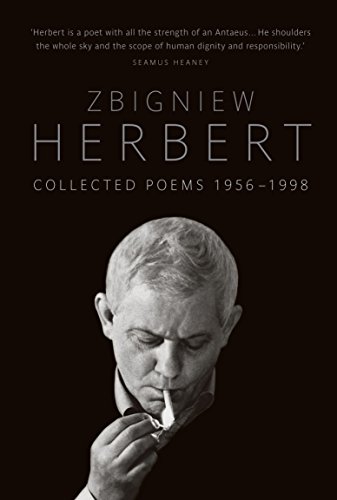
Book 162, Poland: "Collected Poems: 1956-1998" by Zbigniew Herbert

One of my favourite poets in the whole wide world is Polish!

I discovered the works of Nobel Lit Prize Winner Wisława Szymborska as a secondary school kid, back in the nineties – loved them so much; huge influence on me, etc. Unfortunately, her output wasn’t huge, so there wasn’t an extra tome of her works I could check out for this project. And I’d already used Czesław Miłosz - Poland’s other Nobel Lit laureate – for my Lithuania book.

Fortunately, there are lots of famous Polish poets. Such as this guy:


I’d heard his name bantered about amongst my friends, so I figured, yeah, why not read something of his? (Yeah, yeah, he was born in Lwow, which is now part of Ukraine, but it was Polish while he was a kid.)

This was the library’s only volume of his works – ye compleat edition, running to 571 pages. But mirabile dictu, it’s good. So good. (I’d considered abandoning it for Adam Zagajewski’s Eternal Enemies, a convenient, skinny little codex, but when I leafed through that, I found myself longing for the lambent voice of my man Herbert.)

We’ve nine different volumes of his poetry packed into this tome:

Chord of Light (1956)

Hermes, Dog and Star (1957)

Sudy of the Object (1961)

Inscription (1969)

Mr Cogito (1974)

Report from a Besieged City (1983)

Elegy for the Departure (1990)

Rovigo (1992)

Epilogue to a Storm (1998)

So we get to follow this man from a post World War to a post-Cold War era; from youth; from the age of 32 to 78. And over the five decades we see his voice develop, shift from focus to focus, intensify and mourn himself.

And it is the same voice throughout – a melancholy, erudite voice, haunted both by the horrors of his own Communist (and pre-Communist) society and the ghosts of classical history. He invokes Hermes, Apollo, Athena, Marsyas, the Minotaur, Elektra, Claudius, Marcus Aurelius, Nefertiti – also Mary Queen of Scots, George Orwell and the Emperor Meiji, come to think of it – but not in a show-off-how-smart-I-am way, but to invoke archetypes of eternal drama to show that the tyranny and torture of his land (of all lands) have ever been thus.

Loads of specific references to his childhood and his Polish contemporaries, too, which were a little harder to get. He calls himself Mr Cogito (therefore he is?) in the latter half of his career, documenting what he sees as his loserly life. But fundamentally, he’s engaged in the same Szymborska-esque mission of mourning for the entire world, for the whole of history.

That hits me, you know? This is poetry that makes me want to write more poetry. To join in the chorus as a testament. Gah.

(Though I personally do like Szymborska better still, because she also finds joy in the senselessness of the universe. But it’s not a competition. Is it?)


Representative quote:

I probably like his prose poems best, but this piece spoke of nation in a way that resonates a lot with me.

TAIL OF A NAIL

For lack of a nail the kingdom fell
- our nannies’ wisdom teaches us – but in our kingdom
there haven’t been nails for a long time nor will there be
neither those handy little ones used for hanging pictures
on a wall nor the big ones with which coffins are sealed

but in spite of this and perhaps precisely because of it
the kingdom endures and even gains others’ admiration
how is it possible to live without nails paper and string
bricks oxygen freedom and whatever else you like
evidently it is possible because it endures and endures

people in this country live in houses and not in caves
factories smoke in the steppe trains cross the tundra
and on the cold ocean a ship blows its bleating horn
there is an army and police a seal an anthem a flag
on the surface it’s just like the rest of the world

it is only on the surface because this kingdom of ours
is not a creation of nature or a creation of humanity
seemingly enduring built on the bones of mammoths
in reality it is weak as if suspended between
the act and the thought existence and nonexistence

a leaf and a stone fall so do all things real
but ghosts live a long time stubbornly despite
sunrise and sunset revolutions of celestial bodies
on the disgraced earth tears and things fall

Next book: Uladzimir Karatkevich's "King Stakh's Wild Hunt", from Belarus? Or Vladimir Kozlov's "Number Ten: A Novella In Translation"? Not sure yet.

Sunday, November 16, 2014

Book 161, Czech Republic: "Rossum's Universal Robots" by Karel Čapek

And thus begins my third set of 80 books! This blog's title is getting more and more inaccurate. (Will I actually get to Book 240? Doubtful, but let's see!)

I actually never got round to finishing Kafka's The Castle, because it didn't seem to be going anywhere interesting (and from the intro, I actually know it doesn't go anywhere at all, since the manuscript's unfinished.)

But I did get round to reading one of the great works of Czech drama - the first text in which the word "robot" appeared, in fact. 


It actually took me a while to decide which book to go with:

The Castle
1. is written by a more iconic writer
2. is in German 
3. is a novel (I've written about loads of them)
4. was actually inspired by the sight of a specific Czech castle.

R.U.R.
1. is written by a less iconic, but still famous writer
2. is in Czech
3. is a play
4. takes place on an unnamed island, accessible by steamer... perhaps not even in Europe...

In the end, my friends instructed me to go with the book that I actually enjoyed. Still feeling guilty, though.

But really, R.U.R. is fascinating. It takes place in the future - the physiologist Rossum (meaning "reason") is said to have retreated to said island in 1920 (the year the play was written), and invented the synthetic protoplasm for robots in 1932. He's interested in using the protoplasm to play God, more or less, creating grotesque semblances of dogs and humans. It's his son who comes up with the idea of turning these homunculi into efficient substitutes for labour. The entire cast of the play are the inheritors of said project, coming a generation later: the scientists and engineers on the island who're trying to perfect the design and marketing of the robots in the global market.

Plays set in the future are often a little dodgy - even George Bernard Shaw wasn't too successful with it - but this works. Perhaps because the device of the robots is so striking (of course it was novel then, but even now, when robot uprisings are a dime a dozen in print and on screen, the idea of seeing one on stage is still uncanny). 

Yet it's also because the tale is so deeply human - even to the point of farce. Its soul is a woman named Helena Glory, the daughter of President Glory (president of what, we're never told). She comes to the island as a fresh young twentysomething, eager to liberate the robots, whom she feels are being exploited. But she finds them too soulless to understand their condition, and is instead wooed by the very persistent CEO Harry Domin... as well as all the other engineers, who are for some reason all male (hey, it was 1920) and are all passionately, immediately, in love with her.

Ten years pass and surprise surprise, Glory's married to Domin. But now there's something off about the robots: we discover from whispers among the engineers that they've led a bloody revolt to exterminate humans - they had the capability after the nations of the world started using them as soldiers. And though they try to shield Glory from the news - they tell her that their getaway boat is actually a pleasure craft, presented to her on the anniversary of her arrival - they're actually shit-scared.

And it turns out that everything is (or may be) her fault. She's the one who demanded that the engineers improve the robots' intelligence, so she would stop feeling so scared and alienated by them. And she's the one who decides to burn Rossum's original manuscripts, which contain the formula for creating the robots - and is the engineers' only bargaining chip, their one chance of survival.

So Helena is Helen of Troy, Pandora, Eve - the woman to be blamed for everything. The introduction to this volume notes that there's actually notes there's a similar figure in the earlier Czech legend of the Golem: the foolish rabbi's wife who insists on using the Golem to help her with everyday chores, only to discover that she cannot control its power.

And yet Helena doesn't come off as an awful person - she might be dumb, but she's the stand-in for the audience in the show; the only main character who actually has normal human emotions beyond a thirst for progress and wealth and control. And (as with Eve) it turns out to be something of a happy fall in the end, as her improvements to the robots perhaps provide new hope for the renewal of the planet in the post-apocalyptic age...

Ah, I know I'm talking more about the human element of the play than the sci-fi stuff or the way the whole thing's a metaphor for the oppression of workers under capitalism (which really is a big thing, and fascinating in its own right). But mostly I'm intrigued by how the piece actually works as a genuinely entertaining play. 

Lots of humour, by the way - as I might have been able to guess from reading Čapek's other famous work, War With the Newts. Also highly recommended. Also check out Vítězslav Nezval's Valerie and Her Week of Wonders, and of course Kafka's Metamorphosis and The Great Wall of China...

Ahhh, the Czechs have loads to offer. Good for them!


View Around the World in 80 Books!!! in a larger map

Representative quote:

HELENA: But that's appalling, Busman!

BUSMAN: How right you are, Mrs Domin. I too used to have a dream. A Busmanesque dream about a new world economic order; an all-too glorious ideal, I'm ashamed to admit. But while I was working here on the balance sheet, it dawned to me that history is made not by great dreams, but by the petty needs of all respectable, mildly crooked and selfish people, that is, everyone. the only thng that idas, lovs, plans, heroisms, all those airy-fairy things are fit for is to be turned into the stuffing of a figure to be displayed at some Museum of the Universe and labelled; Ecce homo. Full stop.

Next book: Zbigniew Herbert's The Collected Poems, from Poland

Thursday, October 23, 2014

Book 160, Slovakia: "Rivers of Babylon" by Peter Pišt'anek

Boy oh boy. See, when I first started looking for books on Slovakia, I got referred to US author Michael Genelin’s detective novel Siren of the Waters, and the memoirs of Alexander Dubček (who is a Slovak politician, but who is known for having engineered the Prague Spring in the present-day Czech Republic, which was then of course part of Czechoslovakia).

But then I goofed around on Amazon and found this: 


(This is not the Amazon cover, mind you. It's from this site. But the Amazon cover is BORING, and I give myself a lot of leeway when I read from the Kindle.)

That guy on the cover is our protagonist, Rácz, who starts off as a penniless orphaned ex-soldier and farmer's son, who vows to leave the village and return as a rich man after seeking his fortune in Bratislava.

When he gets to Bratislava, he just so happens to encounter the stoker of a grand hotel - the Hotel Ambassador, a SIX-storey building (wow wow wow) who's about to retire after milking the corrupt Communist system of hiring more workers than necessary in the basement to supply the central heating. And so he takes over, learning how the century-old pipes work, shovelling coal and turning valves to keep the hotel warm.

But it's 1989, the time of the Velvet Revolution (which was what they called it in the Czech Republic - in Slovakia that called it the Gentle Revolution), and that means the whole Communist system of governance in coming apart. And that leaves room for the bad-asses to take power.

So when the hotel manager decides to punish Rácz for daring to enter the hotel by its front door in his dirty worker's overalls and boots - well, our scruffy underdog takes charge and starts turning off the heating in everyone's rooms. And this is Eastern Europe, with autumn settling into winter, so it HURTS.

Up to now, we've had something like a realist novel. But here, things take a slide into the magically real, because not only does Rácz manage to force everyone, from the cooks and the maids and the cabaret girls and the drivers and every single tourist and travelling businessman to bribe him into turning on their radiators, receiving gifts of soup and sex and Chivas Regal (which he pronounces as hee-vas ree-gal, of course) - but he actually starts climbing the social ladder, earning the respect and power through his ruthlessness that the manager never really had, and the poor old manager is reduced to starving and shivering frostbitten in his office - and yes, it gets weirder from there on.

This is a fun book. Thrilling. Socially insightful. It skips perspectives from character to character, so we get a pretty wide range of Slovakian society - there's Video Urban, the wannabe video artist-cum-currency exchanger-cum-taxi driver; Freddy Piggybank, the fat loser everyman parking lot attendant who goes spectacularly mad; Silvia, the wannabe ballet dancer-cum-cabaret girl-cum-kept woman who lives only for money; her girlfriend Edita (who's bisexual, and pretty hot for Silvia's undies, in fact); the Lawyer who tries to jockey Rácz for power; the former Secret Police Officers who're trying to stay relevant in this age of change through abusing their old warrants... And damn, crazy shit goes down.

All while you can pat yourself on the back for urbanely researching post-Communist Eastern Europe! Hurrah! (Shades of Alaa-Al-Aswany's The Yacoubian Building from Egypt, which I'd also recommend.)

What makes this all the more remarkable is that Pišt'anek's style was unprecedented in Slovakia - their literature previously made them out to be "a nation of wise bee-keepers and virtuous matriarchs", according to the preface. Damned if this isn't more fun to read. And there are sequels, too!

(Trigger warnings for anti-Gypsy racism and rape, though. Our underdog becomes more than an antihero; maybe something of a monster.)


View Around the World in 80 Books!!! in a larger map

Representative quote: Hurrenson found out about the existence of this nation only because of its ridiculously cheap prostitutes, willing to put up with anything that doesn't leave visible traces. Only then did he find out from the residents of this nation about the apparently famous artists, astronomers, and inventors whom he'd never heard of before. But so far Hurrenson has only been able to meet cheap whores, black market hustlers, arrogant waiters and taxi drivers, lazy room-maids and venal policeman. However, Hurrenson does not condemn anyone outright. He believes that the milieu in which he circulates as a bisexual tourist has shaped his opinion. He has no doubt that this nation is composed not merely of parasites and fools, but also of honest and educated working people. The point is that Hurrenson has never yet met such people, nor even found a trace of their existence.

Next book: Franz Kafka's The Castle, from the Czech Republic.

Wednesday, October 15, 2014

Book 159, Hungary: "Fatelessness" by Imre Kertész

So, while bumbling through the train systems of Spain and Portugal, I've been reading this:


It's a novel about the Jewish Holocaust. By an actual concentration camp survivor. Huge bummer. 

And yet and yet and yet... it is worth reading. Kertész is a Nobel Lit Prizewinner, after all (they sure do churn 'em out in central Europe), so this is a tale with a difference, not simply autobiographical and documentarian, but also a commentary on human existence - how we are all, in a way, stuck in concentration camps of our own. (Yes, I know that trivialises the experience of the holocaust. But he has the right to trivialise it if he wants to.)

It follows the experience of a 15 year-old, György Köves, who's living in the Budapest ghetto, viewing the events of his father's deportation to a "work camp", his own placement in a teen bricklaying brigade, and everyone's getting rounded up and placed on trains to Auschwitz, with such a dispassionate, slightly bewildered voice that it startles you - there's no Sturm und Drang at all, no panic, not even when describing the days inside the locked train carriage with nothing to drink and nowhere to piss or shit, the old and the sick dying at their feet, then the separation of healthy and unhealthy into gas chambers and genuine showers, and then the realisation of the survivors as to what had happened, how they had to their surprise been transformed into convicts, as if it were an absurd, laughable magic trick rather than a crime against humanity...

I've no idea how much of this really happened to Kertész (and does it matter?) but the tail end of it involves him genuinely being allowed to recuperate from an infected knee in a concentration camp in Zeitz, which surprised me - I didn't realise any Jews got real medical treatment then.

Also a surprise: how he shows the mingling and hierarchies between different concentration camp internees (Communists, gypsies, etc, who usually got to keep their hair and were a good deal more handsome and human-looking than the starved and shaven Jews) and the divisions between the Jews, who were from dozens of different countries (differentiated by the letters on their yellow triangles - U was for Hungary), and who couldn't even communicate with a common language, not Hebrew since that was a dead language for everyone concerned back then, and even some Yiddish-speaking bastards who refused to interact with other Jews in the camp, telling György, "If you don't speak Yiddish, you must be a Gentile," to which György replies, "Then why I am I here?"

And the horrible way his Hungarianness keeps intersecting with his Jewish identity - how Hungarians treated him with both honour and inhumanity, even trying to persuade those stuck in train carriages to give up their valuables, since, "After all, we're all Hungarians"; how one Polish ghetto kid in the hospital managed to speak to him in Hungarian with great unwillingness, because he didn't like Hungarians, and when György reflects, he realises, yeah, he doesn't have any reason to like Hungarians either.

So when he makes it back as a survivor, all he can feel is detachment, and, when questioned by a journalist, hatred. And yet he can't call what he experienced hell. All he did was survive, and even his Jewish family who didn't get deported can't understand him, can't abide him...

Yeah, it's a mess. But it's just the beginning. Together with Fiasco and Kaddish for an Unborn Child, this forms a trilogy. Do I have the spirit to read them all? Not likely. But I'm glad I read this one.

I mean, I've read and watched lots of holocaust accounts - The Diary of Anne Frank, Schindler's List, Friedrich, even the clownish Life Is Beautiful... I've been to Yad Vashem, too.

But this is a new way to tell the human tragedy, by downplaying it, by making it universal, inescapable, complex.

Yes. Every horror is different. Yes. The complications must be told. 


View Around the World in 80 Books!!! in a larger map

Representative quote: "Before all else, he declared, "you must put the horrors behind you." Increasingly amazed, I asked, "Why should I?" "In order," he replied, "to be able t live," at which Uncle Fleischmann nodded and added, "Live freely," at which the other old boy nodded and added, "One cannot start a new life under such a burden," and I had t admit he did have a point. Except I didn't quite understand how they could wish for something that was impossible, and indeed I made the comment that what had happened had happened, and anyway, when it came down to it, I could not give orders to my memory. I would only be able to start a new life, I ventured, if I were to be reborn or if some affliction, disease, or something of the sort were to affect my mind, which they surely didn't wish upon me, I hoped.

Next book: Peter Pišťanek's Rivers of Babylon, from Slovakia.

Sunday, April 22, 2012

Two European films I have tangential relationships with

I've decided to do Bhutan before Nepal, and Treasures of the Thunder Dragon took me a little longer to pick up from the library. So I'll observe today with a plug for two European films.

1) The first one is Irish/British/Singaporean - Joe and Christine Lawlor's Civic Life: Tiong Bahru, documenting what's currently Singapore's hippest neighbourhood. The whole film's just been uploaded to Vimeo! (Sorry if the embed isn't working... don't know how to fix it on my display.)


TIONG BAHRU from Desperate Optimists on Vimeo.

2) The second one is My Name is Janez Janša, and it's by the three Slovenian artists who had their names legally changed to be the same as that of the right-wing Prime Minister of Slovenia. I got filmed by two of the Janezes at the last Flying Circus Project, in Cambodia. (This is why their lineup looks so multiethnic.)


My Name Is Janez Jansa (excerpt #11) from aksioma on Vimeo.

I've been informed by them that the film needs funding, because it's under attack by their government. Support it by donating money over here.

Friday, February 3, 2012

RIP Wislawa Szymborska (1923-2012)

I just heard about this via Facebook. Lung cancer. She was 88, so she'd had good innings. Still, it makes me want to yell out cuss words. Here's the New York Times obituary.


She was the first poet whose work really amazed me, I think. I first encountered her in an e-mail of poems sent by Alfian Sa'at, I think, with the subject-line "Wislawa Red-Hot Lava". Ever since then, I've tried to imitate that sense of everythingness, that sense of speaking of the whole world, to the whole world, in my poems. Haven't succeeded much.