Showing posts with label historical. Show all posts

Wednesday, December 10, 2014

Book 163, Belarus: "King Stakh's Wild Hunt" by Uladizimir Karatkevich

Somehow the National Library never processed my request for Nancy Richler's Your Mouth Is Lovely, which left me stranded in terms of Belarusian lit. (Richler is Canadian, anyway, and the story might take place in Russian Siberia. :/)

My options included Nechama Tec's Defiance, a non-fiction work about a Jewish resistance army during World War Two (available in the library) and Vladimir Kozlov's Number Ten: A Novella In Translation (available for 99 cents on Kindle).

Luckily, I managed to Google up a free pdf of this:


And I'm glad I chose it. I knew from the description it was gonna be kinda up my alley: a bit of a fantasy thriller about a modern man facing down the phantom of a cursed king, riding for eternity. But in fact, the background's a little more complex than that.

This book was written only in 1964, but it's a Gothic novel - the events take place in the autumn of 1888, with the first-person protagonist Andrey Bełaretski recounting the events as a 96 year-old man. He's an ethnographer (which I hadn't really thought was much of a profession in Europe in the nineteenth century) and his mission is to venture into remote parts of Belarus and document the dying legends, folktales and epics of his people to publish back in Minsk.

So you see we've got a theme of identity formation going on: the rise of a nationalist bourgeois class who want to go back to their peasant roots to understand what their culture is. Unfortunately, that culture is kind of horrifying - we've got horribly impoverished gentry (descended from the Polish, it seems) starving in their broken-down castles and burning their antique furniture for warmth, and thousands of muzyk (that's the word they use for serfs) who're living on even less. 

Andrei's pretty gloomy about all this at the beginning of the book. Then he gets lost in an undisclosed area of his country during an expedition, almost dies from falling into a swamp (a quagmire, they call it), and seeks refuge in the rain in the castle of Marsh Firs, where he's greeted by the Countess - an ugly little 17 year-old thing named Nadzieja Janouskaja, who's plagued by the doom of her noble line, unfamiliar with concepts of sunshine and friendship, and convinced that she, as the twelfth and last of the Janouski dynasty, is fated to die from the curse of King Stakh, whom her ancestor betrayed in his uprising many generations ago.

And of course our modern, Minsk-educated ethnographer pooh-poohs it all, and is determined to discover a rational explanation for why he hears the invisible footsteps of the Blue Lady outside the corridor, not to mention the apparition of the Little Man, and all the other strange phenomena out of folklore that have come out of the mouths of goodwives to haunt him in real life.

As the tale unfolds, however, we realise this is more than a Dracula story, for the main players are actually the various impoverished nobles who are battling over the lands she stands to inherit - some good at heart, like young pure-minded suitor Sviecilovic; some evil, like the impetuous Varona, and some with plenty to hide, like Nadzieja's garrulous uncle, the huge, supremely jovial Rubatouk.

And [SPOILER ALERT!!!] we soon see that this is a book of the Soviet era indeed, because the phantoms are indeed revealed to be the work of jealous nobles, and our working-class descended hero is able to use his wits and strength to defeat them, with the aid of a peasant uprising, complete with pitchforks and a gruff hunter named Ryhol who's able to smack some sense into him every time he wants to take *pity* on one of these leeches of society. (It's kind of like a Scooby-Doo episode - the real monsters aren't the undead, but simple money-grabbing mortals, who'll cloak themselves in masks and darkness to fool the superstitious into believing they cannot be defeated.)

But there's a fairy-tale ending after all - Nadzieja grows in beauty and maturity throughout the story (though she's pretty passive even by the end), enough for Andrej to fall in love with her and marry her and live happily ever after, which frankly made me a little cross, because everything in the novel had been indicating that the story ended in tragedy. Did Karatkevich do this for the censors, the pleasure of his readers, or because his moral compass bade it so? I do not know. [SPOILERS END.]

If you wanna check out this book, it really is loads of fun - a bilingual PDF is for some reason available here, so you can check the English against the Belarusian (which I did not know was a language up till now).

Oh, and by the way, I can't figure out how to embed Google maps properly, so it's already zoomed in on the region I'm talking about. Any advice?


Representative quote: 
"Nothing," she answered dryly. "But it's too late. Everything comes too late in the world. You are too much alive. Go to your people, to those who are alive, who go hungry and can laugh. Go and conquer. And leave the graves to the dead."

"But aren't you my people?" I exploded. "And these people, frightened and hungry, aren't they my people? And Sviecilovic, whom I shall have to betray, isn't he of my people? And these god-forsaken swamps where abominable things occur, aren't these swamps my land? And the children crying at night, when they hear the hoofs of the Wild Hunt, trembling with fright all their lives, aren't they my brethren's children? How can you even dare suggest such a thing to me?"

Next book: Leo Tolstoy's War and Peace, from Russia.

Thursday, January 2, 2014

Book 140, Scotland: "Waverley" by Walter Scott

And ther's a hand, my trusty fiere, 
And gie's a hand o' thine;
We'll tak' a right good willie-waught,
For auld lang syne... 

A Happy New Year and a joyous Hogmanay to you all! And verily, 'tis a shame that I'm not doing Robert Burns's poems - read out a good portion of Tam O'Shanter to my partner at the Fengshan Centre hawker stalls, though.

Instead, I chose to get ahead with my readings for my Novel History class at UEA by reading what's arguably the world's first ever historical novel - a work by an author so worshipped in his native land that they built the world's largest literary monument to him; a novel so successful that it launched an entire line of Scots-themed novels and a flood of English tourism to the previously deserted Scottish highlands and an entire genre of tartan-wrapped myth-making Hibernomania that's culminated in Mel Gibson and Pixar movies; a novel so influential that the Edinburgh railway station is named after it!


Yessir, I'm talking about Waverley, that colossal and no-longer-very-popular novel in two volumes that's now overshadowed by Scott's other works like Rob Roy and Ivanhoe, the latter of which is generally considered to be the most readable of his novels, despite not being about Scotland at all.

And indeed, there's something not very Scottish about Waverley itself. Sure enough, the story's set in Scotland - the entire first volume is basically a travelogue: an excursion from lowlands to highlands, with scenic views of peasants and robber barons and lairds and lords on the way, with commentaries on the hearty nature of Scottish breakfasts (mostly based on an abundance of oatcakes, from what I gathered). The second volume even follows the fate of the Jacobite Rebellion, wherein the Bonnie Prince Charlie, descendant of the Scots-descended Stuart throne overthrown by the Hanovers in the Glorious Revolution, battles to regain kingship of the United Kingdom, reinforced by his Scots allies.

But here's the thing: the eponymous character of the book, Edward Waverley of Waverley-Honour, is English. He's the son of the Lord of Waverley, and a captain in the army of King George, posted to Dundee, only wandering off to explore the countryside and encountering its colourful, kilt-arrayed inhabitants while on leave. Of course, due to some mixups, he's accused of desertion (this only happens at the end of Book One, as the plot takes a helluva long time to develop) and ends up in the care of the fiery laird Fergus MacIvor, allied to the Young Pretender (i.e. Prince Charlie), so that he's able to show his valour in the battles against his own army, on the side of the Scotsmen, all the while feeling guilty and conflicted but knowing that the men he's fighting for are stout-hearted and noble and true...

Honestly? This is exotica. We've seen the same tropes in Dances With Wolves, The Last Samurai, Avatar. TV Tropes calls it Going Native; I call it the insertion of a white (or more ethnonormative) protagonist into a non-white (non-ethnonormative) cultural struggle in order to make that conflict relatable to an audience that's been trained to only identify with white guys on screen. Despite its apparent intentions of expanding empathy, it supports a racist cultural status quo which white guys are always cast as the heroes, even when they're battling against the system their people established.

Waverley himself is a colourless everyman - said to be handsome and charming and invincible in battle only when he's swapped out his trousers for a kilt patterned with the Glennaquoich colours, but romantic and absent-minded otherwise, not unlike your prototypical English reader. He's young and moral and pure and not very rich until the end, Meanwhile, the Scots are foolish or impetuous and proud and wild, especially in their feminine apotheosis as the raven-haired, fiercely patriotic Flora MacIvor, whom we see early on in the novel reciting translations of Gaelic poetry to our hero while accompanying herself on the harp in the mountains, making his poor heart ache...

[SPOILER ALERT!!!] He doesn't get this girl, surprisingly, but does end up boffing another Scots noblewoman, the more subdued and innocent and tender-hearted Rose Bradwardine, who, like the conquered Scots territory, may be tamed and educated and improved until she's as sweet and noble as an English rose.[SPOILERS END.]

Didn't realise I'd do quite as postcolonial a reading on this as I did, but it's bleeding obvious. Still, it's  honestly a little reassuring to realise that the game of Orientalism goes back two hundred years (exactly!!!), when the colonial game was really only starting to get properly into its stride. And sure, Walter Scott was Scottish himself - a lowlander, not a highlander, though - and he was really just trying to inspire appreciation for his nation's romantic history. But the idea that this is what you have to do as a good ambassador for your country is hella creepy - that if you love your motherland, you've gotta pimp it.

Gah. But this wasn't actually a bad read, given that I could skim the Project Gutenberg e-book (there were even pictures!), and I was expecting far worse given the bad press that the Edinburgh Book Lovers Tour guide gave it. One less political note I should supply is that it sounded very Austen-esque at times. Shouldn't have been a surprise, given that she was Scott's contemporary, but the bad Latin and French-spouting numbskull Baron of Bradwardine and the way Flora turns down love with the supremest of rational logic had me definitely thinking of Pride and Sense and Prejudice and Sensibility and Persuasion and Lady Emma Susan Mansfield Northanger Park Abbey.

And thus ends my tour of the British Isles! Can't believe it's taken more than a whole semester to explore. Btw, I'd actually considered doing another previously completed item of coursework for Scotland - an example of tartan noir from my crime fiction class. Despite that omission, I'd still thoroughly recommend Denise Mina's The End of the Wasp Season. This country's got a lot of good writing in it.


View Around the World in 80 Books!!! in a larger map


Representative quote: While, plunged in the sad reflections which the scene excited, he was looking around for some one who might explain the fate of the inhabitants, he heard a voice from the interior of the building singing, in well-remembered accents, an old Scottish song:—

They came upon us in the night,
And brake my bower and slew my knight;
My servants a' for life did flee,
And left us in extremitie.

They slew my knight, to me sae dear;
They slew my knight, and drave his gear;
The moon may set, the sun may rise,
But a deadly sleep has closed his eyes.

Next book: Isak Dinesen's Anecdotes of Destiny, from Denmark.

Tuesday, December 17, 2013

Bonus Review: "1819" by Isa Kamari

I'm back in Singapore! And it's high time to get moving on what I was asked to do a couple of months ago: review Isa Kamari's translated novels. I spoke about Song of the Wind two months ago, but in the past few days, I've neglected Scottish literature in favour of 1819, originally published in Malay in 2011 under the title Duka Tuan Betakhta (Your Sorrow Reigns). ("Tuan" can mean either "lord" or "you" in a super-polite way, so I'm iffy about that translation.)


This one's another historical novel, centred around the British colonization of Singapore in said year and its later effects. Every Singaporean kid studies this: how Sir Stamford Raffles arrives in the land with a heroic vision to develop it as a free port, and how he succeeds in his aim by double-crossing the Malay princes into giving him rights to the land. It's all presented in a rather dispassionate way - it's clear as day that he was doing some dirty dealing, but we're not inspired to patriotic fury over it.

I've seen a number of artistic interpretations of this story - children's books, Asiapac comics, Robert Yeo's play The Eye of History and Haresh Sharma's play Singapore, even a TV serial/movie I remember seeing as a kid. I've been party to this too - I wrote a play called The Last Temptation of Stamford Raffles, rebelling against the "civilising", "ordering" forces that the Brits sought to impose on us. A lot of my research actually relied on The Golden Sword by Nina Epton, a 1969 British novel about Raffles's life.

1819 gives us something new. It's a dramatisation of those times from a thoroughly Malay perspective: that is, it's drawing its historical materials primarily from Malay resources.  This means that alongside  British East India Company colleagues Colonel William Farquhar and Dr John Crawfurd, as well as colonial stooge sellouts like the Temenggong Abdul Rahman, Sultan Hussein and the scribe Munsyi Abdullah, we've got the Muslim saint Habib Noh, the silat warrior Wak Cantuk and the treacherous, queen-shagging royal advisor Abdul Kadir. These are figures who do not appear *at all* in our mainstream textbooks - whom even well-meaning non-Malay Singaporean history buffs like myself are ignorant of.

(That being said, I found out a bunch about Habib Noh and his miracles at a walking tour to his tomb, organised by the NUS Museum a few years ago. You should totally go there.)


I'd urge all Singaporeans to read this book, because the stories in here are incredibly important. They challenge the platitude that Singapore was "a sleepy fishing village" before colonisation, as well as the idea that the Malays were unified or led by noble Sultans (the nobles are opium-addled obese fools and the Malays of the Johor-Riau Empire are in a clandestine war with the Bugis). And we should learn about the miracles of Habib Noh and the murderous amok spree of Wak Cantuk, because they paint a picture of the strangeness and fractiousness that happens when societies go through rapid cultural changes, just like what we're experiencing today.

Now, I don't want to give you the impression that this is a wonderfully readable book - it's not, again due to cultural and aesthetic translation gaps. There's a ridiculous amount of historical *telling* that happens, especially in the first few chapters, as Isa is super-anxious to divulge all the details of history that he's gleaned. Even when it's plopped into dialogue, it's really heavy-handed. The Brits are cartoon villains who cackle at their nefarious plots, and the "common man" is represented by this buffoonish trio of kampung kids named Sudin, Ajis and Ramli, who gossip and piss in their sarongs in that silly distracting way that foolish peasants do in Shakespearean plays. Doesn't work, really - the average joe ends up looking dumb when he has the capacity for nobility.

And if we're gonna impose political agendas on this - and why shouldn't we? - I've also gotta point out that the constant name-calling of Abdul Kadir as a "half-breed bastard" because he's half-Indian is never challenged, not even by Munsyi Abdullah, who was 100% Tamil himself. (Abdullah seems to be a stand-in for the author himself - an intellectual who knows he has the brains to lead the Malay community, only he's been co-opted to the institutions, and only wants to be known as a writer anyway.)

Plus, there's way too little herstory in here - there's only passing reference to the wives of the players, and no acknowledgment that they too had influence on the development/devolution of Singapore: Sophia Raffles, Farquhar's half-Malay half-French concubine Nonio Clement, and the adulterous queen Tengku Perabu (okay, she does get a bit more screen time, because she's instrumental to the downfall of the Sultanate, but very little agency's portrayed). No appearance of that great independent businesswoman Hajjah Fatimah, either, even though she fits right into the time period. But I can't ask an author to be feminist, can I, especially after I've criticised his portrayals of women in his other books.

And the truth is, the imperfections of this book frustrate me to the degree that I want the right to adapt or expand the book to incorporate my own perspectives and historical tidbits - maybe this doesn't belong in a book, really; it should be its own TV serial on Suria or Channel Five, when Mediacorp actually grows a pair.

You see, the stories in this book - tales of betrayal, magic, revenge, cultural genocide - deserve a place in the wider collective imagination. There's only a limited number of eyeballs it can reach in print form, especially with this particular translation. What we need is a transcreation, that adapts with the aim of creating a work of art that stands by itself...

And I suppose I should volunteer to do such a thing, if only I'd the time. What I'll be up to instead is stealing a whole bunch of historical details from this for my own fiction.

Thanks, Isa! Will get round to reading that last book, Rawa, soon - just after my Scottish book. :D

Saturday, November 9, 2013

Book 137, England: "Henry IV" (Parts One and Two) by William Shakespeare

UPDATE: The country marker for this post was later changed from the United Kingdom to England, due to a decision to cover each of the four nations of the UK separately.

It's been a bloody long time since I finished a book while actually located in the nation that book was written - in fact, that moment was probably three years ago, when I started this blog in Singapore.

And truth be told, the last pages of these plays were read in a country that might not even want to be part of the UK anymore. I'm spending Reading Week in Scotland, zipping between Edinburgh, Glasgow, Stirling, St Andrews, holding prolonged conversation with my local informant Scotticus (no, that really is his name) about devolution and the likelihood of secession from the union. In the process, I've learned a bit about how separate this land is - they don't just have their own parliament and banknotes, they've also got a sense of an independent culture - Scotticus didn't even study Shakespeare in English lit! The school did Philip K. Dick instead, which I can't say is an awful choice.


Anyhow: Shakespeare. I know he isn't the most British of writers - he set most of his plays in Italy, for crying out loud - so I'd been thinking about doing Dickens instead, or perhaps a great novelist like George Eliot or Zadie Smith whom I've never actually finished a book by.

But I've been swayed a little by watching Simon Schama's Shakespeare: This England on the plane - piqued by his assertion that Shakespeare was great because he represented the genuine, earthy voices of the pub and the market that still make England England today. In particular, the voices of Falstaff and Mistress Quickly and Doll Tearsheet from his seldom staged duology, Henry IV (Parts One and Two).

Falstaff I'd heard of, of course - he's supposed to be one of the great characters of Shakespeare, popping up again in The Merry Wives of Windsor, which in turn became a Verdi opera. In the Henry plays, he's the wayward father figure whose drunken carousing and mischief-making is viewed as a corrupt force on the young Prince Harry, the future warrior king Henry V. And yet you're supposed to find him a lovable buffoon, a jovial rascal, a character so popular that he promises to come back for further excitement in an epilogue after Part Two (in fact, he died offstage in the first act of Henry V, purportedly because the original actor, William Kempe, had a huge falling out with Shakespeare and left the Lord |Chamberlain's Men to go on a Morris-dancing marathon for London to Norwich).
I didn't actually like Falstaff all that much. One reason, of course, is that reading Shakespeare is hard - even with the Arden footnotes, which are academic rather than explicatory - which dampens the enjoyment of a text. But it's also because he isn't a member of the proletariat: he's a knight who happily exploits the poor, whether by loading the innkeeper Mistress Quickly with credit he can't pay off or by accepting bribes from peasants who don't want to be conscripted into the army and retaining the pay of the poor schmucks who actually get killed in battles. Plus, his whole big prank at the beginning of Part One is a highway robbery. What is this guy, a sociopath?

What makes Falstaff rather more likable, however, is the fact that his rambunctious world of prostitutes and thieves is so much less nasty than that of the kings. There's the gloomy eponymous Henry IV, who feels guilty about his usurpation of Richard II (this is where we get the "uneasy lies the head that wears a crown" line), and Prince John, who reneges on his courtly promise to the rebel leaders to do no them no harm, and of course Prince Harry himself, who's supposed to be on a huge coming-of-age voyage, graduating from his wild boyish days to heroic responsibility, but who actually seems to have had the whole teen rebellion thing planned out in a Machiavellian way from his first appearance:

"So, when this loose behavior I throw off  
And pay the debt I never promised,
By how much better than my word I am,  
By so much shall I falsify men's hopes;"

And then at the duology's end, when he's crowned, he refuses to even recognise the fat old man who's Falstaff, and has his old innkeeper Mistress Quickly whipped. Oh, and he acts like a complete dick to Falstaff all through. What a turd bucket.

So really, it's the rebels I have more sympathy with - Henry Hotspur, in Part One, is something of your classic tragic hero, battling against both royal Henries and dying honorably on the battlefield (though his slaying is falsely claimed by Falstaff, who's a coward and liar on top of everything else). The Archbishop of York's got some great lines in Part Two as well. Plus, in their insurrection, they've actually teamed up with the Scots and the Welsh - they're more of a united kingdom than the king's, thank you very much.

Oh, and Doll Tearsheet's got some great speeches too. She's a doxy: Falstaff's paramour, whom he's promised marriage to, and she's tender and loving to him, but she's a sharp-tongued virago to everyone else. Just do a search on her lines in the full text of Part Two. Bad-ass.

Ah, but as Mohan told me, there's no way I'm able to really grok these plays until I've seen them in performance - even on video. And didja know, Orson Welles did a condensed film version? Even Gus Van Sant's My Own Private Idaho is supposed to be a 20th century gay hooker reinterpretation of the tale.

Odd how no-one stages the history plays - other than Richard III, which is arguably to be classed with historical tragedies like Julius Caesar or Macbeth. Richard II's had a recent revival, of course, but King John and Henry VIII and the trilogy of Henry VI plays have kind of ended up on the historical/literary trash heap. Maybe it's because of the way historical fact gets all wound up into these stories, weighing them down with these interminable speeches and milquetoast queens, while legendary stuff like King Lear allows so much more room for the imagination.

Who knows? Anyway, good to get the UK out of the way. I'll return to Scotland if the referendum says over half the population wants independence. I respect self-determination, y'all.


View Around the World in 80 Books!!! in a larger map

Representative quote:
King: Harry the Fifth is crown'd. Up, vanity
Down, royal state. All you sage counsellors, hence.
And to the English court assemble now,
From every region, apes of idleness.
Now, neighbour confines, purge you of your scum.
Have you a ruffian that will swear, drink, dance,
Revel the night, rob, murder, and commit
The oldest sins the newest kind of ways?
Be happy, he will trouble you no more.
England shall double gild his treble guilt;
England shall give him office, honour, might;
For the fifth Harry from curb'd license plucks
The muzzle of restraint, and the wild dog
Shall flesh his tooth on every innocent.
O my poor kingdom, sick with civil blows!
When that my care could not withhold thy riots,
What wilt thou do when riot is thy care?
O, thou wilt be a wilderness again.
Peopled with wolves, thy old inhabitants!


Next book: Isak Dinesen's Anecdotes of Destiny, from Denmark.

Monday, October 14, 2013

Book 135, Guernsey: "The Guernsey Literary and Potato Peel Pie Society" by Mary Ann Schaffer and Annie Barrows

I've decided, with some regret, not to do Wales, Scotland, Northern Ireland and England as separate entities. We do not have a majority of citizens in these regions calling for independence (not even in Scotland!). Also, if I did all four countries within the UK, I'd logically also have to do all seven emirates in the UAE. All fifty states in the US might be pleasant, but Emirati writing still has a long way to go.


But we're on Guernsey now! One of the two Channel Islands - and you'll see on the map below how close they are to France, and thus how understandable it is that they're regarded as a separate from the UK. Also understandable is how they were occupied by the Nazis during WWII, the Brits tactically abandoning them for the sake of their own behinds.

The Guernsey Literary and Potato Pie Society is a description of that occupation, narrated through the letters and telegrams of the single, thirty-something year-old writer Juliet Ashton in 1946. She's a London girl, the recipient of recent fame and success after the publication of her humorous wartime newspaper columns - because people did need humour during the war - and now on track for her next book. 

One day she receives a letter from a certain Dawsey Adams, a Guernsey fisherman who's very much enjoyed a second-hand copy of Charles Lamb's Selected Essays of Elia which once belonged to her. He mentions the existence of the eponymous literary club during the war - at first an excuse to explain to the Germans why they were out so late during curfew, but later a coping mechanism (the pie being another such coping mechanism). The two commence a correspondence, and gradually Juliet comes to realise her destiny is to go to Guernsey and chronicle the experience of the war there.

It's honestly rather lovely to read an epistolary novel of this sort, recalling a time before e-mail and Whatsapp (though I really have no idea how one-sentence letters exchanged on the same day work - these people do not have footmen, after all). Principal author Mary Ann Shaffer has a wonderful range of voices, vivacious and folksy and prissy, bringing to life the cast of her novel. 

And what a cast it is. On the island, there's the poultice-brewing wise woman Isola Pribby, the haughty Adelaide Addison, the worried half-Jewish butler John Booker - and off the island, there's the frighteningly charismatic American publisher Markham V. Reynolds, and of course the terribly fun Juliet herself. Plus the unseen figure of Elizabeth - this young independent woman who invented the ruse of the literary club and was eventually arrested by the Nazis towards the end of the war, and who ends up being the subject of Juliet's book.

Mind you, this isn't high literature, by certain standards. The cover above shows how marketable it is as  pure and simple chick-lit - period too! An adaptation of Pride and Prejudice's love story: Dawsey is Darcy and Markham is Wickham. But it is so full of story, and texture, and joy, which is why it was a bestseller, and what I'm having so much trouble with in my own writing.

One final note: Shaffer was the original author of the book - wrote it as her first complete novel when she was an old woman, years after being stranded in a bookshop during a foggy Guernsey excursion and learning all about the occupation. However, once the novel had been optioned, changes were suggested - and she was seriously sick - so her niece, Annie Barrows, stepped in and filled her shoes, recreating the familiar style of storytelling she'd heard so much during family visits. I rather like that. Two women, one beginning a story, the other ending it. But there'll no more Shaffer novels, I'm afraid: she's dead and gone as of 2008, just before the book was published in its current form.

I actually finished this book last week - have been trying to keep up with my own reading in the meantime. It's a quick read, as is my next book, so I'll probably have my next update up pretty damn quick.


View Around the World in 80 Books!!! in a larger map

Representative quote: As the mail boat lurched into the harbour, I saw St Peter Port rising up from the sea, with a church at the top like a cake decoration, and I realised that my heart was galloping. However much I tried to persuade myself it was the thrill of the scenery, I knew better. All those people I've come to know and even love a little, waiting to see - me. And I, without any paper to hide behind. Sidney, in these past two or three years, I have become better at writing than living - and think what you do to my writing. On the page, I'm perfectly charming, but that's just a trick I've learnt. It has nothing to do with me.

Next book: Gerald Durrell's Menagerie Manor, from Jersey.

Tuesday, June 19, 2012

Book 99, Maldives: "A Hero In Time" by Royston Ellis

So I'm back from Makassar, and am illuminated by the glory of Eastern Indonesian culture. (Honestly, we always talk about Java and Bali, sometimes Sumatra or Borneo or even West Papua, but never Sulawesi.) Hopefully I'll find some time to divulge what I learned about bissus and lontaras and the epic of La Galigo. But not now: I'm flying off in another few hours to attend my friend's wedding in Long Island. Yessir, I'm a travellin' man, island to island to island, that's me.


On the topic of island nations: the UK and Maldives! I've finished this historical novel by a lesser-known British beat poet, published in Singapore, chronicling the life and adventures of Mohamed Thakurufaanu, the 16th century Maldivian nobleman who fought off an eight-year Portuguese occupation of the islands and founded the Utheem Dynasty.

Frankly, it's not a must-read. Nothing distinctive about the prose, nothing profound about the ideas, nor anything terribly captivating about the characters, who're portrayed as mostly paragons of virtue or black-hearted villains. But Ellis claims his narrative is based on the oral traditions regarding this 400 year-old national hero: methinks he wants to translate the spirit of these little-known legends rather than modernise or subvert them.

(It is of course interesting to observe the slippages between our ideas of virtue and Mohamed's. There's this whole bigamous romance going on, with his courtship of Princess Sitti Mava to be his second wife, but Ellis makes his first wife an active force in fostering this union so we won't feel she's being oppressed. Then there's Mohamed's desire to rid the entire land of infidels, slitting the throats of anyone dares to drink wine or who doesn't speak Dhivehi. Author puts a lot of effort into making us side with a genocidal fundamentalist freedom fighter, fo' sho'.)

There's very little Maldivian history on the Internet; you'd think their proximity to India and their tourist dollars would've given them the resources to pour out their souls online. So I can't actually tell how much Ellis has made up and how much is genuine legend: did the widow queen Kamba Aisha really strike the fatal blow that killed the would-be-usurper Tuffashana? Googling the names only turns up a review of this novel, here.

Okey-dokey, enough blabbering. Must pack. Ah, but if only someone chronicled Singapore's pre-colonial/colonial history this way! Methinks Isa Kamari did so in Malay, but his Infopedia article doesn't say much.


View Around the World in 80 Books!!! in a larger map

Representative quote:  Kamba Aisha grabbed the sword from his hand and pulled him off balance as he tried to turn. He stumbled; she raised the sword and drove it between his shoulder blades. Pushing on it with all her might, she forced him down on his face until the sword was buried in his back, up to its hilt. He died skewered to the sand.

I could not die at the hands of a traitor," she said to his body. "I have saved our country and our innocent people from you."

She turned as a Portuguese soldier burst into the room, his sword drawn. "Ah," she said, a smile spreading over her face. "I die at the infidel's hand. God is great."

 Next book: Michael Ondaatje's Anil's Ghost, from Sri Lanka.

Sunday, March 11, 2012

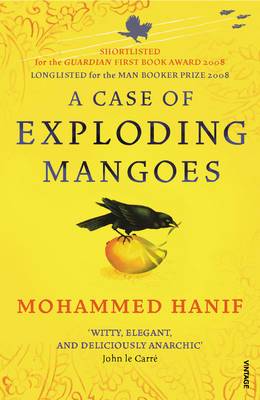
Book 92, Pakistan: "A Case of Exploding Mangoes" by Mohammed Hanif

Remember how I bragged about meeting Dany Laferrière during my Haiti entry? Well, this is another book by a guy I met at the Ubud Writers and Readers Festival, though I don’t recall having a conversation with him as much as I do with his tiny son (daughter? There were two little Desi kids running around, and one of them was his and the other one belonged to some other writer/human rightsy lady, with a name not unlike Samara, god knows who she was).


Anyhow, as I hinted in the last post, it’s a splendid read: as anarchically funny as advertised: all that South Asian verbosity and humour attacking the institution of an Islamic military dictatorship.

Did I mention this was a historical novel? I didn’t realise it was a historical novel for quite some time, not until Osama bin Laden popped up as a character I think. It’s a conjectural Scheherezadean tale surrounding the perfectly factual air crash that took the lives of Pakistani dictator General Muhammad Zia-ul-Haq and half his generalissimos in 1988. (He’s the guy who deposed whatzisname Bhutto, Benazir’s dad. Zulfikar Ali, my iPhone says. I’m drafting this without an Internet connection.)

And what Hanif’s done is he’s told the tale with two different forms of narration (ooh, this is how I teach creative writing): half the chapters are first-person in the form of the much-beleaguered Air Force cadet Ali Shigri, imprisoned in Lahore Fort under byzantine circumstances; the other half in omniscient third person, spanning the viewpoints of the blind rape victim Zainab, the conspiring spymaster General Akhtar, hapless US ambassador Arnold Raphael, a mango-eating crow, and of course the doomed General Zia himself, bamboozled by his security forces and his Quran, harangued by his wife and his tapeworms (both of whose viewpoints we also get to witness, oh joy).

There’s a certain amount of name-dropping involved because Hanif feels he owes his debt to the inspiration of Gabo’s Chronicle of a Death Foretold; even has Ali’s best friend Obaidi nose-deep in said book in the final fatal chapters. But it does not feel derivative, this: it is wholly its own animal, and it delights me. Would that us Singaporeans, ach, even us Southeast Asians, wrote like this!


View Around the World in 80 Books!!! in a larger map

Representative quote: Behind the cordons set up along the road by the police for this VIP procession, people stood and waited and guessed: a teenager anxious to continue his first ride on a Honda 70: a drunk husband ferociously chewing betel nuts to get rid of the smell before he got home, a horse buckling under the weight of too many passengers on the cart, the passengers cursing the cart driver for taking this route, the cart driver feeling the pins and needle sin his legs begging for their overdue opium dose, a woman covered in a black burqa - the only body part visible her left breast feeding her infant child - a boy in a car trying to hold a girl's hand on their first date, a seven-year-old selling dust-covered chickpeas, an old water carrier hawking water out of a goatskin, a heroin addict eyeing his dealer stranded on the other side of the road, a mullah who would be late for the evening prayer, a gypsy woman selling bright pink abby chickens, an air force trainee officer in uniform in a Toyota Corolla being driven by a Dunhill-smoking civilian, a newspaper hawker screaming the day's headlines, Singapore Airline's crew in a van cracking jokes in three languages, a pair of home-delivery arms dealers fidgeting with their suitcases nervously, a third-year medical student planning to end his life by throwing himself on the rail tracks in anticipation of the Shalimar Express, a husband and wife on a motorbike returning from a fertility clinic, an illegal BEngali immigrant waiting to ell his kidney so that he could send money back home, a blind woman who had escaped prison in the morning and had spent all day trying to convince people that she was not a beggar, eleven teenagers dressed in white impatient to get to the field for their night cricket match, off-duty policemen waiting for free rides home, a bride in a rickshaw on her way to the beauty salon, an old man thrown out of his son's home and determined to walk to his daughter's house fifty miles away, a coolie from the railway station still wearing his red uniform an in a shopping bag carrying a glittering sari he'd change into that night, an abandoned cat sniffing her way back to her owner's house, a black-turbaned truck driver singing a love song about his lover at the top of his voice, a bus full of trainee Lady Health Visitors headed for their night shift at a government hospital; as the smoke from idling engines mixed with the smog that descends on Islamabad at dusk, as their waiting hearts got to bursting point with anxiety, they all seemed to have one question on their minds: 'Which one of our many rulers is this? If his security is so important, why don't they just lock him up in the Army House?'

Next book: Salman Rushdie's Shalimar the Clown, from Kashmir.

Tuesday, January 10, 2012

Book 85, United Arab Emirates: "The Sand Fish" by Maha Gargash

The UAE - or more specifically, the Emirate of Dubai - has a special significance for us Singaporeans: it's a tiny country that became a late capitalist success story by specifically emulating our path from third world to first world. But of course, ever since the exposé from the Independent came out, we know there's a dark side to this success too: massive income inequities, overdependence on foreign labour, ruthless exploitation of low-paid foreign workers, rampant pollution, complete erasure of heritage.

I haven't been to the country yet (have talked lots to friends who've worked and travelled there, though), so I was pretty interested in reading a non-fiction book explaining the rise of the city-state: Syed Ali's Dubai: Gilded Cage or Jim Crane's City of Gold, maybe. But then I decided I wanted to hear from a voice within the country. Was there an Emirati author out there, published in English? There was.


Maha Gargash actually wrote this in English. She's been educated in the US and London, and now makes documentaries for Dubai Radio and Television, so she's had to scour her country (and others) for exotica, remnant communities who still remember the Emirati way of life before the oil boom.

In the afterword, she talks about how she was inspired to set her tale in the 1950s, right between the dying age of pearl fishing and the rise of the international petroleum trade. She abandoned an early draft which told the story from the pearl fishers' point of view; now the heroine's Noora, a young mountain girl married off as the third wife of a wealthy trader.

Honestly, it's not a fantastic work of fiction. Perfectly acceptable, yes, but not a must-read. There's something oddly generic about the story, even though the author doesn't make completely conventional decisions. Noora's fundamentally a damsel in distress, reactive rather than proactive, abused by the elder wives, afraid of her fat husband, loins burning for the handsome young manservant Hamad. She does nothing truly heroic throughout the story; she doesn't venture beyond the walls of her sheltered harem life. Of course, the author's furnished her with a modicum of spunk and intelligence to make her seem like less of a doormat.

What's really interesting, I suppose, is Gargash's choice in subject matter: how she refrained from describing the chaos of Dubai today and instead mined history for material; even mapped out the old cities and houses to mark out a believable, tactile setting, bringing the past alive again. It's actually a lot like what Singaporean writers like Catherine Lim and Dawn Farnham have been doing: farming the past for treasure, precisely because so little trace of it persists in the present. Their flavours are ultimately very different: Singapore's past is colourful, noisy and violent, while Dubai's is quiet, parched, detached from the hubbub of urban developments. But we both have that desire to use fiction to remember who we are.

No, not who we are. Who we were. The trouble with historical fiction of this sort is that it's escapist: it concentrates on the terrible social problems of yesterday, allowing us to triumphantly declare that they've been fixed. It makes us ignore the terrible social problems that persist today.

The West is happy to fill the gap with its own Emirati fictions - even in film. What are Emiratis talking about amongst themselves?

Oh, and by the way, a sand fish is a kind of skink.


View Around the World in 80 Books!!! in a larger map

Representative quote:
"Listen to you, you do every filthy thing. Then you pretend you didn't." There was spite in his voice now. "I don't know who you are, what you are. Something very different from the Noora I treasured." He threw his arms in the air. "You dug a hole in the sand and filled it with your shame, thinking it will be buried forever. But the sand is soft and the wind never stops blowing. And one day..." He bit his lip and looked away. "You are like a.. a..."

"Sand fish," she mumbled."

Next book: Hugh Miles's Al-Jazeera: The Inside the Story of the Arab News Channel that is Challenging the West, regarding Qatar.

Wednesday, November 23, 2011

Book 83, Oman: "The Sultan's Shadow" by Christiane Bird

Y'know, I actually own a book given out by the Omani Consulate - one of those propaganda, boo-yeah, look how prosperous we've become since the modernising force of Sultan Qaboos books. Received it as a door gift back when they'd just sailed the Jewel of Muscat to our shores.

But of course, I've chosen this book instead:


And guess what? Despite the National Library classifying it under "Oman", only a third of it actually takes place in the country - the story's focussed instead on the period after Sultan Seyyid Said and his descendants moved the capital of their empire from Muscat to Zanzibar, all the way down in present-day Tanzania.

But dear me, this book is terribly interesting. I should've read it before I started my East African journey, not after: it brings the world that Abdulrazak Gurnah describes to life; this Arab/Swahili/Indian/European world of slavery and debts and faraway colonial powers.

The author isn't just interested in communicating the cause-and-effect of history: she's fascinated by all the little stories and details of the era, which is why she meanders into side-tales of Ali bin Muhammad and the Zanj Rebellion (the greatest slave revolt in world history); of David Livingstone and Tippu Tip and Henry Morton Stanley; and of course of the Princess Salme, who eloped pregnant to marry a German businessman, turning her back on her faith and becoming the world's first-known Arab woman to write an autobiography.

Truth is, I think Christiane Bird extends the narrative a little too long: Salme ceased to be a sympathetic character for me quite early on (she was an apologist for slavery, among other character flaws), and the various threads of history told out of sequence do strain the mind a wee bit.

But now at least I have some understanding of what the East African slave trade entailed (the author objects to the term "Arab slave trade", given that we don't say "European slave trade"), and that old Oman truly was a glorious place with surprisingly enlightened leaders and a still rather tolerant form of Islam in its culture. That's education, baby.


View Around the World in 80 Books!!! in a larger map

Representative quote: Swahili clairvoyants were called in. Many lived in the most remote areas of the island, but they were tracked down by slaves and brought to the palace by boat, horseback, or foot.

Among them was a prophetess "of a quite unnatural corpulence," who claimed to have an unborn child inside her who could foretell the future. Arriving at the palace one afternoon, the woman told the worried family that her omiscient child, who had been living under her heart for years, could see from the tops of the mountains to the depths of the seas. And then, in a high squeaky voice, the "child" described three sailing ships, from the vantage point of the tallest mast, and outlined in detail what every single person on board was doing. Apparently, Seyyid Said was still alive and well. The family rejoiced and the prophetess ordered that a myriad of sacrifices be made. Gladly, the family obeyed, slaughtering animals and distributing meat, cloth, and rice among the woman's followers and the poor.

At the time, Salme and everyone else in the palace believed in the miraculous child. Only later, while living in Germany, did Salme realize that the woman was a ventriloquist.

Next book: The Quran, from Saudi Arabia.

Thursday, October 27, 2011

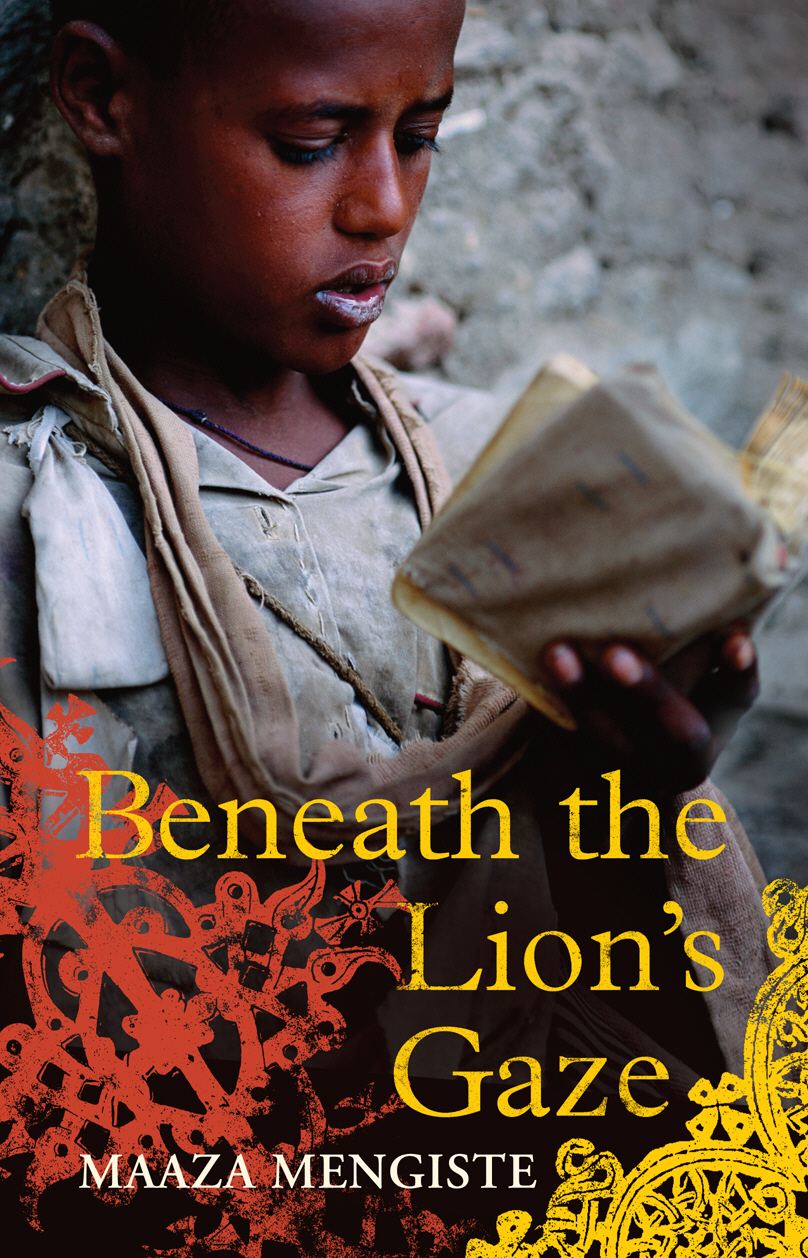
Book 79, Ethiopia: "Beneath the Lion's Gaze" by Maaza Mengiste

Of course the great text of Ethiopia is the Kebra Nagast, the Glory of Kings, the 14th century chronicle of royals from Sheba and Solomon down to medieval times (also the main holy book of the Rastafarians). Sadly, the library only stocks the following:


But I'm being unnecessarily melodramatic, because this novel is awesome. No, seriously, it's superbly well written, really capturing the horror of the Ethiopian Revolution in 1974 and the purges of the Derg: exquisite language, vivid dream sequences, and all following a middle-class family, too, so there's that soap-opera quality that makes it actually enjoyable beach reading.

I actually finished it on Tuesday night, but have been busy with the Singapore Writers Festival and teaching, etc (I'm hosting the Moving Words launch on Saturday now! Just got asked), and come to think of it, I'm pretty tired, so I'll just make two main points:

1. Horrible to admit this, but the author's NYU polished English style plus the fact that the characters are urban intellectuals means that the story doesn't feel like typical African fiction at all: you actually forget the characters are black.

This makes the tale more relatable than ever: you feel yourself inside the skins of these jeans-wearing, stethoscope-toting secular professionals, whose political traumas could've happened in Maoist China or Pol Pot's Cambodia or Stalin's USSR or Bush and Obama's Iraq, really. Odd how that happened. No conscious attempts to whitewash them, as far as I know.

2. The author's created the fictional character of dictator General Guddu for the story. Why? It's based on Mengistu Haile Mariam, so why not just give him that name - she admits to stretching the facts in her afterword, and she did a marvellous job narrating from the viewpoint of a doomed Haile Selassie in the Jubilee Palace.

I suspect she made the change 'cos Mengistu's name sounds too much like hers, and she didn't want to have to field unpleasant questions from dumb folks about whether she was a descendant. Cheating? Yeah, but a sane decision.


View Around the World in 80 Books!!! in a larger map

Representative quote: How would Emperor Haile Selassie later describe the moon that night? Voluminous, as thick as milk, a thousand melted stars that sliced the sky with razor-sharp edges. Even in the dark, from his window, he could make out the outlines of trees shivering in the breeze. A truck with squealing brakes pulled up and a barking order, followed by the confused mutterings of soldiers, made the emperor move back to his cot. There was nothing here that we would want to see. Lying on the bed, he raked his fingers over the spider-bite scabs that dotted his arms, picked at one, and took comfort in the tiny pinch of a peeling wound. This was evidence, he reminded himself, that he was still alive. They hadn't killed him yet.

Next book: Hannah Pool's My Father's Daughter, from Eritrea.

Wednesday, August 10, 2011

Book 73, Tanzania: “Paradise” by Abdulrazak Gurnah

Y’know, I know this is a Booker Prize shortlistee and all, and Gurnah’s imagination and prose skills are pretty powerful. But I’m not really into this book – it’s all setting, all premise, all exposition, with barely any agency on the part of our handsome young hero Yusuf.


The back cover says it’s set in East Africa at the time of colonization – folks refer to Zanzibar and Kawa and Mombasa, but it’s not clear to my unschooled brain if the site of the main action’s in Tanzania or Kenya, or if the main characters are black or Arab (it’s mentioned that Yusuf is Mswahili, while the others speak Arabic – does that help?).

Historical markers oughta narrow it down: the Arabs are still trading amongst the local Sultans of the interior and taking on the kids of their indebted as rehanis; the Germans and English are invading with their askari armies and have ended the slave trade and are forcing the Sultans to cut back on their tribute; somehow there’s a train and an Indian mechanic who knows how to fix cars. Early 20th, very late 19th centuries? Beats me.

There’s also a plot at the end that makes it clear that the whole is an analogy for the tale of Joseph in Genesis, he of the Amazing Technicolor Dreamcoat fame. Yusuf=Joseph (he doesn’t have a coat but he does have a whole lot of disturbing dreams and is very handsome), Uncle Aziz=Potiphar, Zuleikha=well, Zuleika, the Islamic name for Potiphar’s wife who falls for Joseph and tears his shirt as he flees. A lot of Islamic imagery throughout, in fact – blazing gates and hells and gardens: paradise itself.

But really, even though Yusuf’s a gorgeous innocent teenager who’s been torn from his family as a child, how can we have sympathy for him when he has no bloody volition? It’s like trying to get emotionally attached to a pet stone. (Possible, but still a stretch.)

Ahhh, maybe I’ve learned something about lush, descriptive, dreamlike writing. Maybe I’ve learned that you can get away without having a real ending, or much of a plot, and still get wild praise from the criterati.

But y’know, I could’ve read Shaaban Robert, father of Swahili poetry instead. I could’ve CS Forester’s The African Queen, y’know? Grump grump grump.


View Around the World in 80 Books!!! in a larger map

Representative quote:
The air was sharp under the mountain, and the light has a purple tint which Yusuf had never seen before. In the early morning the top of the mountain was hidden by clouds, but as the sun strengthened the clouds disappeared and the peak congealed into ice. On one side, the level plain stretched away. Behind the mountain, he was told by the others who had been here before, lived the dusty warrior people who herded cattle and drank the blood of their animals. They thought war was honourable and were proud of their history of violence. The greatness of their leaders was measured by the animals they had acquired from raiding their neighbours, and by the number of women they had abducted from their homes. When they were not fighting, they adorned their bodies and hair with the dedication of brothel queens.

Next book: Tracy Kidder’s Strength in What Remains, from Burundi.

Thursday, July 28, 2011

Book 71, Mauritius: "The Prospector" by JMG Le Clézio

Yep, yet another Nobel Laureate! Mind you, Le Clézio was born and bred in France, but his dad's from Mauritius and he holds dual French-Mauritian citizenship and he occasionally lives on the island too. So, yeah, he counts. (Still feel guilty I'm not doing Joseph Tsang Mang Kin's The Hakka Epic, though.


As for the book, which is Le Clézio's "crowning achievement" - well, I honestly spent most of it being puzzled over why he won that Nobel. Not because it's badly written - far from it! - but the fact is that the content is far from revolutionary. It's basically a historical novel, telling the story of a poor white colonial kid named Alexis L'Étang living from the late 19th to early 20th centuries. All the necessary exotica's thrown in there: shipwrecks, jungles, plantation life, hurricanes, a sexy and mysteriously wise island girl, worker revolts and a stint in the trenches of World War One.

True, it's written quite beautifully: lush but distanced descriptions of nature and remembered folklore. But the modernist project here is quite subtle: no breaking the form as Orhan Pamuk or Luis Rafael Sánchez do. And remember, the Nobel Committee usually selects someone who's either a political or a poetic revolutionary. Where's the beef?

I only started to get a sense of transcendence when Alexis returns from the war and returns to his obsessive project of attempting to excavate the treasure of the Unknown Corsair, so he can buy back the land his uncle stole from his father: the unforgotten Eden in Boucan Valley, where the tree of knowledge was planted, where he swam with his black companion Denis in the sea. The grand, relentless, desperate search for gold, guided by ancient maps and symbols, seemed to be an allegory for the the writer's craft in uncovering literature from his soul.

And yet the story ends with Alexis accepting the futility of it all. So either Le Clézio's an extreme pessimist or my exegesis fails.


View Around the World in 80 Books!!! in a larger map

Representative quote:
In the evenings, while the twilight deepens, I sit in the sand on the dunes and dream of Ouma and her metal-coloured body. I make a drawing of her with a sharp piece of flint on a basalt block near where the reeds start. But when I want to write the date I realize that I don't know what day or month it is. For a moment I think of running to the telegraph office as I did before, to ask: What day is it? But then I realize that it wouldn't mean anything to me, that the date is of no importance.

Next book: James Mancham's Seychelles Global Citizen, from the Seychelles (duh).

Sunday, May 15, 2011

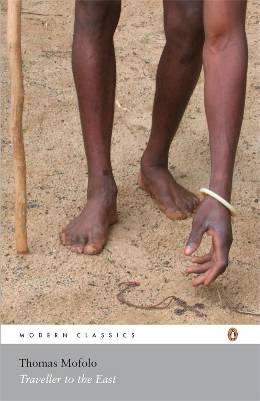
Book 61, Lesotho: "Traveller to the East" by Thomas Mofolo

I'm still in the middle of reading Mpho 'M'atsepo Nthunya's Singing Away the Hunger, and a thoroughly good book it is, too - one of those orature-based subaltern women's narratives with unexpected revelations: amidst the oppression, the casual joy of open marriages where she and her husband are free to "share the blanket" with other men and women (yes, other women: she does have a girlfriend at one point, and her husband and that woman's husband also become good friends). Also the snow in the mountains of Maluti: so cold it is blue, so cold that it robs her husband of his ability to walk, then his life.

But of course, I've been fickle Frannie again and chosen to blog about an entirely different book! Behold: Traveller to the East, or Moeti oa Bochabela, in the original Sesotho.


It's a short novel, just 88 pages long in a biggish font, serialised in a fortnightly newspaper to commemorate the 75th anniversary of the Paris Evangelical Missionary in Morija, Maseru. As you might have guessed from its cover and its provenance, it's a Christian tract.

But here's the humdinger: it was written back in 1907, making it possibly the first modern novel in all of Africa. Beat that, bitches.

I'm just gonna give you a plot summary here and now: it's about this young tribesman in distant times named Fekisi, fair in form, high in honour and skilled in battle, who is weary of the chaos in his village, where festivals cause drunkenness and violence, where his fellow herdboys are abused by older men and by others (no no, I meant that they hit each other with sticks; no sex in this book, not even with women, whom Fekisi shuns although they enter his scherm in vain hopes that he will court them).

He's inspired by the majesty of the rain, the legends of the heroism of the monster-slayer Kholumolumo and the martyrdom of the virtuous Sankatana, and the dream of Ntsoanatsatsi, the place of the rising of the sun. He's also given subtle spiritual comfort by his cattle, especially the white-faced Tsemeli and the grey-faced Tsoelia, to whom he addresses poetic hymns (making him a bit of Krishna-figure as well as a Christ-figure).

Then one day he's somehow able to call down the punishment of the heavens upon his evil neighbour Phakoane. And the experience disturbs him so much that he goes running off towards the East, towards Ntsoanatsatsi, non-stop without rest or food for several days, encountering more incidents that show him that to live is to suffer (at least in Africa, making him a Siddartha Gautama-figure as well), leaving Basutoland, eventually reaching the endless expanse that is the sea (you'll notice that Lesotho is landlocked), whereupon he meets three white men...

... who do not enslave him as in the slave-narrative of Caryl Phillips's Cambridge but instead take pity on him, nurse him back to health on a ship-voyage to Europe, offer him safe return to his homeland (which he refuses, as he desires only the divine), and teaching him CHRISTIANITY and also writing, by the way.

And then he reaches an unnamed European nation where all men follow God and he attends church on the day of the annual Great Feast and JESUS HIMSELF APPEARS and takes his soul with him in a cloud of smoke that staggers even the white priests.

You can see why I'm intrigued by this text. It's trippy, it's eludes all our postcolonial expectations, it blends nativism and Western doctrine almost seamlessly. It is blessedly heterodox, which is not what I expected of an incipient African text at all: I'd thought there'd be aping of the West, the same as there was in much of Asia when Modernism first arrived (cf. Mori Ogai, Ba Jin, Lim Boon Keng). Also, it uses the word "rhebok" to refer to something other than a shoe brand.


View Around the World in 80 Books!!! in a larger map

I'm still going to finish Nthunya's autobiography, mind you: just glad to have encountered this other text. Mofolo's more famous for his historical novel on the Zulu king, Chaka, by the way.

Representative quote: And here Fekisi our young man began to feel frightened and to wonder greatly. He asked himself, what is the sun which shines so brightly? By what or by whom is it guided on its journey from the East to the West? What is it held by that it does not fall to the earth? Where does it go and whence does it return and how does it go and rise again in the West? And what is this its heat which causes all vegetation to grow, and makes people and animals live? Because the sun is life itself, rain without the sun does no good, the sun is like the bread that we eat every day and by which we live, the rain is like meat, a thing of occasions only. And its strength, how great it is! Its warmth which gives life, its warmth like that of a sitting hen, when she warms the eggs so that chickens may come forth!

Next book: Neshani Andreas's The Purple Violet of Oshaantu, from Namibia.

Tuesday, December 28, 2010

Book 42, Guadeloupe: "Who Slashed Celanire's Throat?" by Maryse Condé

This is a brilliant page-turner - a tale of bad-ass supernatural revenge from one of head honchas of postcolonial literature. Ripping stuff.


I chose it over Victoire: My Mother's Mother, which came out this year, because that's a family memoir just like Mr Potter, and anyway the first few pages of Celanire pretty much grab you by the throat.

I'd read about it on the Net before: it's inspired by a piece of news the author heard in her childhood, about the discovery of an infant with her throat slashed in the street: how she decided to take this horrific news and turn it into an almost burlesque thriller, by no means denying the oppression of Afro-Caribbean history but also venturing into the realms of aristocracy and early 20th century international travel: there's episodes that take place on Côte D'Ivoire and Montserrat and French Guiana and Peru as well as Guadeloupe. (Paralleling Condé's own international meanderings, may I add.)

And oh, what a wonder of a character Celanire is - yes, she evokes pity as the sacrificed infant, and she grows up to be a brilliant and beautiful (and bisexual!) educated and enlightened woman who seduces white fascist Governors and reduces them to Africanist opium sots; plus she has utterly contemporary ideas about liberated sexuality and women's education and infibulation bans. (Even quotes that Klingon saying about revenge being a dish best served cold.)

But she's also the vehicle for demons: just watch how she executes her revenge and rains down doom on whoever wronged her, however innocuous they may be.

Very much recommended. In other news, my good friend Shelbi only has two books left to go till she completes her reading challenge for the year! Go Shelbi!

Also, I have way too much translation and journalism work I should be doing, so I'd better stop distracting myself. Toodle-oo.


View Around the World in 80 Books in a larger map

Representative quote: In the meantime, Amarante stared at the dark curtain of trees beyond the illuminated podium. Darkness had locked the palace in its grip and would not let go fro some time. Not until throngs of seabirds, messengers of dawn, had begun to flock across the sky. Darling little Celanire, darling little Celanire. That evening she had been revealed to her, and her beauty struck her like the flash of a frigate bird. Svelte yet strong. Good-humoured yet serene. Knowing what she wanted in life and determined to get it. The glow in her eyes betrayed the passion burning deep down. Was it so that they could meet that fate had brought Celanire back to Guadeloupe?

Next book: Jean Rhys's Sleep It Off Lady, from Dominica.

Wednesday, December 8, 2010

Book 39, St Kitts and Nevis: "Cambridge" by Caryl Phillips

We might have a bit of a gap for a while, since I'm going to Jakarta/Bandung/Yogjakarta for a week come Friday, and I don't really feel like lugging my hardcovers with me. East Indies is East Indies and West Indies is West Indies, and never the twain shall meet.

And really, "Indies" is a good term to use in the case of this book, since Kittitian-British author Caryl Phillips never names the island where it takes place - it's some fictional spot in the Caribbean, in the mid to late 19th century, between the abolition of the slave trade and the actual abolition of slavery itself.


The truly awesome thing about this book, however, is that it's not just a historical novel: it's a historical novel written with the distinctive style of the documents of that era with astonishing verisimilitude of language and style. Sorry, Jean Heyn, this guy blows you out of the water.

Part One's told from the viewpoint of Emily Cartwright, the 29 year-old plantation owner's daughter who makes the sea crossing to manage her father's property, both in terms of land and human livestock. She fancies herself an intellectual: her diary records her anthropological observations of the slaves and their overseers - not unlike Isabella Bird's travel narratives, which I'm reading on my iPhone - and it's lengthy and verbose and flowery and terribly coloured by prejudice, but in the complacent, well-intentioned manner of a person who cannot fathom the idea of a black person as an equal: no demonstrations of excessive hatred, and observations objective enough that damn the slave community as uncivilised in our eyes. It makes us uncomfortable: we want to hate this woman as an oppressor, she even has thoughts of a future lecture tour around the British Isles defending slavery. But we can understand her discomfort and her inability to peer beyond the limits of her class and era.

Then Part Two - better put up a [SPOILER ALERT] sign, because we now find out the unfathomable truth behind a rather minor character, the old slave Cambridge. His section's written in the style of the old slave narratives: think Olaudah Equiano, Frederick Douglass, Mary Prince: eloquent and demonstrative of intellect, but brief, summarising everything from his abuction in Guinea as a child to the present in a tiny pamphlet-sized section - but what a story it is! As a young man he becomes a slave in abolitionist England, learns to read and write and converts to Christianity, gains his master's respect, his freedom on his master's death, and gets married to his fellow servant, a white woman, becomes an abolitionist preacher - all the while mingling with the wide array of 19th century black British society, beggars and fops and doxies and merchantmen, barely conceivable to us except that we know that this historical research has been done, that there've been peoples of African descent in the British Isles since the Romans.

And then, when he's kidnapped and sold back into slavery in the Indies, it's his damnable Christian values and principles of propriety that prevent him from being the true rabble-rouser and rebel that the whites believe he is - reading this section we're screaming, don't be a dumbfuck, just kill your master, or at least tell everyone how educated you are, what happened to you! - but no.

And because of that, the tragic ending occurs without Emily even understanding the remarkable figure who's been at her side, who could have knocked some sense into her brain if they'd only talked for more than five minutes. [SPOILERS END]

There's a Section Three as well, but I won't bore you.


View Around the World in 80 Books in a larger map


Representative quote:
O lucky Isabella that she never lived to see these shores, never lived to witness the treachery of the negro that some would set free to wreak havoc upon our persons. Their lying subservience, their sly pilfering, their murderous violence, mark them out as very like the Irish, but of an even more childish character. If this overworked land possesses a soul it has indeed been profoundly abused and made to endure much that is evil.

Next book:
Jamaica Kincaid's Mr Potter, from Antigua and Barbuda.

Friday, December 3, 2010

Book 38, US Virgin Islands: "The Governor-General's Lady" by Jean Heyn

I'm a little tired, so I'll give this book a speedy review. It's a lightweight historical romance novel by an obscure American author; not really the kind of thing I'd have picked up if I'd understood what it was properly before reserving it at NLB, nor the kind of thing I'd have checked out if there'd been any better options.


Still, it is informative: it's based on the life of real-life 19th century Virgin Islander icon Anna Heegaard, a descendant of slaves and Danish colonists who passed through the hands of many men before ending up with a comfortable fortune of property and the love of Governor-General Peter von Scholten (of course he had a wife and kids back in Copenhagen, though, so he couldn't actually marry her).

Scholten also ended up emancipating the slaves of the entire island, providing the thrust of the story after Anna's well set up for herself. I'd had no idea of how tricky the business of freeing the unfree was: the different stages in history as slaves began to buy (or whore) themselves out of bondage, some reaching middle-class status on par with the whites, while being forced to carry letters proving their free status for generations in case they were stopped in the street; first a ban on the import of new slaves, then a proclamation that all those newly born to slaves would be free, and the institution of slavery falling in neighbouring island after island, with petition after petition by the Governor to the Danish crown before the proper rebellion broke out, birthing the declaration of freedom.

It's pretty entertaining, too: some bodice-ripping sex scenes, even as Anna and Scholten age into their fifties, and lush descriptions of architecture and clothing, jalousies and coral earrings, and a bit of native dialect too. But it's not truly well written - there's amateurish adverbs and excessively painstaking narration of historical fact in between the saintly portrayal of Ms Heegaard herself as a paragon of history.

Ambitious stuff, nonetheless. Pulp isn't necessarily easy to do. Would that I could write something as sensational.


View Around the World in 80 Books in a larger map

Representative quote: His voice suddenly grew soft and sinister. "These are perilous times, Madam, when accidents easily occur. I swear to you that one way or another, if he sides with the blacks, you will find yourself alone on your hilltop, your home in ruins. And what will you be then? I ask you. Not the respected widow of a Virgin Islands governor. No indeed. You'll be nothing but an elderly black whore! I suggest you use your influence."

Anna clenched her fists in outrage. Her voice was icy cold and carefully controlled as she answered him. "You were quite right, Mr Grimes, when you said your visit need not be long. I suggest you leave at once. Good day, Sir." She turned her back on him. With head held high she walked toward her villa. Not once did she deign to look back.

Next book: Caryl Phillips's Cambridge, from St Kitts and Nevis.