Showing posts with label 1980s. Show all posts

Monday, November 24, 2014

Book 162, Poland: "Collected Poems: 1956-1998" by Zbigniew Herbert

One of my favourite poets in the whole wide world is Polish!

I discovered the works of Nobel Lit Prize Winner Wisława Szymborska as a secondary school kid, back in the nineties – loved them so much; huge influence on me, etc. Unfortunately, her output wasn’t huge, so there wasn’t an extra tome of her works I could check out for this project. And I’d already used Czesław Miłosz - Poland’s other Nobel Lit laureate – for my Lithuania book.

Fortunately, there are lots of famous Polish poets. Such as this guy:


I’d heard his name bantered about amongst my friends, so I figured, yeah, why not read something of his? (Yeah, yeah, he was born in Lwow, which is now part of Ukraine, but it was Polish while he was a kid.)

This was the library’s only volume of his works – ye compleat edition, running to 571 pages. But mirabile dictu, it’s good. So good. (I’d considered abandoning it for Adam Zagajewski’s Eternal Enemies, a convenient, skinny little codex, but when I leafed through that, I found myself longing for the lambent voice of my man Herbert.)

We’ve nine different volumes of his poetry packed into this tome:

Chord of Light (1956)

Hermes, Dog and Star (1957)

Sudy of the Object (1961)

Inscription (1969)

Mr Cogito (1974)

Report from a Besieged City (1983)

Elegy for the Departure (1990)

Rovigo (1992)

Epilogue to a Storm (1998)

So we get to follow this man from a post World War to a post-Cold War era; from youth; from the age of 32 to 78. And over the five decades we see his voice develop, shift from focus to focus, intensify and mourn himself.

And it is the same voice throughout – a melancholy, erudite voice, haunted both by the horrors of his own Communist (and pre-Communist) society and the ghosts of classical history. He invokes Hermes, Apollo, Athena, Marsyas, the Minotaur, Elektra, Claudius, Marcus Aurelius, Nefertiti – also Mary Queen of Scots, George Orwell and the Emperor Meiji, come to think of it – but not in a show-off-how-smart-I-am way, but to invoke archetypes of eternal drama to show that the tyranny and torture of his land (of all lands) have ever been thus.

Loads of specific references to his childhood and his Polish contemporaries, too, which were a little harder to get. He calls himself Mr Cogito (therefore he is?) in the latter half of his career, documenting what he sees as his loserly life. But fundamentally, he’s engaged in the same Szymborska-esque mission of mourning for the entire world, for the whole of history.

That hits me, you know? This is poetry that makes me want to write more poetry. To join in the chorus as a testament. Gah.

(Though I personally do like Szymborska better still, because she also finds joy in the senselessness of the universe. But it’s not a competition. Is it?)


Representative quote:

I probably like his prose poems best, but this piece spoke of nation in a way that resonates a lot with me.

TAIL OF A NAIL

For lack of a nail the kingdom fell
- our nannies’ wisdom teaches us – but in our kingdom
there haven’t been nails for a long time nor will there be
neither those handy little ones used for hanging pictures
on a wall nor the big ones with which coffins are sealed

but in spite of this and perhaps precisely because of it
the kingdom endures and even gains others’ admiration
how is it possible to live without nails paper and string
bricks oxygen freedom and whatever else you like
evidently it is possible because it endures and endures

people in this country live in houses and not in caves
factories smoke in the steppe trains cross the tundra
and on the cold ocean a ship blows its bleating horn
there is an army and police a seal an anthem a flag
on the surface it’s just like the rest of the world

it is only on the surface because this kingdom of ours
is not a creation of nature or a creation of humanity
seemingly enduring built on the bones of mammoths
in reality it is weak as if suspended between
the act and the thought existence and nonexistence

a leaf and a stone fall so do all things real
but ghosts live a long time stubbornly despite
sunrise and sunset revolutions of celestial bodies
on the disgraced earth tears and things fall

Next book: Uladzimir Karatkevich's "King Stakh's Wild Hunt", from Belarus? Or Vladimir Kozlov's "Number Ten: A Novella In Translation"? Not sure yet.

Monday, September 29, 2014

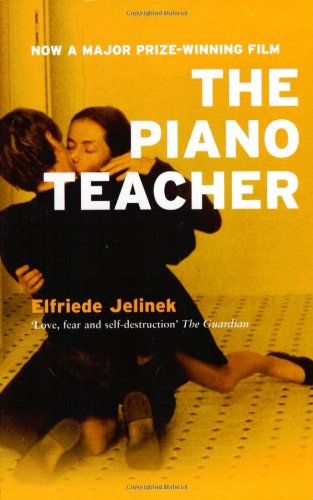
Book 158, Austria: Elfriede Jelinek’s "The Piano Teacher"

Kind of tricky to track down this book – the National Library had only one English-language copy in stock, and it was checked out. (Oddly enough, the Mandarin and Malay translations were still available.)

Had to go down to my old stomping grounds of NTU to check out the copies they had on reserve there as compulsory syllabus readings, in between Thomas Mann’s Death In Venice and WG Sebald’s... something or other.


And damn. Now I know why the censor-happy National Library won’t keep multiple copies in stock. Never mind that this is a work by a Nobel Prize Laureate, the greatest Austrian writer of her generation; a work made into a landmark critically acclaimed work of Franco-Austrian cinema.

The truth is, this book is sick, in the best way possible. Oh, the perspective’s technically third person, but it goes under your skin… It begins with a portrait of the twisted relationship between the 36-ish-year-old piano teacher Erika Kohut and her Mother; they live together in a tiny flat and the Mother refuses Erika any luxuries whatsoever, flying into a rage when she spends money on a dress to make herself look pretty, pretty girls are sluts, etc., all she wants to do is keep Erika as her tool to earn enough money for her old age so they can live together in a bigger condo, and all this good-for-nothing daughter does is waste her pay on frivolities…

So we hate the mother, and we’re rooting for Erika, and even more so when we learn that Erika was groomed to be a great concert pianist from her girlhood, her mother and her grandmother consumed by dreams of fame and success that brought them to Vienna, the city of music. But somehow Erika screwed up a critical recital and has had to live her life as an angry repressed spinster piano teacher at the Vienna Conservatory…

…and it turns out she’s kind of an awful person as well, deliberately kicking or pinching people in crowded trolleybuses, stalking through the Turkish district to look at girlie peepshows or Prater fairgrounds to catch couples doing it in the grass (there’s some horrible things said about Turks and Yugoslavs in the process; hope that’s the character speaking and not the author)…

… and there’s a young, blond, athlete of a piano student named Walter Klemmer, and he’s hot for her, and she’s hot for him, but he’s asserting his god-given male entitlement and worship of his own 7-inch cock on the world, flirting with every young girl, and she won’t do with that, and so she hurts other people, she hurts herself especially, she hurts her mother too, and she hurts Klemmer, in a series of psycho nonconsensual BDSM sequences in the conservatory toilets, broom closets and her mother’s sacred bedroom…

In a way, it’s a feminist’s nightmare: a woman writing about women who are hysterical, steely in public but desiring domination and punishment in private, women who are wildly weak. Women like the heroines of Greek tragedies. Xiao bitches, as Singaporeans would say.

And it is written so damn well. Aiyah, I’ll just leave it at that. Wonder how on earth I can learn from this prose style. (Rather pleased that NTU students are reading it… how does it change their lives?)


View Around the World in 80 Books!!! in a larger map

Representative quote: Erika holds Walter Klemmer at arm's length. She pulls out his dick, which he has already slated for deployment. It only needs the finishing touch, for it is already prepared. Relieved that Erika has taken over this difficult task, Klemmer tries to push his tach down all the way. Now Erika has to resist him with her entire weight so she can remain upright. She holds Klemmer's genital at arm's length while he fumbles about randomly in her vagina. She lets him know that is he doens't stop, she'll leave. She softly repeats her threat several times, because her suddenly superior will has a hard time getting through to him and his rutting fury. His mind seems fogbound with angry intentions. He hesitates. Wondering whether he's misunderstood something. Neither in the history of music nor anywhere else is the suitor simply barred from events. This woman has not a spark of submission. Erika starts kneading the red root between her fingers. She demands a privilege, but refuses to grant it to the man. He must go no further with her.

Next book: Imre Kertész's Fateless, from Hungary.

Thursday, May 15, 2014

Book 149, Lithuania: "Beginning with My Streets: Essays and Recollections" by Czesław Miłosz


We’re at the last of the Baltic states – and the end of Northern Europe! Woohoo!

Now, I know what you’re thinking. Miłosz is a Polish poet – he wrote in Polish, lived in Warsaw (before his defection to the USA) and was a cultural attaché for Poland, for crying out loud.

But it turns out that he always identified as both a Polish and a Lithuanian. He was born in Vilnius, which he knew as Wilno, at a time when the city was under the Polish government. Polish-speakers and Lithuanian-speakers lived alongside each other in his youth (along with Russian and Hebrew and Yiddish speakers), attending different schools and participating in different communities. And the memory of that city haunted him throughout his entire poetic career.

Miłosz wasn’t an obvious choice, of course. Back in Singapore, I thought I was going to do Ričardas Gavelis’s novel Vilnius Poker; scanning WorldCat in Norwich I thought I’d do an inter-library loan for Selected Lithuanian Short Stories from the University of Essex.

But he was a Nobel Prize winner and one of the Righteous Among the Nations (he saved a bunch of Jews during World War Two), plus I’d never read anything by him before.

And there were loads of other Polish writers I could read for Poland. Why not choose this, a volume of essays named for his memory of his childhood in the boulevards of Vilnius/Wilno?


Well, the reason why not is because the book’s effing boring.

I don’t think I was the right reader for it – it seems to be for die-hard fans of Milosz’s poetry, who want every last scrap of wisdom from his mind, and so are willing to wade through esoteric monologues by him about obscure writers (Dwight Macdonald? Robinson Jeffers? Aleksander Wat?) just because they’re there.

And while the fragments of Miłosz’s poems scattered throughout the volume seem nice enough (I don’t quite grasp their transcendence, but that’s true of my relationship with many a great poet), his prose style is just so ambling and leached of any sense of humour or urgency or passion that I come away from it quite uncharmed.

Not that all the pieces here are without interest. You do get an awful lot of the texture of Vilnius/Wilno from the titular essay, “Beginning With My Streets”, and his dialogue with the Lithuanian poet Tomas Venclova. 

Details of his own life leak through in the various transcripts of interviews with him, in “A Poet Between East and West”, and “The Sand in the Hourglass” – his discomfort with Californian hippie mysticism in the ‘60s and ‘70s; his simultaneous comfort with his role as a university lecturer to the same young Californians; his childhood pathos upon reading a condensed volume of James Fenimore Cooper’s works wherein he saw Natty Bumppo age from being a young vigorous Deerslayer to an old man Leatherstocking, bereft of his friends and the wilderness he loved so well. Also his constant surprise when amongst Nobel Laureates, expecting them to be otherworldly higher beings, as he suddenly remembers that he is one himself.

And some of his literary musings are pretty cool – his insistence that Dostoevsky must have been influenced by Swedenborg (he notes that Svidrigailov from Crime and Punishment has a Lithuanian name). Plus his ruminations on the in-betweenness of culture for Central Europeans during the Cold War, caught between Russification and Americanisation.

Ah, but I suppose it’s his Nobel Lecture which is most moving and lucid. Go read it. In it, he considers this terrible tension in his role as a poet, wherein he desires to describe reality from an abstract distance yet with utter detail, rather as the hero of Nobel laureate Selma Lagerhof’s The Wonderful Adventures of Nils does when he flies above the earth. The brutality of the real world keeps getting in the way, he sighs – the horror of the Holocaust and the double horror that there are still those who deny it; the misery of exile and of the human rights crimes for whom dictators remain unpunished. “I hope you will forgive my laying bare a memory like a wound,” he says. “It is possible that there is no other memory than the memory of wounds.”

Ah, but I won’t leave you with just the pithy bits of Milosz. Here’s the end of his essay “On Creators”, which is both infuriatingly opaque and also inspiring with its last two sentences.


View Around the World in 80 Books!!! in a larger map Representative quote:

Some fifty years ago anyone who took a stand against ritual in praise of ritual, observing that, after all, it would lead only to sterility, to intellectual chaos, would have been labeled a reactionary, a defender of old-fashioned “content”. Alas, today one can prove to oneself experimentally what happens to the language of symbols and myths when it is deprived of its deepest reason for being and yet is honored as if nothing had gone wrong. He pursuit of a truth that is otherwise impossible to express used to be its raison d’être, and whatever names that truth might have borne, however much it may have been valued, a language that speaks to itself, with symbols and myths that mean nothing outside a particular closed system (a poem, a painting), gradually loses all its charm and receives its just deserts: indifference. The indifference of others – let us assume not of the creator himself. Thus, the result of the activity ceases to be its goal (for a result is in some sense objective and thus destined for others); the goal becomes the activity itself. It, too, is supposed to be rewarded by society.

“What then must we do?”
“Rethink everything from the beginning.”

Next book: Goethe’s Sorrows of Young Werther, from Germany.

Saturday, April 20, 2013

Book 121, Tokelau: "A Way With Words: Language and Culture in Tokelau Society" by Ingjerd Hoëm

On the plus side, we're finally reading something else by a female author in the Pacific region. On the minus side, she isn't native - she's from Norway. On the even more minus side, she's an anthropologist.

Yesiree, here's one of those dry, brain-numbing, jargon-filled texts (purism? doxic?) that I'd never waste my life reading if I wasn't doing this godforsaken project. It's even marginally about linguistics, which my PhD student sister has proven to be a headache of a pseudoscience, why oh why etc.


But really, this wasn't so bad - except for the bulk of the second half, which consisted of Hoëm consulting every person she could about the meanings of specific Tokelauan terms, from uluifa (spirits that possess people) to fatupaepae (a female authority figure), just to show the imbalance and instability of information between genders and classes. Major snoozefest.

You see, Tokelau's an odd place.  It's a territory of New Zealand, consisting of three atolls, with a combined population of 1,411 (that's today's figures, but the country's always dealt with overpopulation through emigration). Despite that teensy number, they've got a number of feuds and village dialects, exacerbated by the fact that missionaries converted some of them to Catholicism and some to Protestantism (the Catholics allowed more of the indigenous culture to survive, for which I suppose they deserve some thanks).

In the '80s, when the author was conducting her fieldwork, the Tokelauans had only recently adopted a written form of their native language and begun teaching it in schools. They'd previously been using English and Samoan - so they had the weird situation of kids being fluent in a traditional language, their twenty-something year-old parents recommending that they follow their elders for even greater mastery of the tongue, and of course the elders jabbering away in Tokelauan that was infected with Samoan words to begin with...

And that's just the background. The messy politics of how language is used is bewildering: characterised as the shyest of the Polynesian peoples, Tokelauans hold their fono (their ceremonial meetings) in near silence, wary of contradicting people and making enemies, sometimes postponing the most serious issues of each Women's Council or Council of Elders to the next fono, just so no-one's feelings will be hurt. 

(The example given was sorting out a feud so that one island's parents would stop barring their kids from attending school. As an Asian person I believe school is bloody important and they should've just trod on each other's feelings. But that's why I'm not an anthropologist.)

Details of the use of gossip as a sanctioning device, the strange disruptive appearances of older women as clowns, invading official events to mock the hierarchies that keep them bound (yet this is part of the culture that keeps them bound). And the syncretic lyrics of the fatele song and dance shows.

Yet believe it or not, the Tokelauans feel dreadfully insecure about their culture - they feel they're hybrid, westernised folk (many of them have studied or worked in NZ; there's a steady exchange of unruly offspring between Tokelau and the migrant families in Samoa and New Zealand). They even envy the Maoris for the strength of their identity, never mind that Maori culture has been reduced to a superficial display of hakas and carven masks in the midst of a mainstream pakeha culture. (In Tokelau, they call them palagis).

But aren't we in Singapore the same? Weirdly cultured and problematic and unsure if we can be proud of what we have? 

Ah, but Yi-Sheng, the world does not exist for the sake of your reflections. Here's a fatele text.


View Around the World in 80 Books!!! in a larger map

Representative quote:
Fakalogo atu

Fakalogo atu kite leo e sau
Tena e sau
sau mai i ko
pati tokoto ko te toeina
ko te uto kua tini, tini, tini O.

Listen to the sound coming
That is coming
coming from there
applauding [while] lying down, the Elder
The young sprout of the germinating coconut [i.e. the young people] have finished, finished, finished.

Next book: Reverend Joseph King's WG Lawes of Savage island and New Guinea, from Niue.

Monday, October 17, 2011

Book 78, Somalia: "Maps" by Nuruddin Farah

Good lord. Finally finished this book. And I’m sad to say that after all that trouble it took to get a hold of a copy, Maps has turned out to be one of those terribly acclaimed works of literature that I don’t like very much.


Even though it’s not obviously long like A House For Mr Biswas and Pynter Bender, it drags. The narrative’s more theme-based than plot-based: we spiral around moments and symbols in the orphan Askar's life: blood, lots of it; eventually maps as well; impenetrable dreams; women's bodies; amputations, etc.

And it's true what they say about Somalis being unstereotypical of the African continent, because Farah is ruthlessly intellectual: Askar's a prodigy to begin with, and then he's matched up with Mogadishu elites like his Uncle Hilaal and his Aunt Salaado who debate the historicity of ethnicity and civilisation and barbarianism until after a while you don't care how beautiful the prose is, you just wanna finish and go home to sleep.

Yeah, I'm tired. How'd you guess?

I suppose there's plenty worth learning in here: how Farah dares to jump around from first person to second person to third person in his narrative; how a story centred on a young man can actually end up being centred more on his nursemaid Misra, the utterly oppressed Ethiopian servant who gave him her everything and is still sacrificed to the mobs in the aftermath of the war; how one can be unapologetically brainy, invoking Freud and Plath and Kierkegaard even in the midst of inter-clan murder happening in the third world villages right next door.

But mostly, I'm amazed that the public laps this stuff up. How do they put up with it? Gawd.


View Around the World in 80 Books!!! in a larger map

Representative quote: I hid my inner torment behind the silence I stood in - my hands behind my back, my body upright, my mind alert, my thoughts stirring within me echoes of conversations I had with Misra years agto, with Cusmaan who was my tutor some nine or so years ago, with Salaado - and with myself. Somehow, I felt I had to betray one of them. I had to betray either Misra, who had been like a mother to me, or my mother country. However, part of me was worried - worried that a curse would be placed on my head by either. And I couldn't help remembering dreams in which I saw an old man with a girl's face and features, or another in which the dreamer, a young man who imagined he had envied a woman's menstruation, menstruated.

Next book: Maaza Mengiste's Beneath the Lion's Gaze, from Ethiopia.

Sunday, September 25, 2011

Book 77, Kenya: "Devil on the Cross" by Ngũgĩ wa Thiong'o

Finally finished this book! Hard for me to figure out why it took so long; once I started it properly it really pulled me in.


Basically, it's excellent: the International Herald Tribune quote on the cover don't lie: way better than Ngũgĩ's English language novel The River Between (which was used as a rather stiff educational text here in Singapore), or indeed his somewhat didactic play The Black Hermit.

One big difference is that the story was written in Gikuyu - in fact, this is the first modern novel written in that language; the legendary piece he composed on prison toilet paper while serving out his jail sentence. This means we're importing quite a quite different set of vocabulary and proverbs - "Only a fool sucks at his dead mother's tit - plus the bits which originally appeared in English and Swahili and Latin are italicised, which provides a completely new take on the lexicon.

Ah, but what seduces me is the whole magical realist style (terrible how this has become a throwaway term, when what's possible under this classifier is so divergent). Our beleaguered heroine Wariinga has dreams and hallucinations along with her misfortunes; she has a dialogue with the devil, even. But what's happening in the non-supernatural world is just as strange, as a huge Feast of International Thieves and Robbers is taking place in a cave in Ilmorog, presided over by the greatest exploitative capitalists from the USA, Europe and Japan, while Kenyan millionaires compete for the title of the greatest thief in the nation - proposing nightmarish schemes of how they can exploit the workers of post-independence Africa even further, binding them closer than ever to their former colonial masters...

Yes, it's didactic again: Ngũgĩ sure doesn't like capitalism, and indeed the business shenanigans of many of his neo-colonial bosses are completely legal, completely justifiable in our Friedmanated world; he's mad at the way folks bought up the newly free land and sold it at a profit to the poor, even. It's sobering to realise how far we fall from the Marxian ideal that our forefathers fought for when they cried uhuru and merdeka back in the 1960s. Maybe that's why we don't study this in school - the way things have turned out with globalised capitalism hits too close to home.

(He sure hates religion, too. See how the title turns Christianity on its head? Churches and mosques and parables of investing talents just perpetuate the problem of exploitation, he says, preventing the workers from rising up against those who would control their minds as well as bodies.)

Oh but back to the language; the sheer poetry (yes, he mixes poetry and song and monologue into the fiction). This is what makes the book so good; what makes it completely believable when the author boasts that oral storytellers began memorising the tale and extemporising on it for non-literate audiences: a modern-day Homer or Valmiki or Narada, making the literary arts folk art rather than vice versa.

Thoroughly recommended - and there's a hell of an ending, too. Should go read his most recent Gikuyu novel, the monumental 700-ish page Wizard of the Crow, as well. Or maybe I'll save that for my bucket list.


View Around the World in 80 Books!!! in a larger map

Representative quote: After three days, there came other dressed in suits and ties, who, keeping clsoe to the wall of darkness, lifted the Devil down from the Cross. And they knelt before him, and they prayed to him in loud voices, beseeching him to give them a portion of his robes of cunning. And their bellies began to swell, and they stood up, and they walked towards Wariinga, laughing at her, stroking their large bellies, which had now inherited all the evils of the world..."

Next book: Nuruddin Farah's "Maps", from Somalia.

Thursday, July 28, 2011

Book 71, Mauritius: "The Prospector" by JMG Le Clézio

Yep, yet another Nobel Laureate! Mind you, Le Clézio was born and bred in France, but his dad's from Mauritius and he holds dual French-Mauritian citizenship and he occasionally lives on the island too. So, yeah, he counts. (Still feel guilty I'm not doing Joseph Tsang Mang Kin's The Hakka Epic, though.


As for the book, which is Le Clézio's "crowning achievement" - well, I honestly spent most of it being puzzled over why he won that Nobel. Not because it's badly written - far from it! - but the fact is that the content is far from revolutionary. It's basically a historical novel, telling the story of a poor white colonial kid named Alexis L'Étang living from the late 19th to early 20th centuries. All the necessary exotica's thrown in there: shipwrecks, jungles, plantation life, hurricanes, a sexy and mysteriously wise island girl, worker revolts and a stint in the trenches of World War One.

True, it's written quite beautifully: lush but distanced descriptions of nature and remembered folklore. But the modernist project here is quite subtle: no breaking the form as Orhan Pamuk or Luis Rafael Sánchez do. And remember, the Nobel Committee usually selects someone who's either a political or a poetic revolutionary. Where's the beef?

I only started to get a sense of transcendence when Alexis returns from the war and returns to his obsessive project of attempting to excavate the treasure of the Unknown Corsair, so he can buy back the land his uncle stole from his father: the unforgotten Eden in Boucan Valley, where the tree of knowledge was planted, where he swam with his black companion Denis in the sea. The grand, relentless, desperate search for gold, guided by ancient maps and symbols, seemed to be an allegory for the the writer's craft in uncovering literature from his soul.

And yet the story ends with Alexis accepting the futility of it all. So either Le Clézio's an extreme pessimist or my exegesis fails.


View Around the World in 80 Books!!! in a larger map

Representative quote:
In the evenings, while the twilight deepens, I sit in the sand on the dunes and dream of Ouma and her metal-coloured body. I make a drawing of her with a sharp piece of flint on a basalt block near where the reeds start. But when I want to write the date I realize that I don't know what day or month it is. For a moment I think of running to the telegraph office as I did before, to ask: What day is it? But then I realize that it wouldn't mean anything to me, that the date is of no importance.

Next book: James Mancham's Seychelles Global Citizen, from the Seychelles (duh).

Friday, June 24, 2011

Book 66, Malawi: "Of Chameleons and Gods" by Jack Mapanje

I’m back in Singapore, and ready to catch up on my reading! Opportunities in South Africa were surprisingly slack – only finished Long Walk to Freedom because my movie monitor malfunctioned during the Emirates flight home, on the leg between Dubai and Colombo.

Back when I was planning the trip, I was wondering if I oughta download development celeb William Kamkwamba's The Boy Who Harnessed the Wind, or else check out Jack Mapanje’s Beasts of Nalunga from the library and stow it along. Then I decided I’d bank on the possibility that I might find some of the first-generation greats in a South African bookstore: David Rubadiri or Frank Chipasula – only to discover that:

1) Books are really expensive in South Africa,

2) The storehands at V&A Waterfront in Cape Town and that hip little university joint in Stellenbosch have little knowledge of African lit (they thought Mia Couto was a woman, sniff sniff).

But back at NLB, I discovered that Central Lending owns this book, which was the first to catapult Mapanje to commercial success when published in 1981 (although his incarceration without charges from 1987-1991 made him famous, if you can call it fame, considering that I’d never heard of him till this project).

And it’s good. Really eloquent, passionate stuff, with a lot of personalized references to friends a la Frank O’Hara, a tinge of the hermeticism and experimentation of Arthur Yap, though never quite as academic and lofty as Wole Soyinka or Edwin Thumboo; plus of course the outrage of the third-world liberationist betrayed that’s so common to postcolonial lit.

He honestly sounds like the kind of guy you’d like as your creative writing teacher. (Maybe I’m thinking like this ‘cos I’m typing on the way to NTU, where I’m delivering a poetry reading and handing in my claim forms for exam marking. Or maybe I just need a mentor myself.)

It’s the vibrancy of Mapanje’s words and symbols that really captivates me. Chameleons, nsolo trees, the murders at Chilombwe, calabashes, dagga, ancestral shields, and the imaginary Chief Kwangala, a Yao word which means dancing frantically. How can we approximate this in Singapore literature?

(Of special interest are the references to Chingwe’s Hole, a hole on the verdant Zomba Plateau where wrongdoers were flung in punishment and the supposed source of the Namitembo River. A whole section of the book is titled “Re-entering Chingwe’s Hole”; confronting the juxtaposition of horror, beauty and fertility that is post-independence Africa.)

I’m less keen, however, about the obligatory “I’m dislocated in London” poems, given that I’ve read a few similar ones now. Or maybe I’m just hungry for exotica? Maybe I just want my writers glowing with Afro anger instead of Euro malaise?


View Around the World in 80 Books!!! in a larger map

Representative quote:

Visiting Zomba Plateau

Could I have come back to you to wince
Under the blur of your negatives,
To sit before braziers without the glow
Of charcoal, to cringe at your rivers
That without their hippos and crocs
Merely trickle gratingly down, to watch
Dragonflies that no longer fascinate and
Puff-adders that have lost their puff?
Where is your charming hyena tail –
Praying mantis who cares for prayers once?
Where is the spirit that touched the hearts
Lightly – chameleon colours of home?
Where is your creation myth? Have I come
To witness the carving and jingling only of
Your bloated images and piddling mirrors?

Next book: Mia Couto’s The Last Flight of the Flamingo, from Mozambique.

Friday, December 3, 2010

Book 38, US Virgin Islands: "The Governor-General's Lady" by Jean Heyn

I'm a little tired, so I'll give this book a speedy review. It's a lightweight historical romance novel by an obscure American author; not really the kind of thing I'd have picked up if I'd understood what it was properly before reserving it at NLB, nor the kind of thing I'd have checked out if there'd been any better options.


Still, it is informative: it's based on the life of real-life 19th century Virgin Islander icon Anna Heegaard, a descendant of slaves and Danish colonists who passed through the hands of many men before ending up with a comfortable fortune of property and the love of Governor-General Peter von Scholten (of course he had a wife and kids back in Copenhagen, though, so he couldn't actually marry her).

Scholten also ended up emancipating the slaves of the entire island, providing the thrust of the story after Anna's well set up for herself. I'd had no idea of how tricky the business of freeing the unfree was: the different stages in history as slaves began to buy (or whore) themselves out of bondage, some reaching middle-class status on par with the whites, while being forced to carry letters proving their free status for generations in case they were stopped in the street; first a ban on the import of new slaves, then a proclamation that all those newly born to slaves would be free, and the institution of slavery falling in neighbouring island after island, with petition after petition by the Governor to the Danish crown before the proper rebellion broke out, birthing the declaration of freedom.

It's pretty entertaining, too: some bodice-ripping sex scenes, even as Anna and Scholten age into their fifties, and lush descriptions of architecture and clothing, jalousies and coral earrings, and a bit of native dialect too. But it's not truly well written - there's amateurish adverbs and excessively painstaking narration of historical fact in between the saintly portrayal of Ms Heegaard herself as a paragon of history.

Ambitious stuff, nonetheless. Pulp isn't necessarily easy to do. Would that I could write something as sensational.


View Around the World in 80 Books in a larger map

Representative quote: His voice suddenly grew soft and sinister. "These are perilous times, Madam, when accidents easily occur. I swear to you that one way or another, if he sides with the blacks, you will find yourself alone on your hilltop, your home in ruins. And what will you be then? I ask you. Not the respected widow of a Virgin Islands governor. No indeed. You'll be nothing but an elderly black whore! I suggest you use your influence."

Anna clenched her fists in outrage. Her voice was icy cold and carefully controlled as she answered him. "You were quite right, Mr Grimes, when you said your visit need not be long. I suggest you leave at once. Good day, Sir." She turned her back on him. With head held high she walked toward her villa. Not once did she deign to look back.

Next book: Caryl Phillips's Cambridge, from St Kitts and Nevis.

Thursday, October 21, 2010

Book 28, Jamaica: “Two Can Play” and “School’s Out” by Trevor Rhone

I’m just back from Kuala Lumpur, and man, I should tell you about the harvest of books I got from Silverfish Bookstore. Plays, essays, and fiction, translated and untranslated from our neighbour/separated sibling up north: A. Samad Said, Amir Muhammad, Zakaria Ariffin, Ouyang Wenfeng, Charlene Rajendran, Farish Noor…

But instead, I’m going to babble a bit about the old book of Jamaican drama I managed to get out of the National Library Repostiory when I got back. No worries: it’s good stuff too.

These two plays are early pieces by Rhone, who was educated in drama in the UK but came back and started his own theatre company, playing with the vernacular, commenting on politics while capturing the real human side of Jamaican life at the same time.

School’s Out (first perf 1976) is ostensibly about a dysfunctional church school where the teachers bicker all the time about the disorder of things, their mutual incompetence and the absence of the headmaster and the impossibility of getting the stinking staff toilet fixed – only to rise against the new teacher, Russ Dacre, who has the moral willpower and chutzpah to try and fix things. It’s terribly specific and believable (triggering mental echoes of Haresh Sharma’s Those Who Can’t Teach, but it also functions as an allegory for the failed state, where the oligarchs rebel against the real reformers. (Weirdly enough, Russ’s pushy, Messianic character has a few things in common with Singapore’s own reformist autocrat, Lee Kuan Yew.)

Two Can Play, (first perf 1982) is less heavy-handed - in fact, it's quite amazing how Rhone manages to blend the stories of the personal and the political here, all within the framework of a realist, mobile production of only two actors. A middle-aged couple, Jim and Gloria, have sent their kids away to the US as illegal immigrants, convinced that Jamaica is no place for them to earn a living. When Jim's father dies, there's nothing to keep them from going after their kids anymore - and this is when chauvinist, cowardly Jim ends up pushing Gloria to get papers to fly to the States, becoming a citizen through a fake marriage, only to discover that this process has pushed her into selfhood, so she now refuses to put up with his crap any longer. Just like Ibsen's A Doll's House, only with a happy ending: they reconcile, Jim's ready to change, and they're ready to believe in Jamaica again.

I have a lot to learn from this guy. If only it was a little easier to find Caribbean drama in this country. And it's a little tricky even to find a known writer from Jamaica who actually stayed in Jamaica: Claude McKay was an émigré, and Marlon James didn't even live in the country...


View Around the World in 80 Books in a larger map

Representative Quote:
ROSCO: Discipline! [Hiss.] You see all the boy mi run out of the class, is only one way to deal with that sort of discipline problem. I wish they would make me Headmaster. I know exactly what I would do do. I would construct a Gun Court in the middle of the play field; and come Monday morning, right after Chapel, I would make the whole school gather right round the wire fence, then I would catch the boy and let the parson administer the last rites. Then I would tie up the boy and call the cadets with the long guns and - bang, bang, bang! Then you would see a little discipline in the school. Boy, I wish they would make me the Headmaster!

Next Book: Dany Laferrière’s Heading South, from Haiti.

Thursday, September 23, 2010

Book 25, Belize: “Beka Lamb” by Zee Edgell

This is a bit of a step down from the national epic of Asturias, but it’s a welcome step. Beka Lamb is one of those lovely interior novels that describes a nation’s culture through a single woman’s largely domestic life. In this case, the woman is year-old Beka, a black high school student keeping a wake for her dead friend Toycie in 1960s Belize - scratch that!, I mean British Honduras.


It’s a familiar setting: multi-ethnic, colonial and faintly grubby, like ‘60s Singapore, like ‘60s Malaysia, like sometime French Polynesia. Young girls here attend convent schools with strict yet empathetic nuns, counting themselves lucky to be educated rather than confined to household servitude, dreaming of golden futures as career women while the dangers of handsome boys lurk at their fertile feet.

So yes, maybe it’s a story I’ve heard before. But Edgell writes her cultural landscape so beautifully: stories of the veiled nuns arriving with the missions; the evenings harvesting and eating mangoes and cashews; the petty prejudices of the Caribs and the Mayas and the bakras and the panias; the Creole dialogue; the crash of the waves on the lighthouse dedicated to Baron Bliss, the crippled Englishman who gave his fortune to the colony; the horror stories of the Tataduhende, the thumb-stealing dwarf; the stinking canal bordering Holy Redeemer Cathedral; the great hurricane itself. It's a whole universe. Wish I had that eye for detail.

Methinks there's too much politics, though. Sure, the arguments between the father and the grandmother about independence and Governors rounding up the people for sedition have their place in history, but they don't quite fit in with the rest of the tale - or is that my chauvinism speaking? Why shouldn't politics fit into a woman's coming of age story?

But one thing there's a pleasant surfeit of is food. I revel in the casual lists of cuisine brought about by a meeting of British, Mexican and Caribbean influences: fried barracuda crayfish foot, red snappers stewed in coconut milk, peppered oranges, breadfruit, yams, honey buns, creole bread, relleno soup, red kidney beans with rice, escabeche with hot tortillas, potted meat sandwiches, calves' liver and onions, crushed avocado, salted pigtails, roasted pumpkin seeds, custard apples, craboos...

(Yes, I did compose most of this post before dinner. Why do you ask?)


View Around the World in 80 Books in a larger map

Representative Quote:
'I know. But nothin' lasts here, Beka,' her Gran answered. Her eyes looked funny. 'Things bruk down.'
'Ah wonder why?"' Beka asked, bringing the conch and minced habanero peppers to the stove.
Her gran leaned the fork carefully against the frying pan, pushed the window over the back stairs, and propped it open with a long pole. Then she said,
'I don't know why, Beka. But one time, when I was a young girl like you, a circus came to town. I can't remember where it was from, and don't ask me what happened to it afta. The circus had a fluffy polar bear - a ting Belize people never see befo'. It died up at Barracks Gren, Beka. The ice factory broke down the second day the circus was here.'
Beka's Granny Ivy was crying. Her apron tail was over her face, and she said again and again,
'It died, Beka, it died.'
The conch fritters had burned.

Next Book: Octavio Paz's El laberinto de la soledad, from Mexico. In the original Spanish, too! Wish me luck!

Saturday, September 11, 2010

Book 23, El Salvador: “Salvador” by Joan Didion

I’m feeling guilty for reading yet another book by a canonical American author instead of a local writer. (So many writers in Singapore are beginning to diss this term that I’ve decided to embrace it: it was local literature that accepted me in the first place and I’m not going to shift terms because of some PC agenda to make it sound better for curriculum programmers.)

Truth is, I could’ve borrowed something by salvadoreño novelist Horacio Castellanos Moya: our National Library stocks three books by him and his style reads really well. Reason I didn’t was:

a) Dance With Snakes, the novel I wanted (and the novel that launched him to fame), was checked out by another reader, and when I went the day it was returned the book was still in transit,

b) I was getting tired of novel after novel; we haven’t had a memoir since East Timor, and I don’t want to read I, Rigoberta Menchú for Guatemala when there’s another guy I could read who won his Nobel Prize for Literature, thank you very much, and was actually honest about his work being fiction,

c) I’ve been curious about reading Didion ever since Justin Bond made fun of her in a cabaret show of his I saw in Manhattan. And The Year of Magical Living seems a little trite.


Addendum to (b) is that I really wanted to know what had happened in this damn country for once. Broken by civil war in the ‘70s and ‘80s, and boy, does Didion make it sound like a basket case in her journalistic report (commissioned for Time magazine, I believe). No real heroes of independence, she says, and even the great precolonial civilisations of Mesoamerica and South America only barely touched the tiny country. The traditional way to make wicker, according to an interviewee, is to import it from Guatemala.

But of course, the very point of visiting the country for two weeks during a period of civil war and American-funded dictatorship is that no-one knows what the fuck is going on. All she can do is report the haze of events: the constant killings of young men in the street, the mendaciousness of the ministries, the cluelessness of the embassy, the alienated distance of news agencies, the ever-present atmosphere of danger, the irony that the only earthquake-reinforced building in San Salvador (the American Embassy) was the only one to suffer real damage during the quake, because the others were flimsy enough to ride it and the people were like, well, power’s out again, let’s turn on the generator.

No-one even knew what the population was. When 110% of eligible voters voted in the elections, they just decided to change the record of the number of eligible voters so it became 80% turnout.

Oddly, Didion doesn’t even conjure up rage against the right-wing dictator Roberto D’Aubisson because of the impossibility of gathering concrete evidence (other than widespread assent) that he is behind these killings of families and young men and indigenous villages; doesn’t even get us angry at the Reagan administration’s funding of D’Aubisson as a Cold War tactic because she portrays the US as being actually concerned with stopping the killings, and then being accused of “blackmail” by local politicians when they talk about the possibility of withdrawing it… you read it and you think, oh, it’s all fucked up, no wonder they sent all the other reporters to Beirut and Iran-Iraq instead.

But this sort of southern indifference to preciseness, the very antithesis of the agenda of a norteamericana journalist, and the lack of a real culture replaced by images of American and Mexican pulp - La Bamba in the desolate disco and teenage blonde lovers on the photo albums containing images of the dismembered dead. It’s a real downer. Maybe a little ethnically skewed, too. Really should read Castellanos Moya for his perspective. He speaks about the war’s aftermath.


View Around the World in 80 Books in a larger map

Interesting thing, though: Didion also notes that Gabriel García Márquez’s Autumn of the Patriarch is probably based specifically on Salvadoran dictator General Maximiliano Hernández Martínez, that after living in El Salvador she understands that it he is not a magical realist but a social realist, that the history of Latin America is written as a non-rational tragedy because it is tragically non-rational to begin with. But things have changed, right?

Representative Quote: Even la verdad, the truth, was a degenerated hrase in El Salvador: on my first evening in the country I was asked by a Salvadoran woman at an embassy party what I hoped to find out in El Salvador. I said that ideally I hoped to find out la verdad, and she beamed approvingly. Other journalists, she said, did not want la verdad. She called over two friends, who also approved: no one told la verdad. if I wrote la verdad it would be good for El Salvador. I realized thati had stumbled into a code, that these women used la verdad as it was used on the bumper stickers favored that spring and summer by ARENA people. “Journalists, Tell the Truth!” the bumper stickers warned in Spanish, and they meant the truth according to Roberto D’Aubisson.

Next Book: Miguel Ángel Asturias’s Men of Maize, from Guatemala.


Sunday, September 5, 2010

Book 22, Honduras: "The Mosquito Coast" by Paul Theroux

I'm losing steam on this project. May have to take a break for a while. Could be this book, though: it's a great novel, but it rankles with me that I've ended up reading not a book about Honduras per se but an analogy for the American entrepreneurial spirit of manifest destiny that just happens to take the form of a mad guy trying to build a utopia in the Honduran jungles.


Chose the book 'cos Paul Theroux's famous - he's also worked at the National University of Singapore, and set one of his novels, Saint Jack, in Singapore, which of course spawned the once-banned Bogdanovich movie of the same name. Plus his son, Louis Theroux, is mega-cute and mega-talented as a documentary journalist. Also because there really didn't seem to be anything written by a Honduran in the National Library.

Three reasons why the book gets me down, really.

1. Allie Fox, the megalomaniac father, is so plainly destructive towards his family with his genius and paranoia that you spend the entire book waiting in dread for everything to go to hell - and he's got a wife and a family of five kids too, transfixed by his charisma while also trying to deal with the fact that he lies about his failures to cover his ass, and these aren't small failures, these are great big destroyed-your-entire-community-with-ammonia-and-hydrogen failures, and the story's narrated from the viewpoint of 12 year-old Charlie as well, so there's all the vulnerabilty of adolescence as well...

2. Allie's language is so compellingly written and so juicy with its insanity that I know I will never be able to write something so good, and it annoys the hell out of me, since I've been trying to improve my prose-writing for the last week and a half on 750words.com. Even the way Emily, the pastor's daughter, speaks with her fixation on pop culture has me floored.

3. And of course, I learn nothing about Honduras except that there are native people in the province of Mosquitía (some are called Twahkas and Zambus) who eat a porridge called wabool, and there are guavas and alligators and missionaries and Communists, and a certain form of Indo-Spanglish that people speak. I know that might seem like a fair bit, but the soul of the place is missing. The book is not about Honduras, dammit.

Damn, I'm starting to give my book reviews in point form. What's up with that?


View Around the World in 80 Books in a larger map

Representative quote: But as we sudsed up the river (monkeys on the right, kinkajous on the left), Father said, 'I find it hard to believe that some missionary hasn't been here before and bought their souls with Twinkies and cheese-spread in spray cans and creates of Rice-a-Roni.' He watched a monkey on a branch. 'Hershey bars.' We passed by. He looked back at the monkey. 'Diet Pepsi.' Now he turned to the kinkajous. 'Kool-Aid.' He flicked his cigar butt into the river. 'Makes your mouth water, doesn't it?'

Next book: Another impasse: Joan Didion's non-fiction book Salvador or Horacio Castellano Moyas's novel Dance With Snakes. Both from/about El Salvador.

Thursday, August 19, 2010

Book 20, Costa Rica: "The Children of Mariplata" by Miguel Benavides

Well well well, another dark horse. On the insistence of my sister, I went for the youth literature by an actual Costa Rican dude: 55 pages of Aesop-esque fables involving princesses, talking tortoises, disobedient youths and talking sturgeons.


And it's good - "deceptively simple", as the back cover states. A whole bunch of the stories are political agitprop: the eponymous story is about decolonisation and dictatorship, via the allegory of a cultural shift among the fish of the Caribbean. A small fish protests to a big fish that he shouldn't eat him 'cos he's his nephew; the idea sticks, and the big fish nearly starves by abstaining from eating small fish, until he learns to fish for humans using sunken treasure, and everyone starts doing it, but the whole practice of storing human flesh in warehouses during the winter causes the manager to become a tyrant, and then all the fish have to lead a bloody socialist revolution against him...

Yeah, it's odd. But fascinating! The stories are short and simple, so there's no time to weary of the preaching. Even the non-political ones are cool: A Story for Esteban is all about a tortoise who breaks his legs and gets bicycle wheels instead, just 'cos the other animals prayed for him! But he abuses his newfound speed and loses respect for others, and pays the price...

The moral's sometimes a little difficult to discern, though: The Twilight Which Has Lost Its Colour is about these starving little boys who steal bread and go gleaning coffee beans, but they get caught and one of them dies and the mother goes mad, and the narrator ends off by saying:

"Now Ismael is twelve and I am thirteen. We left our wretched village and came to live in the town. If anybody wants to help us, they will find us in Culture Square, working as prostitutes."


View Around the World in 80 Books in a larger map

Despite all the talk of armed revolution against the kleptocratic elites, it's a little confusing to read online that things are pretty okay in Costa Rica now. Decent human rights, democracy, economy picking up because of eco-tourism (and maybe the hot gay sex scenes being filmed there, who knows?). But then these stories were originally published in newspapers in the late eighties; things were probably rather more fucked then.

Representative quote: Also many fishes in their grief saw how their friend the sturgeon was mortally wounded by a huge swordfish, and they relate his last words:
"One life worth more than individual freedom, but collective freedom is proportionally worth more than one life. Long live freedom!"

Next book: Rubén Darío's Azul, from Nicaragua.

Sunday, August 1, 2010

Book 17, Ecuador: "The Old Man Who Read Love Stories" by Luis Sepúlveda

Couldn't find an Ecuadorian writer at the National Library. Who've we got instead? A Chilean living in Germany. He'll do!


This book is a real treat to read - 131 pages of easily swallowable, widely spaced print: a novella really. And such a beautiful tale - a man who loses his wife in the attempt to settle the Amazon jungle, and ends up going native with the Shuar tribe instead, learning all the secrets of the animals, and then betrayed by old age, the creeping advance of civilisation and a spate of mysterious ocelot attacks...

To tell the truth, I'm not sure if the love stories take centrestage enough in the novel - yet the fact that the man finds solace in reading purple romances set in exotic European cities is the one thing that problematises the anti-urbanisation idyll of co-existence with nature. There's surprisingly little revealed about the novel he's reading - something involving gondoliers kissing maidens in Venice, when he's unfamiliar with gondoliers, Venice and the act of kissing itself.

But then there's journey of self-discovery as he realises he can read, the way these substitute fantasies of love make up for his widowerhood, the way that love is paralleled in the figure of the man-eating female ocelot he hunts (barely any other female figures appear in the book: there's reference to the black prostitute who recommends the romances via the dentist and a schoolmistress with a library and the dead wife and a temporary Shuar wife and a Jibaro lady who vomits at being kissed by a white prospector... but no direct speech from any of these).

Rather sudden ending, too. But I shouldn't give too much away. Shades of Hemingway's "The Old Man and the Sea", quite obviously.


View Around the World in 80 Books in a larger map

Representative quote: Sometimes the snake was quicker than Antonio José Bolívar, but that didn't worry him. He knew he would swell up like a toad and be delirious with fever for a few days, but then his moment of revenge would come. He was immune, and liked to swagger about in front of the settlers showing off his scar-covered arms.

Next book: Laura Restrepo's Delirium from Colombia.

Thursday, July 1, 2010

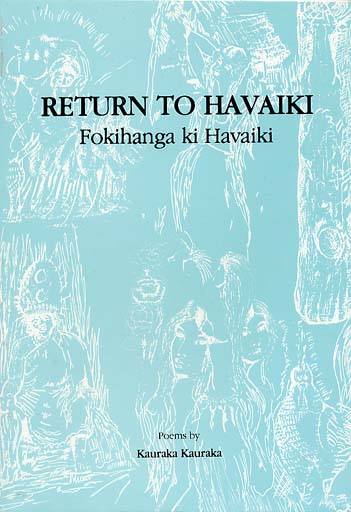
Book 13, the Cook Islands: "Return to Havaiki" by Kauraka Kauraka

Surprisingly, I liked this.


I wasn't expecting to, after the disappointment of "Hingano". This one's another grab from the NUS Library - a slim book of poems in Manihiki and English (the first such bilingual book ever, according to the inside info). Illustrations of gods and heroes on the inside, and a mix of love poetry, mystic poetry and anti-colonial poetry, exhorting us to snap out of our spells of video and New Zealand academic degrees and compete over husking coconuts, drawing power from the memory of the Polynesian ancestral land of Manuhiki/Havaiki, for crying out loud. (If this was written for any race with power out there, it'd be imperialist.)

But the spiritual grounding of Kauraka Kauraka (heehee, what a beautifully tautonymic name) makes up for it - his encomiums to gods ring true, as if he's still in touch with that fount of native culture which other authors like Albert Wendt claim their countries have lost touch with.

(There's also some very cute nursery-rhyme stuff that can only reveal its alliterative genius in Manihiki. "Slippery edible sea slug,/Do you want to eat sea slug?" originally reads as "Pahekeheke te patito,/Ka kai koe i te patito?")

But I think we have the translator to thank for a certain gracefulness of language, a certain wisdom that holds back where other translators would have been too effusive. And though a whole bunch of people are thanked for helping, it does seem as if K Kauraka himself was the principal translator. Hooray for him!

Incidentally, Manhiki words are italicised with footnotes, which is not the ideal solution but turns out to be pretty practical considering how much of such verbiage there is. Gods and goddesses and heroes and plants and animals. Untranslatable beings.

(Ooh, but it turns out that hingano/hinano is basically just pandan.)

View Around the World in 80 Books in a larger map

Representative quote:

MAUI-POKITI

Hey Maui-Pokiti! What are you doing?
I'm weaving me a basket.
What is your basket for?
I'm flying to Manuhiki.

To climb for some coconuts,
to t some puraka
To dive for clam shells,
To trap some titihi
And take them to the sun to be roasted
For the feast of the king of the sky


**
(Maui-Pokiti = a Polynesian demi-god and legendary hero
Manuhiki = the original name of Manihiki Island, the ideal Manihiki society
puraka = an edible tuber
titihi = the "Moorish idol" or butterfly fish, which is most abundant in August)

Next book: Celestine Hitiura Vaite's "Frangipani" from French Polynesia

Sunday, June 27, 2010

Book 11, Samoa: "Leaves of the Banyan Tree" by Albert Wendt

Yes, I've dissed Prof Thumboo before for his lofty style, but I have to say I'm bloody impressed by his philanthropy. Turns out the entire RDET section on Level 6 of the National Library stands for Reference: Donation of Edwin Thumboo, and the only reason I can get these South Pacific writers in the first place is that he bought (or was personally given) these volumes while on tour in the islands.


"Leaves of the Banyan Tree", for example, comes with a personal dedication to ET's wife:

For Swee Chin,
With best wishes
And alofa,
Al Wendt
25/6/85
Suva

Furthermore, it comes with several kilos of kickass.

It's an epic saga of a family over the course of the 20th century, as they move from poverty in the old clan system of plantations in the village to cosmopolitan nihilism in the city and back, centering on the voyage of the ambitious leader Tauilopepe who stops at nothing to gain power: mowing down the sacred bush of the village, sodomising his rival's wife, beating his children (who of course run away and rebel, and maybe one comes back...)

Ah yes, and here's the coolest thing: the book's written in three sections, each of which is in a slightly different style. The first is your standard realist post-colonial novel in third person, the second is in first person and much funnier, more sardonic (in fact, it began as the titular novella of "Flying-Fox in the Freedom Tree"), while the third is realist and third person again, only with a tinge of humour left over.


View Around the World in 80 Books in a larger map

It's really good. A pity I couldn't check it out of the library: I had to camp in and finish its 411 pages in three shots. Very readable - I love the childhood opinions of the son Pepe who goes to school in the capital city, Apia, and he's all prepared to be the hero of the village who's absorbed all the wisdom of the elders, rescuing them from the corruption of his father. But then he drops out of school and invests himself in cheating tourists out of their money and semi-abusively seducing girls and committing violent crimes...

It's a world after the Fall: no returning to the dreamworld of the gods they're named after. Criously, the characters are proud of not having been completely colonised unlike their neighbours, yet they're subsumed by Christianity and family structures and exploitative economics. Sure, some of them get rich and enter white men's clubs and go to New Zealand for boarding school and learn to say words like jake and bloody and raining cats and dogs (does it really rain animals in the winter?) but it's uncertain if independence is a triumph for them.

But it is a more optimistic ending than you'd expect, given the way everyone buggers each other upside-down in the book. Anyhow, highly recommended.

Oh, and language WIN: liberal use of Samoan words like fale, papalagi, umu (getting familiar, these are) but with a glossary at the end.

Representative quote: The papalagi and his world has turned us and people like your rich but unhappy father and all the modern Samoans into cartoons of themselves, funny crying ridiculous shadows on the picture screen. Nevermind, we tried to be true to our selves. That is all I think any man with a club can do.

Next book: Ze Lin Xiao's "Tutuila" from American Samoa

P.S. Apologies for calling this country Western Samoa when I first wrote this post! It was changed in 1997 and I never knew.

Friday, June 25, 2010

Book 10, Tonga: “Hingano” by Konai Helu Thaman

It’s strange to think that there may be another reader in another city, also reading her way around the world, and that her only impression of Singapore literature may be an amateurish volume of unstellar poetry – Koh Buck Song or Min Lim or something – that’s found its way into her public library by chance.


What I’m saying is, yeah, “Hingano” really isn’t all that. It’s the wide-eyed notations of someone who’s delighted at having mastered the English language, knowing she has a lot to say, being a rare Anglophone in an oppressed low-income nation culture.

The result is these terribly sincere poems about love and women’s power and the beauty of the natural world. Not bad, and by no means as irritating as Sudesh Mishra – Thaman is global enough to write about visiting Waikiki and Huangshan, but holds back from expounding on a planetary angst. Still, it might be making her descendants blush, just as we blush at “The Three Sisters of Sz”.


View Around the World in 80 Books in a larger map
The book is Thaman’s third volume. It’s published in 1987, with works composed between ’66 and ’86. This copy’s donated to the reference section of NLB by Edwin Thumboo. Figures.

Several of the poems begin rather well, actually, with strong striking images and phrases - but drift off towards the end into vaguely. And there’s use of quite a few Tongan words: fale palangi, ‘umu, tapa, nukulau, malie, hingano; and with no glossary. All in boldface though, which is even more distracting than italics.

I’ve included one of her better pieces (though the slightly perverse “Our Way” and the ode to Huangshan “Have You Ever” are also very good). And I’m finding my general dissatisfaction with the book is drawing me to the catalogue of the publisher, the Suva-based South Pacific Creative Arts Society. If there was a regional Anglophone literary community then, what’s happening now?

Is there someone like me in the middle of Tonga, overeducated, deracinated, nuts, also wondering his way through other people’s words?

Representative quote:

MISSIONARY

when grandmother went
to the darkened land
we wept and cursed
the gods who sent her

untold stories turn slowly
in our thoughts
her voice
clothed in Solomon dust
remains a night’s whisper

the church and grandfather
assured us that our loss
was the mission’s gain
and God’s light shines forth
through pain

now we sit and wait
by the imaginary grave
where one day grandmother
would rise and say
‘it is finished – they want independence!’

Next book: Albert Wendt's "Flying Fox in a Freedom Tree" from Western Samoa, I think...