Showing posts with label 2010s. Show all posts

Thursday, May 18, 2017

Book 170, Bulgaria: "The Physics of Sorrow" by Georgi Gospodinov

I had a few options for Bulgaria: the 1981 Nobel Prize-winning Elias Canetti (who didn't write about Bulgaria much, as far as I could tell); or Ivan Vazov, whose 1888 novel Under the Yoke is considered the greatest classic of Bulgarian literature.

However, I ultimately decided on someone more current, who also happened to be stocked in the National Library of Singapore: the poet Georgi Gosponidov. Surely, I thought, reading a book of poetry could be speedily done, putting me back on track for my round-the-world trek.

Alas, the book the library had 283 pages. And it's experimental. Is it a novel or a memoir or both? I dunno.


What I do know is that it's good. Gospodinov looks back at his life—he was born in 1968, stayed in village basements as a child because his dad earned too little on his veterinarian's salary, and witnessed as a young man the fall of Communist Bulgaria and the birth of a new globalised, capitalist nation—and he tries to find in his biography, his father's biography, his grandfather's biography, a meaning for the loneliness and sorrow that have haunted him all his life.

And in that basement he finds the Minotaur. A myth of the Greeks—who are of course neighbours to the Bulgarians—and who was not just a monster but also an abandoned child, a freak left to wander through a darkened labyrinth. He latches on to his grandfather's memory of a funfair full of sideshows in 1925, including (fictionally?) a young, abused Minotaur; he sees innocence in that vegetarian head and his lustful mother Pasiphaë who forsook him and the pages of classical authors who never once gave him words or empathy.

(Empathy is key to all this: he claims that as a child he immediately would go into spells where he would empathise so much with characters in stories, with voices, with animals, that he would tunnel into their lives and it would always be a long time before he could find his way back to his own body. Catatonic. Stopped happening when he was a teenager, which he regrets: not growing up and healing, but growing old and losing a special gift, a faculty of the imagination.)

His life's related in a nonlinear fashion, shifting from his meeting with his grandfather's Hungarian lover from World War II to his memories of burying time capsules and playing cowboys and Indians in the 1980s with the neighbourhood kids (did you know the East Germans made Westerns, but always made out the Indians to be the good guys?) and how the nostalgia for that has faded today, and his own flight from Bulgaria in 1995 after his countrymen attacked him for writing an op-ed about them being, according to a survey, the saddest place in the world, and wandering through the obscure cities of Europe, writers' festival after festival, his daughter being born, and himself growing older and foreseeing his death through his father's death...

Life as a labyrinth. And himself either the Minotaur or Theseus, determined to slay the monster.

It's strange how a writer's story of success ends up being one of sorrow as well (true to the title he considers the physics of it all, the infinite possibilities of the universe, God as a boson or a neutrino). And we've seen this strange way what's externally a good life is summed up with regret in VS Naipaul's A House for Mr Biswas, but the strangeness of this all seems uniquely Eastern European, a thing of Kafka or Gogol or Herta Müller.

The Eastern Europeans really have had an inheritance of the bizarre. I wish to learn from them. But alas, this is the last book from the region we'll be doing.

On to Southern Europe next!


Representative quote: It hurts right here, something down on the left, maybe it's my appendix.
Stop with the self-diagnoses, if you please. The appendix is on the right. There's nothing that could be hurting there on the left.
What do you mean nothing?
Just that. There's nothing there.
Well, it's precisely that nothing that's hurting me.

Next book: Hesiod's Theogony and Works and Days, from Greece.

Wednesday, January 11, 2017

Book 167, Moldova: "Bessarabian Nights" by Stella Brinzeanu

Happy New Year! And yes, I'm still chugging along slowly with my reading program. This one was tricky: there's not a lot of Moldovan literature translated into English. Most of what I found on offer at the library were books about the sex trafficking of Moldovans, which is of course an urgent issue to discuss but also seems kind of voyeuristic and creepy when explored from a foreigner's point of view...

Luckily, I managed to find a Kindle book about sex trafficking of Moldovans by an actual Moldovan...


And you know what? It's really not very well written. The English is hella awkward, and I don't know if there was even a proofreader involved. I'm kind of shocked to discover that the author describes herself as a writer, rather than just a well-meaning citizen who wanted to share the problems of her nation.

The flip side of the coin is that the book is a very compelling portrait of Moldova itself. It's got three young women as main characters: Doina, Larisa and the ill-fated Ksenia, who plans to be an artist but is trafficked abroad to Italy by her no-good-boyfriend Boris.

These girls are from country villages but educated enough to work in Western Europe, joining the huge migrant work force that emerged when Communism collapsed. And besides the horrors of sexual slavery, there's a detailed depiction of all that being Moldovan entails: growing up amidst rustic poverty, machismo and alcoholism, selling lice as folk medicine (inspired by Roma folk), a village witch who's really just a charlatan, the growing religious conservatism, a skilled diaspora reduced by their government's financial incompetence to manual labour in Italy and the UK...

Also the strange problems of identity—the main trio, like the population, are a mix of the different races that make up the nation, Roma and Romanian and Russian. The Moldovan national language is, in effect, Romanian, in spite of all their valiant desires to be known as a separate country.

And though these women are depicted as the talented tenth who can rise above the problems of their people, starting overseas companies and newsletters to unite the diaspora, the ending is hella depressing. Brinzeanu evidently doesn't feel it's honest—or in the character of a Moldovan—to project an optimistic future, where good triumphs over evil and maybe someone who's been rescued from sexual slavery can actually be a survivor.

I don't want to give away too many details, but suffice to say that there is actually a worthwhile story in these pages. This author just needs an editor and a few redrafts. As most of us do, you know.


Representative quote: "The tragedy is that we are a starved nation. We are starved for food and like you say, Ichim, we are starved for assets too, slaving away blindly without a vision whatsoever beyond the immediate betterment of our material situation."

"We work so hard and despite it all, we are still poor — the poorest people in Europe, according to some sources," the surgeon-labourer hastened to add.

Next book: Nicolai Lilin's Siberian Education, from Transnistria. (That's right, it's another unrecognised state!)

Thursday, January 3, 2013

Book 113, Guam: "Attitude 13" by Tanya Chargualaf Taimanglo

I've just flown into Myanmar, where I'll be maintaining the Flying Circus Project Blog for the next two weeks. I'm terribly short of sleep, and I've just learnt that we're not gonna get the chance to meet Aung San Suu Kyi at the Freedom Film Fest.

So let's get this over with, shall we? (I want to invest in a nap now so I can live larger later.)


Honestly, Attitude 13: A Daughter of Guam's Collection of Short Stories isn't that great. The style has a strong whiff of the amateur and the plots tend to end anticlimactically. If I had to grade these, I might give a B+ if I were being kind (some are better than others, though: Chirika's Pepper Plant, which won the author a prize with Latte Magazine, isn't half bad).

But the content is what saves the day. Taimanglo's exploring what it means to be a Guamese Chamorro woman in the 21st century - no longer sarong-clad natives to be studied by anthropologists, but college students in Honolulu, expatriates in Seattle, army officers serving their terms of duty in Afghanistan while their daughters wail for them on their home islands, 88 year-old marathon runners in nursing homes with spiky pink and blue hair. Also explored is the condition of being biracial: the author is Chamorro-Korean, and she's described what it's like to be labelled a Jap in school and denied recognition of your true island heritage in the clumsily titled Yes I Am. And also a rather nice fantasy piece at the beginning: an encounter between a washed-ashore mermaid and a jeep-driving, zori-wearing, culturally deracinated Guamese girl in today's world. (Yes, there are stories about boys and men too, but it's clearly womanhood that takes centrestage.)

I suppose I'm drawn to this cultural testimony - not just because I love how foreign vocabularies collide with English: chenchule', pica, buñuelos aga', dinugan, donne', finadene', Hafa Adai - but also because so many texts from Oceania are written by outsiders. Immigrants, colonists, anthropologists, wayfarers - they have the resources to talk about these cultures, not the natives themselves.

Taimanglo happens to be an emigrant, though - she's lived in San Diego and now she's a military spouse in Washington, if the Internet's to be believed. Well, better brains draining out and speaking out than brains staying mute under scrutiny, I suppose.

Damn, I need sleep. Later!


View Around the World in 80 Books!!! in a larger map

Representative quote: I left the movie theater and the cold Washington air embraced me. It was almost midnight and I was out with my fiancé. This was the 18th movie I watched with a date. You can feel happy for me. This was my own doing. I didn't get to the age of 35, engaged and still a virgin, by accident. I am a Goddess on purpose. I am a beautiful Chamorro woman, on purpose. My fat is no longer my shield. 

Next book: Hiroshi Funasaka's Falling Blossoms, from Palau.

Monday, December 3, 2012

Book 110, North Korea: "Nothing to Envy" by Barbara Demick

I'd read a couple of books about North Korea before: Guy Delisle's graphic memoir Pyongyang and Hyejin Kim's "novelisation" of defector accounts, Jia. I didn't think I had to read any others, especially not this one. After all, if a Canadian and South Korean had already given me their two cents' worth, what fresh insights could an American have?


Ah, but Barbara Demick's proven me wrong. I've realised that the two above accounts capture only a tiny fragment of the North Korean experience, mostly confined to the capital city, which it seems is a huge Potemkin village, where only good-looking, able-bodied citizens are allowed to roam so that foreign visitors will be impressed.

This book looks instead at the northern factory city of Chongjin, home to gulags and coal mines and party officials and undesirables alike. We follow the lives of six ordinary North Koreans who escape the famine in the nineties, wading their way past the border with China, then flying into South Korea: the rebellious POW-daughter Mi-ran, the rich university student Jun-sang, the party loyalist Mrs Song, her daughter Oak-hee, the street kid Kim Hyuck.

And god, it's heartbreaking. Demick is a master storyteller: she begins with the teenage love story between Jun-sang and Mi-ran, in the blacked-out darkness of their city, bereft of electricity, noting its provenance: Mi-ran was now a prosperous and well-adapted resident of Seoul, married to another man, yet wistful for her innocent past.

The density, maybe length of the story, matters so much. We learn how life is different for insiders and outsiders, what they ate, what they feared, what they sang (the title is a reference to a North Korean children's song, that claims We Have Nothing to Envy in the World). We see disaster unfolding, slowly, as the horrible political realities of Juche creep up on idealistic youngsters and Kim Jong-Il dies and the famine descends with its pellagra and constipation, weird rashes appearing in spectacle-circles around people's eyes, the most virtuous dying first, the old then the children then the men then the women, and the crazy run-around cycle of imprisonments and recaptures that so many people had to go through to finally make it into the promised land of Hanguk.

Come to think of it, it's also important that we're hearing the stories of individuals. So many images of North Korea portray its people as brainwashed masses, or else single out idealised heroines among them (seems a majority of defectors are women, partly because they can sell themselves off as wives or prostitutes). The unique quirks that these people have, the different extents to which they've adapted to South Korean culture (did you know, what strikes the Northerners as weirdest is how South Koreans kiss and hug in public?) are just so compelling, and inspiring - because of all the six, all of them seem to have done okay, in the end.

Also amazing is Demick's discipline in creating this book: she spent six years interviewing over 100 defectors, heaven knows if she speaks Korean, she must by now. I'll be teaching a non-fiction course next semester - how can I convince kids that that kind of investment is worth it?

Bloody amazing, anyway. And I'm glad I finished this before I fly off for the ILGA Conference tomorrow.


View Around the World in 80 Books!!! in a larger map


Representative Quote: Dr Kim looked down a dirt road that led to farmhouses. Most of them had walls around them with metal gates. She tried one; it turned out to be unlocked. She pushed it open and peered inside. On the ground she saw a small metal bowl with food. She looked closer - it was rice, white rice, mixed with scraps of meat. Dr Kim couldn't remember the last time she'd seen a bowl of pure white rice. What was a bowl of rice doing there, just sitting out on the ground? She figured it out just before she heard the dog's bark.

Up until that moment, a part of her had hoped that China would be just as poor as North Korea. She still wanted to believe that her country was the best place in the world. The beliefs she had cherished for a lifetime would be vindicated. But now she couldn't deny what was staring her plainly in the face: dogs in China ate better than doctors in North Korea.

Next book:  Murasaki Shikibu's The Tale of Genji, from Japan.

Sunday, January 22, 2012

Book 88, Kuwait: “The Chronicles of Dathra, a Dowdy Girl from Kuwait, Vol I" by Danderma

Good lord. What a horrifying book this is.

I’ve grumbled before about Western fantasies of the oppressed Muslim woman, so I was rather gratified that I’d found a piece of what’s essentially Kuwaiti chick-lit: an insider perspective of the nation, first uploaded onto a blog then self-published via Lulu. And of course I was prepared that it might be badly written and a little shallow – as one trufan was squealing, “Sophie Kinsella watch out!” – but I honestly wasn’t ready for this.


You see, Dathra is written breathlessly – it’s full of typos and subject-verb disagreements and tense malfunctions and exclamation marks! and exclamation marks!! and exclamation marks!!! One charming thing is that it’s also composed in Arablish: mixed up English and Kuwaiti Arabic, spelt in the fashion of text messages, replacing the letter “hair” with 7; the letter “ain” with 3, etc, so that the book’s full of mystifying ejaculations such as “G63!” (disgusting) and ”7arra!” (eat your heart out) and “bo6a6a!” (French fries)

More frighteningly, Dathra herself (the word means “dowdy and unfashionable”) is a 32 year-old rich girl with a severe overeating disorder – and no, this is not a charmingly funny junk food addiction like Liz Lemon’s; it’s a problem that hospitalises her after she cooks and eats two kilos of samosas at a go. She also happens to be incredibly obnoxious – she starts fights and screams and yells and throws food at bewildered service staff and folks in the queue for Pinkberry – and in a bid to reinvent herself, starts spending lavishly on designer items: MAC lipsticks and Hermès scarves and sequined tube tops and stiletto heels that smear and creak and burst against her weight.

She has the mindless consumerism of Cathy and the maniacal violent streak of Hothead Paisan, with the redeeming qualities of neither. No, she’s not a layabout: she has a job that pays a good salary (very little description of women’s rights being limited here*) and spends loads of time on her Blackberry, but we’re not even told what her job is, let alone whether she cares about it or loves it.

And yet we’re called upon to sympathise with her. The whole story’s narrated from her perspective, as she hurtles from one disaster to the next; we’re given moment-by-moment motivations for her to hurl yoghurt and trifle on her cousin’s face. We’re directed to root for her to get back her perfect fiancé, the one she violently dumped because he refused to go to Burger Hub with her (plus he was hogging the stuffed grape leaves).

And such is the nature of chick lit that we – or perhaps it’s just me – I can’t put this freaking book down, even though I’m reading it as an oversized pdf on my Kindle, so most of the bottom lines of each page get cut off unless I blow up the screen and look at each page in sixths. This terrible woman, this monster of consumerism in all its forms, living in a society similarly dominated by relentless consumerism, with no sense of self-awareness whatsoever – she is our protagonist, and her uncontrollable urges parallel mine: she keeps eating and fighting, I keep reading.

(The fact that there are so many descriptions of food is also a guilty stimulant. Big Macs, halloumi, imsabbag zbaidi, tea Estekanas, tabbouleh over rocca salad, rice mixed with marag, mini kibbeh filled with labna and garnished with pomegramate seeds, sheesh tawooq, chocolate covered strawberries, fatayer, mini pizzas, vermicelli crème brulee, falafel sandwiches with hummus and tahini, English breakfast, qaymar…)

Oh, and here’s a spoiler: she has a happy ending by the end of this volume. Can you believe it? Let’s hope that in Volume Two she experiences a dramatic epiphany that turns her into a Nice Person.

*Oh, here’s the one interesting “oppressed woman” tidbit: the back-story of the villainess, Sabkahawa, is that she publicly confessed she was in love with a much older Kuwait University professor while she was just twenty, and this was a no-no: a woman must wait for a man to approach her, or else to be matchmade. To openly have feelings oneself is social suicide.


View Around the World in 80 Books!!! in a larger map

Representative quote:
She turned to face him, all her frustration and apparent humiliation poured out of her as she screamed her lungs out ‘Killa MINIK1! O min Elde3la MORTIK2! THE FRUIT TRIFLES ARE GONE, FINISHED, SOLD OUT! I HAVE ASKED THAT WOMAN TO SELL THEM BACK BUT SHE WON’T GIVE THEM TO ME!’

‘Dathra...’

‘CHUB! LA TETKALAM! WALA KILMA! EVER AGAIN TO ME! NEVER TALK TO ME, EVER! YOU CAUSED THE STUPID ACCIDENT, YOU MADE ME LATE, THE FRUIT TRIFLES INBA3AW1! I WANT THEM O OHOM INBA3AW, RA7AW! I MUST FOLLOW THE WOMAN NOW. MOVE OUT OF MY FACE AND NEVER TALK TO ME AGAIN.’

Next book: Princess, Priestess, Poet : The Sumerian Temple Hymns of Enheduanna, ed. Betty De Shong Meador, from Iraq.

Wednesday, November 23, 2011

Book 83, Oman: "The Sultan's Shadow" by Christiane Bird

Y'know, I actually own a book given out by the Omani Consulate - one of those propaganda, boo-yeah, look how prosperous we've become since the modernising force of Sultan Qaboos books. Received it as a door gift back when they'd just sailed the Jewel of Muscat to our shores.

But of course, I've chosen this book instead:


And guess what? Despite the National Library classifying it under "Oman", only a third of it actually takes place in the country - the story's focussed instead on the period after Sultan Seyyid Said and his descendants moved the capital of their empire from Muscat to Zanzibar, all the way down in present-day Tanzania.

But dear me, this book is terribly interesting. I should've read it before I started my East African journey, not after: it brings the world that Abdulrazak Gurnah describes to life; this Arab/Swahili/Indian/European world of slavery and debts and faraway colonial powers.

The author isn't just interested in communicating the cause-and-effect of history: she's fascinated by all the little stories and details of the era, which is why she meanders into side-tales of Ali bin Muhammad and the Zanj Rebellion (the greatest slave revolt in world history); of David Livingstone and Tippu Tip and Henry Morton Stanley; and of course of the Princess Salme, who eloped pregnant to marry a German businessman, turning her back on her faith and becoming the world's first-known Arab woman to write an autobiography.

Truth is, I think Christiane Bird extends the narrative a little too long: Salme ceased to be a sympathetic character for me quite early on (she was an apologist for slavery, among other character flaws), and the various threads of history told out of sequence do strain the mind a wee bit.

But now at least I have some understanding of what the East African slave trade entailed (the author objects to the term "Arab slave trade", given that we don't say "European slave trade"), and that old Oman truly was a glorious place with surprisingly enlightened leaders and a still rather tolerant form of Islam in its culture. That's education, baby.


View Around the World in 80 Books!!! in a larger map

Representative quote: Swahili clairvoyants were called in. Many lived in the most remote areas of the island, but they were tracked down by slaves and brought to the palace by boat, horseback, or foot.

Among them was a prophetess "of a quite unnatural corpulence," who claimed to have an unborn child inside her who could foretell the future. Arriving at the palace one afternoon, the woman told the worried family that her omiscient child, who had been living under her heart for years, could see from the tops of the mountains to the depths of the seas. And then, in a high squeaky voice, the "child" described three sailing ships, from the vantage point of the tallest mast, and outlined in detail what every single person on board was doing. Apparently, Seyyid Said was still alive and well. The family rejoiced and the prophetess ordered that a myriad of sacrifices be made. Gladly, the family obeyed, slaughtering animals and distributing meat, cloth, and rice among the woman's followers and the poor.

At the time, Salme and everyone else in the palace believed in the miraculous child. Only later, while living in Germany, did Salme realize that the woman was a ventriloquist.

Next book: The Quran, from Saudi Arabia.

Thursday, October 27, 2011

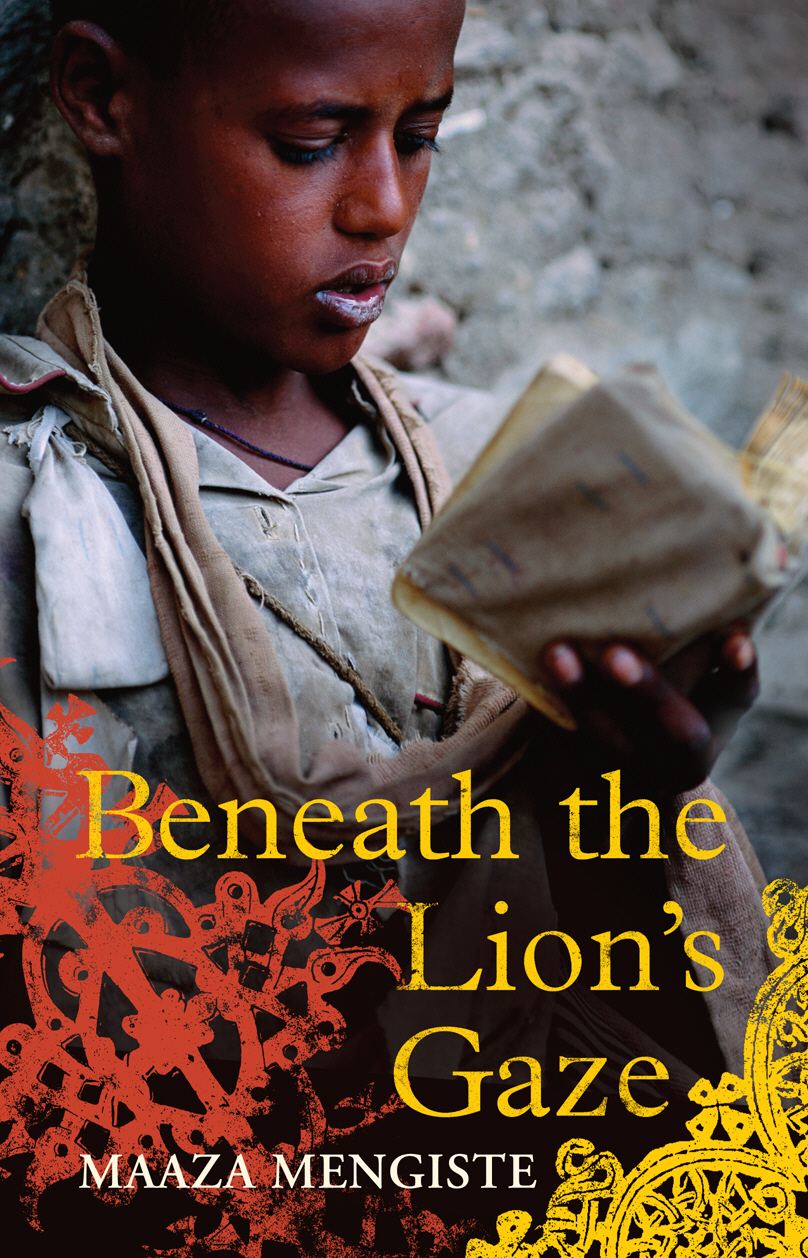
Book 79, Ethiopia: "Beneath the Lion's Gaze" by Maaza Mengiste

Of course the great text of Ethiopia is the Kebra Nagast, the Glory of Kings, the 14th century chronicle of royals from Sheba and Solomon down to medieval times (also the main holy book of the Rastafarians). Sadly, the library only stocks the following:


But I'm being unnecessarily melodramatic, because this novel is awesome. No, seriously, it's superbly well written, really capturing the horror of the Ethiopian Revolution in 1974 and the purges of the Derg: exquisite language, vivid dream sequences, and all following a middle-class family, too, so there's that soap-opera quality that makes it actually enjoyable beach reading.

I actually finished it on Tuesday night, but have been busy with the Singapore Writers Festival and teaching, etc (I'm hosting the Moving Words launch on Saturday now! Just got asked), and come to think of it, I'm pretty tired, so I'll just make two main points:

1. Horrible to admit this, but the author's NYU polished English style plus the fact that the characters are urban intellectuals means that the story doesn't feel like typical African fiction at all: you actually forget the characters are black.

This makes the tale more relatable than ever: you feel yourself inside the skins of these jeans-wearing, stethoscope-toting secular professionals, whose political traumas could've happened in Maoist China or Pol Pot's Cambodia or Stalin's USSR or Bush and Obama's Iraq, really. Odd how that happened. No conscious attempts to whitewash them, as far as I know.

2. The author's created the fictional character of dictator General Guddu for the story. Why? It's based on Mengistu Haile Mariam, so why not just give him that name - she admits to stretching the facts in her afterword, and she did a marvellous job narrating from the viewpoint of a doomed Haile Selassie in the Jubilee Palace.

I suspect she made the change 'cos Mengistu's name sounds too much like hers, and she didn't want to have to field unpleasant questions from dumb folks about whether she was a descendant. Cheating? Yeah, but a sane decision.


View Around the World in 80 Books!!! in a larger map

Representative quote: How would Emperor Haile Selassie later describe the moon that night? Voluminous, as thick as milk, a thousand melted stars that sliced the sky with razor-sharp edges. Even in the dark, from his window, he could make out the outlines of trees shivering in the breeze. A truck with squealing brakes pulled up and a barking order, followed by the confused mutterings of soldiers, made the emperor move back to his cot. There was nothing here that we would want to see. Lying on the bed, he raked his fingers over the spider-bite scabs that dotted his arms, picked at one, and took comfort in the tiny pinch of a peeling wound. This was evidence, he reminded himself, that he was still alive. They hadn't killed him yet.

Next book: Hannah Pool's My Father's Daughter, from Eritrea.

Thursday, July 14, 2011

Book 70, Réunion: "The Last Colony" by Michael Steane

Don't buy this book. Seriously. It cost me US$0.99 via Amazon Kindle and I still feel like it wasn't worth the money. As Dorothy Parker said, "This is not a novel to be tossed aside lightly. It should be thrown with great force."


But of course The Last Colony: An Experience of Reunion Island isn't a novel; it's a memoir, written by a British electric technician who spent three years there as an English teacher en route to migrating to Australia. A bit like With Sword and Chain in Lusaka, only in this case the author's an utter nobody, who can't even write that well - he even admits as much in his intro, when he apologises for how disjointed the book is, utterly contrary to the advice he used to give his students.

Truth is, I can deal with the disjointedness. It's actually pretty interesting to read the details Steane gives about culture on the island: the drunkenness, the high prices, the overlapping of Islam, Catholicism and Hinduism, the mendacious marabout shamans from mainland Africa, the violent crime, the beauty of the Creole girls, the skills of the pickup artists and the scandals and corruption of the politicians.

What I can't deal with is:

1) The fact that most of the book is about his struggle with French bureaucracy, and how contrary to the principles of the newly inaugurated European Union all this is (he migrated in '91 and couldn't find a job because he was British and jobs were reserved for Frenchies). Truly, he's got nothing good to say about the French - he claims their greatest contribution to civilisation was giving Henry VIII syphilis thus leading to the English Reformation. Reading an anger-filled screed against foreign civil servants is not much fun.

2) Really odd grammar. He's made the conscious decision to narrate most of the book in present tense, despite the fact that most of the events are long behind him, thus necessitating frequent shuttlings between present and past tense. Combined with the jumbled sequence of events - well, really, there's no story in the end. No recurring characters, barely any dialogue - it doesn't have to be genuine: A Trip to the Beach made up half its sequence and it still leaves you with a sense of joy in life.

Gah, the guy just can't write well or just isn't trying. Couldn't even tell "principle" apart from "principal". Don't think that was a typo.

What's really weird is the fact that he confesses to having really loved certain aspects of the island: the gorgeous nature, the volcanoes, the children, the ladies (not one of whom has her character elaborated upon - did they just not stick around long enough to find out?). He even closes the book with a bunch of tips on tourist attractions. But after having read such an irritable travelogue, who would want to visit?


View Around the World in 80 Books!!! in a larger map

(I'd want to, actually. The Indian Ocean Regional Poetry Slam is held there, and Singapore's sending a representative there following our own slam finals on 21 July. Benjamin Chow deserves to go as our best champion, but it'd be so freaking cool to attend!)

If you're looking for alternatives to this book, there's a whole tradition of littérature réunionnaise you can look up yourself, but none of it seems to have been translated into English.

Representative quote: Farewell Reunion. Forgive me for my anger. Forgive me for the book I am going to write.

Next book: J.M. Clézio's The Prospector, from Mauritius.

Wednesday, November 24, 2010

Book 37, St Maarten: W. R. Groman's "Oasis of the Sea: Sint Maarten Sonnets"

Blogger has stats now, so I know what countries my readers come from (Singapore=453; USA=425; Brazil=22; UAE=13), and that my all-time most popular page is my review of the unknown, younger-than-me, just-published-this-year-on-Kindle-author Ze Lin Xiao from American Samoa.

Who'd've thunk? But now I'm gearing up for another hitstorm, because I'm reviewing another unknown, younger-than-me, just-published-this-year-on-Kindle-author, W.R. Groman from... well, I don't know where he's from, really.


He has a poetry blog, where he writes in both English and Spanish. He's one degree of separation from me via Facebook, so I know he's Brown '04 and Harvard grad school. But that's it in terms of biography. I could assume he's American, but who knows for sure? Ze Lin's Samoan, and she's at Stamford.

His poems are verbose, cerebral and weirdly archaic (they're Shakespearean sonnets after all; slant-rhymed, but still!). None of the expected paeans to the sun and the sea; instead we've got lizards and satyrs and dusty streets with discordant jazz music, but not in a social realist style either - no, the true nation of the 28 sonnets in this chapbook is Groman's head. He occasionally lights on a theme directly related to the setting: oil slicks, orange blossoms, Spanish vocabulary, black boatmen - but certain sonnets are simply about his mind wandering, trying to find its place in the universe between flesh and ether and "the panorama/of sand and lizards and children and streets/washed over by the goats' glaze and drama".

Honestly, I'm not engaged. There's no hook - the language is unexpected but not fresh, obscure but not musical, not magical. I can't find a good reason to follow him on his quest for truth.

Structurally, the poems are rather fine, of course: this isn't a Creative Writing 101 emo-fest, but real products of skill. Plus, I rather like the fact that he's dwelling on grunge rather than rose-tinted tourist brochure shots.

(What's rather odd is that he does pepper the text with rose-tinted tourist brochure shots of the beaches and landscapes of St Maarten. Very odd effect. It's like throwing in photos of the Lake District or Guilin into the folder notes of a Nine Inch Nails album. This is one of the clues that makes me think he's not an actual native of St Maarten... but who knows, really? Maybe he's estranged.)


View Around the World in 80 Books in a larger map

Small grumble, though: if I'd been thinking properly when I read A Trip to the Beach, I would've realised that only the southern half of this island is the Dutch country of Sint Maarten, part of the former Netherlands Antilles; the upper half is the French collectivity of Saint Martin, administered by Guadeloupe.

So by coming directly here from Anguilla, I'm actually violating one of my own rules about crossing other nations on the way between stops. Bugger. The god of literary blogging will forgive me, I'm sure.

I'm including one of the few poems in the the chapbook that I really like. I know the fair use claim is iffy here, so I'll take it down if he asks me.

Representative quote:
12

The rain has softened into fresh linen,
but these bloodshot eyes still remember,
on this island of goats, fruit and venom,
in this month six months before December:
the porch was on fire, the hammock singed
down, and the lovely light green almost grayed
away into nothing - a light bulb binged
and purged on its own power and sprayed:
This whole island is purgation, vomit-
even the waves spew forth firewaters,
and certain hooves dance on tails and dumb it
down, and the lights leak lies made of fathers:
This must be the oasis of the seas,
where sand and salt and steel forge reveries.

Next book: Jean Heyn's The Governor-General's Lady, from the US Virgin Islands.

Wednesday, June 30, 2010

Book 12, American Samoa: "Tutuila" by Ze Lin Xiao

I'll admit it. I was going to skip American Samoa at first. After all, most people don't even know there are two Samoas (Western Samoa is an independent nation), and I just couldn't track down an American Samoan book since I'd already read Margaret Mead's "Coming of Age in Samoa", which I do not recommend as a light read...

But then I surfed the Amazon Kindle Store and I got this for 99 cents:


It's by a Stanford computer science student. Go look her up. She's Class of 2011, which means she's 21 years old or something, and she wrote the short stories just to hold on to her memories of that place of few opportunities she was lucky enough to transcend.

And boy, from her descriptions of Pago Pago, it does sound like a place you might want to move away from - all the suburban nightmare of the American dream: strip malls and drunken teenagers and high divorce rates, coupled with the poverty and disease and underdevelopment of the tropics - trash and dogs in the street, roads where cars can only run 25 mph. But there's charm, of course - an abusive woman with a flower in her hair, screaming at a palagi (white) lady for daring to use the word "loofah", which sounds like "ufa", in a supermarket.

Unfortunately, most of the stories aren't very good. They don't have satisfying endings - they just dump you on the floor, leaving all these characters you want to know more about unfinished. Or they're about two paragraphs long.

Also I wish she'd gone into more detail about the half-Japanese and Chinese characters - I'll have to admit that one of the reasons I snapped up the book was because I miss writing about stuff by people with Chinese names. Cockroaches of the Earth, you know.


View Around the World in 80 Books in a larger map

It's short at least. And it's contemporary - published just this year, in Feb! No hard copy version, either - all virtual! And the first short story, "White Sunday" is actually rather good - her descriptions have a kind of poetry to them, and the landscapes of people's lives jump right into focus.

Will she write more? So that other people doing this project can keep an eye out for the still colonised? More power to her if she does.

Representative quote: (from "White Sunday")
The second ring was from my dad. My parents met each other at Starkist, an unlikely place, but nevertheless my story is true. Mom said that Dad was packing tuna when she first met him. He was the one who trained her to operate those large assembly line machines for the cans of tuna. Two weeks later, they were stripping off clothes saturated with fish-scented perfume in the back of a pickup truck.

Next book: Kauraka Kauraka's "Return to Haivaki" from the Cook Islands.