Showing posts with label western europe. Show all posts

Monday, September 29, 2014

Book 158, Austria: Elfriede Jelinek’s "The Piano Teacher"

Kind of tricky to track down this book – the National Library had only one English-language copy in stock, and it was checked out. (Oddly enough, the Mandarin and Malay translations were still available.)

Had to go down to my old stomping grounds of NTU to check out the copies they had on reserve there as compulsory syllabus readings, in between Thomas Mann’s Death In Venice and WG Sebald’s... something or other.
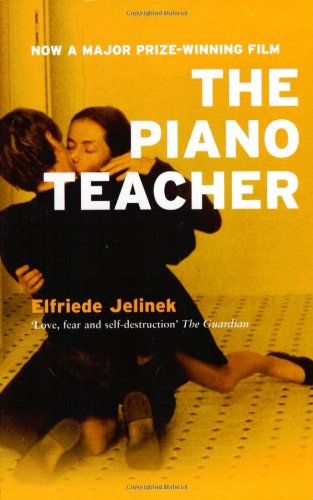

And damn. Now I know why the censor-happy National Library won’t keep multiple copies in stock. Never mind that this is a work by a Nobel Prize Laureate, the greatest Austrian writer of her generation; a work made into a landmark critically acclaimed work of Franco-Austrian cinema.

The truth is, this book is sick, in the best way possible. Oh, the perspective’s technically third person, but it goes under your skin… It begins with a portrait of the twisted relationship between the 36-ish-year-old piano teacher Erika Kohut and her Mother; they live together in a tiny flat and the Mother refuses Erika any luxuries whatsoever, flying into a rage when she spends money on a dress to make herself look pretty, pretty girls are sluts, etc., all she wants to do is keep Erika as her tool to earn enough money for her old age so they can live together in a bigger condo, and all this good-for-nothing daughter does is waste her pay on frivolities…

So we hate the mother, and we’re rooting for Erika, and even more so when we learn that Erika was groomed to be a great concert pianist from her girlhood, her mother and her grandmother consumed by dreams of fame and success that brought them to Vienna, the city of music. But somehow Erika screwed up a critical recital and has had to live her life as an angry repressed spinster piano teacher at the Vienna Conservatory…

…and it turns out she’s kind of an awful person as well, deliberately kicking or pinching people in crowded trolleybuses, stalking through the Turkish district to look at girlie peepshows or Prater fairgrounds to catch couples doing it in the grass (there’s some horrible things said about Turks and Yugoslavs in the process; hope that’s the character speaking and not the author)…

… and there’s a young, blond, athlete of a piano student named Walter Klemmer, and he’s hot for her, and she’s hot for him, but he’s asserting his god-given male entitlement and worship of his own 7-inch cock on the world, flirting with every young girl, and she won’t do with that, and so she hurts other people, she hurts herself especially, she hurts her mother too, and she hurts Klemmer, in a series of psycho nonconsensual BDSM sequences in the conservatory toilets, broom closets and her mother’s sacred bedroom…

In a way, it’s a feminist’s nightmare: a woman writing about women who are hysterical, steely in public but desiring domination and punishment in private, women who are wildly weak. Women like the heroines of Greek tragedies. Xiao bitches, as Singaporeans would say.

And it is written so damn well. Aiyah, I’ll just leave it at that. Wonder how on earth I can learn from this prose style. (Rather pleased that NTU students are reading it… how does it change their lives?)


View Around the World in 80 Books!!! in a larger map

Representative quote: Erika holds Walter Klemmer at arm's length. She pulls out his dick, which he has already slated for deployment. It only needs the finishing touch, for it is already prepared. Relieved that Erika has taken over this difficult task, Klemmer tries to push his tach down all the way. Now Erika has to resist him with her entire weight so she can remain upright. She holds Klemmer's genital at arm's length while he fumbles about randomly in her vagina. She lets him know that is he doens't stop, she'll leave. She softly repeats her threat several times, because her suddenly superior will has a hard time getting through to him and his rutting fury. His mind seems fogbound with angry intentions. He hesitates. Wondering whether he's misunderstood something. Neither in the history of music nor anywhere else is the suitor simply barred from events. This woman has not a spark of submission. Erika starts kneading the red root between her fingers. She demands a privilege, but refuses to grant it to the man. He must go no further with her.

Next book: Imre Kertész's Fateless, from Hungary.

Sunday, September 21, 2014

Book 157, Liechtenstein: "Liechtenstein: A Modern History" by David Beattie

Sometimes doing this blog is more of a ritual than anything else...

 So, Liechtenstein. Principality of 35,000 people. How many writers amongst them? One prominent one, in fact: Prince Hans Adam II himself, who's scribbled out a rather well regarded text called The State in the Third Millennium.

In retrospect, I should've ordered myself an ebook version, because what I ended up with instead was dry dry book on history and constitutional law and economy:


Was there anything worth remembering from my couple of hours skimming through this book? Well:

• a Roman soldier’s helmet has been discovered on Liechtenstein's territory, bearing his name (not mentioned) but not, alas, his legion,

• during the Middle Age witch-hunts, out of a population of 3,000 people in the principality, 300 were tortured and executed,

• the many Jewish immigrants involved in the banking industry fled before WW2, which was a shame because they would have been pretty safe. Liechtenstein never capitulated to the Nazis, remaining resolutely neutral, avoiding an Anschluss (Hitler once grumbled that he never wanted to hear words Liechtenstein and Switzerland again “because the people there hate me") and a Nazi putsch,

• after the war, Communist Czechoslovakia insisted that the Liechtenstein royal family were Germans and had to hand over their land in their territory, when in fact they were only kinda culturally German the way many German Czechs like Kafka were,

• during the 1968 referendum, separate votes were held amongst men and women to decide whether or not to allow women’s suffrage. Most men – and most women - voted against it. (This kind of direct democracy is quite feasible in such a small country.)

• it's naturally hard to figure out what holds the country together culturally (a third of the residents are non-citizens, though they're mostly Germans and Austrians), but a lot of it's the royal family,

• also, the country's "economic miracle" is thanks not only to banking (the author was very forgiving of the whole tax avoidance and money laundering thing), but also to high industrialisation - they had an early hydroelectric dam, plus manufacturing bases for false teeth.

Yeah, I think that's about it. Most of the book was really fawning over the princes - and yeah, that's all of them on the cover, from Karl I who bought the area in 1608 to Hans Adam who's still there right now. The author's a former British ambassador to Switzerland and Liechtenstein. Maybe he had a crush of Hans, who is quite the silver fox.

There was also a bit about the Princes' extensive art collection, which has been on show at the Met and Singapore (he once sold a Franz Hals to help with state finances, not that there's any public debt now). And in fact I was thinking of reading one of these art catalogues for this entry, but I felt, well, it's kinda awkward when the princes and the art aren't actually housed in Liechtenstein itself.

For a nice fun intro to this country, I'd recommend the chapter on the microstate from George Mikes's Switzerland for Beginners. Not that reading it was a total bore - interesting resonances for a Singaporean to read about this weird little mega-rich nation's survival, prosperity and uncertain future.


View Around the World in 80 Books!!! in a larger map

Representative quote:
“In 2006 the Pinricpality of Liechtenstein will commemorate the 200th anniversary of its full state sovereignty. It is younger than the USA but older than the modern states of Belgium, Greece, Italy, Germany and many others. In the heart of Europe, it is the diversity of Europe. Its people, its traditions, its institutions and its economy give it much to hope for. Amid their justified celebration of the past and heir optimistic anticipation of the future, many Liechtensteiners will reflect on the much-quoted words of Peter Kaiser, their first historian, the country’s representative at the German National Assembly in Frankfrut in 1848-1849 and one of those who defined Liechtenstein identity:

'If we understand our advantage correctly, we may present ourselves as a small nation that endangers nobody but commands respect from all. Life is short; but an honourable name remains and serves down to the latest posterity for an example and for emulation.'”

Next book: Elfriede Jelinek's The Piano Teacher, from Austria.


Friday, September 5, 2014

Book 156, Switzerland: "Heidi" by Johanna Spyri

I've spent a month in Switzerland before, so I've read some of its literature - Friedrich Durenmatt's The Visit and The Physicists and Max Frisch's Homo Faber, for instance. Yet I hadn't, until now, read the most clichéd work of Swiss literature in existence:


Ah, Heidi. I got an illustrated Kindle version off Project Gutenberg. No idea if it was the best translation, but a lot of modern translations seem to be adaptations for younger readers.

And honestly, I can see why they'd target younger readers. The tale is soppy as all hell - Heidi is just five when she enters the scene, and she's all sweetness and light and innocent virtue, never once selfish or rebellious the way actual children are.

She's an orphan: her dad died in a logging accident and her mum died of grief as a result, and her cousin Deta is dumping her on their cranky old grandfather 'cos she's got herself a decent-paying job as a maid in Frankfurt. Never mind that her grandfather, the Alm-Uncle, is famously cranky and solitary and lives all alone in the cold mountains with only his two goats, and everyone in the village thinks she's committing reckless child neglect by placing her in his hands.

But ah, little Heidi is a miracle-worker! She charms the Alm-Uncle into loving her, and is utterly content with only having goat milk and cheese and bread for food and sleeping on a bale of hay, and spends all her days hanging out with Peter, the 11 year-old goatherd, playing with the goats and marvelling at the beauty of the sunrise and sunset and the flowers and the grass and the pines and the everything that you'd think a little Swiss village girl would just see as part of the landscape.

But then we've got the big conflict: Deta returns and asks her to come to Frankfurt to become a friend to Clara, an 8 year-old invalid daughter of the rich Mr Sesseman. The story thus turns into a narrative contrasting the oppressiveness of the German cityscape with the glory of the Swiss countryside.

You see, Heidi creates a huge ruckus in the household with her innocent country ways - she offers to take in an entire litter of kittens from a guy who guards a clock tower, at one point, and freaks out her governess with the surfeit of meowing kittens overflowing from her pockets. But she wins over Clara and Sebastian the butler and rich Mr Sesseman, because she's so pure of heart.

But Frankfurt's all wrong for her, and she gets skinny and sickly and starts sleepwalking, so Mr Sesseman sends her back to the Alps, and eventually sends Clara as well for a holiday. And Clara's so invigorated by the fresh mountain air and the goats' milk and the flowers that she actually starts walking again. Seriously, now.

So yes, it's a sappy story. But it was a pleasure to read - even knowing the ending, I was amused at the exact manner in which the miracle was executed, and how gradually, and how almost believably it came about. And it's fun to enjoy things ironically. Nonetheless, I've a few questions that bug me:

1) Isn't this all a little exploitative? I mean, we're romanticising the lives of the poor here. And their relationship with the rich is one of utter harmony - the Sessemans fall over their feet in their eagerness to bestow gifts unto Heidi's community, and are thanked for it. It's not a problem that some of our characters go barefoot and some ride around on silk cushions, apparently...

2) The levels of Christianity are too damn high. The only good things Heidi gets out of her stay in Frankfurt are the ability to read, and a new understanding of prayer and the ways of God, with which she's able to convince her bitter old grandfather to start going to church again. Really, the preaching is laid on pretty damn thick - not sure how much they preserve this in today's versions.

3) Is Peter an asshole? I wanted to declare him one as I read the story and watched him get rabidly jealous of anyone who became friends with Heidi, because he wanted to be her bestest and only friend aside from the goats - he has a habit of shaking his little fists at the sky, and even pushes Clara's wheelchair down the mountain at the end (without her in it, mind). So he is an incredible brat compared to our heroine. But then he's human - he's the one who actually acts the way a poor kid should act in the presence of the 19th century über-rich, which is to get mad and get smashing.

And a couple of factoids. First, the sequels to this book - Heidi Grows Up and Heidi's Children - weren't written by Johanna Spyri but by her translator. And second, Heidi isn't even her real name. It's Adelheid, which is an actual Christian name, whereof Heidi is a corruption, confusing the proper folks in Frankfurt no end.


View Around the World in 80 Books!!! in a larger map


Representative quote: 
"Grandmama told me that God would make everything much better than I could ever dream. I shall always pray from now on, the way grandmama taught me. When God does not give me something I pray for, I shall always remember how everything worked out for the best this time. W'll pray every day, grandfather, won't we, for otherwise God might forget us."

"And if somebody should forget to do it?" murmured the old man.

"Oh, he'll get on badly, for God will forget him , too. If he is unhappy and wretched, people don't pity him, for they will say: 'he went away from God, and now the Lord, who alone can help him, has no pity on him.'"

Next book: Johann Kraftner's Princely treasures from the House of Liechtenstein, from Liechtenstein.

Thursday, August 28, 2014

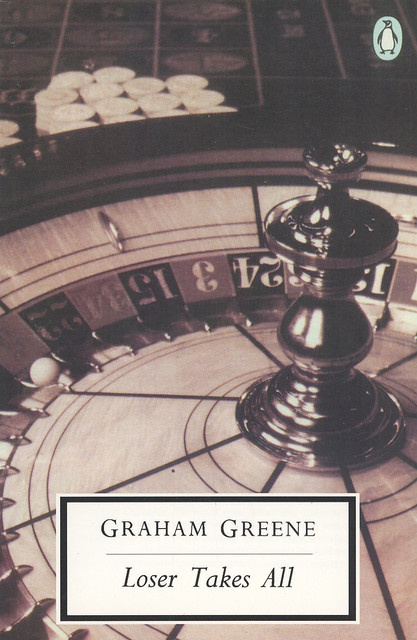
Book 155, Monaco: "Loser Takes All" by Graham Greene

Guess what? I decided that I *would not* let a second month go by wherein I'd only read one book for this blog. So I hitched a ride with my dad over to Jurong East Regional Library, and lo and behold, procured this:


It's a novella about Bertram, a 40 year-old London assistant manager of accounting and a bit of a loser - except that he's about to marry a sweet 20 year-old girl named Cary at a quiet church ceremony. Then, through the off-handed magnanimity of the major shareholder in his company, he ends up having the ceremony in Monte Carlo, Monaco - but when they're stranded at the hotel without the cash to pay their way any further, what can they do? Gamble their way into millions, that's what! And encounter all the ups and downs of riches while that takes place.

Now, I've only read one other Graham Greene novel, The Quiet American, which happens to have been published in 1955, the very same year this came out. And I can't help but be struck by the similarities between the two. Both feature:

1. A middle-aged, unremarkable first-person protagonist who is British and male,

2. and who also happens to be with an innocent 20 year-old (in The Quiet American, her name's Phuong) who appears bubble-headed and flighty but is in reality utterly devoted and surprisingly canny about the ways of life,

3. although there's an awful middle-aged woman involved - in The Quiet American it's Fowler's existing wife who won't grant him a divorce so he can remarry; in Loser Takes All it's Bertram's cheating sexpot of a deceased wife, plus a lady he picks up in the casino just to make Cary feel jealous.

4. Oh yes, and there's a handsome young man around who makes the protagonist jealous (the eponymous quiet American in The Quiet American; a young gambler named Philippe in Loser Takes All), but who does not deserve the girl, dammit.

5. And there's also machinations of power in the background - it's the Vietnam War in The Quiet American; it's the battles for money and power amongst the shareholders in Loser Takes All.

6. Plus, they both take place in exotic locations most Brit readers could only dream of visiting - Monaco! Vietnam! Not so much unlike an Ian Fleming novel after all. (Although it is remarkable that Loser Takes All was published a year before Grace Kelly's wedding to Prince Rainier - hence, it's set in the dowdy days of Monaco, before its great glamorisation.)

Of course, the two books are different, in substantial ways. First off, this one's just a novella, 110 pages long in fairly large print. And second, while The Quiet American is about the corruption of war and imperialism and all, Loser Takes All is about the corruption of wealth and greed - the money spoils everything, and Cary's the only one who can see that clearly.

And yes, this was a hell of a fun read. Probably useful for my writing, too. Although I do still feel bad about losing my copy of The Ruling House of Monaco. Will have to cough up some cash for that.


View Around the World in 80 Books!!! in a larger map


Representative quote: There are so many faces in streets and bars and buses and stores that remind one of Original Sin, so few that carry permanently the sign of Original Innocence. Cary's face was like that - she would always until old age look at the world with the eyes of a child. She was never bored: every day was a new day: every grief was eternal and every joy would last for ever. 'Terrible' was her favourite adjective - it wasn't in her mouth a cliché - there was terror in her pleasures, her fears, her anxieties, her laughter - the terror of surprise, of seeing something for the first time. 

Next book: Johanna Spyri's Heidi, from Switzerland.

Saturday, August 9, 2014

Book 154, France: "In Search of Lost Time, Vol I: Swann's Way" by Marcel Proust

Boy oh boy. I still can't figure out if I made a mistake with this one. I mean, I could've read an action-packed classic novel for this segment - Victor Hugo's The Hunchback of Notre Dame, Alexandre Dumas's The Three Musketeers, Gaston Leroux's The Phantom of the Opera - and no-one would've thought less of me for it.

But instead, I decided I had to go with the major work of world literature I was least likely to get around to reading otherwise. But the one I chose was only one volume of the seven-volume In Search of Lost Time, and not even the most acclaimed volume, either (which I believe is In the Shadow of Young Girls in Flower). 

Still, it is the one with the famous madeleine scene in it!


TBH, the book's not bad, if you know you're diving in for some experimental writing - you can put up with the long sentences and the endless introspection and the utter lack of plot, and enjoy the sketches of the ridiculous grandmothers and maidservants and aunts, not to mention the absurdly lovestruck M. Swann and his coquettish peacock of a lover/wife Odette, who may or may not be cheating on him, we have no idea. The most beautiful prose pops up in the section Names of Places, when he's reflecting on the many towns and landscapes he might have chosen to visit as a child had his health been better:

"...between Bayeux, so lofty in its noble coronet of rusty lace,w hose highest point caught the light of the old gold of is second syllable; Vitré, whose acute accent barred its ancient glass with wooden lozenges; gentle Lamballe, whose whiteness ranged from egg-shell yellow to a pearly grey; Voutances, a Norman Cathedral, which its final consonants, rich and yellowing, crowned with a tower of butter; Lannion with the rumble and buzz, in the silence of its village street, of the fly on the wheel of the coach; Questambert, Portorson, ridiculously silly and simple, white feathers and yellow beaks strewn along the road to those well-watered and poetic spots; Benodet, a name scarcely moored that seemed to be striving to draw the river down into the tangle of its seaweeds; Pont-Aven, the snowy, rosy flight of the wing of a lightly poised coif, tremulously reflected in the greenish waters of a canal; Quimperlé, more firmly attached, this, and since he Middle Ages, among the rivulets with which it babbled, threading their pearls upon a grey background, like the pattern made, through the cobwebs upon a window, by rays of sunlight changed into blunt points of tarnished silver?"

But I'm also rather lucky that I was concurrently reading David M. Halperin's incredibly insightful book How To Be Gay, that examines how there is a gay culture of irony and beauty-worship despite activist claims that this is mere stereotype. Halperin points towards Proust's work as an exemplar of his ideas - how, even in the early reaches of the 20th century, even in a work that does not explicitly declare its author's sexuality, we still have this tale of a terrible longing to be loved by one's mother (Proust's mum believed that over-excessive displays of love were unhealthy, and tried to restrict her warmth, clumsily) and the sheer camp surrounding the depictions of the absurd men and (especially) women of upper middle-class French society. Hell, even his childhood crush on a girl called Gilberte doesn't redeem him orientation-wise.

Nonetheless, I do think reading Hugo or Dumas would have been better for my writing. Another day!


View Around the World in 80 Books!!! in a larger map


Representative quote: The reality that I had known no longer existed. It sufficed that Mme Swann did not appear, in the same attire and at the same moment, for the whole avenue to be altered. The places that we have known belong now only to the little world of space on which we map them for our own convenience. None of them was ever more than a thin slice, held between the contiguous impressions that composed our life at that time; remembrance of a particular form is but regret for a particular moment; and houses, roads, avenues are as fugitive, alas, as the years.

Next book: John Glatt's The Ruling House of Monaco : the Story of a Tragic Dynasty, from Monaco.

Tuesday, July 8, 2014

Book 153, Luxembourg: “At the Edge of Night” by Anise Koltz

We’re at the last and the littlest of the Benelux countries now! Luxembourg’s got a weird history: its half a million inhabitants speak a mix of French, German and Luxembourgish (apparently almost a dialect of German), and its writers produce literature in all three languages.


Koltz, for instance, writes in French – as most of her fellow poets do. But she used to write in German before the death of her husband in 1971 (he was imprisoned during World War II, and she says he was a late victim of the Nazis). Plus, she still writes children’s books in Luxembourgish.

Critics even say Koltz’s French is very German-like – and certainly, in this bilingual compilation of her poetry from the 2000s, her French feels spare, almost schoolchild-simple. It’s full of these stark, Rimbaud-like invocations of hell - fire, bones, wolves, invocations of monstrous mothers and fathers and brothers.

But there’s no jumble – these are brief, devastating pieces of writing, focused on just a few images, like joined-up haiku. And it’s weird, because I don’t think I would advise my writing students to create stuff like this. The title of this collection, for example, comes from this poem

COLD

At the edge of night
my mother is seated
her clothes in tatters
two fangs
in her toothless mouth

She throws herself on me
and sucks out my marrow 

It’s a nightmare vision, but you can imagine an angsty adolescent writing it in a I-hate-my-mom kind of way. It does sound better in French, but doesn’t everything?

FROID

Au bord de la nuit
Ma mere est assise
ses vêtements en loques
deux crocs
dans sa bouche édentée

Elle se jette sur moi
et me suce la moelle

Some of her short stuff is fantastically clever and awesome, though:

LA TERRE

Quand tu marches
tu sens terre
s’agripper
à tes semelles

Elle n’oublie pas de t’oublier


THE EARTH

When you walk
you feel the earth
cling
to your soles

It doesn’t forget to forget you

Damn, reading this stuff makes me miss translation work. There’s a marvelous alchemy that happens when poetic language passes from one tongue to another.

The only longish poems here might be the ones from her 2003 collection Fire-Eater/L’avaleur de feu, dedicated to her husband René – though for all I know, these are just glued-together untitled fragments, separated by rows of asterisks and arranged in columns of Roman numerals. It’s hard to digest continuity when you’re reading two versions at the same time: facing pages, parallel texts.

My favourite piece in here is from that collection, btw. I’ve included it below:


View Around the World in 80 Books!!! in a larger map

Representative quote:

***

Ma mémoire est lourde
comme un vaiseau qui coule

J’ai vogué
dans toutes les parties du mond
les dieux m’égorgeaient
je les égorgeais –

Ecrivant dans leurs bouches
dans leurs entrailles
j’ai oublié la poésie –

je suis devenue poète

***

My memory is heavy
like a sinking ship

I have wandered
all over the world
the gods slit my throat
I slit theirs –

writing in their mouths
in their entrails
I forgot poetry –

I became a poet

Next book: Marcel Proust’s Swann’s Way, from France.

Monday, June 30, 2014

Book 152, Belgium: Hygiene and the Assassin by Amélie Nothomb

Belgium’s famous for its comic writers – Peyou of the Smurfs and Hergé of Tintin, for instance. It’s got a whole museum devoted to the graphic novel form. 

But I’m still on the road, and so I’ve to make do with Kindle books instead. I realise now I should’ve downloaded a free copy of Nobel Prize-winning playwright Maurice Maeterlinck’s The Blue Bird, an allegedly insipid little drama about children and innocence.

Instead, I bought the first novel of Francophonie superstar Amélie Nothomb, whose novella Sulphuric Acid is so amazing that I’ve regularly lent it out to my students as an exemplary creative writing text. And surprisingly, Hygiene and the Assassin (originally Hygiene del’Assassin) is also about children and innocence and a Nobel Prize-winning author… 


But I’m getting ahead of myself. The tale’s set in 1991, when the First Gulf War is breaking out. A horrifically ugly and obese 83 year-old shut-in of a novelist named Prétextat Tach has learned he has succumbed to incurable cartilage cancer, and has finally agreed to grant interviews to curious journalists about his life and work.

Tach uses the interviews as opportunities to demonstrate his power over the journalists, insulting and mentally torturing them. (One guy is reduced to retching just through a description of Tach’s daily diet, which mostly consists of fatty by-products.)

Then one day, a 30 year-old female journalist turns up – her name is Nina, by the way – and she will not take his nonsense. She’s the only one of the lot who’s read all his books, who actually claims to enjoy them despite his insistence that they’re written to the detriment of the human race with all their graphically debauched depictions of human depravation, and who rightly determines which one of them is actually autobiographical.

I won’t spoil this one for you guys – it’s that good. And one of the coolest things about it is that it’s written mostly in dialogue format – in duologue format, in fact, since it’s almost entirely made up of scenes of Prétextat and his interviewer alone in a darkened room. And god, the power play with Nina is awesome. Wasn’t surprised to discover that the story’s already been adapted into a play in Paris.

Which brings me to a point of uncertainty for this blog: does Hygiene and the Assassin actually take place in Belgium? I really can’t tell – there’s a mention of francs, but those were used in both France and Belgium before the introduction of the euro. And there are mentions of Sartre, but of Maeterlinck also. And we discover that Tach grew up on a château at Saint-Sulpice – and while there's places called Saint-Sulpice in France, none of them is a volcanic plateau as far as I know.

I’ve decided, however, to believe that this interview takes place in the French half of the city of Brussels/Bruxelles, where Nothomb lives when she’s not in Paris. If enough people protest, maybe I’ll read Henri Michaux’s Darkness Moves instead.


View Around the World in 80 Books!!! in a larger map

Representative quote: 

“Let’s not play with words, all right?”

“You are saying this to a writer?”

“I’m not talking to the writer, I’m talking to the assassin.”

“One and the same.”

“Are you sure of that?”

“Writer, assassin: two aspects of a same profession, two conjugations of the same verb.”

“Which verb is that?”

“The rarest and most difficult of verbs: the verb ‘to love.’ Isn’t it funny how school grammar books sometimes use it as an example, when it’s the verb with the most incomprehensible meaning?”

Next book: Anise Koltz’s At the Edge of Night, from Luxembourg.


Sunday, June 22, 2014

Book 151, Netherlands: "The Discovery of Heaven" by Harry Mulisch

I'm in Greece! Physically, not reading-wise. On a little jaunt to see as much of Europe as I can before my lease runs out.

Reading-wise, I'm finally done with my Netherlands book, and what a joy it was. I'd had a tough time deciding on what to pick - I'd read the most famous book in Dutch, Anne Frank's Diary of a Young Girl, and the next most classic works - the 17th century playwright Joost van den Vondel's Lucifer and the 19th century novelist Multatuli's Max Havelaar, weren't actually set in the Netherlands.

Fortunately,a simple Google search with the terms "greatest Dutch novel" threw up the results of an official 2007 survey of what the people of the Netherlands regard as their greatest work in the form -and then all I had to do was apply for an Interlibrary Loan for this volume, and ta-da!


It's 730 pages long, but guess what? It's worth it. Especially if you're one of those semi-cynic, semi-mystic folks like me, who indulge in the guilty pleasures of reading Dan Brown's The Da Vinci Code because it does after all spin a thriller out of Templar secrets, and who similarly enjoyed Umberto Eco's Foucault's Pendulum because of the way it draws on the Gnostic past for mystery, while at the same time acknowledging that all our efforts to build conspiracy theories of divinity are absurd...

The Discovery of Heaven is like that, only more epic, because it takes place over several generations - oh, and did I mention it's narrated by angels? Its prologue and intermezzos are made up of a dialogue between two ruthless angels trying to chart Humankind's course for the sake of the Chief (i.e. God), which is why they direct the strange coincidences of the tale.

What actually happens in the story is that Max, an astrophysicist, meets Onno, an amateur cryptographer. They discover they were conceived at the same time and become BFFs - companions in mind because of their commonly esoteric intellectualisms (there's loads of factoid-laden digressions here, with snippets of Latin and German thrown in, because Onno just happens to speak like, every language). But the angels' plan is to have them both - in a way - to be fathers of a new sort-of-Messiah...

And on the way there are lovers (female) of different ages, a journey to 1960s Cuba and to 1980s Israel, and loads of angst about the Netherlands' complicity in the Jewish Holocaust of the 1940s - hell, Max's observatory is built at Westerbork, one of the transit camps for the Jews on their way to extermination. Oh yes, and a Messiah named Quinten, with sapphire eyes and a weirdly innocent intelligence that can be a little annoying (it's clearly put in place so that other characters can explain the minutiae of the Bible and lock-picking and classical architecture for the readers, but I do think that given his genius lineage, he would've figured it out for himself).

You can see I'm trying not to give away too many spoilers, because I do think this is a book worth picking up for yourselves. Basically, I'm glad I've had this opportunity on my round-the-world trip to sample one of those high literary works that's also a pacy crowd-pleaser - the Holy Grail for literary agents, so I'm told. Gotta learn how to write that stuff myself.

One last thing of note: there's quite a few mentions of the Netherlands' Indonesian population, especially of the Moluccans. Turns out many of the Moluccans fought for the Dutch against the Indonesians during the War for Independence - so they had to seek refuge in the Netherlands afterwards. They were actually housed in Westerbork, despite the spot's genocidal legacy - and were forced out of their huts to assimilate in none too ceremonious a fashion.

And another thing - Vondel and Multaluti both get a mention in the book. Yessir, this volume is all-encompassing. That's what you can do with 730 pages.  And if you're too impatient for that, catch the 2001 film, starring Stephen Fry. Or at least the Brows Held High review thereof.


View Around the World in 80 Books!!! in a larger map

Representative quote: Once he stood motionless on the balcony looking at the balustrade, at the gray stone banister on the wooden amphora-shaped pillars. Max squatted down beside him to see if there was perhaps an insect walking among them; but only when Quinten carefully put his forefinger on a certain spot did he see that there was a tiny, fossilized trilobite, from the Paleozoic period, about 300 million years old. At the same moment he realized that the creature that Quinten had discovered had lived at about the moment that the extragalactic cluster in constellation of Coma Berenices - "Berneice's Hair" - had emitted the light that was now reaching earth.

Quinten looked at him.

"That's a trilobite," said Max, "a kind of silver fish. What would you like? Shall we free it?"

Next book: Henri Michaux's Darkness Moves, from Belgium.

Wednesday, May 21, 2014

Book 150, Germany: "The Sorrows of Young Werther" by Johann Wolfgang von Goethe

Guess what? We're now in Western Europe! And with a blessedly short book, too!

For a while I'd been thinking of doing Hannah Arendt's The Origins of Totalitarianism, as my Read the World... Proportionally! post recommended. But that's 576 pages, in three volumes in the UEA Library. 

Given that I'm cultivating my fiction writing now, how much better to go with a classic of the Romantic era, Goethe's big breakout novel, the one that turned him into an overnight celebrity and inspired a slew of copycat suicides in yellow pants and blue jackets... 

Seriously, some sociologists call it the Werther Effect. Trigger warnings may be necessary.


The story's presented as a profile of a dysfunctional young man, collated by an invisible narrator, consisting of his letters, arranged by date, accompanied by a final series of notes surrounding the circumstances of his suicide.

Werther himself is an upper-class young man who's just secured a position in court. He's also a poet, of a rather excitable nature - his opening sentences are, "How happy I am to be away! My dear friend, what a thing is the heart of Man!" And he's spending some time in the village of Garbenheim, revelling in the serenity of the rural surroundings, delighting in the simplicity of the peasants and their children, declaring that he needs no other books to stimulate his soul than Homer and Ossian.

But of course, he's invited to a stately home where he falls in love a pretty dark-haired girl named Lotte, although he's been expressly told not to, since she's already engaged. (Yeah, he's a bit of an idiot.)

The rest of the book is mostly him going nuts over this girl. It actually has a surprising amount in common with Nikolai Gogol's Diary of a Madman. He goes around explaining his philosophy of Romanticism and the sensations to all the well-tempered Enlightenment folks around him, including Lotte's fiancé, Albert, whom I do not blame for lending him a set of pistols at the end of the story. (He'd seen Werther experimenting with the guns in suicidal contexts before, mind you.)

What I do wonder is how satirical a figure Werther is supposed to be. Is his justification of suicide a thought experiment on Goethe's behalf, or is he a genuine mouthpiece for Goethe's own thoughts? It's said that the novella was written really quickly - so was it written in the heat of passion, giving voice to emotions he had felt unable to express in polite society? None of which precludes a self-consciousness, an awareness that one is being absurd.

I've recently watched Kyle Kallgren's Brows Held High review of Baz Luhrmann's Romeo + Juliet, and he was pointing out that Shakespeare's success with R+J is that he manages to make the giddy-headedness of teenage passion feel genuine - not that he validates it, with all the bloodshed that ensues. And I guess that's what this book does.

And on a side note - how sensible is Lotte? One of the first things we see her do is calming everyone when a thunderstorm surrounds the house party: all the ladies are scared out of their wits, but she forces them to play a counting game, in which anyone who loses count has their ears boxed. Which is a weirdly violent way of establishing order, but it works, and she admits herself that she was one of the most frightened (did they not understand how thunderstorms work?).

Why on earth would a level-headed woman like that put up with Werther? At the end of the book, after his suicide, it's stated that there are fears for her life. Did she pick up hysteria from her gentleman friend? Though I suppose a lot of people would be nervous wrecks if someone they knew shot themselves in their house. Even now.

My fellow UEA coursemate Dani Redd assured me that this would be a good read, by the way. I guess it is - but more in a freak show kind of way. Romantics, man. They so crazy.


View Around the World in 80 Books!!! in a larger map


Representative quote:
'Ah, you sensible people,' I cried, with a smile. 'Passions! Intoxication! Insanity! You are so calm and collected, so indifferent,  you respectable people, tut-tutting about drunkenness and holding unreasonable behaviour in contempt, passing by like the priest and thanking God like the Pharisee that you are not as other men. I have been intoxicated more than once, my passions have never been far off insanity, and I have no regrets: because I have come to realize, in my own way, that people have always felt a need to decry the extraordinary men who accomplish great things, things that seemed impossible, as intoxicated and insane. How intolerable it is in everyday life, too, to hear them say, the moment anyone does something remotely free or noble or out of the ordinary, "The fellow's drunk, he's off his head!" You should be ashamed of yourselves, you sensible people, you sages!'

Next book: Harry Mulisch's The Discovery of Heaven, from the Netherlands.