Showing posts with label novel. Show all posts

Tuesday, December 12, 2017

Book 172: The General of the Dead Army, by Ismail Kadare

I'm kind of flabbergasted. How did I neglect this blog for over half a year?

Yes, yes, I've been busy: I've published a new collection of poetry and started on a PhD programme. But the truth is, I finished this novel in July, and just got distracted from blogging about it—partly because it was due at the library and I had to return it, and out of sight, out of mind... 


And it's a pretty interesting book: the author's first novel, written in 1963, not from the viewpoint of Albanians but from their former oppressors: our protagonist's an unnamed Italian general returning to the country to recover the bodies of his World War II soldiers who were slain there.

It's a pathetic, Sisyphean task, dealing with unlabelled coffins and stadiums built on top of graveyards and angry locals and memories of weeping mothers and sexy lady-friends and his own grumbling wife—but while he's from a nation defeated in the war, he has reason to disdain the Albanians too, this hickish uncivilised collectivist farmers on the wrong side of the Iron Curtain. He travels with a priest, whose remarks on faith just underscore how hollow the ritual of recovery is. He even meets a German general on the same mission, and they bond, two losers stuck in the middle of nowhere.

And there are the voices of the dead here too: stories of shame and betrayal and dumb heroism, last thoughts in italics intruding on the narrative and loose diary pages from a defector hiding out in a farm, at the mercy of both sides of the war. We might be in Southern Europe, but there's a deep sense of Eastern European fatalism suffusing this text.

It makes me think of the books I've been reading for my PhD: postcolonial works of the Indian and Atlantic Ocean diasporas, Amitav Ghosh and Michael Ondaatje and Olive Senior and Derek Walcott and Caryl Phillips. They're writing about history, how the long shadow of colonialism refuses to go away even after the promised liberation of independence. And that's happening here, too. The scars of the war alive two decades later. The dead soldiers still haunting the land.

Of course, now it's seventy years later, and Fascists and Nazis are no longer ghosts, but walking and legislating among us. Sympathy for the losers of history is all well and good, but dead ideologies have a habit of becoming undead. Which spells some mighty trouble for those of us who just wanna stay alive.
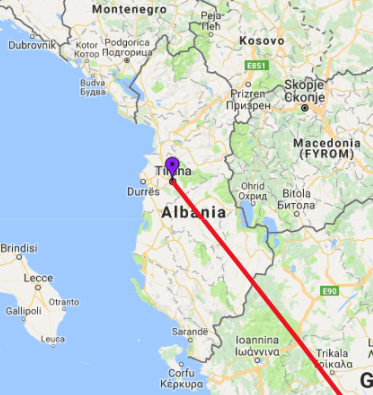
(From My Maps)

Representative quote: 

I have a whole army of dead men under my command now, he thought. Only instead of uniforms they are all wearing nylon bags. Blue bags with two white stripes and a black edging, made to order by the firm of "Olympia". And those bags will now be inserted into their coffins, tiny coffins of precisely determined dimensions, of a size stipulated in the contract signed with the local governments' association. At first there had been just a few sections of coffins, then, gradually, companies and battalions were formed, and now we are on our way to completing regiments and divisions. An entire army clothed in nylon.

"And what shall I do with it, my army?" he said between his teeth.

Next book: The Legend of Kalesh Andja, by Stale Popov, from Macedonia.

Thursday, May 18, 2017

Book 170, Bulgaria: "The Physics of Sorrow" by Georgi Gospodinov

I had a few options for Bulgaria: the 1981 Nobel Prize-winning Elias Canetti (who didn't write about Bulgaria much, as far as I could tell); or Ivan Vazov, whose 1888 novel Under the Yoke is considered the greatest classic of Bulgarian literature.

However, I ultimately decided on someone more current, who also happened to be stocked in the National Library of Singapore: the poet Georgi Gosponidov. Surely, I thought, reading a book of poetry could be speedily done, putting me back on track for my round-the-world trek.

Alas, the book the library had 283 pages. And it's experimental. Is it a novel or a memoir or both? I dunno.


What I do know is that it's good. Gospodinov looks back at his life—he was born in 1968, stayed in village basements as a child because his dad earned too little on his veterinarian's salary, and witnessed as a young man the fall of Communist Bulgaria and the birth of a new globalised, capitalist nation—and he tries to find in his biography, his father's biography, his grandfather's biography, a meaning for the loneliness and sorrow that have haunted him all his life.

And in that basement he finds the Minotaur. A myth of the Greeks—who are of course neighbours to the Bulgarians—and who was not just a monster but also an abandoned child, a freak left to wander through a darkened labyrinth. He latches on to his grandfather's memory of a funfair full of sideshows in 1925, including (fictionally?) a young, abused Minotaur; he sees innocence in that vegetarian head and his lustful mother Pasiphaë who forsook him and the pages of classical authors who never once gave him words or empathy.

(Empathy is key to all this: he claims that as a child he immediately would go into spells where he would empathise so much with characters in stories, with voices, with animals, that he would tunnel into their lives and it would always be a long time before he could find his way back to his own body. Catatonic. Stopped happening when he was a teenager, which he regrets: not growing up and healing, but growing old and losing a special gift, a faculty of the imagination.)

His life's related in a nonlinear fashion, shifting from his meeting with his grandfather's Hungarian lover from World War II to his memories of burying time capsules and playing cowboys and Indians in the 1980s with the neighbourhood kids (did you know the East Germans made Westerns, but always made out the Indians to be the good guys?) and how the nostalgia for that has faded today, and his own flight from Bulgaria in 1995 after his countrymen attacked him for writing an op-ed about them being, according to a survey, the saddest place in the world, and wandering through the obscure cities of Europe, writers' festival after festival, his daughter being born, and himself growing older and foreseeing his death through his father's death...

Life as a labyrinth. And himself either the Minotaur or Theseus, determined to slay the monster.

It's strange how a writer's story of success ends up being one of sorrow as well (true to the title he considers the physics of it all, the infinite possibilities of the universe, God as a boson or a neutrino). And we've seen this strange way what's externally a good life is summed up with regret in VS Naipaul's A House for Mr Biswas, but the strangeness of this all seems uniquely Eastern European, a thing of Kafka or Gogol or Herta Müller.

The Eastern Europeans really have had an inheritance of the bizarre. I wish to learn from them. But alas, this is the last book from the region we'll be doing.

On to Southern Europe next!


Representative quote: It hurts right here, something down on the left, maybe it's my appendix.
Stop with the self-diagnoses, if you please. The appendix is on the right. There's nothing that could be hurting there on the left.
What do you mean nothing?
Just that. There's nothing there.
Well, it's precisely that nothing that's hurting me.

Next book: Hesiod's Theogony and Works and Days, from Greece.

Thursday, April 13, 2017

Book 169, Romania: "The Land of Green Plums", by Herta Müller

I'm feeling a little bad for choosing this work. Yes, Herta Müller is a Nobel Prize winner who was born in Romania, and yes, The Land of Green Plums is set in that country, describing the experience of state surveillance and paranoia under the regime of the Communist dictator Nicolae Ceausescu.


However, the story doesn't represent the experiences of the average Romanian, but that of the Banat Swabians, i.e. the German minority. These guys were scapegoated in society, due to the role of Germany during World War Two—sometimes almost rightfully: the protagonist (and Müller herself!) had fathers who had loyally served in the SS.

And yet they were also privileged in a sense: Germany was an important political and cultural power, which they could (and did) escape to as refugees. Even ordinary Romanians wanted to learn German. So they had a double consciousness, rather like the Chinese or Jewish diaspora across the world.

The book itself is quite wonderful: it's a dreamlike, poetic vision of a nightmarish world, narrated from the viewpoint of Müller (it's partly autobiographical, and the protagonist is never named). She's a student in an academy where her wayward classmate Lola hangs herself—or is she murdered by the Secret Police? (That theme of suicide and/or political murder will return.)

She befriends three other boys, also Swabians: Edgar, Georg and Kurt, and they find themselves questioned and persecuted by the authorities, hiding their poems, writing letters in code to each other as they enter the working world, in factories and offices and schools across Romania. How they're losing their souls, losing their minds as they're questioned by the insidious Captain Pjele.

Their mothers write to them from their villages, where their bones are aching, chiding them for getting on the wrong side of the political system, reminding them of their suffering. Their other friends may or may not be informants or traitors. They find themselves fired, or so depressed they can't work, so they have to fake illnesses—not so difficult to do, since you can bribe doctors in the dysfunctional Communist economy.

It's a wrenching, Kafkaesque view of another world—and it's pretty damn strange to read, when under late capitalism, I have friends who are advocating a return to Communism as the ideology that will save us all. The Communist states of Eastern Europe and East Asia are bad examples, they say. A true Communist state has never existed yet, but that doesn't mean we shouldn't keep trying.

But then again, even today, in Singapore and Malaysia and Trump's USA, me and my friends rightfully fear persecution for our activism. I watched 1987: Untracing the Conspiracy recently, and afterwards I had to ask my boyfriend what should I do if the authorities took me in and cowed me with threats that they would harm him?

And how strange that Kafka was able to inspire an image of dystopia in Eastern Europe, even before the Communist revolutions took hold. Back when it was all a beautiful utopian dream that we thought might work.


Representative quote: 
As I wandered, I didn't only see the demented and their dried-up belongings. I also saw the guards walking up and down the streets. Young men with yellowish teeth standing guard at the entrances of big buildings, outside shops, on squares, at tramstops, in the scruffy park, in front of the dormitories, in bodegas, outside the station. Their suits fitted them badly; they were either too loose or too tight. They knew where the plum trees were in every precinct they policed. They even took roundabout routes to pass by the plum trees. The boughs drooped. The guards filled their pockets with green plums. They picked them fast, their pockets bulged. One picking was supposed to last them a long time. After they had filled their jacket pockets, they quickly left the trees behind. Plumsucker was a term of abuse. Upstarts, opportunists, sycophants and people who stepped over dead bodies were called that. The dictator was called a plumsucker too.

The young men walked up and down and reached their hands inside their jacket pockets. They took the plums out a fistful at a time, to attract attention less often. Only when their mouths were full could they close their fists. 

Because they always took so many plums at once, one or two always fell on the ground or rolled down their sleeves while they ate. The guards kicked the plums that fell on the ground into the grass, like little balls. They fished the other plums from the crooks of their elbows and stuffed them into their already bulging cheeks.

I saw the foam on their teeth and thought: You can't eat green plums, the pits are still soft, and you'll swallow your death.

Next book: The Physics of Sorrow, by Georgi Gospodinov, from Bulgaria.

Tuesday, February 28, 2017

Book 168, Transnistria: "Siberian Education" by Nicolai Lilin

Yup, we're doing another contested nation: Transnistria, aka the Pridnestrovian Moldavian Republic! The UN claims it's part of Moldova, and only three other contested states recognise it: Abkhazia, South Ossetia and Nagorno-Karabakh. (Lord knows if I'll be able to find literature from or about those nations.)

But you know what? I'm hella glad I tried to find an author from this country that doesn't even send delegates to Miss Universe, because Siberian Education is pretty damn amazing.


It's a memoir (with admitted creative licence) written by a young writer who grew up in the organised criminal society of Bender, descended from gangsters and other outcasts deported to Siberia during the Soviet Union. He describes its intricate culture, with all its codes of honour and formality about guns and crucifixes and taboos against speaking directly to cops and its own effing criminal language—a culture which makes rival gangs, such as the oft-maligned Black Seed, seem like barbarians in comparison.

There’s several chapters to this story, detailing the gifting of his ceremonial pike (switchblade) at the age of six, his harrowing journey into enemy territory on his thirteenth birthday, a stint in a filthy juvenile detention facility, a teenage mission into other neighbourhoods to destroy the perpetrators of the rape of a neurodivergent girl (he claims that his society always respected the crazy and disabled as God’s children)—and it’s not in strict chronological order because he keeps diverging into other memories and family legends and folktales before returning to the main thread, Arabian Nights style, so that the whole thing’s a series of nested matryoshka-style tales. It’s really incredibly well told.

…In fact, the whole thing may be a little too incredible, full stop. He does come across as a bit of an all-star Mary Sue, an excellent fighter with a natural brain for poetry and archaic religious Russian, not to mention his phenomenal skills as a tattoo artist (which are legit; Lilin runs a tattoo parlour IRL). And Donald Rayfield, a professor of Russian and Georgian, straight-up calls the whole thing "a fantasist's ravings". Huge factual holes are being found in Lilin's sequel to this book, Free Fall: A Sniper's Story, about his military service in Chechnya—and the odd thing is, Lilin replies to most of these objections with an admission that he made most of it up for literary effect.

So how much of the core of these tales is true? Maybe not much—he wrote these tales in Italy, in the Italian language, far from his hometown, and he says that the Moldovan invasion's destroyed the society he documented. So there aren't that many people around who can directly contradict him.

And told up—upon further Googling, I've discovered that the book was never translated into Russian (although it was into about 40 other languages) and has been dismissed by a Russian journalist as a hoax. And even after that hullabaloo,  a 2013 film was made. Now I'm starting to wonder if Lilin actually is Transnistrian.

Ah well, it's still a hell of a book. If nothing else, it's a tale of what happens on the fringes of Russian culture, making it clear that the former Soviet Union was never as united as it seemed, with huge rivalries between those from the western, Moscow and St Petersburg-dominated side and Georgians, Armenians, Ukrainians and—of course—the Siberians. Makes you wonder about that upcoming superhero movie, Guardians, with heroes from different former republics, including a bear-man from Siberia. Would they all really have been friends?


Representative quote: "And now tell me why we should trust those who have spent their whole lives killing our brothers, locking us up in prison, torturing us and treating us as if we didn't belong to the human race? How is it possible, tell me, to trust those who live thanks to our deaths? Cops are different from the rest of humanity, because they have an innate desire to serve, to have an employer. They don't understand anything about freedom, and they're scared of free men."

Next book: Herta Müller's The Land of Green Plums, from Romania.

Wednesday, January 11, 2017

Book 167, Moldova: "Bessarabian Nights" by Stella Brinzeanu

Happy New Year! And yes, I'm still chugging along slowly with my reading program. This one was tricky: there's not a lot of Moldovan literature translated into English. Most of what I found on offer at the library were books about the sex trafficking of Moldovans, which is of course an urgent issue to discuss but also seems kind of voyeuristic and creepy when explored from a foreigner's point of view...

Luckily, I managed to find a Kindle book about sex trafficking of Moldovans by an actual Moldovan...


And you know what? It's really not very well written. The English is hella awkward, and I don't know if there was even a proofreader involved. I'm kind of shocked to discover that the author describes herself as a writer, rather than just a well-meaning citizen who wanted to share the problems of her nation.

The flip side of the coin is that the book is a very compelling portrait of Moldova itself. It's got three young women as main characters: Doina, Larisa and the ill-fated Ksenia, who plans to be an artist but is trafficked abroad to Italy by her no-good-boyfriend Boris.

These girls are from country villages but educated enough to work in Western Europe, joining the huge migrant work force that emerged when Communism collapsed. And besides the horrors of sexual slavery, there's a detailed depiction of all that being Moldovan entails: growing up amidst rustic poverty, machismo and alcoholism, selling lice as folk medicine (inspired by Roma folk), a village witch who's really just a charlatan, the growing religious conservatism, a skilled diaspora reduced by their government's financial incompetence to manual labour in Italy and the UK...

Also the strange problems of identity—the main trio, like the population, are a mix of the different races that make up the nation, Roma and Romanian and Russian. The Moldovan national language is, in effect, Romanian, in spite of all their valiant desires to be known as a separate country.

And though these women are depicted as the talented tenth who can rise above the problems of their people, starting overseas companies and newsletters to unite the diaspora, the ending is hella depressing. Brinzeanu evidently doesn't feel it's honest—or in the character of a Moldovan—to project an optimistic future, where good triumphs over evil and maybe someone who's been rescued from sexual slavery can actually be a survivor.

I don't want to give away too many details, but suffice to say that there is actually a worthwhile story in these pages. This author just needs an editor and a few redrafts. As most of us do, you know.


Representative quote: "The tragedy is that we are a starved nation. We are starved for food and like you say, Ichim, we are starved for assets too, slaving away blindly without a vision whatsoever beyond the immediate betterment of our material situation."

"We work so hard and despite it all, we are still poor — the poorest people in Europe, according to some sources," the surgeon-labourer hastened to add.

Next book: Nicolai Lilin's Siberian Education, from Transnistria. (That's right, it's another unrecognised state!)

Saturday, June 18, 2016

Book 164, Russia: "War and Peace", by Leo Tolstoy

Guess what? I'm reviving my blog after a year and a half of inactivity! Because I've finally finished this bloody tome.


(I've decided on a new format for the pictures, btw—instead of just covers, I'm using the Instagram images I've posted at #yishreads. New year, new apps, y'know?)

Why did it take me so long to finish this? Hard to say. Part of it is that it moves really really slowly, so slowly that one forgets names and attributes and events.  It's hard to really feel like one's making progress, though the division into fifteen separate books and an epilogue helps—there's little dramas that begin and finish within an individual book.

There's no obvious main character either, which is why I suspect it would've been easier to get through Anna Karenina. The closest thing we've got is the innocent Pierre, who starts off as an impoverished illegitimate twenty-something.

Then he inherits money and a title, becomes a fat, cuckolded aristocrat who's scorned by all good society (and can't even exercise his well-intentioned reforms on his peasants without them suffering for it). And then the French invade, and he sees the city of Moscow collapse utterly, and he fails so utterly in his foolhardy attempt to assassinate Napoleon that the French see him as a loyal friend, but then he tries to save a girl from rape and gets captured as a prisoner-of-war and is marched through the steppes in deadly bitter frost before finally coming back into his title and comfort in the end, a better man for his suffering...

That's about the only plot I can hold onto. There's loads of other characters, but the only one I've got a strong impression of is Natasha, a foolish girl who plans to elope with a scoundrel but is saved when someone tells her he's already married. Pierre buys his silence. It sounds like a trivial little tale, but it's pretty vivid.

And you can tell from the contrast of these tales that this literally is a book about war and peace—it's got the horrors of a war diary (there are intense descriptions of the battlefield, limbs being torn off and everything), and the very next chapter may well be princesses in palaces worrying about gossip and respectability, and each is treated with equal importance. It's Pride and Prejudice meets Saving Private Ryan, I tell you.

We've seen some of this before in Walter Scott's Waverley, but that was a romance. This is a beast of a different nature—also a historical novel, but with a philosophy based on the randomness of history rather than some great narrative of the rise and fall of Scottish culture. Tolstoy has whole chapters of theory mixed in with the fiction, pointing out the folly of historians for telling the story of history as led by Great Men, or by the ideas of the intellectuals of the time, when really, in battles, everyone's just scrabbling around with no idea what they're doing, and every individual person's exercising his or her own will all the time.

He even punctures the popular myth of Muscovites burning their own city rather than letting the French have it by pointing out that any city with wooden houses, if left unattended in a battle, is going to be in danger of a mass conflagration. Not a romantic at all.

I think you can tell that I am fond of this book. It's nuts that it's so long and so disperse, but it does have great ideas and great moments embedded into it. Was it worth the time? I don't know. At least when I boasted about having finished this text, folks got that it was a big deal. More obscure texts just don't register.

Honestly, however, another reason this took a long time is because I borrowed the book from the library and kept having to return it, then switched over to the Kindle edition (which felt even more interminable, since you can't see the pages moving), only discovering a month or so ago that I actually had a copy on the shelves of my house....

And part of it was because once you stop trying to finish a book every week, you kind of enjoy being open to loads of other reading options, and going back to your original goal is kind of a chore. So I'm no longer going to force myself to read one book every week. I'll just update this site whenever I please.


Representative quote: "People speak of misfortune and suffering," remarked Pierre, "but if at this moment I were asked, 'Would you rather be what you were before you were taken prisoner, or go through all this again?' then for heaven's sake let me have captivity and horseflesh! We imagine that when we are thrown out of our usual ruts all is lost, but it is only then that what is new and good begins. There is much, much before us."

Next book: German Sadulaev's I Am a Chechen!, from Chechnya.

Wednesday, December 10, 2014

Book 163, Belarus: "King Stakh's Wild Hunt" by Uladizimir Karatkevich

Somehow the National Library never processed my request for Nancy Richler's Your Mouth Is Lovely, which left me stranded in terms of Belarusian lit. (Richler is Canadian, anyway, and the story might take place in Russian Siberia. :/)

My options included Nechama Tec's Defiance, a non-fiction work about a Jewish resistance army during World War Two (available in the library) and Vladimir Kozlov's Number Ten: A Novella In Translation (available for 99 cents on Kindle).

Luckily, I managed to Google up a free pdf of this:


And I'm glad I chose it. I knew from the description it was gonna be kinda up my alley: a bit of a fantasy thriller about a modern man facing down the phantom of a cursed king, riding for eternity. But in fact, the background's a little more complex than that.

This book was written only in 1964, but it's a Gothic novel - the events take place in the autumn of 1888, with the first-person protagonist Andrey Bełaretski recounting the events as a 96 year-old man. He's an ethnographer (which I hadn't really thought was much of a profession in Europe in the nineteenth century) and his mission is to venture into remote parts of Belarus and document the dying legends, folktales and epics of his people to publish back in Minsk.

So you see we've got a theme of identity formation going on: the rise of a nationalist bourgeois class who want to go back to their peasant roots to understand what their culture is. Unfortunately, that culture is kind of horrifying - we've got horribly impoverished gentry (descended from the Polish, it seems) starving in their broken-down castles and burning their antique furniture for warmth, and thousands of muzyk (that's the word they use for serfs) who're living on even less. 

Andrei's pretty gloomy about all this at the beginning of the book. Then he gets lost in an undisclosed area of his country during an expedition, almost dies from falling into a swamp (a quagmire, they call it), and seeks refuge in the rain in the castle of Marsh Firs, where he's greeted by the Countess - an ugly little 17 year-old thing named Nadzieja Janouskaja, who's plagued by the doom of her noble line, unfamiliar with concepts of sunshine and friendship, and convinced that she, as the twelfth and last of the Janouski dynasty, is fated to die from the curse of King Stakh, whom her ancestor betrayed in his uprising many generations ago.

And of course our modern, Minsk-educated ethnographer pooh-poohs it all, and is determined to discover a rational explanation for why he hears the invisible footsteps of the Blue Lady outside the corridor, not to mention the apparition of the Little Man, and all the other strange phenomena out of folklore that have come out of the mouths of goodwives to haunt him in real life.

As the tale unfolds, however, we realise this is more than a Dracula story, for the main players are actually the various impoverished nobles who are battling over the lands she stands to inherit - some good at heart, like young pure-minded suitor Sviecilovic; some evil, like the impetuous Varona, and some with plenty to hide, like Nadzieja's garrulous uncle, the huge, supremely jovial Rubatouk.

And [SPOILER ALERT!!!] we soon see that this is a book of the Soviet era indeed, because the phantoms are indeed revealed to be the work of jealous nobles, and our working-class descended hero is able to use his wits and strength to defeat them, with the aid of a peasant uprising, complete with pitchforks and a gruff hunter named Ryhol who's able to smack some sense into him every time he wants to take *pity* on one of these leeches of society. (It's kind of like a Scooby-Doo episode - the real monsters aren't the undead, but simple money-grabbing mortals, who'll cloak themselves in masks and darkness to fool the superstitious into believing they cannot be defeated.)

But there's a fairy-tale ending after all - Nadzieja grows in beauty and maturity throughout the story (though she's pretty passive even by the end), enough for Andrej to fall in love with her and marry her and live happily ever after, which frankly made me a little cross, because everything in the novel had been indicating that the story ended in tragedy. Did Karatkevich do this for the censors, the pleasure of his readers, or because his moral compass bade it so? I do not know. [SPOILERS END.]

If you wanna check out this book, it really is loads of fun - a bilingual PDF is for some reason available here, so you can check the English against the Belarusian (which I did not know was a language up till now).

Oh, and by the way, I can't figure out how to embed Google maps properly, so it's already zoomed in on the region I'm talking about. Any advice?


Representative quote: 
"Nothing," she answered dryly. "But it's too late. Everything comes too late in the world. You are too much alive. Go to your people, to those who are alive, who go hungry and can laugh. Go and conquer. And leave the graves to the dead."

"But aren't you my people?" I exploded. "And these people, frightened and hungry, aren't they my people? And Sviecilovic, whom I shall have to betray, isn't he of my people? And these god-forsaken swamps where abominable things occur, aren't these swamps my land? And the children crying at night, when they hear the hoofs of the Wild Hunt, trembling with fright all their lives, aren't they my brethren's children? How can you even dare suggest such a thing to me?"

Next book: Leo Tolstoy's War and Peace, from Russia.

Thursday, October 23, 2014

Book 160, Slovakia: "Rivers of Babylon" by Peter Pišt'anek

Boy oh boy. See, when I first started looking for books on Slovakia, I got referred to US author Michael Genelin’s detective novel Siren of the Waters, and the memoirs of Alexander Dubček (who is a Slovak politician, but who is known for having engineered the Prague Spring in the present-day Czech Republic, which was then of course part of Czechoslovakia).

But then I goofed around on Amazon and found this: 


(This is not the Amazon cover, mind you. It's from this site. But the Amazon cover is BORING, and I give myself a lot of leeway when I read from the Kindle.)

That guy on the cover is our protagonist, Rácz, who starts off as a penniless orphaned ex-soldier and farmer's son, who vows to leave the village and return as a rich man after seeking his fortune in Bratislava.

When he gets to Bratislava, he just so happens to encounter the stoker of a grand hotel - the Hotel Ambassador, a SIX-storey building (wow wow wow) who's about to retire after milking the corrupt Communist system of hiring more workers than necessary in the basement to supply the central heating. And so he takes over, learning how the century-old pipes work, shovelling coal and turning valves to keep the hotel warm.

But it's 1989, the time of the Velvet Revolution (which was what they called it in the Czech Republic - in Slovakia that called it the Gentle Revolution), and that means the whole Communist system of governance in coming apart. And that leaves room for the bad-asses to take power.

So when the hotel manager decides to punish Rácz for daring to enter the hotel by its front door in his dirty worker's overalls and boots - well, our scruffy underdog takes charge and starts turning off the heating in everyone's rooms. And this is Eastern Europe, with autumn settling into winter, so it HURTS.

Up to now, we've had something like a realist novel. But here, things take a slide into the magically real, because not only does Rácz manage to force everyone, from the cooks and the maids and the cabaret girls and the drivers and every single tourist and travelling businessman to bribe him into turning on their radiators, receiving gifts of soup and sex and Chivas Regal (which he pronounces as hee-vas ree-gal, of course) - but he actually starts climbing the social ladder, earning the respect and power through his ruthlessness that the manager never really had, and the poor old manager is reduced to starving and shivering frostbitten in his office - and yes, it gets weirder from there on.

This is a fun book. Thrilling. Socially insightful. It skips perspectives from character to character, so we get a pretty wide range of Slovakian society - there's Video Urban, the wannabe video artist-cum-currency exchanger-cum-taxi driver; Freddy Piggybank, the fat loser everyman parking lot attendant who goes spectacularly mad; Silvia, the wannabe ballet dancer-cum-cabaret girl-cum-kept woman who lives only for money; her girlfriend Edita (who's bisexual, and pretty hot for Silvia's undies, in fact); the Lawyer who tries to jockey Rácz for power; the former Secret Police Officers who're trying to stay relevant in this age of change through abusing their old warrants... And damn, crazy shit goes down.

All while you can pat yourself on the back for urbanely researching post-Communist Eastern Europe! Hurrah! (Shades of Alaa-Al-Aswany's The Yacoubian Building from Egypt, which I'd also recommend.)

What makes this all the more remarkable is that Pišt'anek's style was unprecedented in Slovakia - their literature previously made them out to be "a nation of wise bee-keepers and virtuous matriarchs", according to the preface. Damned if this isn't more fun to read. And there are sequels, too!

(Trigger warnings for anti-Gypsy racism and rape, though. Our underdog becomes more than an antihero; maybe something of a monster.)


View Around the World in 80 Books!!! in a larger map

Representative quote: Hurrenson found out about the existence of this nation only because of its ridiculously cheap prostitutes, willing to put up with anything that doesn't leave visible traces. Only then did he find out from the residents of this nation about the apparently famous artists, astronomers, and inventors whom he'd never heard of before. But so far Hurrenson has only been able to meet cheap whores, black market hustlers, arrogant waiters and taxi drivers, lazy room-maids and venal policeman. However, Hurrenson does not condemn anyone outright. He believes that the milieu in which he circulates as a bisexual tourist has shaped his opinion. He has no doubt that this nation is composed not merely of parasites and fools, but also of honest and educated working people. The point is that Hurrenson has never yet met such people, nor even found a trace of their existence.

Next book: Franz Kafka's The Castle, from the Czech Republic.

Wednesday, October 15, 2014

Book 159, Hungary: "Fatelessness" by Imre Kertész

So, while bumbling through the train systems of Spain and Portugal, I've been reading this:


It's a novel about the Jewish Holocaust. By an actual concentration camp survivor. Huge bummer. 

And yet and yet and yet... it is worth reading. Kertész is a Nobel Lit Prizewinner, after all (they sure do churn 'em out in central Europe), so this is a tale with a difference, not simply autobiographical and documentarian, but also a commentary on human existence - how we are all, in a way, stuck in concentration camps of our own. (Yes, I know that trivialises the experience of the holocaust. But he has the right to trivialise it if he wants to.)

It follows the experience of a 15 year-old, György Köves, who's living in the Budapest ghetto, viewing the events of his father's deportation to a "work camp", his own placement in a teen bricklaying brigade, and everyone's getting rounded up and placed on trains to Auschwitz, with such a dispassionate, slightly bewildered voice that it startles you - there's no Sturm und Drang at all, no panic, not even when describing the days inside the locked train carriage with nothing to drink and nowhere to piss or shit, the old and the sick dying at their feet, then the separation of healthy and unhealthy into gas chambers and genuine showers, and then the realisation of the survivors as to what had happened, how they had to their surprise been transformed into convicts, as if it were an absurd, laughable magic trick rather than a crime against humanity...

I've no idea how much of this really happened to Kertész (and does it matter?) but the tail end of it involves him genuinely being allowed to recuperate from an infected knee in a concentration camp in Zeitz, which surprised me - I didn't realise any Jews got real medical treatment then.

Also a surprise: how he shows the mingling and hierarchies between different concentration camp internees (Communists, gypsies, etc, who usually got to keep their hair and were a good deal more handsome and human-looking than the starved and shaven Jews) and the divisions between the Jews, who were from dozens of different countries (differentiated by the letters on their yellow triangles - U was for Hungary), and who couldn't even communicate with a common language, not Hebrew since that was a dead language for everyone concerned back then, and even some Yiddish-speaking bastards who refused to interact with other Jews in the camp, telling György, "If you don't speak Yiddish, you must be a Gentile," to which György replies, "Then why I am I here?"

And the horrible way his Hungarianness keeps intersecting with his Jewish identity - how Hungarians treated him with both honour and inhumanity, even trying to persuade those stuck in train carriages to give up their valuables, since, "After all, we're all Hungarians"; how one Polish ghetto kid in the hospital managed to speak to him in Hungarian with great unwillingness, because he didn't like Hungarians, and when György reflects, he realises, yeah, he doesn't have any reason to like Hungarians either.

So when he makes it back as a survivor, all he can feel is detachment, and, when questioned by a journalist, hatred. And yet he can't call what he experienced hell. All he did was survive, and even his Jewish family who didn't get deported can't understand him, can't abide him...

Yeah, it's a mess. But it's just the beginning. Together with Fiasco and Kaddish for an Unborn Child, this forms a trilogy. Do I have the spirit to read them all? Not likely. But I'm glad I read this one.

I mean, I've read and watched lots of holocaust accounts - The Diary of Anne Frank, Schindler's List, Friedrich, even the clownish Life Is Beautiful... I've been to Yad Vashem, too.

But this is a new way to tell the human tragedy, by downplaying it, by making it universal, inescapable, complex.

Yes. Every horror is different. Yes. The complications must be told. 


View Around the World in 80 Books!!! in a larger map

Representative quote: "Before all else, he declared, "you must put the horrors behind you." Increasingly amazed, I asked, "Why should I?" "In order," he replied, "to be able t live," at which Uncle Fleischmann nodded and added, "Live freely," at which the other old boy nodded and added, "One cannot start a new life under such a burden," and I had t admit he did have a point. Except I didn't quite understand how they could wish for something that was impossible, and indeed I made the comment that what had happened had happened, and anyway, when it came down to it, I could not give orders to my memory. I would only be able to start a new life, I ventured, if I were to be reborn or if some affliction, disease, or something of the sort were to affect my mind, which they surely didn't wish upon me, I hoped.

Next book: Peter Pišťanek's Rivers of Babylon, from Slovakia.

Monday, September 29, 2014

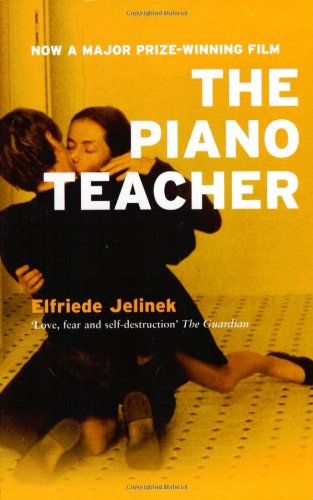
Book 158, Austria: Elfriede Jelinek’s "The Piano Teacher"

Kind of tricky to track down this book – the National Library had only one English-language copy in stock, and it was checked out. (Oddly enough, the Mandarin and Malay translations were still available.)

Had to go down to my old stomping grounds of NTU to check out the copies they had on reserve there as compulsory syllabus readings, in between Thomas Mann’s Death In Venice and WG Sebald’s... something or other.


And damn. Now I know why the censor-happy National Library won’t keep multiple copies in stock. Never mind that this is a work by a Nobel Prize Laureate, the greatest Austrian writer of her generation; a work made into a landmark critically acclaimed work of Franco-Austrian cinema.

The truth is, this book is sick, in the best way possible. Oh, the perspective’s technically third person, but it goes under your skin… It begins with a portrait of the twisted relationship between the 36-ish-year-old piano teacher Erika Kohut and her Mother; they live together in a tiny flat and the Mother refuses Erika any luxuries whatsoever, flying into a rage when she spends money on a dress to make herself look pretty, pretty girls are sluts, etc., all she wants to do is keep Erika as her tool to earn enough money for her old age so they can live together in a bigger condo, and all this good-for-nothing daughter does is waste her pay on frivolities…

So we hate the mother, and we’re rooting for Erika, and even more so when we learn that Erika was groomed to be a great concert pianist from her girlhood, her mother and her grandmother consumed by dreams of fame and success that brought them to Vienna, the city of music. But somehow Erika screwed up a critical recital and has had to live her life as an angry repressed spinster piano teacher at the Vienna Conservatory…

…and it turns out she’s kind of an awful person as well, deliberately kicking or pinching people in crowded trolleybuses, stalking through the Turkish district to look at girlie peepshows or Prater fairgrounds to catch couples doing it in the grass (there’s some horrible things said about Turks and Yugoslavs in the process; hope that’s the character speaking and not the author)…

… and there’s a young, blond, athlete of a piano student named Walter Klemmer, and he’s hot for her, and she’s hot for him, but he’s asserting his god-given male entitlement and worship of his own 7-inch cock on the world, flirting with every young girl, and she won’t do with that, and so she hurts other people, she hurts herself especially, she hurts her mother too, and she hurts Klemmer, in a series of psycho nonconsensual BDSM sequences in the conservatory toilets, broom closets and her mother’s sacred bedroom…

In a way, it’s a feminist’s nightmare: a woman writing about women who are hysterical, steely in public but desiring domination and punishment in private, women who are wildly weak. Women like the heroines of Greek tragedies. Xiao bitches, as Singaporeans would say.

And it is written so damn well. Aiyah, I’ll just leave it at that. Wonder how on earth I can learn from this prose style. (Rather pleased that NTU students are reading it… how does it change their lives?)


View Around the World in 80 Books!!! in a larger map

Representative quote: Erika holds Walter Klemmer at arm's length. She pulls out his dick, which he has already slated for deployment. It only needs the finishing touch, for it is already prepared. Relieved that Erika has taken over this difficult task, Klemmer tries to push his tach down all the way. Now Erika has to resist him with her entire weight so she can remain upright. She holds Klemmer's genital at arm's length while he fumbles about randomly in her vagina. She lets him know that is he doens't stop, she'll leave. She softly repeats her threat several times, because her suddenly superior will has a hard time getting through to him and his rutting fury. His mind seems fogbound with angry intentions. He hesitates. Wondering whether he's misunderstood something. Neither in the history of music nor anywhere else is the suitor simply barred from events. This woman has not a spark of submission. Erika starts kneading the red root between her fingers. She demands a privilege, but refuses to grant it to the man. He must go no further with her.

Next book: Imre Kertész's Fateless, from Hungary.

Friday, September 5, 2014

Book 156, Switzerland: "Heidi" by Johanna Spyri

I've spent a month in Switzerland before, so I've read some of its literature - Friedrich Durenmatt's The Visit and The Physicists and Max Frisch's Homo Faber, for instance. Yet I hadn't, until now, read the most clichéd work of Swiss literature in existence:


Ah, Heidi. I got an illustrated Kindle version off Project Gutenberg. No idea if it was the best translation, but a lot of modern translations seem to be adaptations for younger readers.

And honestly, I can see why they'd target younger readers. The tale is soppy as all hell - Heidi is just five when she enters the scene, and she's all sweetness and light and innocent virtue, never once selfish or rebellious the way actual children are.

She's an orphan: her dad died in a logging accident and her mum died of grief as a result, and her cousin Deta is dumping her on their cranky old grandfather 'cos she's got herself a decent-paying job as a maid in Frankfurt. Never mind that her grandfather, the Alm-Uncle, is famously cranky and solitary and lives all alone in the cold mountains with only his two goats, and everyone in the village thinks she's committing reckless child neglect by placing her in his hands.

But ah, little Heidi is a miracle-worker! She charms the Alm-Uncle into loving her, and is utterly content with only having goat milk and cheese and bread for food and sleeping on a bale of hay, and spends all her days hanging out with Peter, the 11 year-old goatherd, playing with the goats and marvelling at the beauty of the sunrise and sunset and the flowers and the grass and the pines and the everything that you'd think a little Swiss village girl would just see as part of the landscape.

But then we've got the big conflict: Deta returns and asks her to come to Frankfurt to become a friend to Clara, an 8 year-old invalid daughter of the rich Mr Sesseman. The story thus turns into a narrative contrasting the oppressiveness of the German cityscape with the glory of the Swiss countryside.

You see, Heidi creates a huge ruckus in the household with her innocent country ways - she offers to take in an entire litter of kittens from a guy who guards a clock tower, at one point, and freaks out her governess with the surfeit of meowing kittens overflowing from her pockets. But she wins over Clara and Sebastian the butler and rich Mr Sesseman, because she's so pure of heart.

But Frankfurt's all wrong for her, and she gets skinny and sickly and starts sleepwalking, so Mr Sesseman sends her back to the Alps, and eventually sends Clara as well for a holiday. And Clara's so invigorated by the fresh mountain air and the goats' milk and the flowers that she actually starts walking again. Seriously, now.

So yes, it's a sappy story. But it was a pleasure to read - even knowing the ending, I was amused at the exact manner in which the miracle was executed, and how gradually, and how almost believably it came about. And it's fun to enjoy things ironically. Nonetheless, I've a few questions that bug me:

1) Isn't this all a little exploitative? I mean, we're romanticising the lives of the poor here. And their relationship with the rich is one of utter harmony - the Sessemans fall over their feet in their eagerness to bestow gifts unto Heidi's community, and are thanked for it. It's not a problem that some of our characters go barefoot and some ride around on silk cushions, apparently...

2) The levels of Christianity are too damn high. The only good things Heidi gets out of her stay in Frankfurt are the ability to read, and a new understanding of prayer and the ways of God, with which she's able to convince her bitter old grandfather to start going to church again. Really, the preaching is laid on pretty damn thick - not sure how much they preserve this in today's versions.

3) Is Peter an asshole? I wanted to declare him one as I read the story and watched him get rabidly jealous of anyone who became friends with Heidi, because he wanted to be her bestest and only friend aside from the goats - he has a habit of shaking his little fists at the sky, and even pushes Clara's wheelchair down the mountain at the end (without her in it, mind). So he is an incredible brat compared to our heroine. But then he's human - he's the one who actually acts the way a poor kid should act in the presence of the 19th century über-rich, which is to get mad and get smashing.

And a couple of factoids. First, the sequels to this book - Heidi Grows Up and Heidi's Children - weren't written by Johanna Spyri but by her translator. And second, Heidi isn't even her real name. It's Adelheid, which is an actual Christian name, whereof Heidi is a corruption, confusing the proper folks in Frankfurt no end.


View Around the World in 80 Books!!! in a larger map


Representative quote: 
"Grandmama told me that God would make everything much better than I could ever dream. I shall always pray from now on, the way grandmama taught me. When God does not give me something I pray for, I shall always remember how everything worked out for the best this time. W'll pray every day, grandfather, won't we, for otherwise God might forget us."

"And if somebody should forget to do it?" murmured the old man.

"Oh, he'll get on badly, for God will forget him , too. If he is unhappy and wretched, people don't pity him, for they will say: 'he went away from God, and now the Lord, who alone can help him, has no pity on him.'"

Next book: Johann Kraftner's Princely treasures from the House of Liechtenstein, from Liechtenstein.

Thursday, August 28, 2014

Book 155, Monaco: "Loser Takes All" by Graham Greene

Guess what? I decided that I *would not* let a second month go by wherein I'd only read one book for this blog. So I hitched a ride with my dad over to Jurong East Regional Library, and lo and behold, procured this:


It's a novella about Bertram, a 40 year-old London assistant manager of accounting and a bit of a loser - except that he's about to marry a sweet 20 year-old girl named Cary at a quiet church ceremony. Then, through the off-handed magnanimity of the major shareholder in his company, he ends up having the ceremony in Monte Carlo, Monaco - but when they're stranded at the hotel without the cash to pay their way any further, what can they do? Gamble their way into millions, that's what! And encounter all the ups and downs of riches while that takes place.

Now, I've only read one other Graham Greene novel, The Quiet American, which happens to have been published in 1955, the very same year this came out. And I can't help but be struck by the similarities between the two. Both feature:

1. A middle-aged, unremarkable first-person protagonist who is British and male,

2. and who also happens to be with an innocent 20 year-old (in The Quiet American, her name's Phuong) who appears bubble-headed and flighty but is in reality utterly devoted and surprisingly canny about the ways of life,

3. although there's an awful middle-aged woman involved - in The Quiet American it's Fowler's existing wife who won't grant him a divorce so he can remarry; in Loser Takes All it's Bertram's cheating sexpot of a deceased wife, plus a lady he picks up in the casino just to make Cary feel jealous.

4. Oh yes, and there's a handsome young man around who makes the protagonist jealous (the eponymous quiet American in The Quiet American; a young gambler named Philippe in Loser Takes All), but who does not deserve the girl, dammit.

5. And there's also machinations of power in the background - it's the Vietnam War in The Quiet American; it's the battles for money and power amongst the shareholders in Loser Takes All.

6. Plus, they both take place in exotic locations most Brit readers could only dream of visiting - Monaco! Vietnam! Not so much unlike an Ian Fleming novel after all. (Although it is remarkable that Loser Takes All was published a year before Grace Kelly's wedding to Prince Rainier - hence, it's set in the dowdy days of Monaco, before its great glamorisation.)

Of course, the two books are different, in substantial ways. First off, this one's just a novella, 110 pages long in fairly large print. And second, while The Quiet American is about the corruption of war and imperialism and all, Loser Takes All is about the corruption of wealth and greed - the money spoils everything, and Cary's the only one who can see that clearly.

And yes, this was a hell of a fun read. Probably useful for my writing, too. Although I do still feel bad about losing my copy of The Ruling House of Monaco. Will have to cough up some cash for that.


View Around the World in 80 Books!!! in a larger map


Representative quote: There are so many faces in streets and bars and buses and stores that remind one of Original Sin, so few that carry permanently the sign of Original Innocence. Cary's face was like that - she would always until old age look at the world with the eyes of a child. She was never bored: every day was a new day: every grief was eternal and every joy would last for ever. 'Terrible' was her favourite adjective - it wasn't in her mouth a cliché - there was terror in her pleasures, her fears, her anxieties, her laughter - the terror of surprise, of seeing something for the first time. 

Next book: Johanna Spyri's Heidi, from Switzerland.

Saturday, August 9, 2014

Book 154, France: "In Search of Lost Time, Vol I: Swann's Way" by Marcel Proust

Boy oh boy. I still can't figure out if I made a mistake with this one. I mean, I could've read an action-packed classic novel for this segment - Victor Hugo's The Hunchback of Notre Dame, Alexandre Dumas's The Three Musketeers, Gaston Leroux's The Phantom of the Opera - and no-one would've thought less of me for it.

But instead, I decided I had to go with the major work of world literature I was least likely to get around to reading otherwise. But the one I chose was only one volume of the seven-volume In Search of Lost Time, and not even the most acclaimed volume, either (which I believe is In the Shadow of Young Girls in Flower). 

Still, it is the one with the famous madeleine scene in it!


TBH, the book's not bad, if you know you're diving in for some experimental writing - you can put up with the long sentences and the endless introspection and the utter lack of plot, and enjoy the sketches of the ridiculous grandmothers and maidservants and aunts, not to mention the absurdly lovestruck M. Swann and his coquettish peacock of a lover/wife Odette, who may or may not be cheating on him, we have no idea. The most beautiful prose pops up in the section Names of Places, when he's reflecting on the many towns and landscapes he might have chosen to visit as a child had his health been better:

"...between Bayeux, so lofty in its noble coronet of rusty lace,w hose highest point caught the light of the old gold of is second syllable; Vitré, whose acute accent barred its ancient glass with wooden lozenges; gentle Lamballe, whose whiteness ranged from egg-shell yellow to a pearly grey; Voutances, a Norman Cathedral, which its final consonants, rich and yellowing, crowned with a tower of butter; Lannion with the rumble and buzz, in the silence of its village street, of the fly on the wheel of the coach; Questambert, Portorson, ridiculously silly and simple, white feathers and yellow beaks strewn along the road to those well-watered and poetic spots; Benodet, a name scarcely moored that seemed to be striving to draw the river down into the tangle of its seaweeds; Pont-Aven, the snowy, rosy flight of the wing of a lightly poised coif, tremulously reflected in the greenish waters of a canal; Quimperlé, more firmly attached, this, and since he Middle Ages, among the rivulets with which it babbled, threading their pearls upon a grey background, like the pattern made, through the cobwebs upon a window, by rays of sunlight changed into blunt points of tarnished silver?"

But I'm also rather lucky that I was concurrently reading David M. Halperin's incredibly insightful book How To Be Gay, that examines how there is a gay culture of irony and beauty-worship despite activist claims that this is mere stereotype. Halperin points towards Proust's work as an exemplar of his ideas - how, even in the early reaches of the 20th century, even in a work that does not explicitly declare its author's sexuality, we still have this tale of a terrible longing to be loved by one's mother (Proust's mum believed that over-excessive displays of love were unhealthy, and tried to restrict her warmth, clumsily) and the sheer camp surrounding the depictions of the absurd men and (especially) women of upper middle-class French society. Hell, even his childhood crush on a girl called Gilberte doesn't redeem him orientation-wise.

Nonetheless, I do think reading Hugo or Dumas would have been better for my writing. Another day!


View Around the World in 80 Books!!! in a larger map


Representative quote: The reality that I had known no longer existed. It sufficed that Mme Swann did not appear, in the same attire and at the same moment, for the whole avenue to be altered. The places that we have known belong now only to the little world of space on which we map them for our own convenience. None of them was ever more than a thin slice, held between the contiguous impressions that composed our life at that time; remembrance of a particular form is but regret for a particular moment; and houses, roads, avenues are as fugitive, alas, as the years.

Next book: John Glatt's The Ruling House of Monaco : the Story of a Tragic Dynasty, from Monaco.

Monday, June 30, 2014

Book 152, Belgium: Hygiene and the Assassin by Amélie Nothomb

Belgium’s famous for its comic writers – Peyou of the Smurfs and Hergé of Tintin, for instance. It’s got a whole museum devoted to the graphic novel form. 

But I’m still on the road, and so I’ve to make do with Kindle books instead. I realise now I should’ve downloaded a free copy of Nobel Prize-winning playwright Maurice Maeterlinck’s The Blue Bird, an allegedly insipid little drama about children and innocence.

Instead, I bought the first novel of Francophonie superstar Amélie Nothomb, whose novella Sulphuric Acid is so amazing that I’ve regularly lent it out to my students as an exemplary creative writing text. And surprisingly, Hygiene and the Assassin (originally Hygiene del’Assassin) is also about children and innocence and a Nobel Prize-winning author… 


But I’m getting ahead of myself. The tale’s set in 1991, when the First Gulf War is breaking out. A horrifically ugly and obese 83 year-old shut-in of a novelist named Prétextat Tach has learned he has succumbed to incurable cartilage cancer, and has finally agreed to grant interviews to curious journalists about his life and work.

Tach uses the interviews as opportunities to demonstrate his power over the journalists, insulting and mentally torturing them. (One guy is reduced to retching just through a description of Tach’s daily diet, which mostly consists of fatty by-products.)

Then one day, a 30 year-old female journalist turns up – her name is Nina, by the way – and she will not take his nonsense. She’s the only one of the lot who’s read all his books, who actually claims to enjoy them despite his insistence that they’re written to the detriment of the human race with all their graphically debauched depictions of human depravation, and who rightly determines which one of them is actually autobiographical.

I won’t spoil this one for you guys – it’s that good. And one of the coolest things about it is that it’s written mostly in dialogue format – in duologue format, in fact, since it’s almost entirely made up of scenes of Prétextat and his interviewer alone in a darkened room. And god, the power play with Nina is awesome. Wasn’t surprised to discover that the story’s already been adapted into a play in Paris.

Which brings me to a point of uncertainty for this blog: does Hygiene and the Assassin actually take place in Belgium? I really can’t tell – there’s a mention of francs, but those were used in both France and Belgium before the introduction of the euro. And there are mentions of Sartre, but of Maeterlinck also. And we discover that Tach grew up on a château at Saint-Sulpice – and while there's places called Saint-Sulpice in France, none of them is a volcanic plateau as far as I know.

I’ve decided, however, to believe that this interview takes place in the French half of the city of Brussels/Bruxelles, where Nothomb lives when she’s not in Paris. If enough people protest, maybe I’ll read Henri Michaux’s Darkness Moves instead.


View Around the World in 80 Books!!! in a larger map

Representative quote: 

“Let’s not play with words, all right?”

“You are saying this to a writer?”

“I’m not talking to the writer, I’m talking to the assassin.”

“One and the same.”

“Are you sure of that?”

“Writer, assassin: two aspects of a same profession, two conjugations of the same verb.”

“Which verb is that?”

“The rarest and most difficult of verbs: the verb ‘to love.’ Isn’t it funny how school grammar books sometimes use it as an example, when it’s the verb with the most incomprehensible meaning?”

Next book: Anise Koltz’s At the Edge of Night, from Luxembourg.


Sunday, June 22, 2014

Book 151, Netherlands: "The Discovery of Heaven" by Harry Mulisch

I'm in Greece! Physically, not reading-wise. On a little jaunt to see as much of Europe as I can before my lease runs out.

Reading-wise, I'm finally done with my Netherlands book, and what a joy it was. I'd had a tough time deciding on what to pick - I'd read the most famous book in Dutch, Anne Frank's Diary of a Young Girl, and the next most classic works - the 17th century playwright Joost van den Vondel's Lucifer and the 19th century novelist Multatuli's Max Havelaar, weren't actually set in the Netherlands.

Fortunately,a simple Google search with the terms "greatest Dutch novel" threw up the results of an official 2007 survey of what the people of the Netherlands regard as their greatest work in the form -and then all I had to do was apply for an Interlibrary Loan for this volume, and ta-da!


It's 730 pages long, but guess what? It's worth it. Especially if you're one of those semi-cynic, semi-mystic folks like me, who indulge in the guilty pleasures of reading Dan Brown's The Da Vinci Code because it does after all spin a thriller out of Templar secrets, and who similarly enjoyed Umberto Eco's Foucault's Pendulum because of the way it draws on the Gnostic past for mystery, while at the same time acknowledging that all our efforts to build conspiracy theories of divinity are absurd...

The Discovery of Heaven is like that, only more epic, because it takes place over several generations - oh, and did I mention it's narrated by angels? Its prologue and intermezzos are made up of a dialogue between two ruthless angels trying to chart Humankind's course for the sake of the Chief (i.e. God), which is why they direct the strange coincidences of the tale.

What actually happens in the story is that Max, an astrophysicist, meets Onno, an amateur cryptographer. They discover they were conceived at the same time and become BFFs - companions in mind because of their commonly esoteric intellectualisms (there's loads of factoid-laden digressions here, with snippets of Latin and German thrown in, because Onno just happens to speak like, every language). But the angels' plan is to have them both - in a way - to be fathers of a new sort-of-Messiah...

And on the way there are lovers (female) of different ages, a journey to 1960s Cuba and to 1980s Israel, and loads of angst about the Netherlands' complicity in the Jewish Holocaust of the 1940s - hell, Max's observatory is built at Westerbork, one of the transit camps for the Jews on their way to extermination. Oh yes, and a Messiah named Quinten, with sapphire eyes and a weirdly innocent intelligence that can be a little annoying (it's clearly put in place so that other characters can explain the minutiae of the Bible and lock-picking and classical architecture for the readers, but I do think that given his genius lineage, he would've figured it out for himself).

You can see I'm trying not to give away too many spoilers, because I do think this is a book worth picking up for yourselves. Basically, I'm glad I've had this opportunity on my round-the-world trip to sample one of those high literary works that's also a pacy crowd-pleaser - the Holy Grail for literary agents, so I'm told. Gotta learn how to write that stuff myself.

One last thing of note: there's quite a few mentions of the Netherlands' Indonesian population, especially of the Moluccans. Turns out many of the Moluccans fought for the Dutch against the Indonesians during the War for Independence - so they had to seek refuge in the Netherlands afterwards. They were actually housed in Westerbork, despite the spot's genocidal legacy - and were forced out of their huts to assimilate in none too ceremonious a fashion.

And another thing - Vondel and Multaluti both get a mention in the book. Yessir, this volume is all-encompassing. That's what you can do with 730 pages.  And if you're too impatient for that, catch the 2001 film, starring Stephen Fry. Or at least the Brows Held High review thereof.


View Around the World in 80 Books!!! in a larger map

Representative quote: Once he stood motionless on the balcony looking at the balustrade, at the gray stone banister on the wooden amphora-shaped pillars. Max squatted down beside him to see if there was perhaps an insect walking among them; but only when Quinten carefully put his forefinger on a certain spot did he see that there was a tiny, fossilized trilobite, from the Paleozoic period, about 300 million years old. At the same moment he realized that the creature that Quinten had discovered had lived at about the moment that the extragalactic cluster in constellation of Coma Berenices - "Berneice's Hair" - had emitted the light that was now reaching earth.

Quinten looked at him.

"That's a trilobite," said Max, "a kind of silver fish. What would you like? Shall we free it?"

Next book: Henri Michaux's Darkness Moves, from Belgium.