Showing posts with label 1900s. Show all posts

Friday, February 28, 2014

Book 144, Sweden: "Miss Julie and Other Plays" by August Strindberg

Ah Sweden. Home of the Nobel Prize for Literature, and eight laureates thereof (they do have home advantage, after all). Also birthplace of Stieg Larsson's The Girl With the Dragon Tattoo, Maj Sjöwall and Per Wahlöö's Martin Beck detective series, John Ajvide Lindqvist's Let the Right One In and Astrid Lindgren's Pippi Longstocking.

And who do I choose for this blog? A psychotic misogynistic 19th century playwright whose stuff is mostly unstageable. Ladies, I give you: August Strindberg!


Ooh, but isn't that a pretty cover?

There's five plays in here, performed between 1887 and 1907. They're The Father, Miss Julie, The Dance of Death I, A Dream Play and The Ghost Sonata. They're supposed to represent his progression from naturalism - i.e. a social realism that hinges on biological premises of naturally inherited traits of femininity, psychosis, etc - to radical experimentalism.

But the truth is, even in his earlier works, I have no idea what's going on. Is the Captain really nuts in The Father, or is his wife Laura just goading him on, and does that mean that he was going crazy to begin with anyway so she had every right to send him to the loony bin? Seriously, it's quite possible to read the women he wants you to hate as strong but broken women.

This is probably why Miss Julie still gets so much play. It's a two-act piece, a three-hander, between the noblewoman Miss Julie, her manservant and lover Jean, and the servant-girl Kristin, and the big dynamic is about the dominance of Jean over Julie - and yet Kristin's level-headed sense seems to make her the ultimate moral compass of the piece, never mind that Strindberg dismisses her in his infamous preface as a "female slave", the lowest of them all. (This is seriously the only play of his in which I could be pretty sure I knew what was happening.)

It's my second time reading A Dream Play and The Ghost Sonata - and I guess they are worth a reread. While there is very little linearity in these tales, there are such striking images that one wonders if Strindberg was visited by a time-travelling surrealist - the daughter of a god freeing a man imprisoned in a castle, the lovers doomed to fall out of bliss by the paralysis of a quarantine, a Sunday child student who can see ghostly milkmaids, a vampirical servant woman, a living mummy, phantasmagorical hyacinths... and no clear endings, because it was the twentieth century now, and structure be damned.

A Dance of Death I is somewhere in between. I think I know what's going on (but did the Captain's wife and Kurt actually sleep together or what?), yet that's not the point - the entire point is the mood of foreboding that casts its pall over everything...

I suppose my main worry after reading all this is whether I've made the best use of my eyeball-time. I should be reading works that'll improve my writing - what can I learn from these strangenesses?


View Around the World in 80 Books!!! in a larger map


Representative quote: from Miss Julie:

JEAN Don't think, don't think! You're taking all my strength away too, and making me a coward- What's that? I thought the bell moved!- No! Shall we stop it with paper? - - To be so afraid of a bell! - Yes, but it's not just a bell - there's somebody behind it - a hand sets it in motion - and something else sets that hand in motion - but if you stop your ears - just stop your ears! Yes, but then he'll go on ringing even louder - and keep on ringing until someone answers - and then it's too late! Then the police will come - and then...

Two loud rings on the bell.

JEAN: [cringes, then straightens himself up]. It's horrible! But there is no other way!-Go!

Next book: Sally Salminen's Katrina, from the Åland Islands.

Friday, April 26, 2013

Book 122, Niue: "Savage Island" by Basil Thomson

Every now and then, I'm intensely grateful for good writing. It doesn't need to be transcendent: something engaging in some way, something fun, is quite sufficient.

This week, I'd thought I was plum out of luck as I was flipping through an epub version of W.G. Lawes of Savage Island and New Guinea, a miserable hagiography of an early missionary in the Pacific, published in 1909 by the Reverend Joseph King. The title had sounded like a swashbuckler's story - how was I to know it'd be so long and dull? 

I was halfway through when I decided to ditch the bugger and turn over to this other virtual archived text, dating even earlier, to the year 1902:


And boy oh boy, I'm glad I did. Basil Thomson was a civil servant with the Colonial Office - in fact, this book describes an official visit to Niue to arrange for its formal annexation as part of the British Empire, as well as a stop at Tonga to formalise its status as a British Protectorate. But he was also a professional writer, and consequently he knew how to render his descriptions of exotic realms so amusing that even an ardent postcolonialist like myself is delighted at his words.

You see, unlike Rev. Joseph King, Thomson actually accords individual personalities to the people of the Pacific. Of course, he's laughing when he describes the fashion for fatness among the women, and King Tongia's pompous folly in dressing himself in hoop skirts and military hats - a flavour of that half devil and half child colonial mindset of the time. Yet he also acknowledges that these guys have a culture, and real motivations for what they do - e.g. the king had no small talent for being able to convince the elders that they needed a king at all after no-one had occupied the role for 80 years...

Of course, one of the reasons Thomson can afford to make light of the situation is that everything's peaceful. I hadn't known much about this side of colonial history: how some countries would, of their own accord, join the British Empire for the sake of protection, to avoid more destructive invasion and exploitation by the Germans or the French. This is why Tonga, for instance, has been able to hold on to its royal family, one of the few surviving systems of monarchy in the realm.

And then the whole matter of being modern - how these Pacific people, who had been part of a freaking Stone Age civilisation just a couple of generations ago, were now aware of the greater world around them, were consuming its cultural artefacts (Christianity, icons of Queen Victoria, whom they called Vika) and even building themselves Western-style houses. And then their participation in world trade - the Niueans are characterised as the most hardworking of Polynesian races, being actually eager to work overseas, to the detriment of their local industries of growing coconuts and weaving hats out of pandanus leaves. (Seems they've done pretty well for themselves since then - ten years ago, they became the world's first nation to be completely covered by free Internet wifi.)

Add to this the usual staples of colonial travel memoirs: documentation of the flora and fauna (they had crazy plagues of flies and hornets), some notes on national custom and myth (oral history for Niue only goes back 500 years, suggesting that they split off from some other island civilisation before then). Some notation of the music and dance of the islands, too, before a rather abrupt ending.

But once again, I'm bloody glad that this peripatetic journey is bringing me to books that are actually worth digging up and reading. It's not just about going around the world: it's about not having a miserable time doing it.


View Around the World in 80 Books!!! in a larger map

P.S. Why "Savage Island", you ask? Seems that when Captain Cook visited in 1774, the Niueans were one of the few Pacific peoples to refuse to engage in dialogue with him, answering him instead with spears and darts. Smart folks!

Representative quote: "The procession was headed by a dozen men in slop clothes and villainous, billycock hats set at a rakish angle. They all carried spears and paddle-shaped clubs in either hand, and a similar rabble brought up the rear. In the middle of this grotesque bodyguard walked the king and queen, both in petticoats, as befits the sex to which they belonged, for if the queen was a young woman, the king was assuredly an old one. To their united ages of ninety-four His Majesty contributed seventy-six, but what he lacked in youthful elasticity he made up in con- descension, for she had been but a beggar-maid or what corresponds therewith in Niue, where beggary is unknown when he had played Cophetua to her a few months before our visit. She wore a wreath of roses, he the soldier's helmet with the cock's plume, which was all that the officious Samoan teacher would leave him of his military uniform, and from which he refused to be divided, although it assorted ill with his petticoat. To tell the brutal truth, His Majesty was unsexed by the garments that had been chosen for him, and his appearance justified the remark of a friend who, holding the photo- graphs of Their Majesties in his hand and con- fusing them, exclaimed, "Why, the queen's got a beard!"

Next book: Arthur Grimble's A Pattern of Islands, from Kiribati.

Sunday, May 15, 2011

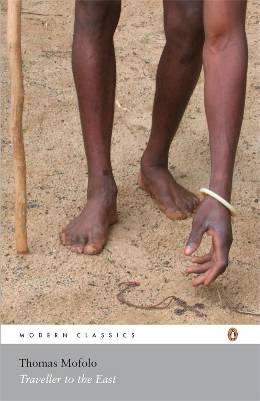
Book 61, Lesotho: "Traveller to the East" by Thomas Mofolo

I'm still in the middle of reading Mpho 'M'atsepo Nthunya's Singing Away the Hunger, and a thoroughly good book it is, too - one of those orature-based subaltern women's narratives with unexpected revelations: amidst the oppression, the casual joy of open marriages where she and her husband are free to "share the blanket" with other men and women (yes, other women: she does have a girlfriend at one point, and her husband and that woman's husband also become good friends). Also the snow in the mountains of Maluti: so cold it is blue, so cold that it robs her husband of his ability to walk, then his life.

But of course, I've been fickle Frannie again and chosen to blog about an entirely different book! Behold: Traveller to the East, or Moeti oa Bochabela, in the original Sesotho.


It's a short novel, just 88 pages long in a biggish font, serialised in a fortnightly newspaper to commemorate the 75th anniversary of the Paris Evangelical Missionary in Morija, Maseru. As you might have guessed from its cover and its provenance, it's a Christian tract.

But here's the humdinger: it was written back in 1907, making it possibly the first modern novel in all of Africa. Beat that, bitches.

I'm just gonna give you a plot summary here and now: it's about this young tribesman in distant times named Fekisi, fair in form, high in honour and skilled in battle, who is weary of the chaos in his village, where festivals cause drunkenness and violence, where his fellow herdboys are abused by older men and by others (no no, I meant that they hit each other with sticks; no sex in this book, not even with women, whom Fekisi shuns although they enter his scherm in vain hopes that he will court them).

He's inspired by the majesty of the rain, the legends of the heroism of the monster-slayer Kholumolumo and the martyrdom of the virtuous Sankatana, and the dream of Ntsoanatsatsi, the place of the rising of the sun. He's also given subtle spiritual comfort by his cattle, especially the white-faced Tsemeli and the grey-faced Tsoelia, to whom he addresses poetic hymns (making him a bit of Krishna-figure as well as a Christ-figure).

Then one day he's somehow able to call down the punishment of the heavens upon his evil neighbour Phakoane. And the experience disturbs him so much that he goes running off towards the East, towards Ntsoanatsatsi, non-stop without rest or food for several days, encountering more incidents that show him that to live is to suffer (at least in Africa, making him a Siddartha Gautama-figure as well), leaving Basutoland, eventually reaching the endless expanse that is the sea (you'll notice that Lesotho is landlocked), whereupon he meets three white men...

... who do not enslave him as in the slave-narrative of Caryl Phillips's Cambridge but instead take pity on him, nurse him back to health on a ship-voyage to Europe, offer him safe return to his homeland (which he refuses, as he desires only the divine), and teaching him CHRISTIANITY and also writing, by the way.

And then he reaches an unnamed European nation where all men follow God and he attends church on the day of the annual Great Feast and JESUS HIMSELF APPEARS and takes his soul with him in a cloud of smoke that staggers even the white priests.

You can see why I'm intrigued by this text. It's trippy, it's eludes all our postcolonial expectations, it blends nativism and Western doctrine almost seamlessly. It is blessedly heterodox, which is not what I expected of an incipient African text at all: I'd thought there'd be aping of the West, the same as there was in much of Asia when Modernism first arrived (cf. Mori Ogai, Ba Jin, Lim Boon Keng). Also, it uses the word "rhebok" to refer to something other than a shoe brand.


View Around the World in 80 Books!!! in a larger map

I'm still going to finish Nthunya's autobiography, mind you: just glad to have encountered this other text. Mofolo's more famous for his historical novel on the Zulu king, Chaka, by the way.

Representative quote: And here Fekisi our young man began to feel frightened and to wonder greatly. He asked himself, what is the sun which shines so brightly? By what or by whom is it guided on its journey from the East to the West? What is it held by that it does not fall to the earth? Where does it go and whence does it return and how does it go and rise again in the West? And what is this its heat which causes all vegetation to grow, and makes people and animals live? Because the sun is life itself, rain without the sun does no good, the sun is like the bread that we eat every day and by which we live, the rain is like meat, a thing of occasions only. And its strength, how great it is! Its warmth which gives life, its warmth like that of a sitting hen, when she warms the eggs so that chickens may come forth!

Next book: Neshani Andreas's The Purple Violet of Oshaantu, from Namibia.

Monday, April 18, 2011

Book 56, Uruguay: "Ariel" by José Enrique Rodó

This here's one of the iconic texts of Latin America, composed in the age of Modernismo as a manifesto for the emergent 20th century. There's an English translation in print out there but the Amazon Kindle download turns out to be in Spanish, which is why I'm this tardy in finishing my read of a mere 100ish-page essay.


And good lord, this is another of those weird texts - my Spanish is shaky, so I may be mistaken in many of my impressions - but first of all Rodó is characterising Latin America as Ariel, the blithe spirit of Shakespeare's Tempest, while the United States is Caliban - an idea that runs completely counter to postcolonial readings of Ariel as the neocolonial native whom Prospero uses to rule by proxy, with Caliban as the indigenous figure whose fate under either government is to be oppressed. We'd normally associate the rich, white and comparatively sophisticated USA with Ariel, surely?

But Rodó's all about the idea of Ariel as the spirit of youth and culture and moral philosophy, emblematic of the greatest achievements of Athens (yes, the guy is the ultimate Hellenomaniac). This is the path that he insists that turn-of-the-last-century Latin America has the choice to pursue.

North America, meanwhile, is corporate, corrupt, debased by that foulest of systems... DEMOCRACY. Yes, true enough, Rodó shows utter disdain for democracy, claiming that rule by the masses will lead to a decline in artistic and cultural standards, yadda yadda. He seeks instead a rule by the elite - not a hereditary elite, but a chosen elite, an aristocracy in the original sense of the word.

Democracy, he says, is only conscionable if it's democracy geared towards a spiritual uplifting of the population - awakening the populace to the higher things in life.

The net effect is that the text seems simultaneously stuck in the 5th century BCE and the late 20th/21st century: there's all this poetic invocation of the Golden Age of the Greeks with a similar disregard for their slave-owning atrocities, but the direct attacks on American politics and pop culture seem drawn directly from Theodor Adorno and Chomsky (although Rodó, the poor sap, thinks that the USA is foolish to believe it can really become a hegemonic political power without going through centuries of development as the nations of Europe have).

The thought occurs to me that Rodó would love Singapore, since our government does very much believe in a system of philosopher-king autocracy and elitism more than democracy by numbers. But then how would he look at the strained relationship between the state and the arts? Ah, he'd probably be okay with it. Moldy old bastard probably wouldn't give two hoots about freedom of speech and gay sex.


View Around the World in 80 Books in a larger map

Representative quote:
¿No la veréis vosotros la América que nosotros soñamos; hospitalaria para las cosas del espíritu, y no tan sólo para las muchedumbres que se amparen a ella; pensadora, sin menoscabo de su aptitud para la acción; serena y firme a pesar de sus entusiasmos generosos; resplandeciente con el encanto de una seriedad temprana y suave, como la que realza la expresión de un rostro infantil cuando en él se revela, al través de la gracia intacta que fulgura, el pensamiento inquieto que despierta?...—Pensad en ella a lo menos; el honor de vuestra historia futura depende de que tengáis constantemente ante los ojos del alma la visión de esa América regenerada, cerniéndose de lo alto sobre las realidades del presente, como en la nave gótica el vasto rosetón que arde en luz sobre lo austero de los muros sombríos.

Next book: Silvina Ocampo's La autobiografía de Irene, from Argentina.