Showing posts with label religious text. Show all posts

Wednesday, May 24, 2017

Book 171, Greece: "Theogony" and "Works and Days" by Hesiod

It's so weird that you can spend your entire childhood and adult life surrounded by references to Greek mythology—from Roger Lancelyn Green's Puffin Classics to Disney's Hercules to references in Plato's Republic in college to hate-watching Percy Jackson and the Lightning Thief—and never actually end up reading the source texts those myths are from.

This is one of those source texts. Hesiod's been dated to around 750 and 650 BCE, the same time as Homer; an era before the Parthenon and Socrates and Aristotle and Euripides and Alexander; just around the time folks began figuring out how to write things down. It's Archaic Greece, before even the Ancient Greece we all know, the Classical Age. There's a wonderful little intro to this edition by ML West that explains that the closest parallels to these poems we've got are from Sumer and Babylon and Egypt and Israel and India: testimony to the fact that Greece of that time was absorbing influence from the East.

Which was something I noticed when I was wandering around the museums of Greece in 2014: though Westerners may use Greek civilisation as evidence for European superiority, actual archaeologists in Greece have no problem admitting that many features of their culture were borrowed from beyond the bounds of Europe. Hell, the very alphabet they were using was based on Phoenician.


Anyway, the poems themselves—I was rather surprised to see that they weren't longer, given their legendary status. Yes, this is a prose translation, with only occasional breaks in the verse, but it comes up to just 61 pages without footnotes. Nothing like the Iliad or the Odyssey or even the collected Homeric Hymns.

Also strange is the fact that they're quite personal. While all we know about Homer is that he was a blind man (and that's from legend; we can't even be sure if the same guy wrote the Iliad and the Odyssey), here Hesiod inserts biographical information. In "Theogony", he describes how the Muses "taught him fine singing" as he tended lambs on Mount Helicon; in Works and Days he spends an inordinate amount of time scolding his brother Perses for having claimed a disproportionate amount of the family lands and then having promptly squandered it away through laziness and also consorting with corrupt officials (though wouldn't this have increased the family fortune?). He also happens to mention that he's taken a boat to Crete before. Turns out petty first-person voices found their way into even ancient literature—which we should be grateful for, since it gives us a tiny bit of insight into how folks of that era lived and thought.

"Theogony" itself is the tale of the origins of the Greek gods—a Greek Kojiki, if you will—and it's got the classic tale of how Kronos was born out from Uranus and Gaia (who're called simply "Chasm" and "Earth" here) and how Kronos castrated his dad and swallowed his ten children, except for Zeus, who was rescued by his mother Rhea and replaced with a rock, and how Zeus eventually overthrew the old gods and banished them as Titans. Here also is the tale of how Prometheus stole the fire from the gods and was damned to have an eagle eat his regenerating liver; also how the gods cursed mankind by giving Epimetheus the first woman, Pandora. (The story of the box is in "Works and Days", though. Surprisingly, the translator says it was probably a jug—an amphora.)

Reading the tales in their original form, it's shocking to realise how mediated my experience of it has been—influenced by the genre of the naturalistic novel and short story and TV and film and theatre, so that every moment of the drama is played out with its full horror and consequence. But this is parataxis, not hypotaxis—the events are reeled off quite matter-of-factly, without psychological insight. And why should there be humanity? We're speaking of gods and Titans, after all, not humans.

Most of the poem is a series of begats describing which god or Titan or nymph or monster or winged beast came from where, though. Biblical begats. And Cerberus is described as having fifty heads and a voice of bronze. Why didn't that become canonical?

"Works and Days" is weirder still: it's mostly a list about farming and household chores according to the seasons. Superstitions, too—we're told to "never place the jug about the mixing-bowl when men are drinking; a dire fate is attached to that". Also, "Do not from the fivebranched, at the prosperous feast shared with the gods, cut the sere from the green with gleaming iron," which basically means don't trim your nails. Reminds you of Leviticus, no?

Interestingly, we've got the myth of the ages of Gold, Silver, Bronze and Iron here—an echo of the Jain story of how human generations have degenerated—and our translator suggests that the men of the Age of Silver were regarded with reverence because they were seen as the creators of ancient tombs. Every generation reveres its own ancients, no? And we of the Age of Information honour these self-hating men of the Age of Iron.

But I don't revere Hesiod completely, because damn, this guy is misogynistic. It's not just the bits about Pandora—it's also the way he talks about wives and chattel women. Women are mere tools here, not to loved or respected as human beings. Not to be the audiences of this poem, apparently.

Ah well. I suppose I could close with something elevated and divine from the "Theogony", but there's such weird stuff in "Works and Days" that I've gotta quote that instead. Let us not hold our forebears in too high regard. Let us be better than them.

(From My Maps!)

Representative quote: Do not urinate standing towards the sun; and after sunset and until sunrise, bear in mind, do not urinate either on the road or off the road walking, nor uncovered: the nights belong to the blessed ones. The godly man of sound sense does it squatting, or going to the wall of the courtyard enclosure. And when your private parts are stained with semen indoors, do not let them be seen as you go near the hearth-fire, but avoid it.

Next book: Ismail Kadare's The General of the Dead Army, from Albania.

Saturday, April 14, 2012

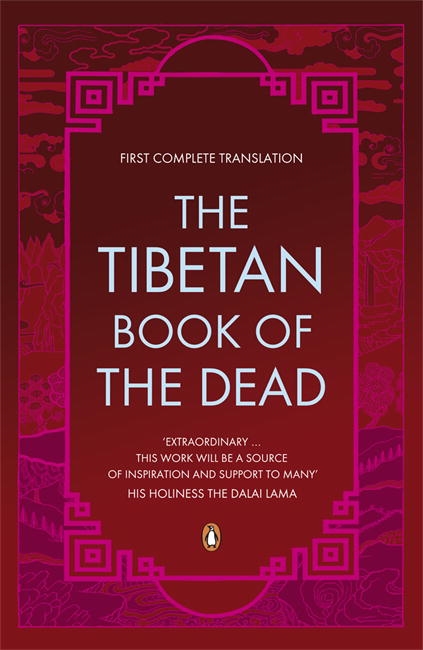
Book 94, Tibet: "The Tibetan Book of the Dead"

Cor. This was a bloody good read, way more interesting than the Quran or the Lotus Sutra or the Bible (most bits of the Bible, anyway). I was gonna say it was easy to see why it became a Western cult classic, then I remembered that for the longest time what the hippies and the beats were perusing was a single portion of this volume: The Great Liberation By Hearing.

This baby I’ve been lugging around is the first full translation, based on the three volume manuscript from the library of the Kyabje Dudjom Rinpoche, completed by the scholar Gjurme Dorje with support by HH the Dalai Lama. Check it!


And what makes this book so awesome? Well, first of all, it’s brilliantly random: as crazy if not crazier than the palimpsest hotchpotch of the Old Testament. It consists of prayers, philosophy, catalogues of deities, medical instructions for determining the date of imminent death, magical rituals for forestalling said death, a detailed practical guide to ensuring enlightenment or at least rebirth as a higher being following said death, and even a masked drama demonstrating the posthumous fates of a butcher and a pious merchant, as Yama Dharmaraja, sage of hell beings, judges them by weighing the white pebbles of their good deeds against the black pebbles of their sins. (Yes, shades of the Egyptians, which is why the English title of this book stuck instead of its proper name, The Bardo Thodol.

Second of all (a phrase my boyfriend insists is ungrammatical) it is so damn *sensual*, so psychedelic that one wonders what the prophets were smoking, or if mountain air just predisposes one toward incredible visions. It’s bizarre, after reading the fairly square first chapters, which concentrate on the usual Buddhist exhortations to renounce worldly attachments, to be told of the copulating, blood-drinking, sexually dimorphic rainbow-coloured buddhas and bodhisattvas and gatekeepers and herukas that inhabit the cardinal portions of one’s skull: Gauri, white-in-colour, carrying a human corpse as a cudgel; fox-headed Srgalamamuki, black in colour, eating entrails; yak-headed Manauraksasi, brownish-white and holding a vajra; sow-headed Varahi, blackish green, holding a noose of fangs; scorpion-headed Amrta, reddish yellow, holding a lotus; three-faced six-armed Vairocana, brandishing a wheel, an axe, a sword, a bell, a ploughsare and a blood-filled skull, joyously and indivisibly embraced by Buddhakrodhesvari; and Samantabhadra and Samantabhadri, the Buddha-body of Reality.

Oh yes, and trying to foretell your death by staring at the sun or your shadow or the tinges of blood in your urine, and channeling your powers of concentration so that should you topple unexpectedly from a mountain, your soul will escape your body from the correct orifice. Madness!

And also the gentle comfort it must give one to imagine one’s body at a funeral, surrounded by loved ones repeating prayers into one’s ear directing the soul to higher realms.

Yes, this is the kind of religious text I like: more imaginative than preachy; the kind I don’t have to take absolutely seriously and expands my imagination rather than limiting it. O Child of Buddha Nature, may you read many more books as weird and wonderful as this!


View Around the World in 80 Books!!! in a larger map

Representative quote:
There are, altogether, nine different pathways through which consciousness transference can occur, and these are associated with persons of superior, average and inferior capacity. The aperture of the crown fontanelle is the pathway through which [consciousness] departs to the pure [realm of the] sky-farers. Given this, [it is said that] one will attain liberation f awareness exits through the [crown fontanelle]. Since this is the supreme pathway, it is extremely important that one trains in directing one’s mental focus towards this [aperture]. Furthermore, if consciousness is transferred through the pathway of the eyes, [it is said that] one will be born as a universal monarch, and if it is transferred through the left nostril, one will obtain an unimpaired human body. These are the three optimum apertures associated with those of superior [capacity].

One will, however, be born as a yaksa if [consciousness is transferred] through the right nostril, or as a god of the world-system of form if [it is transferred] through the ears, and as a god of the world-system of desire if [it is transferred] through the navel. These are the three medial apertures [associated with those of average capacity]. Lastly, one will be born as an animal if [it is transferred] through the urethra, as an anguished spirit if [it is transferred] through the sexual passage, and as a hell being if it is transferred through the rectum. These are the three inferior apertures [associated with those of inferior capacity]. Given that there are such very great consequential differences between the various apertures through which consciousness transference may occur, there wil be inestimable benefits in directing one’s awareness to the crowd of the head, at the time of death.

Such is the forceful consciousness transference. SAMAYA!

Next book: Lil Bahadur Chettri’s Mountains Painted with Turmeric, from Nepal.

Wednesday, February 22, 2012

Book 90, Iran: "Deliverance from Error" and "The Beginning of Guidance" by al-Ghazali

This slim little volume took longer than I thought. But that's okay; I think I actually like Al-Ghazali. He's an oddly modern thinker, rationalist even in his irrationalities.


While the divine/human mind that wrote the Quran is obsessed with hellfire, Al-Ghazali's more interested in the very idea of the Truth. In Deliverance from Error, he explains that he's unwilling to accept proof via miracles: no point is proven through magic tricks of turning stones into gold or rods into serpents. He's smart enough to point out that the Faithful must not dismiss their ideas of infidel philosophers in the realms of natural science, logic, even ethics.

Of course he's silly sometimes: he claims the Greek thinkers are fundamentally flawed because they weren't Muslim; he warns that only the elites should be allowed to access their ideas. I fucking love his imagery here, though:

"It is only the simple villager, not the experienced money-changer, who is made to abstain from dealings with the counterfeiter. It is not the strong swimmer who is kept back from the shore, but the clumsy amateur; not the accomplished snake-charmer who is barred from touching the snake, but the ignorant boy."

Oh, and one of his counter-arguments for complete dependence on natural philosophy is the inductively proven usefulness of magic squares in aiding childbirth.

Yet it's these very imperfections which draw me in as a reader: the knowledge that this religious writer is fallible, is fundamentally human. He charts his own philosophical and spiritual development in this text, acknowledging that rationality can only take one so far and thus the necessity for mysticism - a paradoxical situation he has to live with.

And that fallibility, that very idiosyncrasy, is what makes his commandments in The Beginning of Guidance more charming than ridiculous. It's here that he lays out strict rules for ablutions before prayer, for going to the toilet (never in front of others, step into the room left foot first and exit right foot first, and wipe your cock an odd number of times on a stone).

It's here that he warns against lying, backbiting, cursing, and most important of all, hypocrisy. If every Muslim followed what he prescribed, they'd be saints even to our secular eyes - always turning the other cheek, never judging lest they themselves be judged. It's also here that he advocates moderation in all things, propriety at prayers and in conversation, and naturally respect for elders. It's like he's the reincarnation of Confucius or something.

So I've read two religious texts in a row! Never let it be said that I'm anti-faith, my dears.


View Around the World in 80 Books!!! in a larger map
Representative quote: Beware of association with the learned men of this time, especially those occupied with controversial topics and intellectual disputes. Beware of them; because of their jealousy they wait for you to fall into ill-fortune, imagine various things concerning you, and behind your back make signs with their eyes among themselves while enumerating your faults when they meet together so that sometimes in their anger they confront you with these faults during their rivalries. They do not forgive your faults or slips; nor do they hide your private matters which should be kept hidden. They make an account with you even in the most negligible matter, and they envy you inn everything, small or great. They instigate your friends against you by slandering, spreading false information, and lies. If they are pleased with you they show it through servile flattery; if they are angry with you they are quietly stupid. On their bodies they wear beautiful clothes, but their minds are wolves. This is a judgement based on clear observation of most of them except those whom God (exalted is He!) has protected. Companionship with them is a loss, and association with them is to be forsaken.

Next book: Khaled Hosseini's The Kite Runner, from Afghanistan.

Tuesday, February 7, 2012

Book 89, Iraq: "Princess, Priestess, Poet: The Sumerian Temple Hymns of Enheduanna"

This is the most ancient text I’ve covered so far, and unless groundbreaking archaeological discoveries are made, it’s the most ancient text I’m going to cover in this project, period. It dates from 2300 BCE: the first known text to be accompanied by an author’s name, hailing from Sumer, a civilization was already two millennia old at the time of composition; arguably the very civilization that invented writing, in fact. Fascinatingly, it’s written by a woman: the daughter of Sargon, builder of the world’s first empire, High Priestess of the Moon God Nanna at Ur.


But oh lordy. It’s the wrong book. I made the National Library order this because it looked like the most up to date, complete version of Enheduanna’s corpus, and what do I discover halfway through? That the princess’s most famous works which I’ve heard quoted here and there as evidence for her genius and even her lesbianism, her hymns to the goddess Inanna – they’re her devotional hymns, compiled in an earlier book.

The Temple Hymns are quite a different matter. They’re a political work: one hymn written for every temple in Sargon’s new patchwork of conquered empires. What Enheduanna did to forge their unity was to sing praises to each of their local gods and goddesses, denying none of them, crafting a holy text that would endure as canonical scripture, copied and recopied on cuneiform blocks through the centuries. Note also that the different regions didn’t even speak the same language, but this was ok: she spoke both Akkadian from her dad’s side and Sumerian from her mum.

Mind you, the sum and significance of these works is terribly interesting, but ploughing through Betty de Shong Meador’s work tests one’s patience a little – she’s an academic as well as a literary translator, and there’s pages of annotations and explications after each hymn; no way you can read this casually. Even if you skim the hymns themselves, they get a bit repetitive after a while: they’re not narrative, like the anonymously authored Epic of Gilgamesh; they’re fragmentary gasps of glory. Yeah, sometimes they’re studded with dazzling imagery, but even brilliant oohs and aahs can provoke zzzs after a while.

Of course, the annotations do pay off sometimes: without them, I’d never have known that Sumerian religious culture was so, shall we say, womanist; there are notes about female warriors, female religious scribes, female kings, female viziers; gipars (convents for priestesses; monasteries did not exist) and goddesses with tremendous sexual agency: how Ereshkigal of the Underworld sentences the warrior god Nergal to the worlds below to be executed for his intransigence but seduces him instead; bridal songs about erect nipples and throbbing vulvas. And of course, Inanna herself, “the lady of largest heart”, a savage lion battering a wild bull, bearing seven maces, washing her weapons in the blood of battle. Makes the bacchanalian Greeks look positively Puritan.


View Around the World in 80 Books!!! in a larger map

I was going to reproduce a hymn to Inanna for you guys, but on second thoughts, there’s another more intriguing piece dedicated to Nisaba, the goddess of writing, she of the gold or silver stylus. Hers is the temple that ends the sequence, allowing Enheduanna to punctuate the entire corpus with her own name.

Representative text:

Temple Hymn 42
The Erest Temple of Nisaba
Ezagin

this shining house of stars bright with lapis stones
has opened itself to all lands
a whole mix of people in the shrine every month
lift heads for you Eresh
all the primeval lords

soapwort the very young saba on your platform
great Nanibgal Nisaba Lady of Saba

brought powers down from heaven
added her measure to your powers
enlarged the shrine set it up for praising

faithful woman exceeding in wisdom
opens [her] mouth [to recite] over lined tablets
always consults lapis tablets
[and] gives strong council to all lands

true woman of the pure soapwort
born of the sharpened reed
who measures the heavens by cubits
strikes the coiled measuring rod on the earth

praise be to Nisaba

13 lines for the house of Nisaba in Eresh

the person who bound this tablet together
is Enheduanna
my kind something never before created
did not this one give birth to it

the incipit: é-u-nir
the count of its lines is altogether 548

Next book: Al-Ghazzali’s Deliverance from Error and The Beginning of Guidance, from Iran.

Monday, January 2, 2012

Book 84, Saudi Arabia: The Quran

Happy New Year! So after over a month, I'm finally done with al-Quran Qadim!

Yessir, I knew I could've gone with easier choices like Rania al-Baz's Disfigured (socially significant and pretty well written), Rajaa Alsanea's Girls of Riyadh (revolutionary but badly written, according to most critics), and Jean Sasson's Princess (still don't trust its veracity). But I wanted something really iconic, a jewel of world literature. a book worth the boasting rights. Why not a book written (or transcribed) by the most influential man in history, a figure whose name I dare not utter without a pbuh and whose face I dare not upload at all?


And the truth is, there are several reasons why this wasn't an entirely good idea.

I still remember having to read bits of the book for my Contemporary Civilization class during sophomore year; we were guided by an Arabic-speaking Jewish girl who gushed over the sheer poetry of the text, and all the Americans oohed and aahed over how much more liberal and enlightened some of the laws are compared to Deuteronomy or Leviticus. Whereas I was distressedly thinking how all the Muslims I knew (especially in Singapore) were more liberal and enlightened than even that. (Yes, imprisonment for female adultery [an alternative reading of "stoning"] is less draconian than death, but in the 21st century?)

Still, I figured maybe reading the whole thing would give me some context. My friends recommended the rather beautifully archaic Abdullah Yusuf Ali translation for my enjoyment. And now I'm finished, I've ended up delaying my post for three days, so nervous am I about how to appear as both a critical humanist and a non-Islamophobe.

Yet at the risk of incurring the wrath and legal action of everyone in Singapore, I'm going to make a list of 4 reasons why reading the Quran alone isn't a great way to fall in love with Islam.

1. The surahs are super confusing.

The Quran, as you probably know, is a series of divine revelations: each one of them is meant to be a stand-alone insight into spirituality. So they're free to meander as they like from topic to topic, rather than staying focussed on a single issue - e.g. Surah 4, an-Nisa, is supposedly all focussed on women but after 25 verses it goes into more generalised, abstract ethics. Pretty difficult for study, no?

2. The stories are scattered all over the place.

The Book contains all these references to tales of prophets from the Old and New Testaments: Adam, Noah, Lot, Abraham, Moses, Zakariya, Mary, Jesus; also non-Biblical stories like Saleh and the Companions of the Elephant. But these are mostly told in fragments, so that you need a concordance or annotations to piece everything together - plus, a few key details are repeated in sura after sura, while others in the Biblical versions are left out. Thus you'll get pretty damn tired of the Pharaoh yelling at Moses, but no mention is made of the colourful variety of plagues he visited on Egypt. The versions of the stories in the Hebrew and Christian Bibles are patently more accessible and rounded out.

3. The order doesn't help.

I'm not complaining about chronological order here - I know it'd be next to impossible to trace their history, so I can't blame the original redactors for placing them in order of length. But currently, the surahs are arranged from longest to shortest. That's really frustrating for a novice reader: we have to plough through the long, bifurcating thought processes of Surahs 2 through 40 before we start seeing some surahs with the sheer, crystalline focus of secular poems. (Yes, there are wonderful poetic moments in longer surahs, but they get gobbled up in the range of topics covered.) Imagine if they were arranged from shortest to longest: then people would be hooked in by the concise poetry of the early suras and keep reading all the way to the end.

Hmmm. In retrospect, this might not be a good idea. Most of the laws are laid out in the longer suras; they're important.

4. And yes, I know this will be controversial: there's a lot of hellfire.

The Quran does mention tolerance and how Allah is all-merciful, but it's really hard for a non-believer to swallow this when so many of the suras (especially the longer suras) mention fire and punishment for us in some way. We're told we'll be cast into the fiery pit and forced to eat of the tree of Zaqqum; there are also constant invocations of prophets at Warners of the end of the world, when our very bones shall testify against us. It gets really exasperating. Maybe fear works as a conversion tactic for some people, but us freethinker skeptics? You'll catch more flies with honey than vinegar. (It was actually the act of reading the Old Testament that made me stop being a Christian ten years ago.)

Thus I do think it's understandable why some Muslims end up as terrorists, because the Quran contains so much condemnation of unbelievers and polytheists and those who ignore the Signs. While there are commandments for tolerance of other religions - People of the Book, that is - they make up a much smaller total portion of the book.

What does this mean? Well, basically that the Quran is a supremely slippery text, and it's not immediately accessible to outsiders; perhaps not even to insiders. It's quite different from most books of the Bible; in fact, it recalls the compilations of Zhuang Zi in some respects - how nonlinear and poetic it is, and how strange. Obviously Muslims pair it with the Hadith and the writings of religious scholars who've interpreted the Book.

It also means that the best strategy to make people conceive of Islam as a positive force in the world is for Muslims to be positive forces in the world themselves - boasting about the roots of your religion isn't going to be so effective when the roots are so tangled. Let's hope the bits of the Quran that are especially venerated from now on are the ones that celebrate tolerance, science, co-operation, social justice

As for me, I don't know what to think. Sure, I've got minor boasting rights for getting to the end of a book, but do I understand Islam any better than I did before? Damned if I know.


View Around the World in 80 Books!!! in a larger map


Representative quote: And such are the Parables We set forth for mankind, but only those understand them who have knowledge. (29:43)

Next book: Maha Gargash's The Sand Fish, from the United Arab Emirates