Showing posts with label thriller. Show all posts

Wednesday, December 10, 2014

Book 163, Belarus: "King Stakh's Wild Hunt" by Uladizimir Karatkevich

Somehow the National Library never processed my request for Nancy Richler's Your Mouth Is Lovely, which left me stranded in terms of Belarusian lit. (Richler is Canadian, anyway, and the story might take place in Russian Siberia. :/)

My options included Nechama Tec's Defiance, a non-fiction work about a Jewish resistance army during World War Two (available in the library) and Vladimir Kozlov's Number Ten: A Novella In Translation (available for 99 cents on Kindle).

Luckily, I managed to Google up a free pdf of this:


And I'm glad I chose it. I knew from the description it was gonna be kinda up my alley: a bit of a fantasy thriller about a modern man facing down the phantom of a cursed king, riding for eternity. But in fact, the background's a little more complex than that.

This book was written only in 1964, but it's a Gothic novel - the events take place in the autumn of 1888, with the first-person protagonist Andrey Bełaretski recounting the events as a 96 year-old man. He's an ethnographer (which I hadn't really thought was much of a profession in Europe in the nineteenth century) and his mission is to venture into remote parts of Belarus and document the dying legends, folktales and epics of his people to publish back in Minsk.

So you see we've got a theme of identity formation going on: the rise of a nationalist bourgeois class who want to go back to their peasant roots to understand what their culture is. Unfortunately, that culture is kind of horrifying - we've got horribly impoverished gentry (descended from the Polish, it seems) starving in their broken-down castles and burning their antique furniture for warmth, and thousands of muzyk (that's the word they use for serfs) who're living on even less. 

Andrei's pretty gloomy about all this at the beginning of the book. Then he gets lost in an undisclosed area of his country during an expedition, almost dies from falling into a swamp (a quagmire, they call it), and seeks refuge in the rain in the castle of Marsh Firs, where he's greeted by the Countess - an ugly little 17 year-old thing named Nadzieja Janouskaja, who's plagued by the doom of her noble line, unfamiliar with concepts of sunshine and friendship, and convinced that she, as the twelfth and last of the Janouski dynasty, is fated to die from the curse of King Stakh, whom her ancestor betrayed in his uprising many generations ago.

And of course our modern, Minsk-educated ethnographer pooh-poohs it all, and is determined to discover a rational explanation for why he hears the invisible footsteps of the Blue Lady outside the corridor, not to mention the apparition of the Little Man, and all the other strange phenomena out of folklore that have come out of the mouths of goodwives to haunt him in real life.

As the tale unfolds, however, we realise this is more than a Dracula story, for the main players are actually the various impoverished nobles who are battling over the lands she stands to inherit - some good at heart, like young pure-minded suitor Sviecilovic; some evil, like the impetuous Varona, and some with plenty to hide, like Nadzieja's garrulous uncle, the huge, supremely jovial Rubatouk.

And [SPOILER ALERT!!!] we soon see that this is a book of the Soviet era indeed, because the phantoms are indeed revealed to be the work of jealous nobles, and our working-class descended hero is able to use his wits and strength to defeat them, with the aid of a peasant uprising, complete with pitchforks and a gruff hunter named Ryhol who's able to smack some sense into him every time he wants to take *pity* on one of these leeches of society. (It's kind of like a Scooby-Doo episode - the real monsters aren't the undead, but simple money-grabbing mortals, who'll cloak themselves in masks and darkness to fool the superstitious into believing they cannot be defeated.)

But there's a fairy-tale ending after all - Nadzieja grows in beauty and maturity throughout the story (though she's pretty passive even by the end), enough for Andrej to fall in love with her and marry her and live happily ever after, which frankly made me a little cross, because everything in the novel had been indicating that the story ended in tragedy. Did Karatkevich do this for the censors, the pleasure of his readers, or because his moral compass bade it so? I do not know. [SPOILERS END.]

If you wanna check out this book, it really is loads of fun - a bilingual PDF is for some reason available here, so you can check the English against the Belarusian (which I did not know was a language up till now).

Oh, and by the way, I can't figure out how to embed Google maps properly, so it's already zoomed in on the region I'm talking about. Any advice?


Representative quote: 
"Nothing," she answered dryly. "But it's too late. Everything comes too late in the world. You are too much alive. Go to your people, to those who are alive, who go hungry and can laugh. Go and conquer. And leave the graves to the dead."

"But aren't you my people?" I exploded. "And these people, frightened and hungry, aren't they my people? And Sviecilovic, whom I shall have to betray, isn't he of my people? And these god-forsaken swamps where abominable things occur, aren't these swamps my land? And the children crying at night, when they hear the hoofs of the Wild Hunt, trembling with fright all their lives, aren't they my brethren's children? How can you even dare suggest such a thing to me?"

Next book: Leo Tolstoy's War and Peace, from Russia.

Thursday, October 23, 2014

Book 160, Slovakia: "Rivers of Babylon" by Peter Pišt'anek

Boy oh boy. See, when I first started looking for books on Slovakia, I got referred to US author Michael Genelin’s detective novel Siren of the Waters, and the memoirs of Alexander Dubček (who is a Slovak politician, but who is known for having engineered the Prague Spring in the present-day Czech Republic, which was then of course part of Czechoslovakia).

But then I goofed around on Amazon and found this: 


(This is not the Amazon cover, mind you. It's from this site. But the Amazon cover is BORING, and I give myself a lot of leeway when I read from the Kindle.)

That guy on the cover is our protagonist, Rácz, who starts off as a penniless orphaned ex-soldier and farmer's son, who vows to leave the village and return as a rich man after seeking his fortune in Bratislava.

When he gets to Bratislava, he just so happens to encounter the stoker of a grand hotel - the Hotel Ambassador, a SIX-storey building (wow wow wow) who's about to retire after milking the corrupt Communist system of hiring more workers than necessary in the basement to supply the central heating. And so he takes over, learning how the century-old pipes work, shovelling coal and turning valves to keep the hotel warm.

But it's 1989, the time of the Velvet Revolution (which was what they called it in the Czech Republic - in Slovakia that called it the Gentle Revolution), and that means the whole Communist system of governance in coming apart. And that leaves room for the bad-asses to take power.

So when the hotel manager decides to punish Rácz for daring to enter the hotel by its front door in his dirty worker's overalls and boots - well, our scruffy underdog takes charge and starts turning off the heating in everyone's rooms. And this is Eastern Europe, with autumn settling into winter, so it HURTS.

Up to now, we've had something like a realist novel. But here, things take a slide into the magically real, because not only does Rácz manage to force everyone, from the cooks and the maids and the cabaret girls and the drivers and every single tourist and travelling businessman to bribe him into turning on their radiators, receiving gifts of soup and sex and Chivas Regal (which he pronounces as hee-vas ree-gal, of course) - but he actually starts climbing the social ladder, earning the respect and power through his ruthlessness that the manager never really had, and the poor old manager is reduced to starving and shivering frostbitten in his office - and yes, it gets weirder from there on.

This is a fun book. Thrilling. Socially insightful. It skips perspectives from character to character, so we get a pretty wide range of Slovakian society - there's Video Urban, the wannabe video artist-cum-currency exchanger-cum-taxi driver; Freddy Piggybank, the fat loser everyman parking lot attendant who goes spectacularly mad; Silvia, the wannabe ballet dancer-cum-cabaret girl-cum-kept woman who lives only for money; her girlfriend Edita (who's bisexual, and pretty hot for Silvia's undies, in fact); the Lawyer who tries to jockey Rácz for power; the former Secret Police Officers who're trying to stay relevant in this age of change through abusing their old warrants... And damn, crazy shit goes down.

All while you can pat yourself on the back for urbanely researching post-Communist Eastern Europe! Hurrah! (Shades of Alaa-Al-Aswany's The Yacoubian Building from Egypt, which I'd also recommend.)

What makes this all the more remarkable is that Pišt'anek's style was unprecedented in Slovakia - their literature previously made them out to be "a nation of wise bee-keepers and virtuous matriarchs", according to the preface. Damned if this isn't more fun to read. And there are sequels, too!

(Trigger warnings for anti-Gypsy racism and rape, though. Our underdog becomes more than an antihero; maybe something of a monster.)


View Around the World in 80 Books!!! in a larger map

Representative quote: Hurrenson found out about the existence of this nation only because of its ridiculously cheap prostitutes, willing to put up with anything that doesn't leave visible traces. Only then did he find out from the residents of this nation about the apparently famous artists, astronomers, and inventors whom he'd never heard of before. But so far Hurrenson has only been able to meet cheap whores, black market hustlers, arrogant waiters and taxi drivers, lazy room-maids and venal policeman. However, Hurrenson does not condemn anyone outright. He believes that the milieu in which he circulates as a bisexual tourist has shaped his opinion. He has no doubt that this nation is composed not merely of parasites and fools, but also of honest and educated working people. The point is that Hurrenson has never yet met such people, nor even found a trace of their existence.

Next book: Franz Kafka's The Castle, from the Czech Republic.

Thursday, August 28, 2014

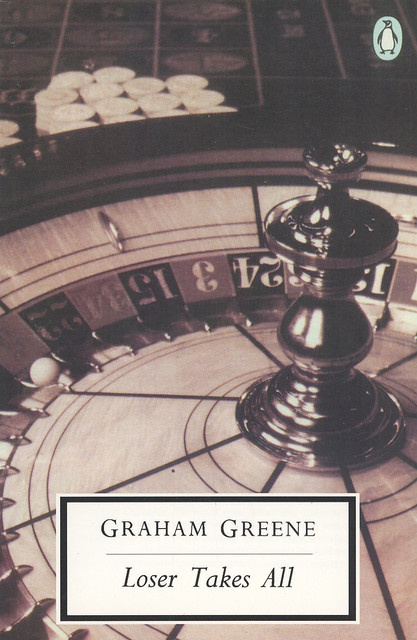
Book 155, Monaco: "Loser Takes All" by Graham Greene

Guess what? I decided that I *would not* let a second month go by wherein I'd only read one book for this blog. So I hitched a ride with my dad over to Jurong East Regional Library, and lo and behold, procured this:


It's a novella about Bertram, a 40 year-old London assistant manager of accounting and a bit of a loser - except that he's about to marry a sweet 20 year-old girl named Cary at a quiet church ceremony. Then, through the off-handed magnanimity of the major shareholder in his company, he ends up having the ceremony in Monte Carlo, Monaco - but when they're stranded at the hotel without the cash to pay their way any further, what can they do? Gamble their way into millions, that's what! And encounter all the ups and downs of riches while that takes place.

Now, I've only read one other Graham Greene novel, The Quiet American, which happens to have been published in 1955, the very same year this came out. And I can't help but be struck by the similarities between the two. Both feature:

1. A middle-aged, unremarkable first-person protagonist who is British and male,

2. and who also happens to be with an innocent 20 year-old (in The Quiet American, her name's Phuong) who appears bubble-headed and flighty but is in reality utterly devoted and surprisingly canny about the ways of life,

3. although there's an awful middle-aged woman involved - in The Quiet American it's Fowler's existing wife who won't grant him a divorce so he can remarry; in Loser Takes All it's Bertram's cheating sexpot of a deceased wife, plus a lady he picks up in the casino just to make Cary feel jealous.

4. Oh yes, and there's a handsome young man around who makes the protagonist jealous (the eponymous quiet American in The Quiet American; a young gambler named Philippe in Loser Takes All), but who does not deserve the girl, dammit.

5. And there's also machinations of power in the background - it's the Vietnam War in The Quiet American; it's the battles for money and power amongst the shareholders in Loser Takes All.

6. Plus, they both take place in exotic locations most Brit readers could only dream of visiting - Monaco! Vietnam! Not so much unlike an Ian Fleming novel after all. (Although it is remarkable that Loser Takes All was published a year before Grace Kelly's wedding to Prince Rainier - hence, it's set in the dowdy days of Monaco, before its great glamorisation.)

Of course, the two books are different, in substantial ways. First off, this one's just a novella, 110 pages long in fairly large print. And second, while The Quiet American is about the corruption of war and imperialism and all, Loser Takes All is about the corruption of wealth and greed - the money spoils everything, and Cary's the only one who can see that clearly.

And yes, this was a hell of a fun read. Probably useful for my writing, too. Although I do still feel bad about losing my copy of The Ruling House of Monaco. Will have to cough up some cash for that.


View Around the World in 80 Books!!! in a larger map


Representative quote: There are so many faces in streets and bars and buses and stores that remind one of Original Sin, so few that carry permanently the sign of Original Innocence. Cary's face was like that - she would always until old age look at the world with the eyes of a child. She was never bored: every day was a new day: every grief was eternal and every joy would last for ever. 'Terrible' was her favourite adjective - it wasn't in her mouth a cliché - there was terror in her pleasures, her fears, her anxieties, her laughter - the terror of surprise, of seeing something for the first time. 

Next book: Johanna Spyri's Heidi, from Switzerland.

Sunday, July 28, 2013

Book 131, Falkland Islands: Carlos Gamerro's "The Islands"

Okay. This is weird. I decided to do a mega-detour to South America, because the Falkland Islands now fit my criteria for inclusion in my project. Previously I'd figured they were too sparsely populated, but they're home to 2,932 people, twice as much as Tokelau or Niue. More importantly, I found a really cool book about the country.


Strange how whenever we talk about the Falklands War/Guerra de las Malvinas, we always hear about the British perspective: Margaret Thatcher as a patriotism-stirring warrior queen, et cetera. Carlos Gamerro tells us about the even more messed-up Argentinean side: a world of byzantine power struggles and sociopathic generals and torture victims, and above all an inability to let go of the shameful defeat. As the narrator says, it's not the criminal who returns to the scene of the crime, but the victim.

The War took place in 1982 and the story's taking place in 1992 - not just the 10-year anniversary, but also the 500th year since the colonisation of the Americas by Christopher Columbus. Aforementioned narrator is Felipe Félix, hacker and Falklands War veteran, employed by the mad Sr Tamerlán to track down the witnesses of a murder committed by his son.

And everything's mad in that delightfully Borgesian manner - magical realist but in an urban, technologically-equipped setting: Tamerlán's office has one-way mirrors as floors and ceilings so that the boss on the upper floor can be the master of a Panopticon; fellow veteran Ignacio spends years creating a fabulously detailed scale miniature model of Puerto Argentino/Stanley, supposedly to aid in plans for a counter-attack but in fact for the purposes of turning back the clock; Felipe creates a video game that enables General Verraco to play at winning the war, ending with him being blessed by the Pope in the middle of Buenos Aires and conquering the British Isles, and so on, and so on.

God, I've missed you, South America. And it's an education to learn how awful, how soul-robbing the war was for the Argentineans - the vets really didn't get decent care taken of them by the state - as the story shuttles between 1982 and 1992 like an acid trip or PTSD.

So yes, this was a positive experience. But harrowing. And also a bit of a betrayal to my friend Dmitri Aronov, who was at first delighted that I was reading Laxness at the same time he was, in preparation for a trip to Iceland. Never you mind, I'll be conquering that epic novel while travelling this coming week, in Bali.


View Around the World in 80 Books!!! in a larger map


Representative quote: He began stomping about the classroom cowboy-fashion, with legs akimbo and fist clenched on groin. 'Argentina is an erect prick ready to breed, and the Malvinas, its balls. When we recover them, fertility shall return to our lands and we shall become the great nation our founding fathers once dreamed of! A potent country! Our wheat shall flower anew, and our cattle shall ply our oceans of grass; our trains shall run laden with the produce of the land to every corner of the country. Buenos Aires shall be the new Paris, the envy of all the cities of the globe. The Argentine name of the Argentineans shall ring pristine in the ears of the world with peals of welath and progress! From our recovered Islands an Argentinean sun of unimaginable grandeur shall mark the day on which the former colony becomes the world power we all long for!'

Next book: Halldor Laxness's Independent People, from Iceland. 

Monday, May 20, 2013

Book 124, Cayman Islands: "The Firm" by John Grisham

So yeah, I tried reading Dr. Florence Goring-Nozza's One and One Is Two: Caribbean Thriller. First off: it's not a thriller: it's a dreary little self-centred memoir talking about how the Caymans were oh so nice before they became a rich international banking centre with no taxes. Second: it's incredibly badly written. Run-on sentences galore. No sense of self-awareness. What an idiot this author is - the doctorate, believe it or not, is from the Yale School of Divinity. Yep, she's a preacher. Sigh.

Of course I do favour the practice of reading from the national literatures of the nations I'm surveying, but this project is also about filling my brain up with the best lit the world has to offer. So why not a nice American thriller instead?


I haven't watched the 1993 film version of The Firm - rather mind-boggling to realise Tom Cruise has been an action star for twenty years now - but I have read Grisham's later novel The Runaway Jury, which I thoroughly enjoyed while in a backpacker inn, maybe in Tel Aviv or Brazil, not sure where.

The similarities between the two are striking. Thorough knowledge of the legal profession and practice, of course, but both also have young, handsome male protagonists on outlaw missions; invisible but kickass dames on the side, and a healthy distrust of big corporations - Runaway Jury is about a guy rigging a jury to convict a tobacco consortium in a class action lawsuit; The Firm is about a Memphis-based law firm that works for the Mob and ices every associate or partner that they think might blab to the FBI. Big money all over the place, destined to be brought down hard. Some relevance to the contemporary economy (which of course TV producers have attempted to take advantage of).

Honestly, one does develop a soft spot for Mitch McDeere early on in the book - a tall, athletic 25 year-old, born into poverty and crime but with the drive (and insomnia) to put himself through Harvard Law School, working in a convenience store to pay the bills, offered the job of his dreams with a six-figure salary and then suddenly discovering how deep in shit he is, with the firm (Bendini, Lambert & Locke is its name) blackmailing and surveilling and threatening to murder him on one side, and the FBI tailing and tantalising him and telling him that if he doesn't bend, he'll eventually be caught out and jailed forever, on the other. Oh, and he's got a pretty wife, too. Raises the stakes.

Some words about the movie, which I've read up about on Wikipedia. Tom is very pretty indeed in there, but I can't take him seriously in there after all the silly Scientology. Also, what irks me is how the ending's been made really happy, with all loose ends tied up and Mitch still able to practise law, not having broken his vow of client confidentiality, etc. The book's all about him as an individual on the run, breaking free of the bounds and escaping to... you guessed it: the Cayman Islands.

Nothing much to say about the islands themselves, except their status as a tax shelter, the snorkelling and diving, and I guess a bit of random info about the population of British whites and comfortable blacks (the book uses "Negros" on occasion, surprisingly) and pretty mulatto women and Jamaican Red Stripe beer and roast shark. Oh yeah, and the bit about the only KFC on the island catering to Americans, since no-one on the island actually rears any chickens - that was fun.

Some storytelling devices which I wouldn't have recommended my students, but I suppose I'd better digest them. It's not a bad thing to be able to write a bestseller, after all.

And I'm back in the Western Hemisphere again. Not an awful return trip, I suppose.


View Around the World in 80 Books!!! in a larger map


Representative quote: 
Avery wiped the sweat from his forehead. "This place has always attracted pirates. Once it was Blackbeard, now it's modern-day pirates who form corporations and hide their money here. Right, mon?"

"Right, mon," the driver replied.

Next book: Ron-Luc Nickell's Food Plane Soup: The Desert Island Letters, from the Turks and Caicos Islands.

Tuesday, December 28, 2010

Book 42, Guadeloupe: "Who Slashed Celanire's Throat?" by Maryse Condé

This is a brilliant page-turner - a tale of bad-ass supernatural revenge from one of head honchas of postcolonial literature. Ripping stuff.


I chose it over Victoire: My Mother's Mother, which came out this year, because that's a family memoir just like Mr Potter, and anyway the first few pages of Celanire pretty much grab you by the throat.

I'd read about it on the Net before: it's inspired by a piece of news the author heard in her childhood, about the discovery of an infant with her throat slashed in the street: how she decided to take this horrific news and turn it into an almost burlesque thriller, by no means denying the oppression of Afro-Caribbean history but also venturing into the realms of aristocracy and early 20th century international travel: there's episodes that take place on Côte D'Ivoire and Montserrat and French Guiana and Peru as well as Guadeloupe. (Paralleling Condé's own international meanderings, may I add.)

And oh, what a wonder of a character Celanire is - yes, she evokes pity as the sacrificed infant, and she grows up to be a brilliant and beautiful (and bisexual!) educated and enlightened woman who seduces white fascist Governors and reduces them to Africanist opium sots; plus she has utterly contemporary ideas about liberated sexuality and women's education and infibulation bans. (Even quotes that Klingon saying about revenge being a dish best served cold.)

But she's also the vehicle for demons: just watch how she executes her revenge and rains down doom on whoever wronged her, however innocuous they may be.

Very much recommended. In other news, my good friend Shelbi only has two books left to go till she completes her reading challenge for the year! Go Shelbi!

Also, I have way too much translation and journalism work I should be doing, so I'd better stop distracting myself. Toodle-oo.


View Around the World in 80 Books in a larger map

Representative quote: In the meantime, Amarante stared at the dark curtain of trees beyond the illuminated podium. Darkness had locked the palace in its grip and would not let go fro some time. Not until throngs of seabirds, messengers of dawn, had begun to flock across the sky. Darling little Celanire, darling little Celanire. That evening she had been revealed to her, and her beauty struck her like the flash of a frigate bird. Svelte yet strong. Good-humoured yet serene. Knowing what she wanted in life and determined to get it. The glow in her eyes betrayed the passion burning deep down. Was it so that they could meet that fate had brought Celanire back to Guadeloupe?

Next book: Jean Rhys's Sleep It Off Lady, from Dominica.

Monday, August 16, 2010

Book 19, Panama: "The Tailor of Panama" by John le Carré

Another winner. It took a while to warm up to this 460-page story, but it’s worth it. Was worried it was a little déclassé – after all, it’s a spy thriller, isn’t it? But the truth is, le Carré writes with real style and real intelligence: I can see the magical realism and stream-of-consciousness run-on sentences of the Latin American boom braided in with the crisp wit of classic British drawing room drama, and a real moral conscience behind everything.


SPOILER ALERT: It’s a tragedy. It starts off as an amusing expatriate narrative, with Harry Pendel the formerly-of-Savile Row tailor designing top-notch suits for the Panamanian elite; then it becomes a thriller when he’s recruited as a spy on the basis of blackmail, revealing his criminal past; then it becomes a comedy of errors when he’s forced to fabricate data to keep his employers happy, and you find out everyone’s ballooning up the data, and something’s gotta break, the truth will out and Pendel’s got to come out on top because he’s so likeable despite his deceptions, he’s just trying to rise above his Jewish working-class origins by creating these constructs that bend reality in his favour to give him that middle-class respectability and income everyone deserves, dammit.

But the truth doesn’t come out. The British embassy’s just too eager to be relevant in the world, so they latch onto the faked evidence and feed it to the United States and war breaks out, with Pendel in the middle of the firebombing watching his world go up in flames and Andrew Osnard, his fat mendacious paymaster, skiing in the Alps. SPOILERS END.


View Around the World in 80 Books in a larger map

Don’t worry: the war didn’t actually happen. The book’s written in the lead-up to the American handover of the Canal to the Panamanian government in 1999, on the basis that they would love an excuse to hold on to the power of global trade. Lots of elements are based on the aftermath of the Noriega regime, though. Great characters: former student radicals Marta with her permanently smashed-in face, courtesy of the police and Mickie Abraxas, drunken and crushed from his years of being raped in prison.

But oddly enough, the character I’m most intrigued by is Louisa, Pendel’s Zonian wife (Zonian meaning American born and raised in the Panama Canal Zone), with her schizo personality borne simply of being the less attractive daughter in a religious household in a cloistered Yankee aristocrat community, desperately trying to keep together appearances until everything snaps.

Representative quote: “Naomi, I am pleased to hear you because I have been meaning to write to you and now you have saved me a stamp. Naomi, I want you out of my fucking life. No, no, listen to me Naomi. Naomi, if you happen to be passing through the Vasco de Nuñez de Balboa Park and see my husband lying on his back enjoying oral intercourse with Barnum’s baby elephant, I would be grateful if you would tell your twenty best friends and never tell me. Because I don’t want to hear your fucking voice again till the Canal freezes over. Good night, Naomi.”

Next book: Miguel Benavides’ The Children of Mariplata from Costa Rica. Or Café Tropicana by Belinda Jones. Which one? Young people’s writing by a native guy or exoticised chick lit? Can’t decide.