Showing posts with label women's writing. Show all posts

Thursday, April 13, 2017

Book 169, Romania: "The Land of Green Plums", by Herta Müller

I'm feeling a little bad for choosing this work. Yes, Herta Müller is a Nobel Prize winner who was born in Romania, and yes, The Land of Green Plums is set in that country, describing the experience of state surveillance and paranoia under the regime of the Communist dictator Nicolae Ceausescu.


However, the story doesn't represent the experiences of the average Romanian, but that of the Banat Swabians, i.e. the German minority. These guys were scapegoated in society, due to the role of Germany during World War Two—sometimes almost rightfully: the protagonist (and Müller herself!) had fathers who had loyally served in the SS.

And yet they were also privileged in a sense: Germany was an important political and cultural power, which they could (and did) escape to as refugees. Even ordinary Romanians wanted to learn German. So they had a double consciousness, rather like the Chinese or Jewish diaspora across the world.

The book itself is quite wonderful: it's a dreamlike, poetic vision of a nightmarish world, narrated from the viewpoint of Müller (it's partly autobiographical, and the protagonist is never named). She's a student in an academy where her wayward classmate Lola hangs herself—or is she murdered by the Secret Police? (That theme of suicide and/or political murder will return.)

She befriends three other boys, also Swabians: Edgar, Georg and Kurt, and they find themselves questioned and persecuted by the authorities, hiding their poems, writing letters in code to each other as they enter the working world, in factories and offices and schools across Romania. How they're losing their souls, losing their minds as they're questioned by the insidious Captain Pjele.

Their mothers write to them from their villages, where their bones are aching, chiding them for getting on the wrong side of the political system, reminding them of their suffering. Their other friends may or may not be informants or traitors. They find themselves fired, or so depressed they can't work, so they have to fake illnesses—not so difficult to do, since you can bribe doctors in the dysfunctional Communist economy.

It's a wrenching, Kafkaesque view of another world—and it's pretty damn strange to read, when under late capitalism, I have friends who are advocating a return to Communism as the ideology that will save us all. The Communist states of Eastern Europe and East Asia are bad examples, they say. A true Communist state has never existed yet, but that doesn't mean we shouldn't keep trying.

But then again, even today, in Singapore and Malaysia and Trump's USA, me and my friends rightfully fear persecution for our activism. I watched 1987: Untracing the Conspiracy recently, and afterwards I had to ask my boyfriend what should I do if the authorities took me in and cowed me with threats that they would harm him?

And how strange that Kafka was able to inspire an image of dystopia in Eastern Europe, even before the Communist revolutions took hold. Back when it was all a beautiful utopian dream that we thought might work.


Representative quote: 
As I wandered, I didn't only see the demented and their dried-up belongings. I also saw the guards walking up and down the streets. Young men with yellowish teeth standing guard at the entrances of big buildings, outside shops, on squares, at tramstops, in the scruffy park, in front of the dormitories, in bodegas, outside the station. Their suits fitted them badly; they were either too loose or too tight. They knew where the plum trees were in every precinct they policed. They even took roundabout routes to pass by the plum trees. The boughs drooped. The guards filled their pockets with green plums. They picked them fast, their pockets bulged. One picking was supposed to last them a long time. After they had filled their jacket pockets, they quickly left the trees behind. Plumsucker was a term of abuse. Upstarts, opportunists, sycophants and people who stepped over dead bodies were called that. The dictator was called a plumsucker too.

The young men walked up and down and reached their hands inside their jacket pockets. They took the plums out a fistful at a time, to attract attention less often. Only when their mouths were full could they close their fists. 

Because they always took so many plums at once, one or two always fell on the ground or rolled down their sleeves while they ate. The guards kicked the plums that fell on the ground into the grass, like little balls. They fished the other plums from the crooks of their elbows and stuffed them into their already bulging cheeks.

I saw the foam on their teeth and thought: You can't eat green plums, the pits are still soft, and you'll swallow your death.

Next book: The Physics of Sorrow, by Georgi Gospodinov, from Bulgaria.

Wednesday, January 11, 2017

Book 167, Moldova: "Bessarabian Nights" by Stella Brinzeanu

Happy New Year! And yes, I'm still chugging along slowly with my reading program. This one was tricky: there's not a lot of Moldovan literature translated into English. Most of what I found on offer at the library were books about the sex trafficking of Moldovans, which is of course an urgent issue to discuss but also seems kind of voyeuristic and creepy when explored from a foreigner's point of view...

Luckily, I managed to find a Kindle book about sex trafficking of Moldovans by an actual Moldovan...


And you know what? It's really not very well written. The English is hella awkward, and I don't know if there was even a proofreader involved. I'm kind of shocked to discover that the author describes herself as a writer, rather than just a well-meaning citizen who wanted to share the problems of her nation.

The flip side of the coin is that the book is a very compelling portrait of Moldova itself. It's got three young women as main characters: Doina, Larisa and the ill-fated Ksenia, who plans to be an artist but is trafficked abroad to Italy by her no-good-boyfriend Boris.

These girls are from country villages but educated enough to work in Western Europe, joining the huge migrant work force that emerged when Communism collapsed. And besides the horrors of sexual slavery, there's a detailed depiction of all that being Moldovan entails: growing up amidst rustic poverty, machismo and alcoholism, selling lice as folk medicine (inspired by Roma folk), a village witch who's really just a charlatan, the growing religious conservatism, a skilled diaspora reduced by their government's financial incompetence to manual labour in Italy and the UK...

Also the strange problems of identity—the main trio, like the population, are a mix of the different races that make up the nation, Roma and Romanian and Russian. The Moldovan national language is, in effect, Romanian, in spite of all their valiant desires to be known as a separate country.

And though these women are depicted as the talented tenth who can rise above the problems of their people, starting overseas companies and newsletters to unite the diaspora, the ending is hella depressing. Brinzeanu evidently doesn't feel it's honest—or in the character of a Moldovan—to project an optimistic future, where good triumphs over evil and maybe someone who's been rescued from sexual slavery can actually be a survivor.

I don't want to give away too many details, but suffice to say that there is actually a worthwhile story in these pages. This author just needs an editor and a few redrafts. As most of us do, you know.


Representative quote: "The tragedy is that we are a starved nation. We are starved for food and like you say, Ichim, we are starved for assets too, slaving away blindly without a vision whatsoever beyond the immediate betterment of our material situation."

"We work so hard and despite it all, we are still poor — the poorest people in Europe, according to some sources," the surgeon-labourer hastened to add.

Next book: Nicolai Lilin's Siberian Education, from Transnistria. (That's right, it's another unrecognised state!)

Monday, September 29, 2014

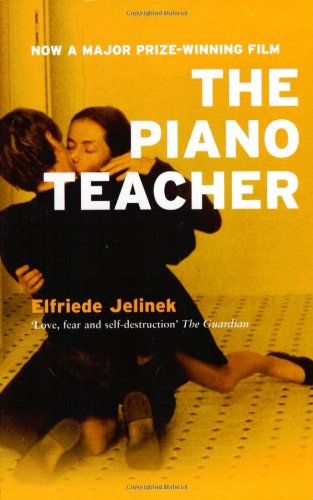
Book 158, Austria: Elfriede Jelinek’s "The Piano Teacher"

Kind of tricky to track down this book – the National Library had only one English-language copy in stock, and it was checked out. (Oddly enough, the Mandarin and Malay translations were still available.)

Had to go down to my old stomping grounds of NTU to check out the copies they had on reserve there as compulsory syllabus readings, in between Thomas Mann’s Death In Venice and WG Sebald’s... something or other.


And damn. Now I know why the censor-happy National Library won’t keep multiple copies in stock. Never mind that this is a work by a Nobel Prize Laureate, the greatest Austrian writer of her generation; a work made into a landmark critically acclaimed work of Franco-Austrian cinema.

The truth is, this book is sick, in the best way possible. Oh, the perspective’s technically third person, but it goes under your skin… It begins with a portrait of the twisted relationship between the 36-ish-year-old piano teacher Erika Kohut and her Mother; they live together in a tiny flat and the Mother refuses Erika any luxuries whatsoever, flying into a rage when she spends money on a dress to make herself look pretty, pretty girls are sluts, etc., all she wants to do is keep Erika as her tool to earn enough money for her old age so they can live together in a bigger condo, and all this good-for-nothing daughter does is waste her pay on frivolities…

So we hate the mother, and we’re rooting for Erika, and even more so when we learn that Erika was groomed to be a great concert pianist from her girlhood, her mother and her grandmother consumed by dreams of fame and success that brought them to Vienna, the city of music. But somehow Erika screwed up a critical recital and has had to live her life as an angry repressed spinster piano teacher at the Vienna Conservatory…

…and it turns out she’s kind of an awful person as well, deliberately kicking or pinching people in crowded trolleybuses, stalking through the Turkish district to look at girlie peepshows or Prater fairgrounds to catch couples doing it in the grass (there’s some horrible things said about Turks and Yugoslavs in the process; hope that’s the character speaking and not the author)…

… and there’s a young, blond, athlete of a piano student named Walter Klemmer, and he’s hot for her, and she’s hot for him, but he’s asserting his god-given male entitlement and worship of his own 7-inch cock on the world, flirting with every young girl, and she won’t do with that, and so she hurts other people, she hurts herself especially, she hurts her mother too, and she hurts Klemmer, in a series of psycho nonconsensual BDSM sequences in the conservatory toilets, broom closets and her mother’s sacred bedroom…

In a way, it’s a feminist’s nightmare: a woman writing about women who are hysterical, steely in public but desiring domination and punishment in private, women who are wildly weak. Women like the heroines of Greek tragedies. Xiao bitches, as Singaporeans would say.

And it is written so damn well. Aiyah, I’ll just leave it at that. Wonder how on earth I can learn from this prose style. (Rather pleased that NTU students are reading it… how does it change their lives?)


View Around the World in 80 Books!!! in a larger map

Representative quote: Erika holds Walter Klemmer at arm's length. She pulls out his dick, which he has already slated for deployment. It only needs the finishing touch, for it is already prepared. Relieved that Erika has taken over this difficult task, Klemmer tries to push his tach down all the way. Now Erika has to resist him with her entire weight so she can remain upright. She holds Klemmer's genital at arm's length while he fumbles about randomly in her vagina. She lets him know that is he doens't stop, she'll leave. She softly repeats her threat several times, because her suddenly superior will has a hard time getting through to him and his rutting fury. His mind seems fogbound with angry intentions. He hesitates. Wondering whether he's misunderstood something. Neither in the history of music nor anywhere else is the suitor simply barred from events. This woman has not a spark of submission. Erika starts kneading the red root between her fingers. She demands a privilege, but refuses to grant it to the man. He must go no further with her.

Next book: Imre Kertész's Fateless, from Hungary.

Friday, September 5, 2014

Book 156, Switzerland: "Heidi" by Johanna Spyri

I've spent a month in Switzerland before, so I've read some of its literature - Friedrich Durenmatt's The Visit and The Physicists and Max Frisch's Homo Faber, for instance. Yet I hadn't, until now, read the most clichéd work of Swiss literature in existence:


Ah, Heidi. I got an illustrated Kindle version off Project Gutenberg. No idea if it was the best translation, but a lot of modern translations seem to be adaptations for younger readers.

And honestly, I can see why they'd target younger readers. The tale is soppy as all hell - Heidi is just five when she enters the scene, and she's all sweetness and light and innocent virtue, never once selfish or rebellious the way actual children are.

She's an orphan: her dad died in a logging accident and her mum died of grief as a result, and her cousin Deta is dumping her on their cranky old grandfather 'cos she's got herself a decent-paying job as a maid in Frankfurt. Never mind that her grandfather, the Alm-Uncle, is famously cranky and solitary and lives all alone in the cold mountains with only his two goats, and everyone in the village thinks she's committing reckless child neglect by placing her in his hands.

But ah, little Heidi is a miracle-worker! She charms the Alm-Uncle into loving her, and is utterly content with only having goat milk and cheese and bread for food and sleeping on a bale of hay, and spends all her days hanging out with Peter, the 11 year-old goatherd, playing with the goats and marvelling at the beauty of the sunrise and sunset and the flowers and the grass and the pines and the everything that you'd think a little Swiss village girl would just see as part of the landscape.

But then we've got the big conflict: Deta returns and asks her to come to Frankfurt to become a friend to Clara, an 8 year-old invalid daughter of the rich Mr Sesseman. The story thus turns into a narrative contrasting the oppressiveness of the German cityscape with the glory of the Swiss countryside.

You see, Heidi creates a huge ruckus in the household with her innocent country ways - she offers to take in an entire litter of kittens from a guy who guards a clock tower, at one point, and freaks out her governess with the surfeit of meowing kittens overflowing from her pockets. But she wins over Clara and Sebastian the butler and rich Mr Sesseman, because she's so pure of heart.

But Frankfurt's all wrong for her, and she gets skinny and sickly and starts sleepwalking, so Mr Sesseman sends her back to the Alps, and eventually sends Clara as well for a holiday. And Clara's so invigorated by the fresh mountain air and the goats' milk and the flowers that she actually starts walking again. Seriously, now.

So yes, it's a sappy story. But it was a pleasure to read - even knowing the ending, I was amused at the exact manner in which the miracle was executed, and how gradually, and how almost believably it came about. And it's fun to enjoy things ironically. Nonetheless, I've a few questions that bug me:

1) Isn't this all a little exploitative? I mean, we're romanticising the lives of the poor here. And their relationship with the rich is one of utter harmony - the Sessemans fall over their feet in their eagerness to bestow gifts unto Heidi's community, and are thanked for it. It's not a problem that some of our characters go barefoot and some ride around on silk cushions, apparently...

2) The levels of Christianity are too damn high. The only good things Heidi gets out of her stay in Frankfurt are the ability to read, and a new understanding of prayer and the ways of God, with which she's able to convince her bitter old grandfather to start going to church again. Really, the preaching is laid on pretty damn thick - not sure how much they preserve this in today's versions.

3) Is Peter an asshole? I wanted to declare him one as I read the story and watched him get rabidly jealous of anyone who became friends with Heidi, because he wanted to be her bestest and only friend aside from the goats - he has a habit of shaking his little fists at the sky, and even pushes Clara's wheelchair down the mountain at the end (without her in it, mind). So he is an incredible brat compared to our heroine. But then he's human - he's the one who actually acts the way a poor kid should act in the presence of the 19th century über-rich, which is to get mad and get smashing.

And a couple of factoids. First, the sequels to this book - Heidi Grows Up and Heidi's Children - weren't written by Johanna Spyri but by her translator. And second, Heidi isn't even her real name. It's Adelheid, which is an actual Christian name, whereof Heidi is a corruption, confusing the proper folks in Frankfurt no end.


View Around the World in 80 Books!!! in a larger map


Representative quote: 
"Grandmama told me that God would make everything much better than I could ever dream. I shall always pray from now on, the way grandmama taught me. When God does not give me something I pray for, I shall always remember how everything worked out for the best this time. W'll pray every day, grandfather, won't we, for otherwise God might forget us."

"And if somebody should forget to do it?" murmured the old man.

"Oh, he'll get on badly, for God will forget him , too. If he is unhappy and wretched, people don't pity him, for they will say: 'he went away from God, and now the Lord, who alone can help him, has no pity on him.'"

Next book: Johann Kraftner's Princely treasures from the House of Liechtenstein, from Liechtenstein.

Tuesday, July 8, 2014

Book 153, Luxembourg: “At the Edge of Night” by Anise Koltz

We’re at the last and the littlest of the Benelux countries now! Luxembourg’s got a weird history: its half a million inhabitants speak a mix of French, German and Luxembourgish (apparently almost a dialect of German), and its writers produce literature in all three languages.


Koltz, for instance, writes in French – as most of her fellow poets do. But she used to write in German before the death of her husband in 1971 (he was imprisoned during World War II, and she says he was a late victim of the Nazis). Plus, she still writes children’s books in Luxembourgish.

Critics even say Koltz’s French is very German-like – and certainly, in this bilingual compilation of her poetry from the 2000s, her French feels spare, almost schoolchild-simple. It’s full of these stark, Rimbaud-like invocations of hell - fire, bones, wolves, invocations of monstrous mothers and fathers and brothers.

But there’s no jumble – these are brief, devastating pieces of writing, focused on just a few images, like joined-up haiku. And it’s weird, because I don’t think I would advise my writing students to create stuff like this. The title of this collection, for example, comes from this poem

COLD

At the edge of night
my mother is seated
her clothes in tatters
two fangs
in her toothless mouth

She throws herself on me
and sucks out my marrow 

It’s a nightmare vision, but you can imagine an angsty adolescent writing it in a I-hate-my-mom kind of way. It does sound better in French, but doesn’t everything?

FROID

Au bord de la nuit
Ma mere est assise
ses vêtements en loques
deux crocs
dans sa bouche édentée

Elle se jette sur moi
et me suce la moelle

Some of her short stuff is fantastically clever and awesome, though:

LA TERRE

Quand tu marches
tu sens terre
s’agripper
à tes semelles

Elle n’oublie pas de t’oublier


THE EARTH

When you walk
you feel the earth
cling
to your soles

It doesn’t forget to forget you

Damn, reading this stuff makes me miss translation work. There’s a marvelous alchemy that happens when poetic language passes from one tongue to another.

The only longish poems here might be the ones from her 2003 collection Fire-Eater/L’avaleur de feu, dedicated to her husband René – though for all I know, these are just glued-together untitled fragments, separated by rows of asterisks and arranged in columns of Roman numerals. It’s hard to digest continuity when you’re reading two versions at the same time: facing pages, parallel texts.

My favourite piece in here is from that collection, btw. I’ve included it below:


View Around the World in 80 Books!!! in a larger map

Representative quote:

***

Ma mémoire est lourde
comme un vaiseau qui coule

J’ai vogué
dans toutes les parties du mond
les dieux m’égorgeaient
je les égorgeais –

Ecrivant dans leurs bouches
dans leurs entrailles
j’ai oublié la poésie –

je suis devenue poète

***

My memory is heavy
like a sinking ship

I have wandered
all over the world
the gods slit my throat
I slit theirs –

writing in their mouths
in their entrails
I forgot poetry –

I became a poet

Next book: Marcel Proust’s Swann’s Way, from France.

Monday, June 30, 2014

Book 152, Belgium: Hygiene and the Assassin by Amélie Nothomb

Belgium’s famous for its comic writers – Peyou of the Smurfs and Hergé of Tintin, for instance. It’s got a whole museum devoted to the graphic novel form. 

But I’m still on the road, and so I’ve to make do with Kindle books instead. I realise now I should’ve downloaded a free copy of Nobel Prize-winning playwright Maurice Maeterlinck’s The Blue Bird, an allegedly insipid little drama about children and innocence.

Instead, I bought the first novel of Francophonie superstar Amélie Nothomb, whose novella Sulphuric Acid is so amazing that I’ve regularly lent it out to my students as an exemplary creative writing text. And surprisingly, Hygiene and the Assassin (originally Hygiene del’Assassin) is also about children and innocence and a Nobel Prize-winning author… 


But I’m getting ahead of myself. The tale’s set in 1991, when the First Gulf War is breaking out. A horrifically ugly and obese 83 year-old shut-in of a novelist named Prétextat Tach has learned he has succumbed to incurable cartilage cancer, and has finally agreed to grant interviews to curious journalists about his life and work.

Tach uses the interviews as opportunities to demonstrate his power over the journalists, insulting and mentally torturing them. (One guy is reduced to retching just through a description of Tach’s daily diet, which mostly consists of fatty by-products.)

Then one day, a 30 year-old female journalist turns up – her name is Nina, by the way – and she will not take his nonsense. She’s the only one of the lot who’s read all his books, who actually claims to enjoy them despite his insistence that they’re written to the detriment of the human race with all their graphically debauched depictions of human depravation, and who rightly determines which one of them is actually autobiographical.

I won’t spoil this one for you guys – it’s that good. And one of the coolest things about it is that it’s written mostly in dialogue format – in duologue format, in fact, since it’s almost entirely made up of scenes of Prétextat and his interviewer alone in a darkened room. And god, the power play with Nina is awesome. Wasn’t surprised to discover that the story’s already been adapted into a play in Paris.

Which brings me to a point of uncertainty for this blog: does Hygiene and the Assassin actually take place in Belgium? I really can’t tell – there’s a mention of francs, but those were used in both France and Belgium before the introduction of the euro. And there are mentions of Sartre, but of Maeterlinck also. And we discover that Tach grew up on a château at Saint-Sulpice – and while there's places called Saint-Sulpice in France, none of them is a volcanic plateau as far as I know.

I’ve decided, however, to believe that this interview takes place in the French half of the city of Brussels/Bruxelles, where Nothomb lives when she’s not in Paris. If enough people protest, maybe I’ll read Henri Michaux’s Darkness Moves instead.


View Around the World in 80 Books!!! in a larger map

Representative quote: 

“Let’s not play with words, all right?”

“You are saying this to a writer?”

“I’m not talking to the writer, I’m talking to the assassin.”

“One and the same.”

“Are you sure of that?”

“Writer, assassin: two aspects of a same profession, two conjugations of the same verb.”

“Which verb is that?”

“The rarest and most difficult of verbs: the verb ‘to love.’ Isn’t it funny how school grammar books sometimes use it as an example, when it’s the verb with the most incomprehensible meaning?”

Next book: Anise Koltz’s At the Edge of Night, from Luxembourg.


Tuesday, March 4, 2014

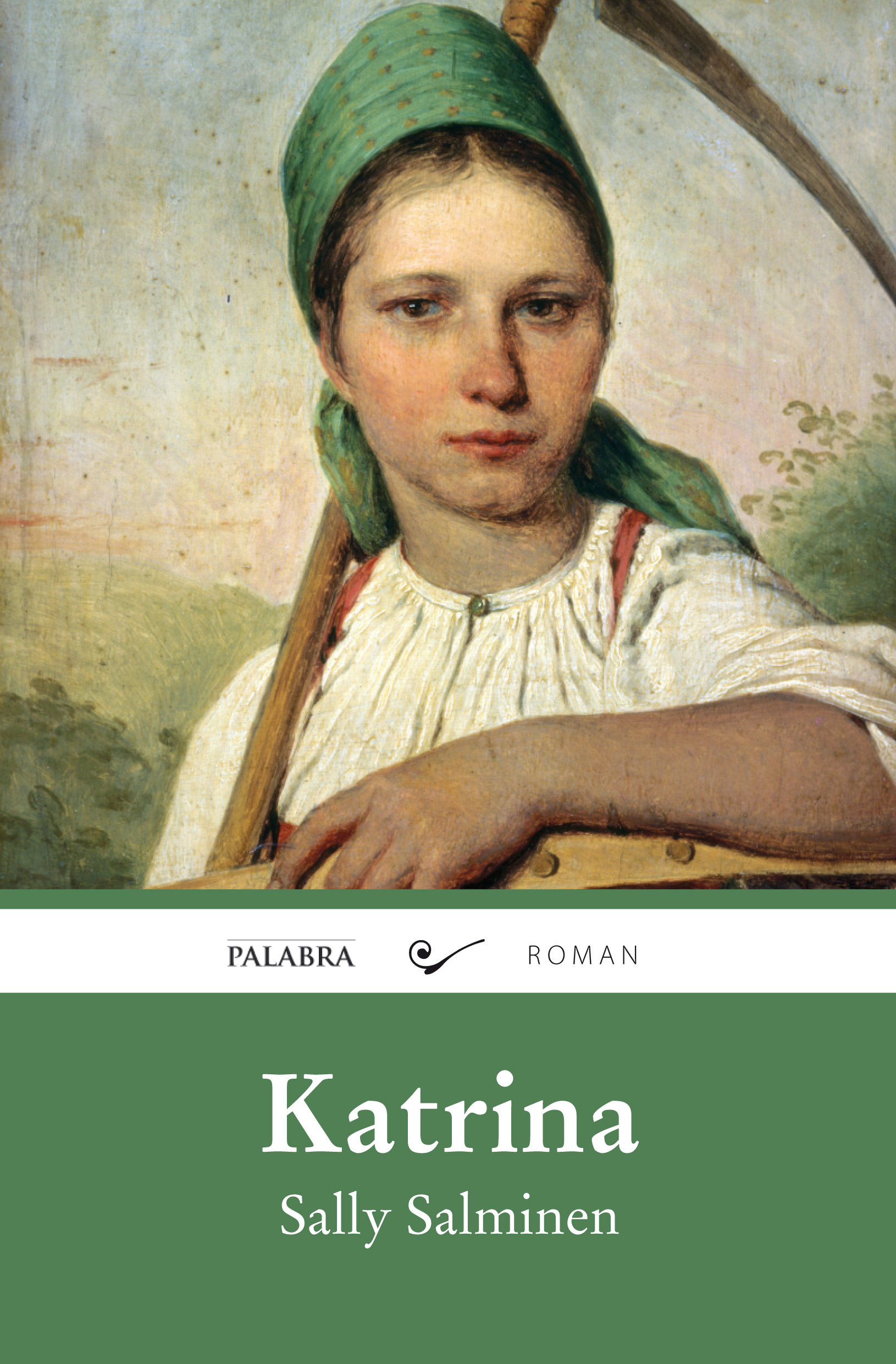
Book 145, Åland: "Katrina" by Sally Salminen


I’m writing this from Colchester, where I’m staying at the home of Suzanne Pemberton. She teaches English as a Second Language at the University of Essex here, and she had me visit her classes on as a guest. Turns out that Kazakh and Iraqi students are ridiculously smart and motivated. Citizens of BRICS and MINT countries, you’d better watch out.

Ah, but why am I at U of E? Because I had to track down a book at the Albert Sloman Library (via SCONUL Access), hailing from one of the most obscure is-it-a-country-or-not-a-country geopolitical entities. I’m talking of course about Åland (pronounced AW-land), the autonomous Swedish-speaking islands to the west of Finland, home to fewer than 30,000 people and the 1936 runaway hit novel Katrina – which was, believe it or not, translated into twenty different languages in its time.

And although the copy of the book I’ve got hasn’t been checked out since forever, I can see why it was popular – hell, I had little tears jerking out of my eyes by the end.


The eponymous Katrina starts off the story as a proud, beautiful 23 year-old farmer’s daughter in northern Österbotten (a region of Finland now called Ostrobothnia). She’s seduced by a young Ålander called Johan, who lures her into marriage with the promise to take her to his mansion on his island, where they grow exotic, luxurious things like wheat and apples. (Seriously.)

Of course, once she arrives she discovers that he’s been lying his ass off, that in fact he’s the town liar and his home is just a rented shack with only nettles in his garden (wheat and apples do grow on other people’s property, though), and he has to sail off that very night, because that’s what sailors do, don’t they, and meanwhile the powerful landlords Captain Nordkvist and Captain Svensson expect her to do indentured labour on the farms for them, paid in kind, not cash. Slavery, she thinks in despair, lying desolate in her cot, exhausting from her days in the field with a psyche or on the mudflats pulling up rushes.

And you figure maybe you know what’s coming: she’s gonna liberate herself, pack up and leave behind this good-for-nothing trickster, maybe with the baby in her belly, because she’s strong and spirited and can even beat down Svensson with her fists when he comes knocking on her door for sex.

And yet she doesn’t. I suppose we’re going into spoiler territory here, but this 381-page book isn’t the tale of a young woman but the tale of a woman – it follows her all the way to her death, the years rolling by quickly, child after child, famine and flu, tragedy and triumph, even learning to love her childlike, fabulist, happy-go-lucky husband on the way. And so it goes, till the time she’s an old woman with her children dead or scattered in Australia or Marienhamn, and the islands now separate from Finland after World War One (which means the bulk of the story must have taken place in the nineteenth century), her descendants actually living bourgeois lives with servants and fine china in the city while she scrimps by in her hut, immobile, too stubborn to move to get out of the cold, only one apple tree she planted herself left in the yard upright and unwithered.

It’s kind of instructive when you think of it in terms of novel-length writing, because it doesn’t consist of overarching quests so much as how a woman copes with all the challenges facing her, how she reacts or rebels or falls into depression but is above all strong, despite the faithlessness and follies of her husband and sons. She’ll face down the landlords to get money for her husband’s medicine, bully her kids into going back to school, drown her son’s dog, take in her son’s retarded baby momma, climb out of the broken ice, chew ferns as she sits stranded on an islnad, anything to survive, even when her own children curse her for her Österbotten accent.

And in the end, she’s just a poor country woman on the doorstep of her son’s house, whose own grandchildren can’t even recognize her. This is a woman’s epic, told from the viewpoint of the one who stays at home, holding it all together while the men board ships and disappear into the distance. A Penelopiad, if you will.

Honestly, it’s like the Scandinavians wrote great developing-nation novels before we even thought of the term “developing nation”. Cf. The Kingdomof the Earth, cf. Independent People.

Most of Katrina actually takes place in a village called Västerby on an island called Torsö, but I can't seem to track them down. Wonder if Salminen cooked them up, or the names of the places just changed?


View Around the World in 80 Books!!! in a larger map

Representative quote:
They both kept their courage, though the effort was great. Once outside, Gustav slung his bag on his back, and waved from right to left at the little cabins as he went whistling down the hillside. Katrina stood by the window and watched him disappear.

He was so like Johan – so unsteady and reeling in his walk, and already he held his body bent forward. An infinite sadness filled Katrina. Years seemed to have rolled backwards, and she herself was a young woman, standing there saying good-bye to her husband. It had been good-bye, good-bye while life endured.

Next book: The Kalevala, from Finland.

Wednesday, January 8, 2014

Book 141, Denmark: "Anecdotes of Destiny" by Isak Dinesen

Just been to watch Disney’s Frozen. It’s good! Just awfully American.

This is relevant to our discussion, of course, since it’s based on a work by Denmark’s most famous author: a weird, kinda effed-up, mysteriously sexual and amoral little girl-quest called The Snow Queen. Read it if you haven’t already. - it’s honestly one of his less horrifying fairytales. The Little Mermaid beats The Steadfast Tin Soldier, but is in turn beat by the hair-raising Red Shoes. (Oh man, I just remembered that Death himself appears in The Nightingale. Brrr.)

I’d honestly considered doing Hans Christian Andersen’s autobiography or travel writings, but they were a little too long and uncanonical. What I wanted was something so famous that a film had been made about it, hell, maybe even a local publisher had decided to name an entire line of books after it…


I mean “Babette’s Feast”, of course. It’s just one of the five stories in this collection. Isak Dinesen (whose real name was Karen Blixen, not vice versa) is actually better known for her similarly cinematic novel Out of Africa, which takes place in Kenya.

And hell, these stories are good. Like, break-your-heart, amazeballs, despair-at-your-own-fictive-abilities good. Ohhh, I can’t give away the plot of “Babette’s Feast” – you just have to read it for yourselves – but suffice it to say that it involves a great chef who sacrifices everything for her art.

These are tales of sacrifice, really – of people deciding that the rational way of living judiciously or grasping contentment as it comes is simply not the thing to be done, and how they lead counter-intuitively satisfying lives for all that. Bizarre people. Sexy people, come to think of it. There’s a whiff of fucking or almost-fucking in pretty much all five stories.

What’s more worth emulating for me, possibly, is the way she’s so willing to give every one of her characters a back story – she divides her tales into sections, so that we can step back and examine the youth of each fallen heroine before action properly begins – and there’s a crystalline brevity to each section that makes it impossible to call even the longer stories novellas (maybe novelettes?). These aren’t quite in the short story tradition: they’re tales told round the fire, drawn from faraway lands…

Yeah, for some reason, Dinesen wasn’t into writing about Denmark much. “The Diver”’s set in Shiraz, Iran; “The Immortal Story” in Canton, China; and “Babette’s Feast” and “Tempests” happen in Norway, which happened to be a Danish colony then: the former’s in a colony on the Bervelaag Fjord, while the latter’s in the town of Christianssand.

Bu before you yell that I’ve gotta disqualify this volume, I’ll have you know there are Danish characters, dammit – the Copenhagen theatre troupe owner Herr Soerensen and the innocent 17 year-old sailor Povl Velling from Marstal – and the very last of the stories takes place in the country estate of a young Danish squire, though it doesn’t actually say which part of the country he lives in. But even that Danish tale takes place two hundred and fifty years before publication. These are Arabian nights exotica, to a degree, with events shifted to magical elsewheres all the better to help the reader swallow the oddness that is life itself…

(The melancholy and magic in these tales: are they like Andersen’s? Maybe.)

One little political note: I don’t quite understand why, with “The Immortal Story”, you should choose to set a story in China and not have it feature any Chinese people except servants. Instead we’ve got a Scroogey Englishman, a beautiful and impetuous Frenchwoman, a Jew with Asperger’s and a young, dumb Dane. But perhaps that’s what the spell of Canton was back then – a land where whites ran away to, to survive – and the same reason why Singapore is mentioned in the same story, as a place whereof the less is said, the better.

Leaving my home country at 5pm today, btw. Will be visiting a friend in Hanover, then back to school again! Looking forward and fearing at the same time, would you believe it.


View Around the World in 80 Books!!! in a larger map

Representative quote: (from “The Immortal”)  Elishama stood and looked after him. When the big young figure was no longer in sight, he himself lifted the shell to his ear. There was a deep, low surge in it, like the distant roar of great breakers. Elishama’s face took on exactly the same expression as the sailor’s face a few moments ago. He had a strange, gentle, profund shock, from the sound of a new voice in the house, and in the story. “I have heard it before,” he thought, “long ago. Long, long ago. But where?”

Next book: William Heinesen’s Black Cauldron, from the Faroe Islands.

Monday, October 14, 2013

Book 135, Guernsey: "The Guernsey Literary and Potato Peel Pie Society" by Mary Ann Schaffer and Annie Barrows

I've decided, with some regret, not to do Wales, Scotland, Northern Ireland and England as separate entities. We do not have a majority of citizens in these regions calling for independence (not even in Scotland!). Also, if I did all four countries within the UK, I'd logically also have to do all seven emirates in the UAE. All fifty states in the US might be pleasant, but Emirati writing still has a long way to go.


But we're on Guernsey now! One of the two Channel Islands - and you'll see on the map below how close they are to France, and thus how understandable it is that they're regarded as a separate from the UK. Also understandable is how they were occupied by the Nazis during WWII, the Brits tactically abandoning them for the sake of their own behinds.

The Guernsey Literary and Potato Pie Society is a description of that occupation, narrated through the letters and telegrams of the single, thirty-something year-old writer Juliet Ashton in 1946. She's a London girl, the recipient of recent fame and success after the publication of her humorous wartime newspaper columns - because people did need humour during the war - and now on track for her next book. 

One day she receives a letter from a certain Dawsey Adams, a Guernsey fisherman who's very much enjoyed a second-hand copy of Charles Lamb's Selected Essays of Elia which once belonged to her. He mentions the existence of the eponymous literary club during the war - at first an excuse to explain to the Germans why they were out so late during curfew, but later a coping mechanism (the pie being another such coping mechanism). The two commence a correspondence, and gradually Juliet comes to realise her destiny is to go to Guernsey and chronicle the experience of the war there.

It's honestly rather lovely to read an epistolary novel of this sort, recalling a time before e-mail and Whatsapp (though I really have no idea how one-sentence letters exchanged on the same day work - these people do not have footmen, after all). Principal author Mary Ann Shaffer has a wonderful range of voices, vivacious and folksy and prissy, bringing to life the cast of her novel. 

And what a cast it is. On the island, there's the poultice-brewing wise woman Isola Pribby, the haughty Adelaide Addison, the worried half-Jewish butler John Booker - and off the island, there's the frighteningly charismatic American publisher Markham V. Reynolds, and of course the terribly fun Juliet herself. Plus the unseen figure of Elizabeth - this young independent woman who invented the ruse of the literary club and was eventually arrested by the Nazis towards the end of the war, and who ends up being the subject of Juliet's book.

Mind you, this isn't high literature, by certain standards. The cover above shows how marketable it is as  pure and simple chick-lit - period too! An adaptation of Pride and Prejudice's love story: Dawsey is Darcy and Markham is Wickham. But it is so full of story, and texture, and joy, which is why it was a bestseller, and what I'm having so much trouble with in my own writing.

One final note: Shaffer was the original author of the book - wrote it as her first complete novel when she was an old woman, years after being stranded in a bookshop during a foggy Guernsey excursion and learning all about the occupation. However, once the novel had been optioned, changes were suggested - and she was seriously sick - so her niece, Annie Barrows, stepped in and filled her shoes, recreating the familiar style of storytelling she'd heard so much during family visits. I rather like that. Two women, one beginning a story, the other ending it. But there'll no more Shaffer novels, I'm afraid: she's dead and gone as of 2008, just before the book was published in its current form.

I actually finished this book last week - have been trying to keep up with my own reading in the meantime. It's a quick read, as is my next book, so I'll probably have my next update up pretty damn quick.


View Around the World in 80 Books!!! in a larger map

Representative quote: As the mail boat lurched into the harbour, I saw St Peter Port rising up from the sea, with a church at the top like a cake decoration, and I realised that my heart was galloping. However much I tried to persuade myself it was the thrill of the scenery, I knew better. All those people I've come to know and even love a little, waiting to see - me. And I, without any paper to hide behind. Sidney, in these past two or three years, I have become better at writing than living - and think what you do to my writing. On the page, I'm perfectly charming, but that's just a trick I've learnt. It has nothing to do with me.

Next book: Gerald Durrell's Menagerie Manor, from Jersey.