Showing posts with label contested nation. Show all posts

Tuesday, February 28, 2017

Book 168, Transnistria: "Siberian Education" by Nicolai Lilin

Yup, we're doing another contested nation: Transnistria, aka the Pridnestrovian Moldavian Republic! The UN claims it's part of Moldova, and only three other contested states recognise it: Abkhazia, South Ossetia and Nagorno-Karabakh. (Lord knows if I'll be able to find literature from or about those nations.)

But you know what? I'm hella glad I tried to find an author from this country that doesn't even send delegates to Miss Universe, because Siberian Education is pretty damn amazing.


It's a memoir (with admitted creative licence) written by a young writer who grew up in the organised criminal society of Bender, descended from gangsters and other outcasts deported to Siberia during the Soviet Union. He describes its intricate culture, with all its codes of honour and formality about guns and crucifixes and taboos against speaking directly to cops and its own effing criminal language—a culture which makes rival gangs, such as the oft-maligned Black Seed, seem like barbarians in comparison.

There’s several chapters to this story, detailing the gifting of his ceremonial pike (switchblade) at the age of six, his harrowing journey into enemy territory on his thirteenth birthday, a stint in a filthy juvenile detention facility, a teenage mission into other neighbourhoods to destroy the perpetrators of the rape of a neurodivergent girl (he claims that his society always respected the crazy and disabled as God’s children)—and it’s not in strict chronological order because he keeps diverging into other memories and family legends and folktales before returning to the main thread, Arabian Nights style, so that the whole thing’s a series of nested matryoshka-style tales. It’s really incredibly well told.

…In fact, the whole thing may be a little too incredible, full stop. He does come across as a bit of an all-star Mary Sue, an excellent fighter with a natural brain for poetry and archaic religious Russian, not to mention his phenomenal skills as a tattoo artist (which are legit; Lilin runs a tattoo parlour IRL). And Donald Rayfield, a professor of Russian and Georgian, straight-up calls the whole thing "a fantasist's ravings". Huge factual holes are being found in Lilin's sequel to this book, Free Fall: A Sniper's Story, about his military service in Chechnya—and the odd thing is, Lilin replies to most of these objections with an admission that he made most of it up for literary effect.

So how much of the core of these tales is true? Maybe not much—he wrote these tales in Italy, in the Italian language, far from his hometown, and he says that the Moldovan invasion's destroyed the society he documented. So there aren't that many people around who can directly contradict him.

And told up—upon further Googling, I've discovered that the book was never translated into Russian (although it was into about 40 other languages) and has been dismissed by a Russian journalist as a hoax. And even after that hullabaloo,  a 2013 film was made. Now I'm starting to wonder if Lilin actually is Transnistrian.

Ah well, it's still a hell of a book. If nothing else, it's a tale of what happens on the fringes of Russian culture, making it clear that the former Soviet Union was never as united as it seemed, with huge rivalries between those from the western, Moscow and St Petersburg-dominated side and Georgians, Armenians, Ukrainians and—of course—the Siberians. Makes you wonder about that upcoming superhero movie, Guardians, with heroes from different former republics, including a bear-man from Siberia. Would they all really have been friends?


Representative quote: "And now tell me why we should trust those who have spent their whole lives killing our brothers, locking us up in prison, torturing us and treating us as if we didn't belong to the human race? How is it possible, tell me, to trust those who live thanks to our deaths? Cops are different from the rest of humanity, because they have an innate desire to serve, to have an employer. They don't understand anything about freedom, and they're scared of free men."

Next book: Herta Müller's The Land of Green Plums, from Romania.

Saturday, April 14, 2012

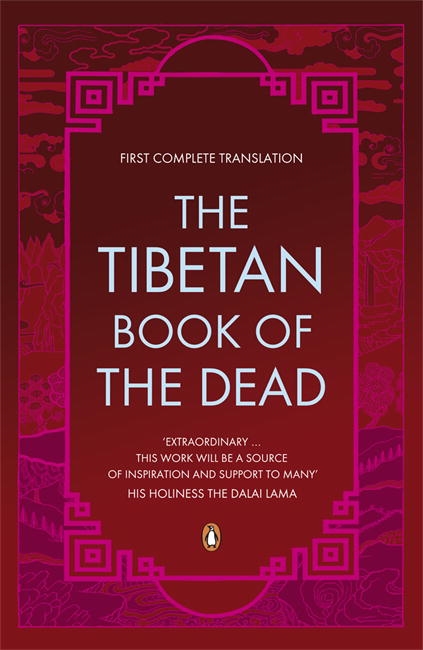
Book 94, Tibet: "The Tibetan Book of the Dead"

Cor. This was a bloody good read, way more interesting than the Quran or the Lotus Sutra or the Bible (most bits of the Bible, anyway). I was gonna say it was easy to see why it became a Western cult classic, then I remembered that for the longest time what the hippies and the beats were perusing was a single portion of this volume: The Great Liberation By Hearing.

This baby I’ve been lugging around is the first full translation, based on the three volume manuscript from the library of the Kyabje Dudjom Rinpoche, completed by the scholar Gjurme Dorje with support by HH the Dalai Lama. Check it!


And what makes this book so awesome? Well, first of all, it’s brilliantly random: as crazy if not crazier than the palimpsest hotchpotch of the Old Testament. It consists of prayers, philosophy, catalogues of deities, medical instructions for determining the date of imminent death, magical rituals for forestalling said death, a detailed practical guide to ensuring enlightenment or at least rebirth as a higher being following said death, and even a masked drama demonstrating the posthumous fates of a butcher and a pious merchant, as Yama Dharmaraja, sage of hell beings, judges them by weighing the white pebbles of their good deeds against the black pebbles of their sins. (Yes, shades of the Egyptians, which is why the English title of this book stuck instead of its proper name, The Bardo Thodol.

Second of all (a phrase my boyfriend insists is ungrammatical) it is so damn *sensual*, so psychedelic that one wonders what the prophets were smoking, or if mountain air just predisposes one toward incredible visions. It’s bizarre, after reading the fairly square first chapters, which concentrate on the usual Buddhist exhortations to renounce worldly attachments, to be told of the copulating, blood-drinking, sexually dimorphic rainbow-coloured buddhas and bodhisattvas and gatekeepers and herukas that inhabit the cardinal portions of one’s skull: Gauri, white-in-colour, carrying a human corpse as a cudgel; fox-headed Srgalamamuki, black in colour, eating entrails; yak-headed Manauraksasi, brownish-white and holding a vajra; sow-headed Varahi, blackish green, holding a noose of fangs; scorpion-headed Amrta, reddish yellow, holding a lotus; three-faced six-armed Vairocana, brandishing a wheel, an axe, a sword, a bell, a ploughsare and a blood-filled skull, joyously and indivisibly embraced by Buddhakrodhesvari; and Samantabhadra and Samantabhadri, the Buddha-body of Reality.

Oh yes, and trying to foretell your death by staring at the sun or your shadow or the tinges of blood in your urine, and channeling your powers of concentration so that should you topple unexpectedly from a mountain, your soul will escape your body from the correct orifice. Madness!

And also the gentle comfort it must give one to imagine one’s body at a funeral, surrounded by loved ones repeating prayers into one’s ear directing the soul to higher realms.

Yes, this is the kind of religious text I like: more imaginative than preachy; the kind I don’t have to take absolutely seriously and expands my imagination rather than limiting it. O Child of Buddha Nature, may you read many more books as weird and wonderful as this!


View Around the World in 80 Books!!! in a larger map

Representative quote:
There are, altogether, nine different pathways through which consciousness transference can occur, and these are associated with persons of superior, average and inferior capacity. The aperture of the crown fontanelle is the pathway through which [consciousness] departs to the pure [realm of the] sky-farers. Given this, [it is said that] one will attain liberation f awareness exits through the [crown fontanelle]. Since this is the supreme pathway, it is extremely important that one trains in directing one’s mental focus towards this [aperture]. Furthermore, if consciousness is transferred through the pathway of the eyes, [it is said that] one will be born as a universal monarch, and if it is transferred through the left nostril, one will obtain an unimpaired human body. These are the three optimum apertures associated with those of superior [capacity].

One will, however, be born as a yaksa if [consciousness is transferred] through the right nostril, or as a god of the world-system of form if [it is transferred] through the ears, and as a god of the world-system of desire if [it is transferred] through the navel. These are the three medial apertures [associated with those of average capacity]. Lastly, one will be born as an animal if [it is transferred] through the urethra, as an anguished spirit if [it is transferred] through the sexual passage, and as a hell being if it is transferred through the rectum. These are the three inferior apertures [associated with those of inferior capacity]. Given that there are such very great consequential differences between the various apertures through which consciousness transference may occur, there wil be inestimable benefits in directing one’s awareness to the crowd of the head, at the time of death.

Such is the forceful consciousness transference. SAMAYA!

Next book: Lil Bahadur Chettri’s Mountains Painted with Turmeric, from Nepal.

Wednesday, March 14, 2012

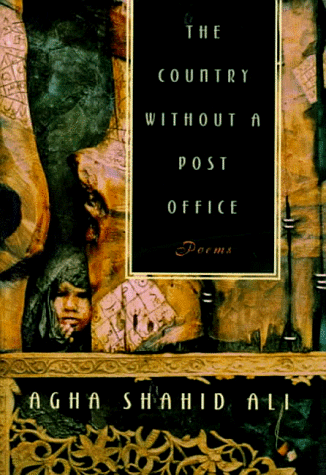
Book 93, Kashmir: "The Country Without a Post Office" by Agha Shahid Ali

News flash: I am sick. I've got one of those fevers that makes me feel hot and cold at the same time and I'm not getting anything productive done (updating this blog does not count as being productive). What makes this all the more ridiculous is that this is part of a cockamamie scheme I had to do non-UN-recognised states: Kashmir, Tibet, Palestine, Hong Kong, Macau, all in the hopes of pissing off some of my Indian and Chinese friends.


Plus, you've noticed that I decided not to do Salman Rushdie's Shalimar the Clown, didn't cha? I actually made that decision fairly early: I wanted someone genuinely Kashmiri, hell, and a highly praised Kashmiri-American emigré poet was just what the doctor ordered.

And seriously, Shahid is awesome. I picked up his posthumous book of ghazals, Call Me Ishmael Tonight, and I fell in love - then I realised this was a patchwork collection snatched from various bodies of work he'd published before. Didn't feel quite right.

So I pulled Rooms Are Never Finished off the shelves: a work mourning his mother, recording his journey from Amherst, Massachusetts to Srinagar to deliver her body for burial. Surprise, surprise: I did not like this one as much: way too many abstractions and allegories, real tragedy subsumed in Zainab's mourning over the martyrdom of Imam Husain and Radha crying out to the Dark Lord. Didn't help that Shahid had a penchant for extremely long poems, written in sections composed of prose poetry or terza rima or sapphics; only the ghazals and villanelles were a a breath of fresh air in between.

So I reserved The Country Without a Post Office from the repository used collection, and hallelujah, the anguish is way more direct and unfiltered: these pieces are written from 1991 to 1995, reflecting on the crazy bloodshed of that era. Thassa right: I combed through four books while enduring illness just for this bloody blog post.

Don't actually feel like analysing it now. Just wanna sleep.


View Around the World in 80 Books!!! in a larger map

Representative quote:

Ghazal

The only language of loss left in the world is Arabic -
These words were said to me in a language not Arabic.

Ancestors, you've left me a plot in the family graveyard -
Why must I look, in your eyes, for prayers in Arabic?

Majnoon, his clothes ripped, still weeps for Laila.
O, this is the madness of the desert, his crazy Arabic.

Who listens to Ishmael? Even now he cries out:
Abraham, throw away your knives, recite a psalm in Arabic.

From exile Mahmoud Darwish write to the world:
You'll all pass between the fleeting words of Arabic.

The sky is stunned, it's become a ceiling of stone.
I tell you it must weep. So kneel, pray for rain in Arabic.

At an exhibition of miniatures, such delicate calligraphy:
Kashmiri paisleys tied into the golden hair of Arabic!

The Koran prophesied a fire of men and stones.
Well, it's all now come true, as it was said in the Arabic.

When Lorca died, they left the balconies open and saw:
his qasidas braided, on the horizon, into knots of Arabic.

Memory is no longer confused, it has a homeland -
Says Shammas: Territorialize each confusion in a graceful Arabic.

Where there were homes in Deir Yassein, you'll see dense forests -
That village was razed. There's no sign of Arabic.

I too, O Amichai, saw the dresses of beauitful women.
And everything else, just like you, in Death, Hebrew, and Arabic.

They ask me to tell them what Shahid means -
Listen: It means "The Belovéd" in Persian, "witness" in Arabic.

Next book: "The Tibetan Book of the Dead", from Tibet.