Showing posts with label poetry. Show all posts

Wednesday, May 24, 2017

Book 171, Greece: "Theogony" and "Works and Days" by Hesiod

It's so weird that you can spend your entire childhood and adult life surrounded by references to Greek mythology—from Roger Lancelyn Green's Puffin Classics to Disney's Hercules to references in Plato's Republic in college to hate-watching Percy Jackson and the Lightning Thief—and never actually end up reading the source texts those myths are from.

This is one of those source texts. Hesiod's been dated to around 750 and 650 BCE, the same time as Homer; an era before the Parthenon and Socrates and Aristotle and Euripides and Alexander; just around the time folks began figuring out how to write things down. It's Archaic Greece, before even the Ancient Greece we all know, the Classical Age. There's a wonderful little intro to this edition by ML West that explains that the closest parallels to these poems we've got are from Sumer and Babylon and Egypt and Israel and India: testimony to the fact that Greece of that time was absorbing influence from the East.

Which was something I noticed when I was wandering around the museums of Greece in 2014: though Westerners may use Greek civilisation as evidence for European superiority, actual archaeologists in Greece have no problem admitting that many features of their culture were borrowed from beyond the bounds of Europe. Hell, the very alphabet they were using was based on Phoenician.


Anyway, the poems themselves—I was rather surprised to see that they weren't longer, given their legendary status. Yes, this is a prose translation, with only occasional breaks in the verse, but it comes up to just 61 pages without footnotes. Nothing like the Iliad or the Odyssey or even the collected Homeric Hymns.

Also strange is the fact that they're quite personal. While all we know about Homer is that he was a blind man (and that's from legend; we can't even be sure if the same guy wrote the Iliad and the Odyssey), here Hesiod inserts biographical information. In "Theogony", he describes how the Muses "taught him fine singing" as he tended lambs on Mount Helicon; in Works and Days he spends an inordinate amount of time scolding his brother Perses for having claimed a disproportionate amount of the family lands and then having promptly squandered it away through laziness and also consorting with corrupt officials (though wouldn't this have increased the family fortune?). He also happens to mention that he's taken a boat to Crete before. Turns out petty first-person voices found their way into even ancient literature—which we should be grateful for, since it gives us a tiny bit of insight into how folks of that era lived and thought.

"Theogony" itself is the tale of the origins of the Greek gods—a Greek Kojiki, if you will—and it's got the classic tale of how Kronos was born out from Uranus and Gaia (who're called simply "Chasm" and "Earth" here) and how Kronos castrated his dad and swallowed his ten children, except for Zeus, who was rescued by his mother Rhea and replaced with a rock, and how Zeus eventually overthrew the old gods and banished them as Titans. Here also is the tale of how Prometheus stole the fire from the gods and was damned to have an eagle eat his regenerating liver; also how the gods cursed mankind by giving Epimetheus the first woman, Pandora. (The story of the box is in "Works and Days", though. Surprisingly, the translator says it was probably a jug—an amphora.)

Reading the tales in their original form, it's shocking to realise how mediated my experience of it has been—influenced by the genre of the naturalistic novel and short story and TV and film and theatre, so that every moment of the drama is played out with its full horror and consequence. But this is parataxis, not hypotaxis—the events are reeled off quite matter-of-factly, without psychological insight. And why should there be humanity? We're speaking of gods and Titans, after all, not humans.

Most of the poem is a series of begats describing which god or Titan or nymph or monster or winged beast came from where, though. Biblical begats. And Cerberus is described as having fifty heads and a voice of bronze. Why didn't that become canonical?

"Works and Days" is weirder still: it's mostly a list about farming and household chores according to the seasons. Superstitions, too—we're told to "never place the jug about the mixing-bowl when men are drinking; a dire fate is attached to that". Also, "Do not from the fivebranched, at the prosperous feast shared with the gods, cut the sere from the green with gleaming iron," which basically means don't trim your nails. Reminds you of Leviticus, no?

Interestingly, we've got the myth of the ages of Gold, Silver, Bronze and Iron here—an echo of the Jain story of how human generations have degenerated—and our translator suggests that the men of the Age of Silver were regarded with reverence because they were seen as the creators of ancient tombs. Every generation reveres its own ancients, no? And we of the Age of Information honour these self-hating men of the Age of Iron.

But I don't revere Hesiod completely, because damn, this guy is misogynistic. It's not just the bits about Pandora—it's also the way he talks about wives and chattel women. Women are mere tools here, not to loved or respected as human beings. Not to be the audiences of this poem, apparently.

Ah well. I suppose I could close with something elevated and divine from the "Theogony", but there's such weird stuff in "Works and Days" that I've gotta quote that instead. Let us not hold our forebears in too high regard. Let us be better than them.

(From My Maps!)

Representative quote: Do not urinate standing towards the sun; and after sunset and until sunrise, bear in mind, do not urinate either on the road or off the road walking, nor uncovered: the nights belong to the blessed ones. The godly man of sound sense does it squatting, or going to the wall of the courtyard enclosure. And when your private parts are stained with semen indoors, do not let them be seen as you go near the hearth-fire, but avoid it.

Next book: Ismail Kadare's The General of the Dead Army, from Albania.

Monday, November 24, 2014

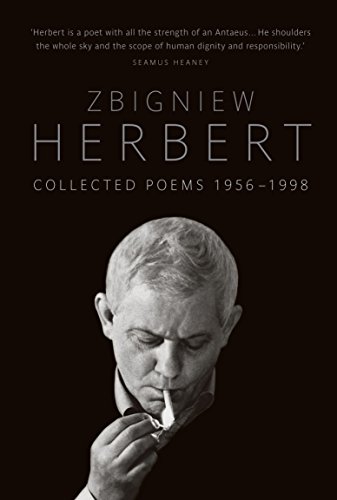
Book 162, Poland: "Collected Poems: 1956-1998" by Zbigniew Herbert

One of my favourite poets in the whole wide world is Polish!

I discovered the works of Nobel Lit Prize Winner Wisława Szymborska as a secondary school kid, back in the nineties – loved them so much; huge influence on me, etc. Unfortunately, her output wasn’t huge, so there wasn’t an extra tome of her works I could check out for this project. And I’d already used Czesław Miłosz - Poland’s other Nobel Lit laureate – for my Lithuania book.

Fortunately, there are lots of famous Polish poets. Such as this guy:


I’d heard his name bantered about amongst my friends, so I figured, yeah, why not read something of his? (Yeah, yeah, he was born in Lwow, which is now part of Ukraine, but it was Polish while he was a kid.)

This was the library’s only volume of his works – ye compleat edition, running to 571 pages. But mirabile dictu, it’s good. So good. (I’d considered abandoning it for Adam Zagajewski’s Eternal Enemies, a convenient, skinny little codex, but when I leafed through that, I found myself longing for the lambent voice of my man Herbert.)

We’ve nine different volumes of his poetry packed into this tome:

Chord of Light (1956)

Hermes, Dog and Star (1957)

Sudy of the Object (1961)

Inscription (1969)

Mr Cogito (1974)

Report from a Besieged City (1983)

Elegy for the Departure (1990)

Rovigo (1992)

Epilogue to a Storm (1998)

So we get to follow this man from a post World War to a post-Cold War era; from youth; from the age of 32 to 78. And over the five decades we see his voice develop, shift from focus to focus, intensify and mourn himself.

And it is the same voice throughout – a melancholy, erudite voice, haunted both by the horrors of his own Communist (and pre-Communist) society and the ghosts of classical history. He invokes Hermes, Apollo, Athena, Marsyas, the Minotaur, Elektra, Claudius, Marcus Aurelius, Nefertiti – also Mary Queen of Scots, George Orwell and the Emperor Meiji, come to think of it – but not in a show-off-how-smart-I-am way, but to invoke archetypes of eternal drama to show that the tyranny and torture of his land (of all lands) have ever been thus.

Loads of specific references to his childhood and his Polish contemporaries, too, which were a little harder to get. He calls himself Mr Cogito (therefore he is?) in the latter half of his career, documenting what he sees as his loserly life. But fundamentally, he’s engaged in the same Szymborska-esque mission of mourning for the entire world, for the whole of history.

That hits me, you know? This is poetry that makes me want to write more poetry. To join in the chorus as a testament. Gah.

(Though I personally do like Szymborska better still, because she also finds joy in the senselessness of the universe. But it’s not a competition. Is it?)


Representative quote:

I probably like his prose poems best, but this piece spoke of nation in a way that resonates a lot with me.

TAIL OF A NAIL

For lack of a nail the kingdom fell
- our nannies’ wisdom teaches us – but in our kingdom
there haven’t been nails for a long time nor will there be
neither those handy little ones used for hanging pictures
on a wall nor the big ones with which coffins are sealed

but in spite of this and perhaps precisely because of it
the kingdom endures and even gains others’ admiration
how is it possible to live without nails paper and string
bricks oxygen freedom and whatever else you like
evidently it is possible because it endures and endures

people in this country live in houses and not in caves
factories smoke in the steppe trains cross the tundra
and on the cold ocean a ship blows its bleating horn
there is an army and police a seal an anthem a flag
on the surface it’s just like the rest of the world

it is only on the surface because this kingdom of ours
is not a creation of nature or a creation of humanity
seemingly enduring built on the bones of mammoths
in reality it is weak as if suspended between
the act and the thought existence and nonexistence

a leaf and a stone fall so do all things real
but ghosts live a long time stubbornly despite
sunrise and sunset revolutions of celestial bodies
on the disgraced earth tears and things fall

Next book: Uladzimir Karatkevich's "King Stakh's Wild Hunt", from Belarus? Or Vladimir Kozlov's "Number Ten: A Novella In Translation"? Not sure yet.

Tuesday, July 8, 2014

Book 153, Luxembourg: “At the Edge of Night” by Anise Koltz

We’re at the last and the littlest of the Benelux countries now! Luxembourg’s got a weird history: its half a million inhabitants speak a mix of French, German and Luxembourgish (apparently almost a dialect of German), and its writers produce literature in all three languages.


Koltz, for instance, writes in French – as most of her fellow poets do. But she used to write in German before the death of her husband in 1971 (he was imprisoned during World War II, and she says he was a late victim of the Nazis). Plus, she still writes children’s books in Luxembourgish.

Critics even say Koltz’s French is very German-like – and certainly, in this bilingual compilation of her poetry from the 2000s, her French feels spare, almost schoolchild-simple. It’s full of these stark, Rimbaud-like invocations of hell - fire, bones, wolves, invocations of monstrous mothers and fathers and brothers.

But there’s no jumble – these are brief, devastating pieces of writing, focused on just a few images, like joined-up haiku. And it’s weird, because I don’t think I would advise my writing students to create stuff like this. The title of this collection, for example, comes from this poem

COLD

At the edge of night
my mother is seated
her clothes in tatters
two fangs
in her toothless mouth

She throws herself on me
and sucks out my marrow 

It’s a nightmare vision, but you can imagine an angsty adolescent writing it in a I-hate-my-mom kind of way. It does sound better in French, but doesn’t everything?

FROID

Au bord de la nuit
Ma mere est assise
ses vêtements en loques
deux crocs
dans sa bouche édentée

Elle se jette sur moi
et me suce la moelle

Some of her short stuff is fantastically clever and awesome, though:

LA TERRE

Quand tu marches
tu sens terre
s’agripper
à tes semelles

Elle n’oublie pas de t’oublier


THE EARTH

When you walk
you feel the earth
cling
to your soles

It doesn’t forget to forget you

Damn, reading this stuff makes me miss translation work. There’s a marvelous alchemy that happens when poetic language passes from one tongue to another.

The only longish poems here might be the ones from her 2003 collection Fire-Eater/L’avaleur de feu, dedicated to her husband René – though for all I know, these are just glued-together untitled fragments, separated by rows of asterisks and arranged in columns of Roman numerals. It’s hard to digest continuity when you’re reading two versions at the same time: facing pages, parallel texts.

My favourite piece in here is from that collection, btw. I’ve included it below:


View Around the World in 80 Books!!! in a larger map

Representative quote:

***

Ma mémoire est lourde
comme un vaiseau qui coule

J’ai vogué
dans toutes les parties du mond
les dieux m’égorgeaient
je les égorgeais –

Ecrivant dans leurs bouches
dans leurs entrailles
j’ai oublié la poésie –

je suis devenue poète

***

My memory is heavy
like a sinking ship

I have wandered
all over the world
the gods slit my throat
I slit theirs –

writing in their mouths
in their entrails
I forgot poetry –

I became a poet

Next book: Marcel Proust’s Swann’s Way, from France.

Monday, April 21, 2014

Book 148, Latvia: "Selected Poems" by Aleksandrs Čaks

So the copy of this book I found at the UEA Library is pint-size. Small as the palm of my hand, and published back in 1979, when Latvia was still part of the Soviet Union! Still, it's got a decent number of poems in it, along with a helpful intro, so it should serve our purposes for discussion.

Some background: Aleksandrs Čaks (how do you pronounce that last name?) was born in 1901 and was active mostly in the 1920s and '30s, influenced by revolutionary Russian poets like Mayakovsky. Prior to him, pretty much all Latvian poetry had centred on the countryside: he diverted attention instead to the capital city of Riga instead, its income divide, its beauty and its squalor, and its later recovery from the ravages of World War Two.

The Soviets investigated him in 1949, which was ironic, because he'd always thought socialism was cool. He died in 1950. :(

But the poems themselves!


Oddly enough, most of these are horny-boy love poems - they're pieces written to beautiful bourgeois women, complaining that they won't look at him since he's a penniless poet, and are instead gonna go shag handsome aristos in tail coats instead. 

There's some wonderful leaps of the imagination in these love-songs, as in "My Ensemble of Cockroaches", in which he promises to "go to Tibet as an ass" for his love, and says he's bought her twelve cockroaches to give her a thrill, while she just smiles and keeps filing her nails. But there's a certain kind of romantic earnestness in all of them that doesn't chime well with my cynical sensibilities.

Ah, but it's not all affairs of the heart. There's descriptions of the city - as in "City Night", where he tells of "old tyres and perished rubber lie about lie firewood in the yard/and send their smell aloft on every breeze...At times the watchman, loudly sighing, unlocks/with jangling keys/for people late at night returning here,/and now and then/a car goes rushing by, a tea-rose shining either side in front,/and with a red carnation at its rear." He's got a lovely human sketch in "The Sailor With Patent Leather Shoes", and a hymn to the revival of the city after the war in "Riga". Loads and loads of things about trams.

A few poems about nature, too, oddly enough. He describes in "Nature", one of the last poems in this collection, how "There came a summer/When my heart felt prodigiously strange,/And I left for the country... For days on end/I wandered through meadows and forests/Drinking from puddles/Feeding on bilberries,/And the soles of my feet grew coarse like the bark of an oak..."

But perhaps it's just a metaphor? A number of the pieces here are just ways of speaking about the creative process. Will leave you with one such piece.


View Around the World in 80 Books!!! in a larger map

Representative quote:


THREE BOOKS

I published a beautiful book
on eternity
    art
        and the sol,
I published it, but
all the bookshops
in unison
sternly
rejected
my book.

Did I plunge into grief?
No!

I published another,
written with frvour -
a book
on brotherhood,
    helping one's neighbour,
        the grandeur of cutlure,
            and the future of man.

In vain
did I look for it, though,
in the bookshop's windows,
among novels sumptuously bound,
modernistic inkstands
and lean-limbed stars of the screen,
in vain.
And then,
When I entered the shop
and asked for my book
which I wrote with such fervour,
the salesgirl, fragrant
like a noble cigar
and with gentle madonna-liek featured,
smiled:
"Mister, this isn't a charity
nor a society for the protection of animals."

And then,
on that foggy autumnal evening
when under the lime-trees on boulevards
no longer the flowers
but streetwalkers
scented the air,
when cars rushed out of the dark,
two shimmering suns on their fronts,
I,
coming home,
pulled off my boots and threw them out of the window,
and sold my coat to the landlady
in lieu of rent for my room,
and sat down
and
started to write:
    "Practical hints
        for men who rob the exchequer,
            murders,
                couples living in sin,
                    inexperienced writers,
                        students who fail their exams,
                            drivers of cars,
                                and people awkward at dancing."

Twenty tycoons
fought as bitterly over my book
as over a government grant.

And when it was published
thousands
of bright
lights
proclaimed its title
to all the nation.

Side by side
with world-famous Dunlop tyres,
excitign Houbigant powder
and Chlorodont toothpaste,
n every corner and hoarding,
in every showcae,
there loomed before you
my face
shrunken and lean
from sleepless nights
and meals only eaten in dreams.

The publisher's agents
promoting my book
shouted:
"Three cheers!"

Seeing my picture,
idlers and schoolboys
wondered: "Is he a yogi,
has he broken all hunger-strike records,
is he wanted for murder,
or is he a boxer, a Japanese
who'll be fighting Jack Dempsey?"
While all the girls sighed:
"He is the saviour, ah, of our souls!"

But
a progressive
tobacco firm
put on the market
a high-grade cigar
made of their poorest tobacco
and gave it my name.

Next book: Czesław Miłosz's Beginning with My Streets: Essays and Recollections, from Lithuania.

Friday, March 28, 2014

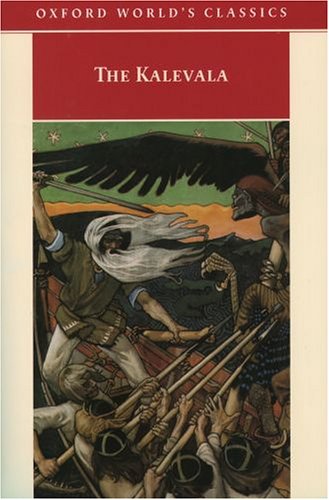
Book 146, Finland: "The Kalevala" by Elias Lönnrot

Aaaaaah!!!  The last week of classes is approaching! (Which does mean more time to do blogging and research and writing, I suppose. But also less discipline.) 

And I'm finally un-distracted enough to finish reading the great epic poem of Finland, forged together in the 19th century from bits of folksong and mythology collected all over the land on a journey of skis and horses, all in a mad bid to create a genuine national identity. 

But you know what? It worked! Today there's streets and paintings and people and even a whole national holiday in Finland named after the epic. It was a major influence for JRR Tolkien's Silmarillion, and even inspired an Estonian epic of the same ilk, The Kalevipoeg. And a Donald Duck comic, believe it or not.


And no wonder - this book is *nuts*. It starts off with the creation of the world from the shards of a duck egg and the weary, submerged, pregnant woman Ilmatar, and the birth of the hapless bard-hero Väinämöinen (it's pronounced "Viner-mer-nun", if this site's correct). Then we get cycle after cycle after cycle, showing how this hero's unable to woo a wife because he isn't good-looking, while the mage-smith Ilmarinen is beating out animals and miracles in his forge (even a genuine gold and silver Realdoll at one point) and Lemminkäinen drowns in a River of Death chasing a black swan only for his bits and pieces to be reanimated by his mother, because she can just DO THAT, and of course the mad blond super-strong boy Kullervo who does everything wrong, e.g. if you tell him to build a fence, he chops down a whole forest to make an unusable fence without doors that towers over the village, and if you give him a baby to sit he'll gouge out the baby's eye, and when he gets sold as a serf to Ilmarinen's wife she bakes him bread with a stone in it, and he's so mad when the stone breaks his father's knife that he drowns all her cattle, and turns a whole pack of wolves and bears into cattle, so that when she goes to milk her cattle for butter she finds them turning on her, ripping apart her beautiful face, pulling apart the sinews in her ankles, snapping her legs in two...

Yes, the story is quite graphic. This is all in strictly metrical poetry, by the way.

And presiding over everything is the dread Witch Queen of the Northland, Louhi, who has a number of beautiful daughters whom the heroes woo; who transforms herself into a bird and fights Väinämöinen for the magical artefact, the Sampo.  That's what's being portrayed in the painting on the book cover, by the way.

Strange to consider the position of women in this tale. Women hardly get a say in The Iliad, but pretty much every later epic lends them a voice. And here, while they're being married off or just stolen, they do wail and complain and even cheat on their would be husband-rapists and get turned into seagulls. So there's some proactivity going on.

And intriguingly, women begin and end the tale. Marjatta, like Ilmatar, is a mother. In Canto 50, she appears as a Virgin Mary figure who becomes mysteriously pregnant after eating a lingonberry (watch out, Ikea food-lovers!) and gives birth to the infant King of Karelia, who can speak at the age of two weeks, admonishing Väinämöinen for his lack of respect to his better. And Väinämöinen wanders off into exile, grumpily, signalling that the age of heroes is past.

Ah, but is it? This poem is a celebration of poets and poetry: the heroes *sing things into other things*, i.e. they can sing a man deeper into the ice to kill him, or sing a wolf into the shape of a cow. The power of words, of imagination. And though Väinämöinen rescues the sun and dispels the demons of illness with the invention of the sauna, his greatest achievement is the invention of the kantele, a zither-like instrument inspired by the bones of the pike.

If poets still live, then are the heroes dead?

Someone oughta gather all the urban ghost stories in Singapore and see if we can make an epic poem out of that.


View Around the World in 80 Books!!! in a larger map

Representative quote:

The old man quickly christened
and briskly baptized the child
king of Karelia
guardian of all power. At that
Väinämöinen was angry -
he was angry and ashamed
and he stepped away
towards the shore of the sea
and there he started singing
sag for the last time -
sang a copper boat
a coppery covered craft
and he sits down in the stern
he cast off on the clear main
and eh uttered as he went
declared as he departed:
'Just let time pass
one day go, another come
and again I'll be needed
looked for and longed for
to fix a new Sampo, to
make a new music
convey a new moon
set free a new sun
when there's no moon, no daylight
and no earthly joy.'

Then the old Väinämöinen
goes full speed ahead
in the copper boat
in the coppery punt
to where mother earth rises
and heaven descends
and there he stopped with his craft
with his boat he paused; but he
left the kantele behind
the fine music for Finland
for the folk eternal joy
the great songs for his children.

Next book: Unt Mati's Things in the Night, from Estonia.

Thursday, January 16, 2014

Latest stash!

So I'm kind of busy with work at the beginning of the semester, so I'll just supply you guys with an update about what I picked up in Singapore, mostly from BooksActually and the Substation's Alternative Art and Book Festival:


Top row: Zhang Yueran's Ten Loves, Colin Goh and Woo Yen Yen's Dim Sum Warriors 2, Jay Bernard's English Breakfast and Tan Mei Ching's Beyond the Blue Gate.

Bottom Row: Escape from the Lion's Paw: Reflections of Singapore's Political Exiles, Jason Wee's The Monsters Between Us, That We May Dream Again (writings of the detainees of Operation Spectrum) and Bernice Chauly's Onkalo.

Ooh, but I haven't shown you my latest find. The National Library's got an exhibit on about the early 20th century Singaporean poet Khoo Seok Wan, and there's free bilingual chapbooks available on Level 8!


Khoo's remarkable for many reasons. He was an intellectual of the Qing Dynasty, and actually qualified for the second (but not the third) round of Imperial Examinations - no mean feat for an overseas Chinese (granted, he was born in China, but spent much of his developmental years in Singapore). He thus wrote poetry in traditional Chinese structured forms - not the free verse you get today, but a dense, highly symbolic version of the language, going back to the Han and Tang Dynasties.

Renowned for his craft in his teens, he later started to describe his Southeast Asian landscape in his writings, describing Malay students, even incorporating Malay words in his pieces. Wrote eulogies for both the Empress Dowager Cixi and Queen Victoria! And he died in 1941, just before World War Two, when modern Singapore as we know it was just starting to get formed.

I've transcribed a couple of his poems here. The first one uses a different name for Singapore - Sin Chew, which literally means "the continent of stars". So nice!

Sin Chew

Of the many islands strung together
The most prominent is Sin Chew
Situated in a sea so vast
That rocky mountains can hardly be seen
Today's travellers to the region
Will find their sojourn easier now
Steady in its role as a favourable locale
A well-equipped, strident junction

星洲

群岛重连锁,星洲建一环。
冲层不见石,到海欲无山。
车辙殊今昔,航途利往还。
由来形胜地,设备等严关。

Here's another, more political piece. Couldn't find the Chinese ideograms to transcribe the first word, sorry, so you'll just have to read it in English.

TEMPEST
In the eighth month, upon hearing of the coup in Beijing

A tempest rattles the window
The beating of flags against the wall
An echo of guns

After the wind, leaves and branches lie
Fallen, as the storm clouds depart
For other locales

In slants of afternoon sunlight
Dust spirals in the wind
A swirling dragon

And in its flight, an anser
Separated from its mate

Where are all our heroes?
It falls to you and me.


Brill, huh? Catch you again next week.

Monday, December 9, 2013

Book 139, Northern Ireland: "Death of a Naturalist" by Seamus Heaney

One of the great things about having access to a university library is the fact that I can read a lot of poetry in its original collections, not in Compleat Works or Selected With Annotations stuff. I kinda wanna see how a writer's oeuvre was originally presented to the public, warts and all.

The Spirit Level is of course widely available - but after I'd picked it up, I realised:

1) I might've read it before, back when I first started getting curious about Heaney.

2) It wasn't actually written while Heaney was living in Northern Ireland (where he did in fact spend the first thirty-three years of his life).

3) I just wasn't connecting with the poems. 

Call me shallow, but the pieces in The Spirit Level all seemed messy and disperse and referring to incidents and people I wasn't familiar with, which is in itself not an unfamiliar sensation during this project. But I do want to honour great writers by saying nice things about their work, and to have a good time reading myself.

So I've decided to go back to the volume that started everything off: Heaney's very first collection, published by Faber and Faber back in 1966:


It's easy to like Death of a Naturalist. Most of these poems are these wonderfully earthy things, reflecting on what it means to be a poet who's grown up in the country as the son of a farmer, hence you've got schoolkid classics like Digging, wherein he imagines himself digging with his pen into his heritage, just as his forefathers dug with their spades for potatoes. Also the scary frogspawn of the titular poem, his mother's dairy alchemy in Churning Day, the tragedy of a child's death in Mid-Term Break, the assumption of adulthood and responsibility around the horse-plough of Follower. And of course the weird Thomas Wyatt-esque loss of innocence in Blackberry-Picking, another piece we kept on seeing on our literature worksheets, and which someone told me actually referred to the Eucharist.

All very sensual, all very real, all very lovely on the ears and accessible. In fact, quality actually goes sideways towards the end of the book when we just start getting fluffy love songs and nature poems, whose depth can in no way compare to the stuff in the first half. But if I'd wanted depth, I'd have gone with The Spirit Level, no? My own damn fault for being stupid and impatient.

Since we're on the topic of Northern Ireland, however, we've gotta mention The Troubles. And though the violence only peaked in the seventies (during which time Heaney wrote works like Wintering Out, which I personally find a tad forgettable), we do actually have a threatening yet thoroughly human figure of a Protestant activist whose "fist would drop a hammer on a Catholic" in The Docker. "Oh yes, that kind of thing could start again", the poet says, and sure enough it did.

Things have been peaceful enough since the nineties, thank god, and I'm planning to visit Belfast next year. Still, it did drive Heaney to Dublin, where he spent the rest of years until his death in April (which I shamefully didn't remark upon in this blog). What's the relationship between Northern and Republic of today? I've heard of people switching nationalities just to get their university fees slashed. Will find out through travel, not literature, I dare say.

Anyhow, Singapore's experiencing troubles of its own right now. Not sure how I could (should?) turn that into literature.


View Around the World in 80 Books!!! in a larger map

Representative quote: 


"From A Potato Digging"
III.

Live skulls, blind-eyed, balanced on
wild higgledy skeletons
scoured the land in "forty-five,"
wolfed the blighted root and died.

The new potato, sound as stone,
putrefied when it had lain
three days in the long clay pit.
Millions rotted along with it.

Mouths tightened in, eyes died hard,
faces chilled to a plucked bird.
In a million wicker huts
beaks of famine snipped at guts.

A people hungering from birth,
grubbling, like plants, in the bitch earth,
were grafted with a great sorrow.
Hope rotted like a marrow.

Stinking potatoes fouled the land,
pits turned pus into filthy mounds:
and where potato digger are
you still smell the running sore.

Next book: Sir Walter Scott's Waverley, from Scotland. Or shall I do Robert Burns?

Sunday, July 8, 2012

Book 102, Thailand: "The Story of Phra Abhai Mani" by Sunthorn Phu

The real Phra Abhai Mani is a 30,000-line epic poem that took 20 years to write: this is only a 111-page prose translation (available online!) that ends with suspicious abruptness. I shouldn't be doing it, really - I've tried to steer myself away from abridged texts, mostly because they don't feel real.

On the other hand, this translation was done by a Thai Prince, Prem Burachat, in 1952. My copy of the book was even printed in Thailand. So it's definitely authentically Thai, more so than stuff by recent emigres and expats. And it feels important to incorporate something pre-modern into my Southeast Asian reading list: something that shows that we had a culture even before the imported invention of the novel.


And by golly gosh, I'm glad I decided to read this. This story is trippy, no doubt about it. It's set in a magical timeless fantasy world wherein our princely hero Phra Abhai Mani, wanders from island to island, falling ridiculously in love with various hot women (a sea giantess, a mermaid and two warrior princesses, one of whom also does a stint as a nun).

He's armed only with his handsomeness and his magical ability to make everyone fall asleep when he plays his flute. (Don't pour scorn on this skill; it's extremely useful against invading armies.) He's also assisted by his two prodigious sons, Sin Samudr and Sud Sakorn, of giantess and mermaid stock respectively. They're pictured as ten year-old boys each with the strength of ten men: Sud Sakorn actually rides a magical beast with the face and tail of a dragon and the body of a horse, upon which he slays giant man-eating butterflies. Ripping stuff!

The crazy thing is, this book isn't from an antique age: it was composed from the 1820s to the 1840s, same time as Europe was colonising our part of the world and undergoing an Industrial Revolution and Byron was writing mock-epics like Don Juan and Mary Shelley was writing Frankenstein. Should we consider this extended court poem as a work of modern fantastika?

There's evidence of the modern in the text: the island of castaways includes "Chinese, Brahmins, Indians, Thai, Javanese, Englishmen, Hollanders and other Europeans", and even the princess Suvarnamali is threatened by an English pirate named Surang. Then there's all this interest in sciences and skills and cunning which allows the heroes to triumph over their enemies - no bloody duke-em-out battles here, as in The Iliad or Fengshen Bang. (Or is that modern? Plenty of sailing around and outsmarting people in The Odyssey and The Seven Voyages of Sindbad, too.)

But quibbling aside, here's what gets up my hackles: if this book is so good, so good that there are monuments and movies and comics and waxwork exhibitions and beach megaliths to commemorate it, then why isn't there a full-length English translation of the work yet? And why isn't the work more widely known outside Thailand? The country's full of people who speak English well; why can't they follow in the learned prince's footsteps and disseminate their culture to the world of earnest world literature junkies like myself?

I suppose the reason is the scale of the work - The Tale of Khun Chang Khun Phaen (which I believe Sunthorn contributed to) was translated two years ago, and that book's 984 pages long! That baby deserves a place on my reading list too, I suppose. Lord have mercy.


View Around the World in 80 Books!!! in a larger map

Representative quote: Once more, the hermit came to the aid of his ward. There was a deafening sound. Sud Sakorn looked up and saw the old man descending astride a rainbow. Gathering the bruised body of the boy up in his arms, the hermit took him aloft and gently laid him ont he mountain top. He then proceeded to teach the boy thus: "Put not your trust in any mortal, for their wiles are immeasurable. Even the most tortuous creepers round the hoariest tree are not as crooked as a man's heart. True love among mortals is only to be found in the love of a father or mother. The only support you can rely upon is yourself. So you must be careful and wise, my boy. There is no better armour than knowledge. Now you must go and recover your magic stick." As soon as he had said this, the hermit vanished from sight.


Next book: A Samad Said's The Morning Post, from Malaysia.

Wednesday, March 14, 2012

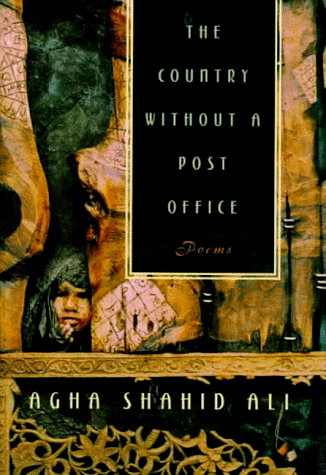
Book 93, Kashmir: "The Country Without a Post Office" by Agha Shahid Ali

News flash: I am sick. I've got one of those fevers that makes me feel hot and cold at the same time and I'm not getting anything productive done (updating this blog does not count as being productive). What makes this all the more ridiculous is that this is part of a cockamamie scheme I had to do non-UN-recognised states: Kashmir, Tibet, Palestine, Hong Kong, Macau, all in the hopes of pissing off some of my Indian and Chinese friends.


Plus, you've noticed that I decided not to do Salman Rushdie's Shalimar the Clown, didn't cha? I actually made that decision fairly early: I wanted someone genuinely Kashmiri, hell, and a highly praised Kashmiri-American emigré poet was just what the doctor ordered.

And seriously, Shahid is awesome. I picked up his posthumous book of ghazals, Call Me Ishmael Tonight, and I fell in love - then I realised this was a patchwork collection snatched from various bodies of work he'd published before. Didn't feel quite right.

So I pulled Rooms Are Never Finished off the shelves: a work mourning his mother, recording his journey from Amherst, Massachusetts to Srinagar to deliver her body for burial. Surprise, surprise: I did not like this one as much: way too many abstractions and allegories, real tragedy subsumed in Zainab's mourning over the martyrdom of Imam Husain and Radha crying out to the Dark Lord. Didn't help that Shahid had a penchant for extremely long poems, written in sections composed of prose poetry or terza rima or sapphics; only the ghazals and villanelles were a a breath of fresh air in between.

So I reserved The Country Without a Post Office from the repository used collection, and hallelujah, the anguish is way more direct and unfiltered: these pieces are written from 1991 to 1995, reflecting on the crazy bloodshed of that era. Thassa right: I combed through four books while enduring illness just for this bloody blog post.

Don't actually feel like analysing it now. Just wanna sleep.


View Around the World in 80 Books!!! in a larger map

Representative quote:

Ghazal

The only language of loss left in the world is Arabic -
These words were said to me in a language not Arabic.

Ancestors, you've left me a plot in the family graveyard -
Why must I look, in your eyes, for prayers in Arabic?

Majnoon, his clothes ripped, still weeps for Laila.
O, this is the madness of the desert, his crazy Arabic.

Who listens to Ishmael? Even now he cries out:
Abraham, throw away your knives, recite a psalm in Arabic.

From exile Mahmoud Darwish write to the world:
You'll all pass between the fleeting words of Arabic.

The sky is stunned, it's become a ceiling of stone.
I tell you it must weep. So kneel, pray for rain in Arabic.

At an exhibition of miniatures, such delicate calligraphy:
Kashmiri paisleys tied into the golden hair of Arabic!

The Koran prophesied a fire of men and stones.
Well, it's all now come true, as it was said in the Arabic.

When Lorca died, they left the balconies open and saw:
his qasidas braided, on the horizon, into knots of Arabic.

Memory is no longer confused, it has a homeland -
Says Shammas: Territorialize each confusion in a graceful Arabic.

Where there were homes in Deir Yassein, you'll see dense forests -
That village was razed. There's no sign of Arabic.

I too, O Amichai, saw the dresses of beauitful women.
And everything else, just like you, in Death, Hebrew, and Arabic.

They ask me to tell them what Shahid means -
Listen: It means "The Belovéd" in Persian, "witness" in Arabic.

Next book: "The Tibetan Book of the Dead", from Tibet.

Friday, January 20, 2012

Book 87, Bahrain: "Voices: an Annotated Anthology of Contemporary Bahraini Poetry" ed. Hasan Marhamah

Yo! So I’m writing this on the plane to New Zealand, where I’m spending a week’s holiday with my parents. (They’re evidently non-traditional enough to want to escape the comfort of relatives during Chinese New Year, which surprises me.) I’ve spent the flight watching a Chinese martial arts movie and a Danish documentary on a Japanese inventor, while occasionally dipping into my e-book of Bahraini poetry:


Yeah, it’s a dowdy cover, but as it turns out, the contents aren’t half bad. There’s a timeless, infinite, declarative air to Bahraini poetry – which may well be a feature of Arabic poetry in general, though I can’t tell, having only read Mahmud Darwish and bits of the Sufi mystics in the past.

Certainly it’s very different from a Singaporean poetry anthology, which would be full of minute descriptions of circumstance, society, geography, autobiography – the influence of Western traditions, surely. The Bahrainis are from a tiny, recently developed island nation like ourselves, and yet when they write, it feels like they’re calling out to the desert, it feels like they’re calling out to the sea.

The translator/editor spends a lot of time in his intro guiding us through the different eras of Bahraini poetry: 1) the Classical Movement, composed by princes and influenced by Nabatean; 2) the Neo-Classical Movement, which fused that style with the emergent anti-colonial Nationalism of the early 20th century; 3) the Romantic Movement, obsessed with P. B. Shelley as the epitome of passion, patriotism and rebellion; 4) the Neo-Realists and Modernists, now comprising many middle-class intellectuals, including many women, inspired by late 20th century Arab politics, byzantine imagery, and oddly enough, T.S. Eliot. (There’s even a reference to Hollow Men in one of the poems.)

The actual collection is all 20th century stuff, and we only hear a couple of poems per poet, so it’s a comfortable, jaunty survey, unified by the voice of the translator despite variations in subject matter and structure. Footnotes point out references to Palestine, to imprisonment, to Bahraini symbology of the palm tree and wine, to various tales of the Quran (e.g. Balqis, the Queen of Sheba who took on Solomon’s religion; e.g. Iqlima and Luza; ugly and beautiful; the wives of Cain and Abel respectively; the sisters of Abel and Cain also respectively. Surprisingly, there’s also a fair bit of referencing to Sumerian history and legend (Bahrain, then Delmon, was the source of the Epic of Gilgamesh, says the translator), and even a feminist piece called the Wanderings of Scheherezade. What a culture, no?

Quite beautiful, and unexpectedly so. Hurrah for the talents of tiny nations.


View Around the World in 80 Books!!! in a larger map
Representative quote:

An Invitation to a Forbidden Party
-Ahmad al-Shamlan

My apology to you my good friends:
My party is poor
For I spent what I earned on my future journeys.
Exhausted, I arrived carrying my drowned guitar
With a melody you have heard before.
When it was captive
And you were the lyrics in the depressing jails,
While the thug gurgled his anger;
His crushed nails tortured my guitar and continued in a small party.

****

I fetched you tonight palm wine,
Do you like dates?
I possess nothing but the vintage liquor;
I stole it,
It is condensed but genuine;
Those who sold its tree never became intoxicated,
But I was intoxicated by an infant.
What shall I say?
In my eye there was an impossible question,
Wandering through long nights but never fulfilled…
A candle in a beautiful one-time party.
But they have changed my home address;
My home is a melody tonight,
A distracted in a small dream
And I fear the street guards.

The street guards have plotted against me,
They have changed my home address.
My friends,
Come in,
I have for you
Liquor
Reproach
And joy.

Next book: Dandera’s The Chronicles of Dathra, a Dowdy Girl from Kuwait, from Kuwait.

Wednesday, September 7, 2011

Book 76, Uganda: “Song of Lawino & Song of Ocol” by Okot p’Bitek

I’ve actually read a bit of Song of Lawino before, in my sister’s old secondary school English textbook, if you can believe it. It was an extract from Chapter 5: “The Graceful Giraffe Cannot Become a Monkey”, in which Lawino sings of how her natural springy Afro do is different but equal to the silky straight locks of a white woman. The textbook illustrator had a fine time drawing the safari animals of her proverbs, drawing the scene where Lawino’s rival has her wig torn from her head by the spirit of a dead white woman.

Commonwealth literature, baby! It’s what us Singaporean poets were raised on.


Turns out, though, that the extract were expurgated – there’s loads of verses and lines in the original that were excised for the sake of children’s tender minds. The poem’s full of stuff that’d shock an innocent schoolkid: excremental imagery of shit and piss and vomit, tribal values that are utterly other: acceptance of polygamy, scorn of Christianity and book-reading and Westernised medicine, even some positive fetishisation of shit and piss and vomit. Who but a witch would love a homestead where the compound is not strewn with the excreta of children, she cries. Oo-er.

Oh, and the whole poem’s about anger – Lawino’s the scorned wife, calling out her Westernised intellectual husband, Ocol, who verbally abuses her for her love of tradition, for her lack of education, for her ignorance. At first the poem’s attacking Clementine aka Tina, Ocol’s Westernised lover, she of the white woman’s wig. But soon she goes on to cover every dimension of the colonized mind: her husband’s political career, his love of ballroom dance, his Christian name (Melchizedek Gregory, no wonder, she’d rather stick with Ocol). Sure, she stops herself now and then to say folks can do what folks choose to, just don’t make her change, but really, it’s invective – there’s a bit where she conjectures that Tina’s aborted her twins into the latrine, where she enumerates all the varieties of human dung to be found at the dance hall (gawd, so excremental).

Basically, it’s a rather thrilling read. Not as brief as you’d expect a book of poetry to be. The introduction makes a good case for the level of ressentiment: after so many European writings had denigrated African tradition, most African writers went on the defensive, saying, “We’re not that bad! If you forget the infibulation-y stuff,” whereas Song of Lawino is on the offensive, written from the viewpoint of an uneducated woman who nonetheless sure as hell knows what she likes and what she doesn’t. Same reason it became an international success, even on the African continent – village folks recognised what she was saying as common talk; the only shock was seeing it in print.

The last bit of Lawino is especially good: she entreats the husband to return to his culture, giving a step-by-step account of the rituals of vomiting and rattle-shaking he should conduct to exorcise the white spirits. After all that, Song of Ocol is actually a disappointment: our poet Okot p’Bitek isn’t interested in giving us a balanced viewpoint, but is making Ocol out to be a supervillain, throwing Lawino out of the house, blustering to the constituents who elected him into office, vowing to blow up Kilimanjaro and fill in the Rift Valleys and execute the shamans, longing to be white. Not a coherent piece; Ocol’s too psycho, shuttling from his nightmares to his proclamations, not even consistent in his villainy when he points out how downtrodden “proud Africans” are.

But there’s an odd logic to the chaos, y’know: three years after this piece was published, the Scots-loving colonial gentleman-dictator Idi Amin came into power; Ocol personified. Song of Ocol is thus a prophecy of the madness that would follow.

Interestingly enough, Lawino was written first in Acoli and Ocol in English. Wondering if I should zap some of the former to show my writing students the effective incorporation of foreign language idioms into English language poetry.


View Around the World in 80 Books!!! in a larger map

Representative quote:


My husband’s house
Is a mighty forest of books,
Dark it is and very damp,
The steam rising from the ground
Hot thick and poisonous
Mingles with the corrsive dew
And the rain drops
That have collected in the leaves.

They choke you
If you stay there long,
They ruin your nose and tongue
So that you no longer
Enjoy the fresh smell of of simsim oil
Or the taste of malakwang;

And the boiling darkness
Bursts your eye balls
And the sticky juices
That drop form the gum trees
Block the holes of your ears,
And when ten girls
Standing on the hillock
In the moonlight
Sing oyele songs,
Throwing stones of abuse
At the rough-skinned ugly old men
Chosen for them as husbands
By their money-loving fathers,

Or when your daughter
Sings a lovely lullaby
To her baby brother
Strapped on her back,
And she sways forwards and backwards
As she sings

O baby
Why do you cry?
Are you ill?
O baby stop crying
Your mother has fried the
aluru birds
In ghee!


When the girls sing cycle songs
And the nurse sings her lullaby
You hear only noises,
Noises that disturb you
Like a brick
Thrown on top of the iron roof.

Next book: Ngugi wa’Thiongo’s Devil on the Cross, from Kenya.

Friday, August 19, 2011

Singapore Poetry Today

I've been terribly distracted by deadlines, so I've only made a teensy bit of progress with The Strength of What Remains. In the interim, enjoy my summary of the state of Singapore poetry today, published on the British Council's Writing the City blog.

Sunday, July 10, 2011

Book 69, Madagascar: “24 Poems” by Jean-Joseph Rabearivelo

Unfortunately I can’t get my paws on the recent English translation of this guy’s poems, Translated from the Night. This bunch forms just a thin volume – more of an illustrated pamphlet, really – and was published by les Amis de Rabearivelo in Ibadan, 1962. (It’s only in the National Library’s reference section because of good ol’ Edwin Thumboo’s donation. That’s a good laureate!)


Rabearivelo’s historically important because he’s widely viewed as Africa’s first modern poet. This is why folks doing a reading project like this should pick his work instead of trashy, viciously reviewed novels like The Sapphire Sea.

But he’s also aesthetically important because he’s really a rather good poet. True, I’m reading the stuff in English rather than in French/Malagasy, but there’s a dreamlike grace and vibrancy to his images that you don’t see everywhere – complete beauty and ambivalence of feeling, yet clear strength.

Oh, and he’s clearly a nature poet. Barely a breath of the city in these pieces: some Christian/Muslim village life, a black glassmaker, an artist who plucks bamboo to shape it into zithers in town.

This is nature in a very European sense, though: not jungle but a sedate, stellar, almost astronomical view of lianas and birds and pomegranate bushes, kissed with passionate dispassion by the sun. (Astronomical is quite right; there’s a lot of talk of stars and moonbeams and the movement of the Earth: he calls the Southern Star the white bull, as the Arabs do.)

Some cool modernist paintings in this edition too, by M.E. Betts: they look like what Picasso might make with Chinese ink, only they’re black and white and from Africa, so maybe they’re something quite other.

Sorry, not much else to say. Teeny-tiny book!


View Around the World in 80 Books!!! in a larger map

Representative quote:

X

There you stand
erect and naked
you are a lime tree and remember;
but truly you are the child of this fertile shadow
that feeds on lunar milk;
slowly you take the shape of a pillar
on this low wall over which dreams of flowers drift
and the perfume of a relaxed summer.

To feel to believe that roots sprout at your feet
and move and twist themselves like thirsty snakes
towards some underground source
or that clench the sand
and make you part of it, you, living one,
unknown tree, unnamed tree
that develops fruit
which you must pluck yourself.

Your crown,
in your hair dishevelled by the wind,
conceals a nest of transcendant birds,
and when you will come to sleep in my bed,
and I will recognise you, my errant brother,
your touch, your breath, and the odour of your skin
will provoke the rustling of mysterious winds
even to the frontiers of sleep.

Next book: Michael Steane’s The Last Colony: An Experience of Reunion Island from Réunion.

Friday, June 24, 2011

Book 66, Malawi: "Of Chameleons and Gods" by Jack Mapanje

I’m back in Singapore, and ready to catch up on my reading! Opportunities in South Africa were surprisingly slack – only finished Long Walk to Freedom because my movie monitor malfunctioned during the Emirates flight home, on the leg between Dubai and Colombo.

Back when I was planning the trip, I was wondering if I oughta download development celeb William Kamkwamba's The Boy Who Harnessed the Wind, or else check out Jack Mapanje’s Beasts of Nalunga from the library and stow it along. Then I decided I’d bank on the possibility that I might find some of the first-generation greats in a South African bookstore: David Rubadiri or Frank Chipasula – only to discover that:

1) Books are really expensive in South Africa,

2) The storehands at V&A Waterfront in Cape Town and that hip little university joint in Stellenbosch have little knowledge of African lit (they thought Mia Couto was a woman, sniff sniff).

But back at NLB, I discovered that Central Lending owns this book, which was the first to catapult Mapanje to commercial success when published in 1981 (although his incarceration without charges from 1987-1991 made him famous, if you can call it fame, considering that I’d never heard of him till this project).

And it’s good. Really eloquent, passionate stuff, with a lot of personalized references to friends a la Frank O’Hara, a tinge of the hermeticism and experimentation of Arthur Yap, though never quite as academic and lofty as Wole Soyinka or Edwin Thumboo; plus of course the outrage of the third-world liberationist betrayed that’s so common to postcolonial lit.

He honestly sounds like the kind of guy you’d like as your creative writing teacher. (Maybe I’m thinking like this ‘cos I’m typing on the way to NTU, where I’m delivering a poetry reading and handing in my claim forms for exam marking. Or maybe I just need a mentor myself.)

It’s the vibrancy of Mapanje’s words and symbols that really captivates me. Chameleons, nsolo trees, the murders at Chilombwe, calabashes, dagga, ancestral shields, and the imaginary Chief Kwangala, a Yao word which means dancing frantically. How can we approximate this in Singapore literature?

(Of special interest are the references to Chingwe’s Hole, a hole on the verdant Zomba Plateau where wrongdoers were flung in punishment and the supposed source of the Namitembo River. A whole section of the book is titled “Re-entering Chingwe’s Hole”; confronting the juxtaposition of horror, beauty and fertility that is post-independence Africa.)

I’m less keen, however, about the obligatory “I’m dislocated in London” poems, given that I’ve read a few similar ones now. Or maybe I’m just hungry for exotica? Maybe I just want my writers glowing with Afro anger instead of Euro malaise?


View Around the World in 80 Books!!! in a larger map

Representative quote:

Visiting Zomba Plateau

Could I have come back to you to wince
Under the blur of your negatives,
To sit before braziers without the glow
Of charcoal, to cringe at your rivers
That without their hippos and crocs
Merely trickle gratingly down, to watch
Dragonflies that no longer fascinate and
Puff-adders that have lost their puff?
Where is your charming hyena tail –
Praying mantis who cares for prayers once?
Where is the spirit that touched the hearts
Lightly – chameleon colours of home?
Where is your creation myth? Have I come
To witness the carving and jingling only of
Your bloated images and piddling mirrors?

Next book: Mia Couto’s The Last Flight of the Flamingo, from Mozambique.

Saturday, March 12, 2011

Book 52, French Guiana: "Pigments - Névralgies" by Léon-Gontran Damas

Confession time: I didn't understand most of this book. I took French a long time ago, and while I can still read fiction, the surreal poetry of the Négritude movement is a little beyond me.


However, I had the hubris to go out and order a copy of this book via the French department of Kinokuniya bookstore, based on the premise that it's probably good for my brain to read other languages a little more often. Cost me $22.50 in SGD - not bad for an esoteric classic, hein?

And Pigments is actually okay - I used it as casual toilet reading, since the poems are short and a lot of it's about being a black and angry colonial intellectual in 1930s Paris. Loads of stuff about Antillean rhythms and "masques africaines" alongside mentions of Gauloises and the Le Monument aux Morts; civilisation and its discontents. Even some urgent pleas about what Herr Hitler's doing to les juifs en Allemagne, because he can tell that kind of politics don't look good.

Névraglies (trans. = neuralgias) is another story - longer poems, quite a few of them love/sex pieces, but far less political (even though it was published in 1966, a plenty political time as well), so it's harder to figure out the context of these pieces, or really what's going on, given my limited vocabulary. Less of that vivid, obvious imagery I liked so much in the previous section:

But oh, it's good to read. The delicious legato of the French language combined with Damas's magic rhythms: ostinatos of brevity and repetition, odd flourishes of concrete poetry as lines don't cross the page but tumble down it - and then those vivid, visceral images that I don't know how to process: flesh, blood, curtains - although flipping through the book again, there's an awful lot of pieces overloaded with abstract nouns instead. No wonder I'm so confused.


View Around the World in 80 Books in a larger map

And sleepy! Was attending the Singapore Biennale opening today, as well as the opening of Michael Corbidge's show Jus, plus teaching at NTU, then came home to behold the tsunami footage in Japan and helped my mother to rework her Blackberry message to the Tokyo branch of her company in perfect English - nothing compared to what some of you do for a living, but it tires me out.
I think I'll accept my French poetry in translation from now on.

Representative quote:

LA COMPLAINTE DU NÈGRE

Ils me l'ont rendue
la vie
plus lourde et lasse

Mes aujourd'hui ont chacun sur mon jadis
de gros yeux qui roulent de rancœur
de honte

Les jours inexorablement
tristes
jamais n'ont cessé d'être
à la mémoire
de ce que fut
ma vie tronquée

Va encore
mon hébétude
du temps jadis
de coups de corde noueux
de corps calcinés
de chair morte
de tisons
de fer rouge
de bras brisés
sous le fouet qui se déchaîne
sous le fouet qui fait marcher la plantation
et s'abreuver de sang de mon sang de sang la sucrerie
et la bouffarde d commandeur crâner au ciel.

Next book: Augusto Boal's Theater of the Oppressed, from Brazil.

Monday, February 28, 2011

Book 50, Guyana: “Lovelines for a Goat-Born Lady” by John Agard

So originally I was going to read the Poems of Martin Carter, whom some website claims is Guyana’s greatest poet. Then I checked him out and discovered his writing is rubbish.

What’s a bibliovore to do? Fortunately, I’ve a personal Guyanese connection: way back at Singapore Writers’ Week ’97, I attended workshops and readings by the Guyanese-British husband-and-wife team John Agard and Grace Nichols, who got me jump-started on the idea of performance poetry before slam even came to town.


Agard and Nichols mostly write children’s poetry, but I’ve read some of their adult works before: Agard’s Mangoes and Bullets and From the Devil’s Pulpit; Nichols’s Sunris and The Fat Black Womans's Poems. Lovely stuff. Lovelines for a Goat-Born Woman was one I hadn’t seen before, though: it was part of the Edwin Thumboo bequest, so I had to sit in the library and read it a couple of goes, just like Leaves of the Banyan Tree.

Oh, but it was worth it. Bless me, these poems are sexy.

Agard’s nuts about Nichols and he finds every way of saying so. He calls her his beloved capricorn, his mudhead woman (Guyanese are called mudheads because of their low-lying silty coastland), de headmaster’s daughter, Miss Curling Toes, Gracey, his pink-eyed one. He eroticises her overcome by sleep, annoyed by allergenic pollen, in knickers, before mirrors, in a towel fresh out of the shower, plaiting her hair, pregnant, peeing behind a half-closed door.

He calls her body a ship bound for dreamland, a creature rooting in the soil of heaven, He calls her vulva her cunt, her other mouth, her wanton parts, her squeezing crab, her pum-pum. And he eroticises their homeland’s watermelon ladies, Antillean breezes, Kissing Rocks, rivers, zinc roofs, eels, crabs, hibiscus, hummingbirds and guenip seeds, star apples. Writes one poem entirely in Creole, too. (Damn, I’ve got to try eroticizing Singapore/Singlish in some of my slam poetry. Difficult, but I’m sure it can be done. Easier for him of course, since they’re émigrés missing their tropical disaster zone, “hugging her under dis quilt of England”.)

He also freely mentions the fact that she, too, is a poet. That’s worth something. It’s quite wonderful to read love poems, written from one creative person to another – one of the reasons why Sonnets from the Portuguese is so renowned. And oh my; after writing that I have visions of Robert Browning and Elizabeth Barrett doing it under the sun on a Caribbean coconut plantation. Freaky, but given Browning’s possible ancestry, not entirely far-fetched. First heard about that connection in Agard’s book We Brits, by the way. Just hope they’re still happy together.

(There's something fishy going on Google Maps: it seems to have been hacked by the Encyclopaedia Britannica, of all sites. Oh, it's fixed now!)


View Around the World in 80 Books in a larger map

Representative quote:

Invocation

Lord of Iron, Ogun,
grant me hardness
when and where it matters

Queen of waters, Yemanja,
bless my man-water
with good seed

Sacred harlot, Oshun,
bejwelled to the crotch
girdled with the moon
guide me to the slut
beneath my graceful lady

Sky-Serpent, Damballah,
may I inherit
your divine wriggle
when I lie on her

You there, Legba,
randy trickster,
keeper of the gateway
guardian of the centerpiece,
help me transfix her

While governments making plans
your vulva sparkles on my moustache
we guilty of a subversive trickle

Next book: Aphra Behn’s “Oroonoko”, from Suriname.