Showing posts with label short stories. Show all posts

Saturday, November 26, 2016

Book 166, Ukraine: "The Collected Tales of Nikolai Gogol"

I'm still here!!!

Yeah, I've been terrible about keeping this blog. But I'm still reading furiously (as you'll see from my Instagram tag), and about a week ago I got round to finishing this:


Gogol was ethnically Russian. He wrote in Russian and enjoyed literary success in St Petersburg, Russia. Most of his best-known stories are set in Russia, too, such as The Diary of a Madman, The Portrait and The Nose.

Yet he was born and raised in Ukraine, and that's what he drew on when he published his first short story collections, Evenings on a Farm Near Dikanka and Mirgorod. In Richard Pevear's preface, he explains that these stories are exotica, in many ways, following a fashion of the times for stories of "Little Russia", a part of Ukraine which was then being Russianised. They're not super-accurate: Gogol often claims stories he dreamt up himself are old folktales, and he had to write back to his mother for all those luscious ethnographic details which he'd failed to note when he was actually resident in Ukraine. Nevertheless, these yarns of Cossacks and witches and ancient curses and fat landowners have nonetheless been embraced by Ukrainians as part of their heritage—as is Gogol himself to this day.

And damn, this stuff is fun. Some of it is straight up Gothic horror, like The Terrible Vengeance and Viy (which has been turned into a movie recently!), though there are also comic supernatural tales with blessed fools like The Night Before Christmas and Austenesque minor nobility stories like Old World Landowners and The Story of How Ivan Ivanovich Quarreled with ivan Nikiforovich. Tall tales of the outback, the margins of the empire where anything can happen.

And what's fascinating to me is how, as a 19th century writer, Gogol straddles both genre horror and surreal modernist slipstream—the The Nose and The Overcoat presage Kafka in their portrayal of how the dehumanisation of big city life can only be expressed through stories of the impossible. Meanwhile, the ravings of insane clerks and artists in "Diary of a Madman", "The Portrait" and Nevsky Prospekt feel like the miracles of the margins, transposed into modern settings that can only medicalise them...

And I love it, since I'm trying to write magical realism in a first world country, drawing on our third world roots of folk horror. I'll end with a quote from "Viy".


Representative quote:
He paused for a minute. In the middle, as ever, stood the motionless coffin of the terrible witch. "I won't be afraid, by God, I won't be afraid!" he said, and, again drawing a circle around himself, he began recalling all his incantations. The silence was dreadful; the candles flickered, pouring light all over the church. The philosopher turned one page, then another, and noticed that he was not reading what was in the book at all. In fear he crossed himself and began to sing. This cheered him somewhat: the reading went ahead, and pages flashed by one after another. Suddenly... amidst the silence... the iron lid of the coffin burst with a crack and the dead body rose. It was still more horrible than the first time. Its teeth clacked horribly, row against row; its lips twitched convulsively, and, with wild shrieks, incantations came rushing out. Wind whirled through the church, icons fell to the floor, broken glass dropped from the windows. The doors, tore from their hinges, and a numberless host of monsters flew into God's church. A terrible noise of wings and scratching claws filled the whole church. Everything flew and rushed about, seeking the philosopher everywhere.

Next book: Bessarabian Nights, by Stela Brinzeanu, from Moldova.

Sunday, June 26, 2016

Book 165, Chechnya: "I Am a Chechen!" by German Sadulaev

I know Chechnya isn't a recognised state by any international bodies. But while Russia and the UN don't recognise self-determination, that's no reason I shouldn't.

And anyway, this book is amazeballs.


Interesting fact: German Sadulaev didn't even mention the Chechens in his first book, Radio Fuck. And why should he have? He was a lawyer in St Petersburg, writing in his first language, Russian. He passed as Russian; indeed, his mother's ethnically Russian.

But he was born in Shali, a village in Chechnya. And he only escaped the violence there because he'd gone off to study in Leningrad at the age of 16. From a distance, he watched his idyllic hometown descend into war and chaos, brought on by the onslaught of heartless Russian bombers...

It's hard what to make of the text, actually. The first few chunks are written as dreamlike memoirs, clearly using autobiographical material, but with tonnes of magical realism thrown in: he claims all these portents of madmen and bleeding cattle that foretold the destruction; empathises with the agony of the swallows who saw their nests bombed to bits (the souls of unborn children, according to Chechen tradition), associates the race of the Chechens with the kshatriyas who were expelled from India in the age of the Upanishads... yet always returning to the detail of the "I" whose biography corresponds with that of his own: half-Chechen, half-Russian, suffering from the survivor's guilt and the weight of traditional machismo that prevents him from weeping out his pain.

And as the book progresses, we get more into the realm of fiction: in "When the Tanks Awoke", he confesses to the common childhood fantasy of having a twin, which eventually develops into a tale of himself as two boys, Zelik and Dinka, one with a Russian father and a Chechen mother, one with a Chechen father and a Russian mother, playmates and rivals who eventually end up facing one another on the battlefield. Later, clear fictions: "Victory Day", about an old Chechen World War II Soviet soldier who beats up a Neo-Nazi in Lithuania; "Snuff", about a phantom lover in New Orleans.

But always the sadness, always the sense of exile, always the sense of a kingdom lost—not just the Shali of his childhood, but the Soviet Union that he grew up proud to be part of.

It's strange to be reading this as Chechen literature, really. He's from Chechnya but not part of it, able to separate himself from the horrors of the war. But his family has suffered through it, been nearly killed by the sniper fire; he's had to demand that Russian flight crew allow his paralysed sister the right to stay on a plane because Russians have only read the state media that claim only terrorists have been attacked, when in reality, it's everyone, all the innocents, all those who once believed they were one people.


Representative quote: In the combat report from the front I heard that during the battle of Urus-Martan the Shali tank regiment had been eliminated. An enemy formation. When Russians die, they talk of 'losses', or even say they've 'fallen'. When Chechens die, they describe them as 'eliminated'. Because Chechens are the enemy. I too am Chechen: the enemy. And when I die, they'll describe me as 'eliminated'.

Next book: The Collected Tales of Nikolai Gogol, from Ukraine.

Wednesday, January 8, 2014

Book 141, Denmark: "Anecdotes of Destiny" by Isak Dinesen

Just been to watch Disney’s Frozen. It’s good! Just awfully American.

This is relevant to our discussion, of course, since it’s based on a work by Denmark’s most famous author: a weird, kinda effed-up, mysteriously sexual and amoral little girl-quest called The Snow Queen. Read it if you haven’t already. - it’s honestly one of his less horrifying fairytales. The Little Mermaid beats The Steadfast Tin Soldier, but is in turn beat by the hair-raising Red Shoes. (Oh man, I just remembered that Death himself appears in The Nightingale. Brrr.)

I’d honestly considered doing Hans Christian Andersen’s autobiography or travel writings, but they were a little too long and uncanonical. What I wanted was something so famous that a film had been made about it, hell, maybe even a local publisher had decided to name an entire line of books after it…


I mean “Babette’s Feast”, of course. It’s just one of the five stories in this collection. Isak Dinesen (whose real name was Karen Blixen, not vice versa) is actually better known for her similarly cinematic novel Out of Africa, which takes place in Kenya.

And hell, these stories are good. Like, break-your-heart, amazeballs, despair-at-your-own-fictive-abilities good. Ohhh, I can’t give away the plot of “Babette’s Feast” – you just have to read it for yourselves – but suffice it to say that it involves a great chef who sacrifices everything for her art.

These are tales of sacrifice, really – of people deciding that the rational way of living judiciously or grasping contentment as it comes is simply not the thing to be done, and how they lead counter-intuitively satisfying lives for all that. Bizarre people. Sexy people, come to think of it. There’s a whiff of fucking or almost-fucking in pretty much all five stories.

What’s more worth emulating for me, possibly, is the way she’s so willing to give every one of her characters a back story – she divides her tales into sections, so that we can step back and examine the youth of each fallen heroine before action properly begins – and there’s a crystalline brevity to each section that makes it impossible to call even the longer stories novellas (maybe novelettes?). These aren’t quite in the short story tradition: they’re tales told round the fire, drawn from faraway lands…

Yeah, for some reason, Dinesen wasn’t into writing about Denmark much. “The Diver”’s set in Shiraz, Iran; “The Immortal Story” in Canton, China; and “Babette’s Feast” and “Tempests” happen in Norway, which happened to be a Danish colony then: the former’s in a colony on the Bervelaag Fjord, while the latter’s in the town of Christianssand.

Bu before you yell that I’ve gotta disqualify this volume, I’ll have you know there are Danish characters, dammit – the Copenhagen theatre troupe owner Herr Soerensen and the innocent 17 year-old sailor Povl Velling from Marstal – and the very last of the stories takes place in the country estate of a young Danish squire, though it doesn’t actually say which part of the country he lives in. But even that Danish tale takes place two hundred and fifty years before publication. These are Arabian nights exotica, to a degree, with events shifted to magical elsewheres all the better to help the reader swallow the oddness that is life itself…

(The melancholy and magic in these tales: are they like Andersen’s? Maybe.)

One little political note: I don’t quite understand why, with “The Immortal Story”, you should choose to set a story in China and not have it feature any Chinese people except servants. Instead we’ve got a Scroogey Englishman, a beautiful and impetuous Frenchwoman, a Jew with Asperger’s and a young, dumb Dane. But perhaps that’s what the spell of Canton was back then – a land where whites ran away to, to survive – and the same reason why Singapore is mentioned in the same story, as a place whereof the less is said, the better.

Leaving my home country at 5pm today, btw. Will be visiting a friend in Hanover, then back to school again! Looking forward and fearing at the same time, would you believe it.


View Around the World in 80 Books!!! in a larger map

Representative quote: (from “The Immortal”)  Elishama stood and looked after him. When the big young figure was no longer in sight, he himself lifted the shell to his ear. There was a deep, low surge in it, like the distant roar of great breakers. Elishama’s face took on exactly the same expression as the sailor’s face a few moments ago. He had a strange, gentle, profund shock, from the sound of a new voice in the house, and in the story. “I have heard it before,” he thought, “long ago. Long, long ago. But where?”

Next book: William Heinesen’s Black Cauldron, from the Faroe Islands.

Sunday, December 1, 2013

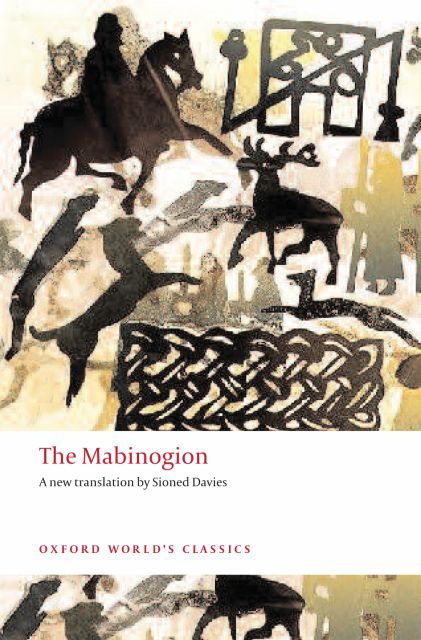
Book 138, Wales: "The Mabinogion"

I know, I know. I said I was going to do the UK as a single entity, not as the four separate nations of England, Wales, Scotland and Northern Ireland. But somehow I gave in to temptation and had a peek at Welsh literature - and it occurred to me that quite apart from the popular opinion of my friends (which was that I should indeed read four separate books), there is simply a lot of good writing from each of these lands, and I might as well avail myself of them while I'm in the British Isles. And anyway, didn't I do Macau as if it was its own country?

I had a choice of texts, too. At first I was skimming through Dylan Thomas's memoir-cum-short story collection, Portrait of the Artist as a Young Dog. Got through half of it in an evening, too. But then I flipped through the first few pages of this baby, and I was hooked:


The Mabinogion is a series of eleven Celtic tales, dated between 1382 and 1410, translated from Welsh to English in the nineteenth century by Lady Charlotte Guest. The first four of these are 'The Four Branches of the Mabinogi': ancient, primal tales of kings and witches and savagery that will f*cking blow your mind.

Lemme tell you what happens in the Fourth Branch, to give you a taste of these nuts. There's a guy called Math son of Mathonwy, and he can't live unless his feet are in the lap of a virgin. (No explanations. Just go with it.) But then his nephew, Gilfaethwy falls in love with said virgin, a gal named Goewin, who's the fairest maiden of her generation. So he and his brother Gwydion come up with a  plan. They approach Math with a plan: they wanna team up with him to capture these strange creatures who've never been seen before on the island of Britain who taste better than beef (they're pigs, I think). 

They dress up with eleven other men as poets, and go to the court of Pryderi, son of Pwyll. They offer in exchange for the pigs twelve stallions with golden saddles and bridles, and twelve hounds with golden collars and leashes, which Gwydion made out magic, because that's a thing. And they get the pigs, but when they get back to Math, they tell him, oh no, Pryderi is after us because the magic's worn off and he now knows he's been cheated. Math and his armies flee to another cantref (province) where the pigs are being held, and meanwhile Gilfaethwy rapes Goewin on her master's bed.

Then there's a huge war between Math and Pryderi over these pigs, and when peace returns and Math returns to his castle to lay his feet in Goewin's lap again (he didn't die because the rules don't apply when he's at war), she says, sorry, I'm not a virgin anymore. And Math gets crazy mad at Gwydion and Gilfaethwy, and says they'd better not show their faces up here again. And they don't. For several years. But then they do turn up, 'cos Math banned anyone from giving them food or drink, and they come to the court, and Math takes his magic wand, and turns Gwydion into a stag and Gilfaethwy into a hind. And he curses them to live and mate with each other like wild animals, and return within a year.

And they do return after a year, and they've got a little fawn with them. Math keeps the fawn, but he turns Gilfaethwy into a wild boar and Gwydion into a wild sow. And they go off and mate with each other for a year, and they come back with a wild piglet, which Math keeps. Then he turns Gwydion into a he-wolf and Gilfaethwy into a she-wolf, and they go off and mate with each other for another year, and come back with a cub. And Math say, okay, you guys have been punished by having to have incestuous cross-gendered sex with each other for three years, here are your fawn and piglet and cub who've turned back into boys and I've had baptised. Oh yes, and I need another virgin please. So they suggest their sister Aranrhod, and Math makes her walk over his magic wand, and she immediately gives birth to a yellow-haired boy, which makes her flee in shame...

And that's just the beginning of the tale of the hero Lleu Llaw Gyffen, who is said yellow-haired boy, cursed by his mother to never have a name, never have weapons, never get married, et cetera, all of which he manages to overcome by outsmarting her.

Talk about magical realism - these stories just rattle off impossible things in crazily compressed language and expect you to deal. There's Bendigeidfran, who deals with a demolished bridge in a battle by lying across a river and letting his men walk over him (because suddenly he's a giant!), a massacre in Ireland that leaves no-one alive but five pregnant women, whose sons eventually grow up and repopulate the island by having sex with each other's mothers, a giant and an even bigger giantess who can only be got rid of by luring them into an iron house and heating it until it's white hot (and even then they manage to flee by breaking down a near-molten wall), talking immortal salmon and stags and eagles, murderous shieldmakers and shoemakers, a hero who tries to hang a pregnant field mouse despite being dissuaded by a cleric, a priest and a bishop (she turns out to be the queen of an enemy king who turned his army into mice to eat up all the grain in the fields), a princess made of flowers, a cauldron that reanimates the dead, Welshmen stranded in England who maintain their language by cutting out the tongues of their English wives, so their children will speak only Welsh...

Trippy. Things actually get a little more standard and formulaic in the book's second half, which is dominated by Arthurian romances - all these Welsh knights fulfilling their destiny in the court of Arthur and Gwenhwyfar (yes, that's how they spell Guinevere), and every knight more handsome and noble and strong, and every maiden more beautiful than the last. But it's still gloriously mad, and by the time we get to the piss-soaked stable and unexplainable ravens and gwddbwyll games (it's a board game of some kind) and half-red half-white half-black horses of "Rhonabwy's Dream", we're pretty much spent.

Anyhow: while I'm in Great Britain, I'm gonna milk it for all it's worth.

Also of note: this is where Lloyd Alexander got his Prydain series from! I grew up on that stuff. There's even a forgotten Disney movie based on the books, The Black Cauldron. I know: Disney did a Welsh princess before a Scottish princess. Odd, huh?


View Around the World in 80 Books!!! in a larger map

Representative quote: 
           ‘I want the birds of Rhiannon, they that wake the dead and lull the living to sleep, to entertain me that night.’
           'It is easy for me to get that, though you may think it's not easy.'
           'Though you may get that, there is something you will not get. The cauldron Diwrnach Wyddel, the steward of Odgar son of Aedd, king of Ireland, to boil food for your wedding guests.'
           'It is easy for me to get that, though you may think it's not easy.'
           'Though you may get that, there is something you will not get. I must wash and shave my beard. I want the tusk of Ysgithrwyn Pen Baedd to shave with. It will be no use to me unless it is pulled from his head while he's alive.'
           'It is easy for me to get that, though you may think it's not easy.'
           'Though you may get that, there is something you will not get. I will not enturst the keeping of the tusk to anyone except Caw of Prydyn. The sixty cantrefs of Prydyn are under him. He will not leave his kingdom willingly, nor can he be forced.'
           'It is easy for me to get that, though you may think it's not easy.'
           'Though you may get that, there is something you will not get. I must dress my beard to be shaved. It will never straighten out until you get the blood of the Very Black Witch, daughter of the Very White Witch, from Pennant Gofid in the uplands of hell.'

Next book: Seamus Heaney's "The Spirit Level", from Northern Ireland.

Thursday, January 3, 2013

Book 113, Guam: "Attitude 13" by Tanya Chargualaf Taimanglo

I've just flown into Myanmar, where I'll be maintaining the Flying Circus Project Blog for the next two weeks. I'm terribly short of sleep, and I've just learnt that we're not gonna get the chance to meet Aung San Suu Kyi at the Freedom Film Fest.

So let's get this over with, shall we? (I want to invest in a nap now so I can live larger later.)


Honestly, Attitude 13: A Daughter of Guam's Collection of Short Stories isn't that great. The style has a strong whiff of the amateur and the plots tend to end anticlimactically. If I had to grade these, I might give a B+ if I were being kind (some are better than others, though: Chirika's Pepper Plant, which won the author a prize with Latte Magazine, isn't half bad).

But the content is what saves the day. Taimanglo's exploring what it means to be a Guamese Chamorro woman in the 21st century - no longer sarong-clad natives to be studied by anthropologists, but college students in Honolulu, expatriates in Seattle, army officers serving their terms of duty in Afghanistan while their daughters wail for them on their home islands, 88 year-old marathon runners in nursing homes with spiky pink and blue hair. Also explored is the condition of being biracial: the author is Chamorro-Korean, and she's described what it's like to be labelled a Jap in school and denied recognition of your true island heritage in the clumsily titled Yes I Am. And also a rather nice fantasy piece at the beginning: an encounter between a washed-ashore mermaid and a jeep-driving, zori-wearing, culturally deracinated Guamese girl in today's world. (Yes, there are stories about boys and men too, but it's clearly womanhood that takes centrestage.)

I suppose I'm drawn to this cultural testimony - not just because I love how foreign vocabularies collide with English: chenchule', pica, buñuelos aga', dinugan, donne', finadene', Hafa Adai - but also because so many texts from Oceania are written by outsiders. Immigrants, colonists, anthropologists, wayfarers - they have the resources to talk about these cultures, not the natives themselves.

Taimanglo happens to be an emigrant, though - she's lived in San Diego and now she's a military spouse in Washington, if the Internet's to be believed. Well, better brains draining out and speaking out than brains staying mute under scrutiny, I suppose.

Damn, I need sleep. Later!


View Around the World in 80 Books!!! in a larger map

Representative quote: I left the movie theater and the cold Washington air embraced me. It was almost midnight and I was out with my fiancé. This was the 18th movie I watched with a date. You can feel happy for me. This was my own doing. I didn't get to the age of 35, engaged and still a virgin, by accident. I am a Goddess on purpose. I am a beautiful Chamorro woman, on purpose. My fat is no longer my shield. 

Next book: Hiroshi Funasaka's Falling Blossoms, from Palau.

Wednesday, May 23, 2012

Book 97, Bangladesh: "Selected Short Stories" by Rabindranath Tagore

As you know, Tagore was an amazing poet: made the Europeans swoon with his Gitanjali. (Left me a bit ho-hum, to tell the truth: I am not a truly mystical soul.)


I'm here to report that he was also a master of the short story form. These pieces are some of the first literary short stories ever written in Bengali, composed while he was looking after his ancestral states in East Bengal (now Bangladesh) in the 1890s, reflecting on the nature of Indian village life which he'd seldom encountered in Calcutta and Sussex. The intro says that he was only driven to write these 'cos the magazine editors wanted 'em - a lot of critics back then didn't like 'em, in fact; said they were unrealistic, overwrought.

The way I see it, they're wonderful admixtures of poetry, realism and fantasy - and, yes, fantasy: he has Poe-like horror pieces like The Hungry Stones and Skeleton; fables like Wishes Granted in which a fictional Goddess of Desires descends to make a boy and his father swap places. Even in the social realist pieces, there's that wonderful sense of destiny and fate and spirituality looming over everything - the heartbreaking reappearances of vanished sons in Little Master Returns, Wealth Surrendered, Son-sacrifice, and the curse averted in The Gift of Sight...

Oh and I should warn you that Tagore is prepared to do horrible things to his characters. No Dickensian jolly opportunities for reform here; instead the Catherine Lim-esque ironies bounce back on these folks and ruin the very purpose of their lives. This is the Kaliyuga, after all: the age of the fallen. But speaking of ages, it's incredible to think these are tales from two centuries ago: the concerns are identical to those of South Asia today: religious divides, caste, bride prices, oppression of women, a culturally denatured generation of middle-class intellectuals. It's only when they mention that they're riding horse carriages rather than Tata Nanos that you realise how ancient this is.

Interesting thing about my earlier concerns about whether this is a Bangladeshi text, since the characters aren't Muslim. There are indeed Muslims, but they're marginal, sometimes exotic figures - an ancient Mughal princess in False Hope, a murderous but kindly sweetmeat seller in Kabuliwallah, a secret mistress of a Brahmin land-owner in A Problem Solved. 

What makes this Bangladeshi for me is the call of the river Padma: the flooding waters that strand lovers on islands and swallow up firstborn sons. Floods are very Bangladeshi indeed.


View Around the World in 80 Books!!! in a larger map

Representative Quote: from Guest.

 Early monsoon clouds formed in the sky. The village-river had been dried up for weeks; there was water only in holes here and there; small boats lay stuck in these pools of muddy water, and the dry river-bed was rutted with bullock-cart tracks. But now, like Parvati returning to her parents' home, gurgling waters returned to the empty arms of the village; naked children danced and shouted on the river-bank, jumped into the water with voracious joy as if trying to embrace the river; the villagers gazed at the river like a dear friend; a huge wave of life and delight rolled through the parched village. There were boats big and small with cargoes from far and wide; in the evening the ghat resounded with the songs of foreign boatmen. The villages along the river had spent the year confined to their own small worlds: now, with the rains, the vast outside world had come in its earth-coloured watery chariot, carrying wondrous gifts to the villages, as if on a visit to its daughters. Rustic smallness was temporarily subsumed by pride of contact with the world; everything became more active; the bustle of distant cities came to this sleepy region, and the whole sky sang.

  Next book: Theater of Memory: The Plays of Kalidasa.

Tuesday, April 26, 2011

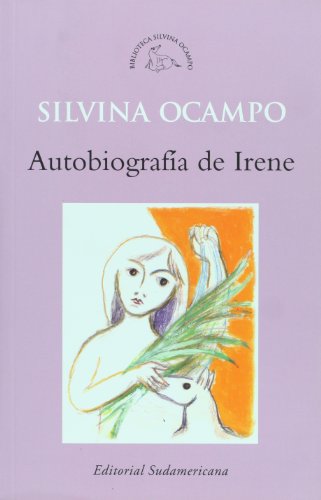
Book 57, Argentina: "Autobiografía de Irene" by Silvina Ocampo

I'm actually feeling kinda sick, so I'll try to do this quickly. But but but HOORAY, we're done with South America!

And what a pleasant way to go out (I'm honestly feeling guilty about crossing borders and doing Uruguay before Argentina, but it would've sucked to leave the continent with Ariel). This is a collection I actually picked up in Buenos Aires, by one of Borges's lesser-known and barely translated contemporaries.

I've blogged all about this funky lady here.


And hurrah: the funky lady does indeed write well. The pieces in this book have the same realm of paradoxical, paranoiac phantasy as the works of Borges or her husband Adolfo Bioy Casares. But they're tenderer, less strictly logic-based - and as much as women continue to appear as objects, they're also subjects.

There's the beautiful Flavia, whose three alternative reactions to the ministrations of her psycho husband Claudio Emilio is the key to Epitafio Romano. There's Kêng-Su, who goes utterly mad when pursued by a vengeful, literate butterfly in La Red. Even El Impostor, which is mostly focussed on its dual male protagonists Heredia and Maidana, involves the agency of the love interest María in its film summary version (why that's in there, I have no clue). And of course, there's the titular story, about a precognitive woman, serenely relieved on her deathbed of the mind-bending contradictions of her gift.

And come to think of it, even Fragmentos del Libro Invisible begins and returns to the womb of the prophet's mother. Yeah, you're getting an idea of how beautifully mad this book is, aren't you? Don't think it's translated yet, but the Spanish is pretty lucid (especially if you have a smartphone translation dictionary at your side).


View Around the World in 80 Books in a larger map

Enough of South America then! You realise that this is only the second continent, after Oceania, that I've actually completed? Lots more to come.

Representative quote:
Pasé por muchas puertas transparentes, como de hielo, en cuyas transparencias se veían ciertos colores que los mortales no alcanzan a ver; por muchas puertas altísimas, silenciosas, cubiertas de follajes, de frutos y de pájaros cuyas alas trémulas irradiaban luz en las maderas labradas. Pasé por muchas puertas horribles - algunas eran diminutas, algunas tenían una mano de jierro o de bronce, a un lado, o la cabeza de un león mordiendo un aro en el centro - antes de hallar el otro mundo en un paisaje complicado, entre edificios y objetos heterogéneos, entre camas, cuadros, armarios, arcos, estatuas, columnas, glorietas, miniaturas, látigos, sistros, tabernáculos, aureolas, espadas, baldaquines, linternas mágicas, barajas, astrolabios, cariátides, mapamundis.

Next book: H.P. Lovecraft's At the Mountains of Madness, from Antarctica.

Monday, January 3, 2011

Book 43, Dominica: "Sleep It Off, Lady" by Jean Rhys

Do I know why the Singapore National Library has a first edition of Jean Rhys's last work before her death? No I do not.


But I'm glad all the same, because this is a lovely book - arguably more beautiful than her more famous novel Wide Sargasso Sea, which I only liked on a second read.

There's a distant, interior style, characteristic of an earlier, more genteel age - I kept thinking of Eudora Welty - and indeed, Rhys (it's pronounced Rees) began writing in Paris in the '20s, soaking up the culture of refined Modernism while never quite shedding her Caribbean roots and accent.

Another thing I love is how this series of fictions carries us through the line of Rhys's life, from her childhood in Dominica to her boarding school blues in rural England to her London musical-hall and Parisian demimondaine days, up till her senescence, retirement (and afterlife). The cover sleeve claims the stories are based on her own life, and indeed there are tales narrated in first person, and little mysterious details that cohere more with the randomness of true living than with the ideal contours of plot.

But the truth is, most of the female characters (often mildly to wildly neurotic) have names of their own: the molested Phoebe, the spiteful Daisie, the untouchable Margaret, the obsessive Audrey and the pathetic Miss Verney. So their lives are cut short as each story ends, and we're left with that beautiful sense of mystery as we move into another woman's life.

It's also pretty refreshing to see the tropics portrayed so coolly and dispassionately, by one for whom the experience of snowy England was far more bizarre than a land of rainforests and volcanoes. Sure, there's voodoo and murders and miscegenation, but that was part of the course of life as they viewed through the distant windows of childhood.

Quite different from most colonial narratives. She even makes fun of the exoticisation of the Indies in "The Insect World", which ends up comparing sandflies to London subway passengers in the war, to the ticking biological clock of a single woman in a city about to swallow her whole.


View Around the World in 80 Books in a larger map

Representative quote: Well there was one thing. Now she felt very wise, very grown-up, she could forget these childish worries. She could hardly believe that only a few weeks ago she, like all the others, had secretly made lists of her trousseau, decided on the names of her three children. Jack. Marcus. And Rose.

Now goodbye Marcus. Goodbye Rose. The prospect before her might be difficult and uncertain but it was far more exciting.

Next book: Frantz Fanon's "Black Skin, White Masks", from Martinique.

Thursday, December 23, 2010

Book 41, Montserrat: "The Three Suitors of Fred Belair" by E. A. Markham

Yeah, I'm done with this book now. Don't read it.


Not that it's entirely unenjoyable. But it's basically the rather autobiographical scribblings of an old, very erudite, very privileged man making his way through an international academic world: Dublin and Paris and London and Boston and Amherst and DC, a few memories of the south of France.

The main character's a poet called Pewter (who somehow morphs into the author himself by the end of the book, with a eulogy to his brother etc). Bits about sestinas and Pliny the Elder. Not entirely uninteresting but he supplies very little reason for us to care about him. Pfah. The eponymous Winifred Belair appears at the beginning, a 40-something bachelorette French teacher who's lived in Martinique and Paris who puts ads in literary journals to meet some serious suitors: there's some nice fictional high-jinks involving strong, spirited women at the beginning, but then we're in the world of intellectual aristocrats again. Yawn.

(We never even hear what happened to her in the end, after she's held hostage in Martinique by her family when she announces her desire to adopt an African child. Really, you'd think this should have been resolved? But then Markham died a year before the book was published, so maybe this is just a scrap-heap of a volume?

I might have been much better off with his other volume, Meet Me in Mozambique, which seems to include a little more time in the West Indies, and actually precedes the events of this book. But then I didn't like the opening pages, so.)

Ah, something interesting: I couldn't tell what race Pewter and Fred Belair were for a lot of the book: they're just incredibly *white* in terms of their education and family status: tweed and hors d'oeurvres and quiet senescent neurosis and only the odd comment about Henry Louis Gates Jr or Ayaan Hirsi Ali thrown in. But they're black; that's made quite clear by the end. Odd that we're still at a point in our culture that we can't quite reconcile the image of the black man and the stuffy old fogey of a writer.

Also interesting, of course, is the fate of the fictional island of St Caesare, where Fred Belair lives. It's based on what happened in Montserrat: the capital was utterly destroyed in 1995, buried under volcanic ash, people evacuated to five continents and only returning in fits and starts, newly cosmopolitanised: a tale of international alienation happening on a not entirely developed tropical island in the Caribbean.

No tropical idylls here. Just post-apocalyptic exile and meanderings towards death.

And I don't mean that in a sexy way. Seriously. The book's not worth it.


View Around the World in 80 Books in a larger map

Representative quote: She still had friends, of course; from the good time that was pre-volcano. Now - well, now, was it something in the air; was it the volcanic ash that was addling their brains? Was it the sense that suddenly so much that you valued was taken from you, and you not exactly living in a war zone, you not being subject to some brutal human dictator with the sexual habits of a prophet? Suddenly, you had to reassess your life lived above the ash.

Next book: Maryse Condé's Who Slashed Celanire's Throat, from Guadeloupe. Next five authors are all world-famous literary heavyweights. It's gonna be good. :)

Saturday, October 23, 2010

Book 29, Haiti: “Heading South” by Dany Laferrière

Whoo! Another chance to clear out my stash of not-yet-read books!

I received Heading South from Laferrière last year, when we were both guests at the Ubud Writers and Readers’ Festival - he arrived late and jetlagged at a party in a white raja's mansion where no-one recognised him, including me, but I was feeling lonely and was eager to practise my bad French with someone else who wasn't fitting into the whole partay groove. (As I recall, Fatima Bhutto, Marco Calvani and Hari Kunzru were really cuttin' a rug on the dance floor.)

Hélas, mon ami Jean-François, this book doesn't have as provocative a title as Comment faire amour avec un nègre sans se fatiguer. But not to worry: it's just as pornographic.

It's another one of those lovely short story collections that add up to a novel: all these disperse characters living their own lives around Port-au-Prince who end up intersecting, often sexually. You see, one of the big themes of the book is the strange powers of attraction that (usually younger) black Haitian men have on (usually older) white women from France or the United States or Canada, married WASPs and intellectual Jewish harridans who end up having their worlds turned upside-down when they enter the sultry climes of Hispaniola and discover the core of their womanhood, erupting in desire at the sight of a beautiful black lad of seventeen.

Oh yes, it's ridiculous, and probably misogynist and reversely racist, definitely perversely so, shades of Mustafa wanting to colonise Europe with his penis in Tayeb Salih's Season of Migration to the North. But it's bloody good reading; thrilling erotica; strangely affirming in the light of all our knowledge of restavek child slavery and post-earthquake anarchy; and to think all these expatriate ladies in the country for sex tourism or to live with their one true ebony loves are there during the '70s, during the regime of the murderous Papa Doc Duvalier: there are throwaway lines by the young men noting how they're not scared of the tyrant's tonton-macoute squads, amidst all the miscegenous revels at the Bellevue Circle and the jazz clubs and the bedroom.

It's not just black boys and white women, though. It's black girls with older white men, including the American consul; and black girls doing it with black boys, and black girls doing it with each other. Laferrière does not run out of imagination when it comes to the libido. (And it's harder than you'd think to write a sex scene without feeling clichéd. Try it!)

Really, this book went by in a flash. A joy to read. Not sure if you'd enjoy it as much if you were a white man or a black woman, though.


View Around the World in 80 Books in a larger map

Representative quote: Charlie dips his tongue into the juiciest bit of fruit in Port-au-Prince. Missie never tires of this exotic but exquisitely executed caress. Especially towards the end of the afternoon. She is always the one who insists on it. Missie's sweet, pulpy body.. Her sex exhales an odour of ripened fruit. She may be European on the outside, but inside she is pure Caribbean. Her slit smells of guava; her stomach tightens and lifts at the same time, inviting Charlie's tongue to resume its exploratory probe.

Next book: How the Garcia Girls Lost Their Accents by Julia Álvarez, from the Dominican Republic.

Saturday, August 28, 2010

Book 21, Nicaragua: "Azul" by Rubén Darío

As you can see, I finally managed to get a copy of Azul from Amazon for US$0.99! From the online edition here, the contents seem to be based on the first edition.


Fyi, Darío's known as the great Nicaraguan poet who invented modernismo in the late 19th century, the first literary movement to begin in the Americas and later spread to Europe.

But a couple of surprises:

1. Although Darío's famous as a poet, Azul(his first collection) is actually mostly made up of short stories, descriptive passages. There's a chunk of poems at the end, though.

2. Modernismo isn't actually very modernist. It's excessively flowery and effusive in praise of love and the beauty of young women and nature and jewels, bordering on Aubrey Beardsley-esque decadence. No sex, though. The poems are still pretty structured, too.

3. Hardly any of these pieces take place in Nicaragua. They're set in places with princesses (Italy?) or underground in the gnome kingdom or in Paris or Valparaíso - in fact, all the descriptive passages are about Chile, where Azul was published. The only piece set in Nicaragua is a weird autobiographical-sounding thang called Palomas Blancas y Garrzas Morenas, which is about him falling in love with his cousin while growing up with her and his grandmother, gawking at her 15 year-old body, with hair as blonde as German, no seriously, by the light of the silvered moon, "la luz de una luna argentina, dulce, una bella luna de aquellas del país de Nicaragua."

I'm honestly not that keen on the book. Sure, it's interesting as a cultural artefact, and some of the pieces are pretty cool - there's El Rey Burgués, a sad fable of the bourgeois king who cages the starving poet in his zoo, and La canción de oro, a crazy intense paean about gold and its effects on man. Also the descriptions of the tiger in his poem Estival. But given the difficulty of reading (my book had bizarre spellings: Js instead of Gs and vice versa, &c), I don't think I got a great payoff.

Didn't learn much about Nicaragua, either. There was a casual reference to the swamp crocodiles he encounters after his wedding in Palomas blancas, but this ain't a very nationalistic book. Which is okay, innit?


View Around the World in 80 Books in a larger map

Representative quote: Ya tenía quince años y medio Inés. La cabellera, dorada y luminosa al sol, era un tesoro. Blanca y levemente amapolada, su cara era una creación murillesca, si veía de frente. A veces, contemplando su perfil, pensaba en una soberbia medalla siracusana, en un rostro de princesa. El traje, corto antes, había descendido. El seno, firme y esponjado, era un ensueño oculto y supremo; la voz clara y vibrante, las pupilas azules, inefables; la boca llena de fragancia de vida y de color de púrpura. ¡Sana y virginal primavera!

Next book: Paul Theroux's The Mosquito Coast, from Honduras.