Showing posts with label east asia. Show all posts

Saturday, May 4, 2013

I think I'm turning Japanese!

I think I'm turning Japanese, I really think so...

Not really. But I've been on an odd little Japanese kick recently. Reading these two volumes, both for work purposes:


Ihara Saikaku's The Great Mirror of Male Love is research material for the new pan-Asian gay men's magazine Element. I'm including it in a list of gay Asian classic books, and it's really awesome for the purpose: it's a series of 40 short stories, all celebrating male-male romance/sex, published in 1687 by a landmark author of erotica, proof that there was an age when Asians weren't squeamish at all about homosexuality; when it was actually institutionalised, to an extent. (Not sure how I'll treat the fact that the "bottoms" were usually boys under the age of 16, and that a lot of the stories end in ritual seppuku.)

Ben Hills's Princess Masako: Prisoner of the Chrysanthemum Throne is the real-life tale of a modern-day Japanese lady who became a princess and did not live happily ever after; pressured by the imperial staff into a state of terrible depression. I'm reading it for an article for What's Up: News For Kids - I've been asked to write about how the princess has just been seen at her first overseas trip in 10 years, and I realised this volume would give me the background story more efficiently than snooping around on the web. (Quite a tinge of cultural imperialism in the authorial voice, imho.)

As such, my progress on my Kiribati book has been slow. Stay tuned!

Thursday, April 4, 2013

Bangkok books?

So I'm back from the ILGA Asia Conference in Bangkok! Will be writing a Fridae article about it, too. But it wasn't much of a holiday - didn't even make it to Chatuchak Weekend Market. Too busy blogging during the conference, and attending the ASEAN SOGI Caucus in the two days afterwards.

Thus, the only book I acquired during that sojourn was this:


The English title seems to be Violated Lives: Narratives from LGBTIQs and Internatioanl human Rights Law. I got it free from a table where goodies were being handed out.

Yes, it's mostly in Thai, but the annex is bilingual, and it covers the Yogyakarta Principles (and can I say right now how proud I am as a Southeast Asian that a landmark document on sexual orientation and gender identity rights was crafted in my own neighbourhood?).

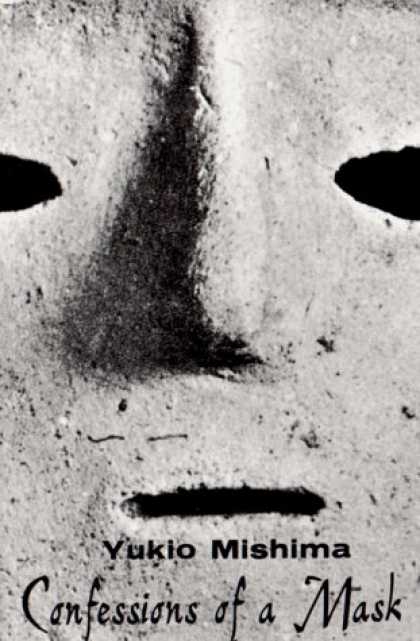
What I actually spent most of my time reading, however, was this:


I'm doing an article on classic gay Asian lit now (not gay Asian American lit, thank you very much), so of course I've got to peruse Yukio Mishima's landmark tortured-gay-man-in-the-closet novel, Confessions of a Mask. 

Oh god, but I don't know if I should recommend it to the average reader. It's so dark and twisted and upsetting, perhaps even dangerous for the insecure gay man. And honestly, his other works, like his Noh Plays and The Sailor Who Fell With Grace From the Sea, are more transcendent and beautiful, presenting psychosis on a platter rather than being immersed in it.

I'll probably list it, anyway, due to its historical importance. Must live with the possibility that one of my future readers will end up committing hara-kiri because of me.

Too many deadlines now to even think of heading down to the library to read my Tokelau book, by the way. Maybe I can squish it in towards the end of next week.

Thursday, December 20, 2012

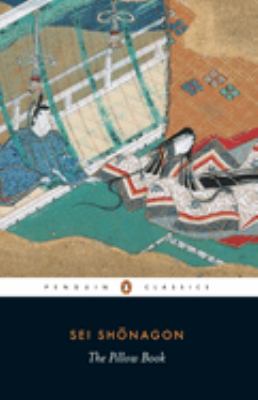
Book 111, Japan: "The Pillow Book" by Sei Shonagon


I’m back in Singapore! ILGA and the Scandinavian winter were amazing, consciousness-expanding experiences – I’ve written about some bits of ‘em on the ILGA Blog, and I might upload my e-mails to my folks to my personal site, The Paradise of Flowers and Fruit. Doing this project turned out to be pretty useful for socialising too - if I met a guy from Samoa, why, I could just mention that I'd read Albert Wendt and we'd have something to talk about straight off.

As for The Pillow Book, oh my: it took me all holiday to read. Surprising, considering how lightweight it is as a text, but Kindle for Mac had me clicking the screen all the time for the endnotes – it’s not a conducive medium to skimming at all.

But it was rather nice, absorbing these Japanese aesthetics of nature and seasonal change while trundling through the snow-covered mountainscapes of Norway. As much as Sei delights (this is a word used often) in the floral colours of court dress, she’s also in love with the images of winter: the snow on a gentleman visitor’s cloak, a lady holding a lighted coal to a letter to read it in the darkness.

Much has been made of the lists in this book – refined and elegant things, things that make your heart beat fast, things that make you nostalgic – but as translator/annotator Meredith McKinney notes, the literary form was quite established by 994, when Sei received the gift of paper which formed The Pillow Book. In fact, she deviates from standard lists, distracted by personal memories and commentaries.

And so much of this text is made of memories: little episodes in court that show off the pageantry of Emperor Ichijo and Empress Teishi, that are evidence of her wit as she bests the male courtiers in their games of quoting the Chinese classics – though a refined woman was not supposed to be able to read Chinese; thus her exhibitionism was necessarily veiled by sly self-effacement.

And what a strange world for women this was: where it was proper for court ladies to remain behind screens when addressing men, yet extra-marital affairs were not frowned upon. (A disproportionate number of these East Asian texts I’m reading are by women; have you noticed?)

Of course the whole work’s made more poignant because you know this gilded world was not to persist: Teishi fell from favour and died two days after childbirth, after which Sei left the court and by tradition died an impoverished crone; a couple of centuries later and the empire was transformed into the wartorn battlefield of The Tale of the Heike.

But for a while, this beauty, this perfection. And how grand that these moments of delight were captured well enough to remain on the shelf of world literature, perennial amidst the changing seasons.


View Around the World in 80 Books!!! in a larger map

Representative quote: 
[71] Rare things – a son-in-law who’s praised by his wife’s father. Likewise, a wife who’s loved by her mother-in-law.

A pair of silver tweezers that can actually pull out hairs properly.

A retainer who doesn’t speak ill of his master.

A person who’s without a single quirk. Someone who’s superior in both appearance and character, who’s remained utterly blameless throughout his long dealings with the world.

You never find an instance of two people living together who continue to be overawed by each other’s excellence and always treat each other with scrupulous care and respect, so such a relationship is obviously a great rarity.

Copying out a tale or a volume of poems without smearing any ink from the book you’re copying from. If you’re copying it from some beautiful bound book, you try to take immense care, but somehow you always get ink on it.

Two women, let alone a man and a woman, who vow themselves to each other forever, and actually manage to remain on good terms to the end.

Next book: Chun Yu Wang's Chicken Feathers and Garlic Skin: Diary of  Chinese Garment Factory Girl on Saipan, from the Marianas.

Monday, December 3, 2012

Book 110, North Korea: "Nothing to Envy" by Barbara Demick

I'd read a couple of books about North Korea before: Guy Delisle's graphic memoir Pyongyang and Hyejin Kim's "novelisation" of defector accounts, Jia. I didn't think I had to read any others, especially not this one. After all, if a Canadian and South Korean had already given me their two cents' worth, what fresh insights could an American have?


Ah, but Barbara Demick's proven me wrong. I've realised that the two above accounts capture only a tiny fragment of the North Korean experience, mostly confined to the capital city, which it seems is a huge Potemkin village, where only good-looking, able-bodied citizens are allowed to roam so that foreign visitors will be impressed.

This book looks instead at the northern factory city of Chongjin, home to gulags and coal mines and party officials and undesirables alike. We follow the lives of six ordinary North Koreans who escape the famine in the nineties, wading their way past the border with China, then flying into South Korea: the rebellious POW-daughter Mi-ran, the rich university student Jun-sang, the party loyalist Mrs Song, her daughter Oak-hee, the street kid Kim Hyuck.

And god, it's heartbreaking. Demick is a master storyteller: she begins with the teenage love story between Jun-sang and Mi-ran, in the blacked-out darkness of their city, bereft of electricity, noting its provenance: Mi-ran was now a prosperous and well-adapted resident of Seoul, married to another man, yet wistful for her innocent past.

The density, maybe length of the story, matters so much. We learn how life is different for insiders and outsiders, what they ate, what they feared, what they sang (the title is a reference to a North Korean children's song, that claims We Have Nothing to Envy in the World). We see disaster unfolding, slowly, as the horrible political realities of Juche creep up on idealistic youngsters and Kim Jong-Il dies and the famine descends with its pellagra and constipation, weird rashes appearing in spectacle-circles around people's eyes, the most virtuous dying first, the old then the children then the men then the women, and the crazy run-around cycle of imprisonments and recaptures that so many people had to go through to finally make it into the promised land of Hanguk.

Come to think of it, it's also important that we're hearing the stories of individuals. So many images of North Korea portray its people as brainwashed masses, or else single out idealised heroines among them (seems a majority of defectors are women, partly because they can sell themselves off as wives or prostitutes). The unique quirks that these people have, the different extents to which they've adapted to South Korean culture (did you know, what strikes the Northerners as weirdest is how South Koreans kiss and hug in public?) are just so compelling, and inspiring - because of all the six, all of them seem to have done okay, in the end.

Also amazing is Demick's discipline in creating this book: she spent six years interviewing over 100 defectors, heaven knows if she speaks Korean, she must by now. I'll be teaching a non-fiction course next semester - how can I convince kids that that kind of investment is worth it?

Bloody amazing, anyway. And I'm glad I finished this before I fly off for the ILGA Conference tomorrow.


View Around the World in 80 Books!!! in a larger map


Representative Quote: Dr Kim looked down a dirt road that led to farmhouses. Most of them had walls around them with metal gates. She tried one; it turned out to be unlocked. She pushed it open and peered inside. On the ground she saw a small metal bowl with food. She looked closer - it was rice, white rice, mixed with scraps of meat. Dr Kim couldn't remember the last time she'd seen a bowl of pure white rice. What was a bowl of rice doing there, just sitting out on the ground? She figured it out just before she heard the dog's bark.

Up until that moment, a part of her had hoped that China would be just as poor as North Korea. She still wanted to believe that her country was the best place in the world. The beliefs she had cherished for a lifetime would be vindicated. But now she couldn't deny what was staring her plainly in the face: dogs in China ate better than doctors in North Korea.

Next book:  Murasaki Shikibu's The Tale of Genji, from Japan.

Tuesday, November 20, 2012

North Korea: "Songs of the Dragons Flying to Heaven"

Update: I have decided to disqualify this book as my North Korean text. Previously, it was listed as Book 110.

Well, this is embarrassing. I wanted to buck the traditional representation of North Korea as a Communist dystopia (which it is) by focussing on its glorious past. It used to be the more developed bit of the Korean peninsula, doncha know; the centre of a whole lotta history. But now I'm bussing out of Singapore to Penang overnight and I've just realised the great Korean epic  Yongbieocheonga was in fact compiled by Sejong the Great in the city of Hanseong, better known today as Seoul.


Alamak! But not to worry. The songs in this 15th century work are composed in praise of Sejong's ancestors: they're the six dragons of the title, Mokjo, Ikjo, Dojo, Hwanjo, Taejo, Taejong. And they did indeed wander through what's now North Korea, before conquering the hell out of the Goryeo Dynasty and setting up the Joseon.

Quick explanation: we don't know who wrote these 125 brief cantos. But we do know their purpose: they were written both to glorify the roots of the scholar-emperor as well as to instruct him on the proper paths to take into future (yep, literati get to tell the emperor what to do! This was the age of Neo-Confucianism).

The poems are also the first ever text written in Hangul, invented specially by Sejong. It's a moment of transition: the annotations were inscribed in the scholarly language of Chinese, as were many of the words within the poems. Pretty much all the allusions being made are to Chinese history: other emperors of the Zhou and the Han and the Tang - these guys are trying, almost for the first time, to build up their own culture, and they need to resort to crutches to do so.

The reason why you don't see this selling in airport bookstores is that it's actually quite difficult to read: the brief poems contain such allusions to specific incidents in history that you've got to switch over to the annotations all the time to understand them, breaking up any sense of reading rhythm (me, I just skipped them on a first read and looked at them later).

What makes things even worse is the fact that there are no names involved - it's the annotations that tell you whether we're talking about Taizong of China or Taejong of Korea, that the false claimant is the usurper King Sinchang of Goryeo.

Oh, but if you do read the annotations, such fun! These kings are pimps: shooting down magpies, two at a time with a single arrow, and being honoured by snakes; getting their armies rescued when they encounter gods in the forms of white-haired old women and white-bearded old men; shooting black dragons out of the sky when they're battling white dragons after being warned by dreams (yes, archery is a big theme here; it's also used for fortune-telling); fending off Red Turbans and Japanese pirates. Even the queens get into the action, handing their husbands armour and feigning sickness so as to meet with them and warn them of developing conspiracies.

But I've no more time to go on babbling; I have a boyfriend to meet and a bus to catch.

[Insert a link to Songdo, where in 1399 a white dragon with fish-scales shining in the sun appeared on the roof of Taejong's submerged palace, foretelling his elevation to the throne.]

Representative quote: 

CANTO CX

The Four Ancestors knew no rest.
In how many places did they swell?
How many rooms
Did their houses contain?
Living in multi-storied palaces,
Enjoying halcyon days,
Let Your Majesty not forget this!

Next book: The Pillow Book of Sei Shonagon, from Japan.

Friday, October 26, 2012

Book 108, Taiwan: "Notes of a Desolate Man" by Chu T'ien-Wen

I've actually been holding on to this book for ages - got it while I was in Columbia, not long after my Modern East Asian Literature course (our token Taiwanese text for the class was Chang Ta-Chun's Wild Kids.) 

Was considering other options for this segment, though: tempted by the thought of doing something untranslated, like that copy of Wang Wenhua's è›‹ç™½è³ªå¥³å­© we have lying around. But life is short, and my excellent translator/author/actor friend Jeremy Tiang recommended this.

And it's a gay experimental novel - by a woman, too. What's not to like?


Oh, but this isn't a casual read - takes a lot longer than the 166 pages of its contents might suggest. There's no real plot: we're wandering with the mind of the narrator (he's too passive for me to really call him a protagonist) Xiao Shao, an ageing Taiwanese gay man, as he contemplates the death of his friend Ah Yao from AIDS.

Ah Yao's the kind of guy you'd expect to be a hero: he's introduced as an extrovert, an ACT UP rights activist who's worked in the US, and a precocious sex maniac. Our narrator nearly humped him in his youth, before he was out himself, but held back. Now he's sitting in his friend's house, observing the decay of Ah Yao's body, contemplating the wastage of his own life - no love, no family, no longer even a real desire for sex.

And yet as the tale wanders, we find there's very little about Ah Yao - most of the story is about his own love affairs and near misses, mostly with a photographer named Yongjie and a dancer named Jay - both absolutely gorgeous men, we're told, even though Shao is a mere academic, with neither fortune nor glamour to his name. And though we witness despair and yearning and heartbreak and the absolute pathetic-ness of aged singlehood (what is the noun form of this word? Internet says patheticalness but that sounds awful), what we're also left with is genuine love, obsessive and romantic and stupid and all, but observed from a distance, like everything else in this tale.

See, Xiao Shao's mind joins up Fellini and Tripataka and Nijinsky and the Rubaiyat and Hayao Miyazaki's Nausicaa, just to describe what he's feeling - not to show off or be politically correct, like I do. And it's paralleled by his own casual descriptions of travel to Athens, to Nara, to Kushinagar, to the Valley of the Kings in Egypt (he resists ever visiting China, which is where Yongjie eventually falls in love with a young farmer on the Silk Road).

All these expanses contrasting with the severe limits of his childhood, growing up in the shadow of the Chiang Kai-Shek dictatorship, and the shadow of his adulthood, his loneliness in the public toilets and video arcades of Taipei and Kaohsiung.

Oh, I won't go on too long about this. Must do some writing of my own. But it is such a different book from most of the works I've been reading - a story that meanders and is lost, and is comfortable being lost.


View Around the World in 80 Books!!! in a larger map

Representative quote:  
And so I felt that life and death shared the same face, right in front, looking down at me.

It was often there, when I crossed a street, or when I was in an elevator, or right now, while writing. The face wasn't all that scary; it even had the hint of a smile, like a Noh mask hanging on a wall looking down on me - or that's how it felt. If it had grown more vivid, it would have been the picture of an Indian goddess, a sword and a human head in two of her outspread arms, while the other two promised blessings and protection. I was right in front of her, coexisting with her. Therefore death is not the Angel of Death, who wore a black cape and a black robe and played chess with a knight in Bergman's The Seventh Seal. It was, instead, life, who looked down on me.

The ancient Greeks said, You can never place your fee tin the same river twice.

Yes, the kalpa gone, the kalpa now, the kalpa to come.

The past, the present, the future.

Next book: Kyung-Sook Shin's Please Look After Mom, from South Korea.

Wednesday, October 3, 2012

Book 107, Hong Kong: "The Unwalled City" by Xu Xi

I'm currently on holiday in Laos, and on holiday from my reading project. But three hours before I left, I managed to finish off my Hong Kong book! Of course I considered Jin Yong (since he's probably HK's most successful writer), but none of his swordfighting novels take place in the city. Also Eileen Chang, but she only spent a couple of years there, it seems - she was essentially Shanghainese.

But Xu Xi's as Hong Kong as Hong Kong noodles - born and bred and teaches at the university there, though she's hopped around Asia and North America in the course of her career. First met her at the Man Hong Kong Literary Festival in 2007; read her Daughters of Hui and really liked it. 


Wrote to her to ask her which one of her works she'd recommend for this project. Of course, she had to suggest the only one which the National Library doesn't stock. Read this on the Kindle, which I didn't want to run the risk of losing or breaking while backpacking.

But I had trouble with this book at first - truth is, the characters float from scenario to scenario with little visible motive force. They're all these lost, good-looking privileged men and women, living in Hong Kong on the cusp of the 1997 handover. They're not even particularly scared of the prospect of going back to Red China. If I were marking this for my creative writing class, I'd have been asking where the thrust was, what made us *care* for these characters.

Still, as time wore on, the story grew on me. It's interesting reading this in the wake of The Bewitching Braid, or that classic Hong Kong romance The World of Suzie Wong, both of which are about race and class relations clashing, then becoming happily reconciled in an age of colonialism. The Unwalled City is determinedly postcolonial - no, that word fails to encapsulate the theme: it is post-postcolonial, occupying a world where global capitalism has collapsed the importance of race and gender.

Look at Colleen, a white Bostonian who speaks Mandarin and Cantonese, married to a Hong Kong Chinese guy but having affairs with loads of men, white and Asian. Look at Gail Szeto, divorcee offspring of an American pilot and a Hong Kong prostitute who's climbed her way to the top of the corporate ladder, caring for her senile mother and more Chinese-than-ever son Gu Kwun. Look at Vince, the Brooklyn photographer and low-caste expat who goes from being an HK newbie to a Cantonese-spouting old hand; Andanna/Lei You Fun who dumps her jazz career to become a Cantopop singer.

These figures whose lives intersect, whose actions frustrate one another (Xu Xi will shift perspectives from one character to the next without warning, so that the follies and misperceptions of the characters are clearly visible to us). They have affairs and dates and epiphanies, but nothing happens, not really, we don't know where their lives are going by the closing chapter as Andanna sings on the stage of the handover ceremony.

The story drifts. We drift. The characters drift, even geographically, from Wan Chai to Singapore to Shanghai to New York. Is this how tales are told today? With no deaths, no marriages, no births, with only pre-planned unhistorical historical events? I'm thinking aloud, of course. Just wondering how people do it - put enough words together, call it a novel. 

Me, I can't finish writing anything right now. Ah well. Maybe the nights in Laos will inspire me.


View Around the World in 80 Books!!! in a larger map
Representative quote: "You are privileged to be here in our city at this moment of historical change." Albert spoke as if he were some kind of elder statesman for Hong Kong, with a possessiveness that conferred distinction to utterances on high. "In a way, Vincent, you are in a slightly better position than some to appreciate it because you originate from a city that once almost defined a new order for what a city was and should be. Of course, New York is somewhat passé now."

Proclaimed not as an opinion but as a fact.

Next book: Chu T'ien-wen's Notes of a Desolate Man, from Taiwan.

Tuesday, September 25, 2012

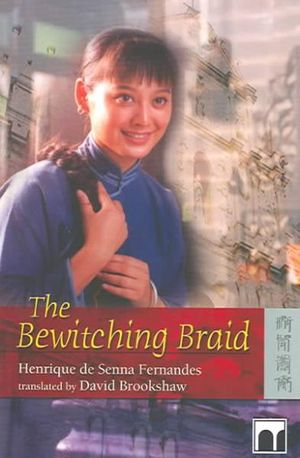
Book 106, Macau: "The Bewitching Braid" by Henrique de Senna Fernandes

Guess what? We're in East Asia! And we're in China, but not in China per se, because if they're going to go around claiming every little island is theirs, I'm going to assert my right to proclaim every disputed and recently returned colonial territory as a distinct country from the mainland.

Thus, Macau. But golly gosh, I'm glad I decided to do this former Portuguese colony, because The Bewitching Braid is loads of fun.


It's fundamentally a romance: boy meets girl and (SPOILER ALERT!) their love triumphs against all odds. The intro notes that the author may be influenced by soapy Cantonese yarns in this respect. But it's written in Portuguese, by a member of the Macanese community: one of the many half-European, half-native mestizo groups the Portuguese empire-builders sired in Goa, Sri Lanka, Melaka, Timor, Brazil.

And it's an interracial love story, too. Thus, we've beautiful details of the privileged 1930s Macanese middle-class world of Handsome Adozindo, playboy about town, as well as the dignified squalor of the Chinese quarter of Cheok Chai Un, where the indomitable Chinese water-seller A-Leng plies her trade. Of course he becomes fascinated with her braid and her spirit, and is determined to seduce her - and yet ends up as her loyal and steadfast husband.

It's not a snap-happy convenient happy ending, mind you: the two are thrown together permanently rather against their will, the boy's family and the girl's community disowning them, leaving them to fend for themselves. Adozindo, being a good-for-nothing, really does look like he's going to become a drunken opium-addled sot at one point.

But they work through it at the end, and by the story closes not with a marriage but with Adozindo's family finally accepting him and his wife and his four children. The point is that it's not comfortable or easy to overcome ostracism and class differences and poverty, but it's possible.

(Btw, I honestly thought there'd be another crisis with the onset of World War Two, but it seems that Portugal was neutral during the war, so Macau ended up being one of the few peaceful refuges during the Japanese Occupation of East Asia.)

Of course, now Macau's gone and become the Las Vegas of the East, and my Hong Kong friends tell me it's hard to find that old, sleepy town they loved so well, a ferry ride over from the hustle and bustle of Kowloon City. More important than ever, then, to have this record of a vanished era.

View Around the World in 80 Books!!! in a larger map

Representative quote:
Adozindo staggered to his feet, his clothes torn, his face and body covered in cuts and bruises. A-Leng swung her weapon of war around to give the boy cover, and urged him to go. She was magnificent, inspiring respect, queen of her territory, beautiful, barefoot, her braid twisting like a whip. Adozindo moved off as speedily as his strength would allow. He was safe and it was a heroic display of love that saved him.

Next book: Xu Xi's History's Fiction, from Hong Kong.

Saturday, April 14, 2012

Book 94, Tibet: "The Tibetan Book of the Dead"

Cor. This was a bloody good read, way more interesting than the Quran or the Lotus Sutra or the Bible (most bits of the Bible, anyway). I was gonna say it was easy to see why it became a Western cult classic, then I remembered that for the longest time what the hippies and the beats were perusing was a single portion of this volume: The Great Liberation By Hearing.

This baby I’ve been lugging around is the first full translation, based on the three volume manuscript from the library of the Kyabje Dudjom Rinpoche, completed by the scholar Gjurme Dorje with support by HH the Dalai Lama. Check it!
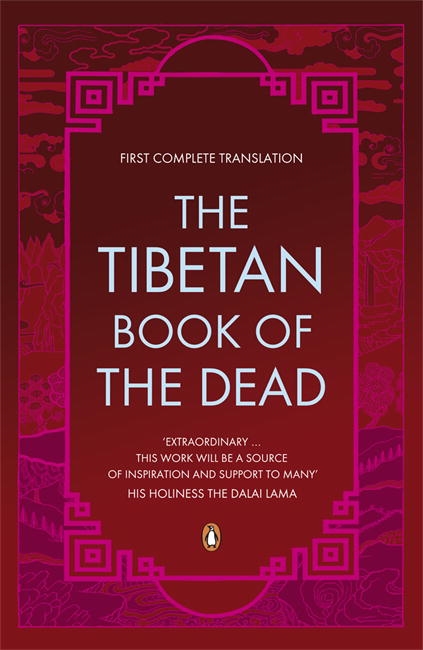


And what makes this book so awesome? Well, first of all, it’s brilliantly random: as crazy if not crazier than the palimpsest hotchpotch of the Old Testament. It consists of prayers, philosophy, catalogues of deities, medical instructions for determining the date of imminent death, magical rituals for forestalling said death, a detailed practical guide to ensuring enlightenment or at least rebirth as a higher being following said death, and even a masked drama demonstrating the posthumous fates of a butcher and a pious merchant, as Yama Dharmaraja, sage of hell beings, judges them by weighing the white pebbles of their good deeds against the black pebbles of their sins. (Yes, shades of the Egyptians, which is why the English title of this book stuck instead of its proper name, The Bardo Thodol.

Second of all (a phrase my boyfriend insists is ungrammatical) it is so damn *sensual*, so psychedelic that one wonders what the prophets were smoking, or if mountain air just predisposes one toward incredible visions. It’s bizarre, after reading the fairly square first chapters, which concentrate on the usual Buddhist exhortations to renounce worldly attachments, to be told of the copulating, blood-drinking, sexually dimorphic rainbow-coloured buddhas and bodhisattvas and gatekeepers and herukas that inhabit the cardinal portions of one’s skull: Gauri, white-in-colour, carrying a human corpse as a cudgel; fox-headed Srgalamamuki, black in colour, eating entrails; yak-headed Manauraksasi, brownish-white and holding a vajra; sow-headed Varahi, blackish green, holding a noose of fangs; scorpion-headed Amrta, reddish yellow, holding a lotus; three-faced six-armed Vairocana, brandishing a wheel, an axe, a sword, a bell, a ploughsare and a blood-filled skull, joyously and indivisibly embraced by Buddhakrodhesvari; and Samantabhadra and Samantabhadri, the Buddha-body of Reality.

Oh yes, and trying to foretell your death by staring at the sun or your shadow or the tinges of blood in your urine, and channeling your powers of concentration so that should you topple unexpectedly from a mountain, your soul will escape your body from the correct orifice. Madness!

And also the gentle comfort it must give one to imagine one’s body at a funeral, surrounded by loved ones repeating prayers into one’s ear directing the soul to higher realms.

Yes, this is the kind of religious text I like: more imaginative than preachy; the kind I don’t have to take absolutely seriously and expands my imagination rather than limiting it. O Child of Buddha Nature, may you read many more books as weird and wonderful as this!


View Around the World in 80 Books!!! in a larger map

Representative quote:
There are, altogether, nine different pathways through which consciousness transference can occur, and these are associated with persons of superior, average and inferior capacity. The aperture of the crown fontanelle is the pathway through which [consciousness] departs to the pure [realm of the] sky-farers. Given this, [it is said that] one will attain liberation f awareness exits through the [crown fontanelle]. Since this is the supreme pathway, it is extremely important that one trains in directing one’s mental focus towards this [aperture]. Furthermore, if consciousness is transferred through the pathway of the eyes, [it is said that] one will be born as a universal monarch, and if it is transferred through the left nostril, one will obtain an unimpaired human body. These are the three optimum apertures associated with those of superior [capacity].

One will, however, be born as a yaksa if [consciousness is transferred] through the right nostril, or as a god of the world-system of form if [it is transferred] through the ears, and as a god of the world-system of desire if [it is transferred] through the navel. These are the three medial apertures [associated with those of average capacity]. Lastly, one will be born as an animal if [it is transferred] through the urethra, as an anguished spirit if [it is transferred] through the sexual passage, and as a hell being if it is transferred through the rectum. These are the three inferior apertures [associated with those of inferior capacity]. Given that there are such very great consequential differences between the various apertures through which consciousness transference may occur, there wil be inestimable benefits in directing one’s awareness to the crowd of the head, at the time of death.

Such is the forceful consciousness transference. SAMAYA!

Next book: Lil Bahadur Chettri’s Mountains Painted with Turmeric, from Nepal.