Showing posts with label south asia. Show all posts

Saturday, June 23, 2012

Book 100, Sri Lanka: "The Legend of Pradeep Mathew" by Shehan Karunatilaka

I'm in New York City and hey! Guess who just hit triple digits in his reading list? (Not aiming for quadruple digits, thank you very much.)

I've also ditched Anil's Ghost for purely practical reasons: it gets only a three-star rating on Amazon; this year's Commonwealth Writers Book Prize winner, by contrast, gets four stars, and also costs US$3.00 less as a Kindle book. Very useful these e-books are, when you're on the move.

Still, I'm not altogether sure if I've made the right choice. And it's not just the way this book is so heavily entrenched in the world of cricket, which I care not a whit for (its original title was Chinaman: The Legend of Pradeep Mathew, from the cricketing term). It's the rambling, rather directionless-save-for-the-Macguffin-of-a-hunt-for-the-legendary-cricket-bowler-Pradeep-Mathew nature of the book. 
No lush Ondaatje prose here: instead we've got the alcoholic sportswriter W. G. Karunasena, dying of liver poisoning and being a bit of an arse about it, indexing and cross-referencing and chronicling his search for Sri Lanka's greatest unsung cricket hero, blacked out from the historical record (literal blackout during the airing of a documentary on the guy!) due to grudges and anti-Tamil prejudice.
What's comforting on the other hand is the knowledge that I'm learning loads about what the country's like now, with its middle-aged middle classes still clad in banians and sarongs, with its multiplicities of Tamils and Sinhalese and Buddhists and Christians and Muslims and Hindus and English and yes, even a few Chinese. With its terrorism and its corruption and its decay; with its intermarriages and expatriations and thwarted dreams of glory.)

(Incidentally, the author reportedly lives and works in Singapore, and laments several times about how Colombo has declined since the colonial days of Ceylon, when it was the envy of our city; now Changi Airport and Mandai Zoo have far outstripped his nation's counterparts.)

Oh, and the whole thing's a metatext too. The book is a chronicle of its writing, and even extends *SPOILER ALERT!!!* beyond the fictional author's death*SPOILERS END*.  And though Karunatilaka claims he's fictionalised the names of everyone in the book, he's allowed the fiction to bleed from the page into virtual space: there's info on Mr Mathew online, too.

Better not go on too long. Attending my friend Edward Rueda's wedding in a few hours. Gotta go!

View Around the World in 80 Books!!! in a larger map

Representative quote:  The answer to my wife's question is of course a no. I would go down ina  hail of bullets for her and for Garfield many times over. And while Aravinda de Silva has delighted me on many an occasion, I wouldn't even take a blister for him.

But the truth, Sheila, is bigger than both of us, whether it be written on the subway walls or on the belly of a lager lout's T-shirt. In thirty years, the world will not care how I lived. But in a hundred years, Bulgarians will still talk of Letchkov and how he expelled the mighty Germans from the 1994 World Cup with a simple header.

Sport can unite worlds, tear down walls and transcend race, the past, and all probability. Unlike life, sport matters.

Next Book: Aung San Suu Kyi's Letters from Burma, from Myanmar.

Tuesday, June 19, 2012

Book 99, Maldives: "A Hero In Time" by Royston Ellis

So I'm back from Makassar, and am illuminated by the glory of Eastern Indonesian culture. (Honestly, we always talk about Java and Bali, sometimes Sumatra or Borneo or even West Papua, but never Sulawesi.) Hopefully I'll find some time to divulge what I learned about bissus and lontaras and the epic of La Galigo. But not now: I'm flying off in another few hours to attend my friend's wedding in Long Island. Yessir, I'm a travellin' man, island to island to island, that's me.


On the topic of island nations: the UK and Maldives! I've finished this historical novel by a lesser-known British beat poet, published in Singapore, chronicling the life and adventures of Mohamed Thakurufaanu, the 16th century Maldivian nobleman who fought off an eight-year Portuguese occupation of the islands and founded the Utheem Dynasty.

Frankly, it's not a must-read. Nothing distinctive about the prose, nothing profound about the ideas, nor anything terribly captivating about the characters, who're portrayed as mostly paragons of virtue or black-hearted villains. But Ellis claims his narrative is based on the oral traditions regarding this 400 year-old national hero: methinks he wants to translate the spirit of these little-known legends rather than modernise or subvert them.

(It is of course interesting to observe the slippages between our ideas of virtue and Mohamed's. There's this whole bigamous romance going on, with his courtship of Princess Sitti Mava to be his second wife, but Ellis makes his first wife an active force in fostering this union so we won't feel she's being oppressed. Then there's Mohamed's desire to rid the entire land of infidels, slitting the throats of anyone dares to drink wine or who doesn't speak Dhivehi. Author puts a lot of effort into making us side with a genocidal fundamentalist freedom fighter, fo' sho'.)

There's very little Maldivian history on the Internet; you'd think their proximity to India and their tourist dollars would've given them the resources to pour out their souls online. So I can't actually tell how much Ellis has made up and how much is genuine legend: did the widow queen Kamba Aisha really strike the fatal blow that killed the would-be-usurper Tuffashana? Googling the names only turns up a review of this novel, here.

Okey-dokey, enough blabbering. Must pack. Ah, but if only someone chronicled Singapore's pre-colonial/colonial history this way! Methinks Isa Kamari did so in Malay, but his Infopedia article doesn't say much.


View Around the World in 80 Books!!! in a larger map

Representative quote:  Kamba Aisha grabbed the sword from his hand and pulled him off balance as he tried to turn. He stumbled; she raised the sword and drove it between his shoulder blades. Pushing on it with all her might, she forced him down on his face until the sword was buried in his back, up to its hilt. He died skewered to the sand.

I could not die at the hands of a traitor," she said to his body. "I have saved our country and our innocent people from you."

She turned as a Portuguese soldier burst into the room, his sword drawn. "Ah," she said, a smile spreading over her face. "I die at the infidel's hand. God is great."

 Next book: Michael Ondaatje's Anil's Ghost, from Sri Lanka.

Friday, June 8, 2012

Book 98, India: "Theater of Memory: The Plays of Kalidasa"

First heard about Kalidasa at the age of thirteen in Sec Two, when our history teacher talked about the Guptas. Bought this book in my senior year of college; had wanted to register for a colloquium on South and Middle Eastern texts but didn't have the time, so ended up buying the second-hand course pack instead. Seven years later, I'm finally reading it!


And it's great to finally find out what the big deal was over Sakuntala and the Ring of Recollection, the divine drama of forgetting that so entranced Goethe. Also wonderful to learn the legend of Urvasi Won By Valor, whose heroine's namesake is a seriously cool queer activist.

But surprisingly, my favourite text is probably the only non-magical one: Agnimitra and Malavika. In a way, it's because this is the least complex tale: it's about a king who's lusting after a beautiful servant girl, thwarted by the rival queens in his harem - but who discovers in the end that she's a noble princess in hiding, hooray, big wedding! Also happens to have quite a bit of comedy, and some plum female roles, including the intellectual nun Kausiki - easy to imagine a girl-heavy student group attempting this (and doing a semi-decent job of it, but oh well).

The other two...well, according to the intro, they're  natakas, or heroic romances. They're about semi-divine kings who fall in love with nymphs. Again there are barriers to their love conquests, making for some pretty romantic seduction and hiding scenes - but the focus is on tragic destinies: Dusyanta is cursed to forget that he married Sakuntala; Urvasi is cursed to leave Pururavas for the heavens as soon as he beholds his son.

The tragedies aren't allowed fulfillment, however - in Urvasi, a heavenly reprieve is granted, an annoying deus ex machina not unlike Athena's trial at the end of Aeschylus' The Oresteia. Sakuntala, on the other hand, is disappointing because it takes such pains to assure us that Dusyanta is a worthy, just king, whose forgettery is not his fault: quite different from the more ambivalent version of the legend in the Mahabharata, in which he's much more of the prototypical knock-up-yo-baby-momma-and-leave asshole.

None of Aristotle's Poetics and catharsis here; what we've got instead is a dramatic theory from the Sage Bharata's Natyasastra, which has the aim of assuring us all that the social order is hunky-dory, no problems, stop asking difficult questions, boy. Which of course rankles with a rebel like myself.

Also the weird fixation on male perspectives: despite the titular centrality of the women in these narratives, it's the desire of the king which is paramount. Sakuntala barely gets any screen time weeping before she's spirited off; Dusyanta discovers the ring of recollection and goes mad with grief, wailing and weeping and painting pictures of his beloved. Pururavas actually gets two scenes of elaborate lover's agony: in one of them he dances the carcari dance and wildly questions the animals and plants, with Urvasi only popping up at the end apologising for being turned into a creeper. (Yeah, it's a little nuts, but great literature tends to be as such.)

Did learn an awful lot from this book, though. Did you know that there are still ancient theatres cut into caves in Eastern India, with murals still on the walls? And that playhouses were allegedly invented on the command of lord Brahma, because demons tried to break up the first play? A divine world indeed.


View Around the World in 80 Books!!! in a larger map

Representative quote:

SAKUNTALA: I've thought of a verse, but I have nothing to write it on.

PRIYAMVADA: Engrave the Letters with your nail on this lotus leaf! It's as delicate as a parrot's breast.

SAKUNTALA (miming what Priyamvada described): Listen and tell me if this makes sense!

BOTH FRIENDS: We're both paying attention.

SAKUNTALA (singing):

I don't know
your heart,
but day and night
for wanting you
love violently
tortures
my limbs,
cruel man.

KING (suddenly revealing himself):

Love torments you, slender girl,
but he completely consumes me -
daylight spares the lotus pond
while it destroys the moon.

Next book: Royston Ellis's A Hero In Time, from the Maldives.

Thursday, May 31, 2012

An apology to South India

I'm still working on Kalidasa, the 4th century playwright and poet, and he's pretty damn interesting. But my conscience has been bugging me a little over my choice, so I've gotta make a post about the cool folks I didn't feature.

You see, when the West discovered Indian culture, they mostly went gaga over Northern Indian culture: the Vedas, Valmiki's Ramayana, the Kama Sutra, etc. This was literature written in Sanskrit, virtually the Ursprach of the Indo-European language family tree.


What's less publicised is the fact that Tamil literature is older and just as rich. In fact, the Tamils believe they were there first: they were the Dravidians of the great Indus Valley culture, the builders of Harappa and Mohenjo-daro, marginalised by the invading Aryan barbarians (although the last bit turns out to have very little actual historical evidence).

As the boyfriend of a Tamil guy, and as a citizen of a country where Tamil is an official national language (and which was once colonised by the Chola Dynasty), I feel a vague sense of duty to stick up for Tamil culture. That's why I read Thiruvalluvar's Thikkural and bought The Blaft Anthology of Tamil Pulp Fiction as soon as I heard about it. I've been bugged to read the Sangam texts too, and Kamban's 12th century version of the Ramayana, the Ramavataram.

In fact, I just received my copy of Shilappadikaram (சிலப்பதிகாரம், or The Ankle Bracelet) in the mail:


It's by the Jain monk/poet/prince Ilango Adigal, and it apparently features a sequence where the widow Kannagi hurls her breasts at the kingdom of an unrighteous king and they turn into grenades and explode! Whoa boy, that's some freaky Japanese shit right there. My friends also assure me that Tamil culture was much more interested in female perspectives than those Sanskrit snobs.

Contemporary Indian culture is still hella Nordocentric, of course: Bollywood and Salman Rushdie and Slumdog Millionaire and The Best Exotic Marigold Hotel and even bloody Octopussy are still all about Delhi-Agra-Rajasthan-and-now-Mumbai; never mind Chennai and Madurai and Mahabalipuram (and Mysore and Bengaluru, I suppose, they're in Kannada-speaking Karnataka but they're also lovely places).

Of course these internal subdivisions are evident in every country; no book is completely representative of the nation it's from. But just wanted to say, you know? Just wanted to say.

UDPATE: Look what Blaft Publications tweeted about this post!


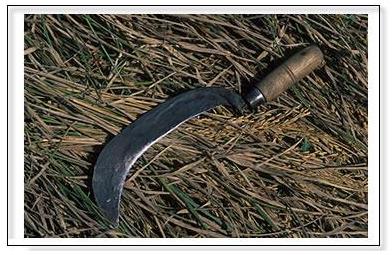
This, by the way, is what an aruval looks like:


Yikes.

Wednesday, May 23, 2012

Book 97, Bangladesh: "Selected Short Stories" by Rabindranath Tagore

As you know, Tagore was an amazing poet: made the Europeans swoon with his Gitanjali. (Left me a bit ho-hum, to tell the truth: I am not a truly mystical soul.)


I'm here to report that he was also a master of the short story form. These pieces are some of the first literary short stories ever written in Bengali, composed while he was looking after his ancestral states in East Bengal (now Bangladesh) in the 1890s, reflecting on the nature of Indian village life which he'd seldom encountered in Calcutta and Sussex. The intro says that he was only driven to write these 'cos the magazine editors wanted 'em - a lot of critics back then didn't like 'em, in fact; said they were unrealistic, overwrought.

The way I see it, they're wonderful admixtures of poetry, realism and fantasy - and, yes, fantasy: he has Poe-like horror pieces like The Hungry Stones and Skeleton; fables like Wishes Granted in which a fictional Goddess of Desires descends to make a boy and his father swap places. Even in the social realist pieces, there's that wonderful sense of destiny and fate and spirituality looming over everything - the heartbreaking reappearances of vanished sons in Little Master Returns, Wealth Surrendered, Son-sacrifice, and the curse averted in The Gift of Sight...

Oh and I should warn you that Tagore is prepared to do horrible things to his characters. No Dickensian jolly opportunities for reform here; instead the Catherine Lim-esque ironies bounce back on these folks and ruin the very purpose of their lives. This is the Kaliyuga, after all: the age of the fallen. But speaking of ages, it's incredible to think these are tales from two centuries ago: the concerns are identical to those of South Asia today: religious divides, caste, bride prices, oppression of women, a culturally denatured generation of middle-class intellectuals. It's only when they mention that they're riding horse carriages rather than Tata Nanos that you realise how ancient this is.

Interesting thing about my earlier concerns about whether this is a Bangladeshi text, since the characters aren't Muslim. There are indeed Muslims, but they're marginal, sometimes exotic figures - an ancient Mughal princess in False Hope, a murderous but kindly sweetmeat seller in Kabuliwallah, a secret mistress of a Brahmin land-owner in A Problem Solved

What makes this Bangladeshi for me is the call of the river Padma: the flooding waters that strand lovers on islands and swallow up firstborn sons. Floods are very Bangladeshi indeed.


View Around the World in 80 Books!!! in a larger map

Representative Quote: from Guest.

 Early monsoon clouds formed in the sky. The village-river had been dried up for weeks; there was water only in holes here and there; small boats lay stuck in these pools of muddy water, and the dry river-bed was rutted with bullock-cart tracks. But now, like Parvati returning to her parents' home, gurgling waters returned to the empty arms of the village; naked children danced and shouted on the river-bank, jumped into the water with voracious joy as if trying to embrace the river; the villagers gazed at the river like a dear friend; a huge wave of life and delight rolled through the parched village. There were boats big and small with cargoes from far and wide; in the evening the ghat resounded with the songs of foreign boatmen. The villages along the river had spent the year confined to their own small worlds: now, with the rains, the vast outside world had come in its earth-coloured watery chariot, carrying wondrous gifts to the villages, as if on a visit to its daughters. Rustic smallness was temporarily subsumed by pride of contact with the world; everything became more active; the bustle of distant cities came to this sleepy region, and the whole sky sang.

  Next book: Theater of Memory: The Plays of Kalidasa.

Friday, May 4, 2012

Book 96, Nepal: "Mountains Painted with Turmeric" by Lil Bahadur Chettri

Not much to say about this book, really. It's an iconic text of modern Nepali literature, mostly by virtue of having been written at a point where there was very little else in print - it actually got put on the lit curriculum of Tribhuvan University within a year of having been written!


Other interesting facts: its author was not in fact Nepali, but a son of Nepali immigrants into Assam - he'd just interviewed loads of hillside villagers when they came to his environs to trade. Also, this translation (with its rather silly title, drawn from a stray line of purple prose in the novella) was probably spurred on by the fact that the book was recently made into a rather successful movie, under its original title Basain. (The word means migration, referring to the fact that the protagonists all get the hell out of the village at the end of the story.)

 Other than that? It's hard to get excited about the book. It's got lush descriptions of village life, but it centres on characters who through little fault of their own end up screwed financially (in the case of the young impoverished farmer Dhané, who is forced off his land by bankruptcy and the landlord's buffalo destroying his crops) and literally (in the case of the virtuous young maiden Jhuma, seduced by a soldier then abandoned). Classic Marxist-influenced third world examination of how the rural economy is fundamentally unjust - shades of Ngugi's The River Between and Minfong Ho's Sing to the Dawn.

 Good translation, though. Lots of local feel, due to the fact that plenty of Nepali terms (e.g. specialised months of the year) have been left in - unobtrusive glossary at the end.

 
View Around the World in 80 Books!!! in a larger map


Representative quote: "The Creator? Is it the Creator who writes our fate?" Today for some reason his small brain was pursuing arguments that were full of hidden revolutionary facts. "Why would fate be so biased? The laborers who wear out their bones in sweat cry out for flour, while those who gather up their bones to suck have other pleasures. Is this what fate really is? No, the Creator is not so unjust! Fate is made by human arrangement. Fate depends on the good order of society, on cooperation in society, on the chances and facilities you can get in society." Today, if he had had even the smallest opportunity, if his society had cared to understand his plight, would his labors not have borne fruit? If society had not been so ready to mock Jhuma's small misdemeanor, would she have left the house today in such desperation? Was the fault hers alone? Was it not the fault of the soldier, who had taken advantage of an innocent girl to gratify his desires? But it is the helpless girl and her family who are punished by society. This was the sum of Dhané's argument with his conscience. Today his heart was rebelling.

  Next book: Rabindranath Tagore's Selected Short Stories, from Bangladesh.

Sunday, April 29, 2012

Book 95, Bhutan: "Treasures of the Thunder Dragon: A Portrait of Bhutan" by Ashi Dorji Wangmo Wangchuck

So this here is a book by the former Queen of Bhutan! (Former because her awesome-ass husband, Jigme Singye Wangchuck, abdicated in favour of his son in 2006. Ashi Dorji Wangmo is his first wife; the current king is the eldest son of him and his third wife. All four of his wives are sisters. Confusing, much?)


Sadly, this book reads precisely like a book written by royalty: i.e. by a person who is not obliged to pay attention to how books are supposed to be written. Its content is pretty good, but its structure is all over the place. The inner flap praises it "a captivating blend of personal memoir, history, folklore and travelogue". I call it a mess.

I'm being cruel, of course. It's not a bad read: you get to learn a load about Bhutanese heritage, from its blue poppies and golden langurs to the 2003 Duar War, where the King himself led volunteer troops to rout the terrorist cells hidden in the nature reserves. And honestly, Queen Ashi sounds like a pretty cool person to hang out with: the kind of gung-ho middle-aged lady who's always hiking up dangerous mountain trails to donate shovels and carrot seeds and solar panels to remote villages, blisters and altitude sickness be damned.

What frustrates me is the gaps. She tells us about her idyllic childhood in Nobgang and her boarding school life at St Helen's Convent in Kalimpong, India; but then it's straight on to her joint wedding with her sisters to the King: nothing about their courtship, nothing about her emotions, nothing psychological or problematic about the institution of polygamy.

And while she describes her wanderings, she mentions the challenges that Bhutan faces in its slow but measured stride towards modernisation - how thieves are breaking into the chortens and stealing their sacred jewels; how women are falling pregnant and going mad when abandoned by their Japanese tourist lovers; how the nation is becoming a population of jet-setters: young people going off to study in Oxford and old people going on pilgrimages in India or else seeking markets to sell their mountain raspberries and peaches.

And yet there is no sense of tension in her voice; she is absolutely convinced that everything will turn out okay; almost all the people she describes are happy, even if their families have been devastated by death and disease; the old woman with the goitre whom she volunteers to send to a a hospital insists that she wants to hold on to that lump of flesh that's been under her chin for fifty years, thank you very much. 

Everyone's so content; everything's so effing ZEN. Or at least the eye of the author makes it so. And while I'm delighted to think that the concept of Gross National Happiness might actually be working; that there is an alternative route to peaceful development other than the Lee Kuan Yew model; I can't help but feel that this implacability is the antithesis of modern literature; that good writing is born out of crisis.

Ah well. Long and short of it is that Bhutan still sounds an awesome place to visit. Wonder if they have cute openly gay boys there. Ooh, Google says there are a few.


View Around the World in 80 Books!!! in a larger map  

Representative quote: On the altar of my shrine room at home is a stone shaped like a chorten, given to me by an old lady in a village in Tongsa. She had found it in a riverbed and kept it on her own altar until the day I walked it into her home. Buffeted and sculpted by ice and snow, rocks and water, on its long journey down the Himalayas to a village in the heart of Bhutan, that stone is for me a symbol of the journeys I have made. An locked inside it, like treasures sealed in a chorten, are the seeds of journeys still to come - there are so many treasures of the Thunder Dragon that still wait to be discovered.
Next book: Lil Bahadur Chettri’s Mountains Painted with Turmeric, from Nepal.

Saturday, April 14, 2012

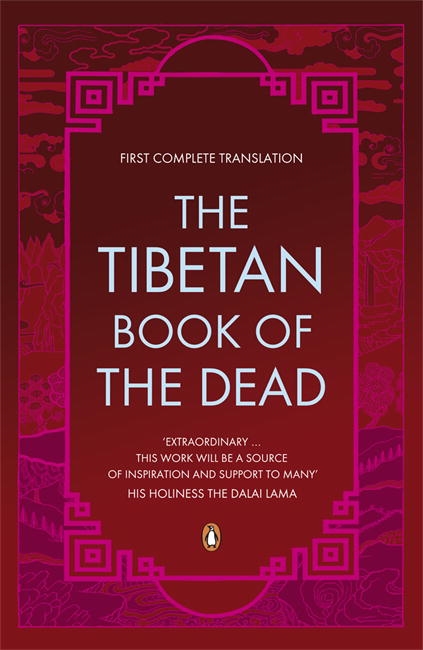
Book 94, Tibet: "The Tibetan Book of the Dead"

Cor. This was a bloody good read, way more interesting than the Quran or the Lotus Sutra or the Bible (most bits of the Bible, anyway). I was gonna say it was easy to see why it became a Western cult classic, then I remembered that for the longest time what the hippies and the beats were perusing was a single portion of this volume: The Great Liberation By Hearing.

This baby I’ve been lugging around is the first full translation, based on the three volume manuscript from the library of the Kyabje Dudjom Rinpoche, completed by the scholar Gjurme Dorje with support by HH the Dalai Lama. Check it!


And what makes this book so awesome? Well, first of all, it’s brilliantly random: as crazy if not crazier than the palimpsest hotchpotch of the Old Testament. It consists of prayers, philosophy, catalogues of deities, medical instructions for determining the date of imminent death, magical rituals for forestalling said death, a detailed practical guide to ensuring enlightenment or at least rebirth as a higher being following said death, and even a masked drama demonstrating the posthumous fates of a butcher and a pious merchant, as Yama Dharmaraja, sage of hell beings, judges them by weighing the white pebbles of their good deeds against the black pebbles of their sins. (Yes, shades of the Egyptians, which is why the English title of this book stuck instead of its proper name, The Bardo Thodol.

Second of all (a phrase my boyfriend insists is ungrammatical) it is so damn *sensual*, so psychedelic that one wonders what the prophets were smoking, or if mountain air just predisposes one toward incredible visions. It’s bizarre, after reading the fairly square first chapters, which concentrate on the usual Buddhist exhortations to renounce worldly attachments, to be told of the copulating, blood-drinking, sexually dimorphic rainbow-coloured buddhas and bodhisattvas and gatekeepers and herukas that inhabit the cardinal portions of one’s skull: Gauri, white-in-colour, carrying a human corpse as a cudgel; fox-headed Srgalamamuki, black in colour, eating entrails; yak-headed Manauraksasi, brownish-white and holding a vajra; sow-headed Varahi, blackish green, holding a noose of fangs; scorpion-headed Amrta, reddish yellow, holding a lotus; three-faced six-armed Vairocana, brandishing a wheel, an axe, a sword, a bell, a ploughsare and a blood-filled skull, joyously and indivisibly embraced by Buddhakrodhesvari; and Samantabhadra and Samantabhadri, the Buddha-body of Reality.

Oh yes, and trying to foretell your death by staring at the sun or your shadow or the tinges of blood in your urine, and channeling your powers of concentration so that should you topple unexpectedly from a mountain, your soul will escape your body from the correct orifice. Madness!

And also the gentle comfort it must give one to imagine one’s body at a funeral, surrounded by loved ones repeating prayers into one’s ear directing the soul to higher realms.

Yes, this is the kind of religious text I like: more imaginative than preachy; the kind I don’t have to take absolutely seriously and expands my imagination rather than limiting it. O Child of Buddha Nature, may you read many more books as weird and wonderful as this!


View Around the World in 80 Books!!! in a larger map

Representative quote:
There are, altogether, nine different pathways through which consciousness transference can occur, and these are associated with persons of superior, average and inferior capacity. The aperture of the crown fontanelle is the pathway through which [consciousness] departs to the pure [realm of the] sky-farers. Given this, [it is said that] one will attain liberation f awareness exits through the [crown fontanelle]. Since this is the supreme pathway, it is extremely important that one trains in directing one’s mental focus towards this [aperture]. Furthermore, if consciousness is transferred through the pathway of the eyes, [it is said that] one will be born as a universal monarch, and if it is transferred through the left nostril, one will obtain an unimpaired human body. These are the three optimum apertures associated with those of superior [capacity].

One will, however, be born as a yaksa if [consciousness is transferred] through the right nostril, or as a god of the world-system of form if [it is transferred] through the ears, and as a god of the world-system of desire if [it is transferred] through the navel. These are the three medial apertures [associated with those of average capacity]. Lastly, one will be born as an animal if [it is transferred] through the urethra, as an anguished spirit if [it is transferred] through the sexual passage, and as a hell being if it is transferred through the rectum. These are the three inferior apertures [associated with those of inferior capacity]. Given that there are such very great consequential differences between the various apertures through which consciousness transference may occur, there wil be inestimable benefits in directing one’s awareness to the crowd of the head, at the time of death.

Such is the forceful consciousness transference. SAMAYA!

Next book: Lil Bahadur Chettri’s Mountains Painted with Turmeric, from Nepal.

Wednesday, March 14, 2012

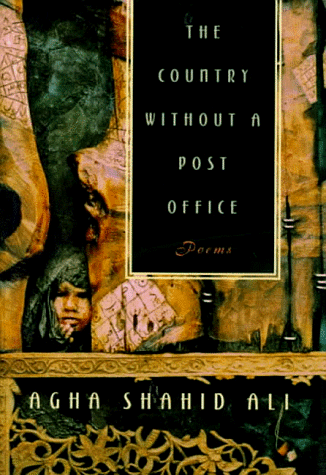
Book 93, Kashmir: "The Country Without a Post Office" by Agha Shahid Ali

News flash: I am sick. I've got one of those fevers that makes me feel hot and cold at the same time and I'm not getting anything productive done (updating this blog does not count as being productive). What makes this all the more ridiculous is that this is part of a cockamamie scheme I had to do non-UN-recognised states: Kashmir, Tibet, Palestine, Hong Kong, Macau, all in the hopes of pissing off some of my Indian and Chinese friends.


Plus, you've noticed that I decided not to do Salman Rushdie's Shalimar the Clown, didn't cha? I actually made that decision fairly early: I wanted someone genuinely Kashmiri, hell, and a highly praised Kashmiri-American emigré poet was just what the doctor ordered.

And seriously, Shahid is awesome. I picked up his posthumous book of ghazals, Call Me Ishmael Tonight, and I fell in love - then I realised this was a patchwork collection snatched from various bodies of work he'd published before. Didn't feel quite right.

So I pulled Rooms Are Never Finished off the shelves: a work mourning his mother, recording his journey from Amherst, Massachusetts to Srinagar to deliver her body for burial. Surprise, surprise: I did not like this one as much: way too many abstractions and allegories, real tragedy subsumed in Zainab's mourning over the martyrdom of Imam Husain and Radha crying out to the Dark Lord. Didn't help that Shahid had a penchant for extremely long poems, written in sections composed of prose poetry or terza rima or sapphics; only the ghazals and villanelles were a a breath of fresh air in between.

So I reserved The Country Without a Post Office from the repository used collection, and hallelujah, the anguish is way more direct and unfiltered: these pieces are written from 1991 to 1995, reflecting on the crazy bloodshed of that era. Thassa right: I combed through four books while enduring illness just for this bloody blog post.

Don't actually feel like analysing it now. Just wanna sleep.


View Around the World in 80 Books!!! in a larger map

Representative quote:

Ghazal

The only language of loss left in the world is Arabic -
These words were said to me in a language not Arabic.

Ancestors, you've left me a plot in the family graveyard -
Why must I look, in your eyes, for prayers in Arabic?

Majnoon, his clothes ripped, still weeps for Laila.
O, this is the madness of the desert, his crazy Arabic.

Who listens to Ishmael? Even now he cries out:
Abraham, throw away your knives, recite a psalm in Arabic.

From exile Mahmoud Darwish write to the world:
You'll all pass between the fleeting words of Arabic.

The sky is stunned, it's become a ceiling of stone.
I tell you it must weep. So kneel, pray for rain in Arabic.

At an exhibition of miniatures, such delicate calligraphy:
Kashmiri paisleys tied into the golden hair of Arabic!

The Koran prophesied a fire of men and stones.
Well, it's all now come true, as it was said in the Arabic.

When Lorca died, they left the balconies open and saw:
his qasidas braided, on the horizon, into knots of Arabic.

Memory is no longer confused, it has a homeland -
Says Shammas: Territorialize each confusion in a graceful Arabic.

Where there were homes in Deir Yassein, you'll see dense forests -
That village was razed. There's no sign of Arabic.

I too, O Amichai, saw the dresses of beauitful women.
And everything else, just like you, in Death, Hebrew, and Arabic.

They ask me to tell them what Shahid means -
Listen: It means "The Belovéd" in Persian, "witness" in Arabic.

Next book: "The Tibetan Book of the Dead", from Tibet.

Sunday, March 11, 2012

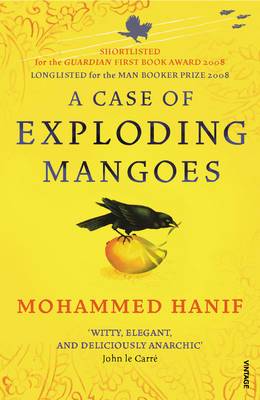
Book 92, Pakistan: "A Case of Exploding Mangoes" by Mohammed Hanif

Remember how I bragged about meeting Dany Laferrière during my Haiti entry? Well, this is another book by a guy I met at the Ubud Writers and Readers Festival, though I don’t recall having a conversation with him as much as I do with his tiny son (daughter? There were two little Desi kids running around, and one of them was his and the other one belonged to some other writer/human rightsy lady, with a name not unlike Samara, god knows who she was).


Anyhow, as I hinted in the last post, it’s a splendid read: as anarchically funny as advertised: all that South Asian verbosity and humour attacking the institution of an Islamic military dictatorship.

Did I mention this was a historical novel? I didn’t realise it was a historical novel for quite some time, not until Osama bin Laden popped up as a character I think. It’s a conjectural Scheherezadean tale surrounding the perfectly factual air crash that took the lives of Pakistani dictator General Muhammad Zia-ul-Haq and half his generalissimos in 1988. (He’s the guy who deposed whatzisname Bhutto, Benazir’s dad. Zulfikar Ali, my iPhone says. I’m drafting this without an Internet connection.)

And what Hanif’s done is he’s told the tale with two different forms of narration (ooh, this is how I teach creative writing): half the chapters are first-person in the form of the much-beleaguered Air Force cadet Ali Shigri, imprisoned in Lahore Fort under byzantine circumstances; the other half in omniscient third person, spanning the viewpoints of the blind rape victim Zainab, the conspiring spymaster General Akhtar, hapless US ambassador Arnold Raphael, a mango-eating crow, and of course the doomed General Zia himself, bamboozled by his security forces and his Quran, harangued by his wife and his tapeworms (both of whose viewpoints we also get to witness, oh joy).

There’s a certain amount of name-dropping involved because Hanif feels he owes his debt to the inspiration of Gabo’s Chronicle of a Death Foretold; even has Ali’s best friend Obaidi nose-deep in said book in the final fatal chapters. But it does not feel derivative, this: it is wholly its own animal, and it delights me. Would that us Singaporeans, ach, even us Southeast Asians, wrote like this!


View Around the World in 80 Books!!! in a larger map

Representative quote: Behind the cordons set up along the road by the police for this VIP procession, people stood and waited and guessed: a teenager anxious to continue his first ride on a Honda 70: a drunk husband ferociously chewing betel nuts to get rid of the smell before he got home, a horse buckling under the weight of too many passengers on the cart, the passengers cursing the cart driver for taking this route, the cart driver feeling the pins and needle sin his legs begging for their overdue opium dose, a woman covered in a black burqa - the only body part visible her left breast feeding her infant child - a boy in a car trying to hold a girl's hand on their first date, a seven-year-old selling dust-covered chickpeas, an old water carrier hawking water out of a goatskin, a heroin addict eyeing his dealer stranded on the other side of the road, a mullah who would be late for the evening prayer, a gypsy woman selling bright pink abby chickens, an air force trainee officer in uniform in a Toyota Corolla being driven by a Dunhill-smoking civilian, a newspaper hawker screaming the day's headlines, Singapore Airline's crew in a van cracking jokes in three languages, a pair of home-delivery arms dealers fidgeting with their suitcases nervously, a third-year medical student planning to end his life by throwing himself on the rail tracks in anticipation of the Shalimar Express, a husband and wife on a motorbike returning from a fertility clinic, an illegal BEngali immigrant waiting to ell his kidney so that he could send money back home, a blind woman who had escaped prison in the morning and had spent all day trying to convince people that she was not a beggar, eleven teenagers dressed in white impatient to get to the field for their night cricket match, off-duty policemen waiting for free rides home, a bride in a rickshaw on her way to the beauty salon, an old man thrown out of his son's home and determined to walk to his daughter's house fifty miles away, a coolie from the railway station still wearing his red uniform an in a shopping bag carrying a glittering sari he'd change into that night, an abandoned cat sniffing her way back to her owner's house, a black-turbaned truck driver singing a love song about his lover at the top of his voice, a bus full of trainee Lady Health Visitors headed for their night shift at a government hospital; as the smoke from idling engines mixed with the smog that descends on Islamabad at dusk, as their waiting hearts got to bursting point with anxiety, they all seemed to have one question on their minds: 'Which one of our many rulers is this? If his security is so important, why don't they just lock him up in the Army House?'

Next book: Salman Rushdie's Shalimar the Clown, from Kashmir.

Tuesday, February 28, 2012

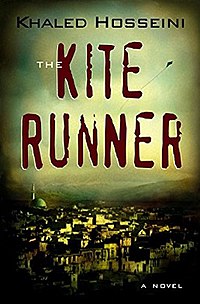
Book 91, Afghanistan: "The Kite Runner" by Khaled Hosseini

Wheeee!!! I'm finally back in the 21st century!!!

And in good old book club territory, too. Not kidding, despite my boyfriend's protestations that its commercialisation means this book isn't authentically Afghan. Stuff gets popular for a reason: I actually finished half of this 371-page baby just sitting at a mama shop just now.


This one's an emigrant's story of his lost country, not Julia Alvarez's story of the Dominican Republic and Carlos Eire's story of Cuba - there's even a similar focus on the gilded lifestyles of the pre-revolutionary aristocracy and their humiliation on becoming lower-caste American immigrants. Lovely immersive descriptions; the kind of stuff I wish us folks in Singapore were turning out.

The key dynamic is between our rich man's son protagonist Amir and his best friend/servant boy Hasan. And I'm not sure if I've ever read a story in which the main character acts so unforgivably cruelly towards another human being. This ends up being a novel about guilt, and ultimately redemption, as Amir returns to Kabul under the Taliban, witnessing its full horrors (and I was signing petitions against those guys BEFORE 9/11, thank you very much), and pulling off a climax that, while barely believable, is just intense enough to redeem everyone involved.

Weirdly enough, in the closing portions (I'm not going to reveal too much), one character becomes an allegory for Afghanistan's suffering and neglect: we all bear responsibility for not interfering more during the Soviet and Taliban occupations, and the crazily long dénouement is testament to the fact that way too much scarring has occurred; healing will take a hell of a long time and a hell of a lot of hope.

Yeah, that's all I have to say about this book, really. Except that it also made me think about Singapore's inhumanity to our own servant classes: foreign workers from the Philippines and Bangladesh and Indonesia who clean up our shit and build our houses.

(Also learned that Hindi music has always been popular in this country - we're definitely in South Asia now, kid.)


View Around the World in 80 Books!!! in a larger map

Representative quote:
"I became what I am today at the age of twelve, on a frigid overcast day in the winter of 1975. I remember the precise moment, crouching behind a crumbling mud wall, peeking into the alley near the frozen creek. That was a long time ago, but it's wrong what they say about the past, I've learned, about how you can bury it. Because the past claws its way out. Looking back now, I realize I have been peeking into that deserted alley for the last twenty-six years."

Next book: Mohammed Hanif's A Case of Exploding Mangoes, from Pakistan

Wednesday, February 22, 2012

Book 90, Iran: "Deliverance from Error" and "The Beginning of Guidance" by al-Ghazali

This slim little volume took longer than I thought. But that's okay; I think I actually like Al-Ghazali. He's an oddly modern thinker, rationalist even in his irrationalities.


While the divine/human mind that wrote the Quran is obsessed with hellfire, Al-Ghazali's more interested in the very idea of the Truth. In Deliverance from Error, he explains that he's unwilling to accept proof via miracles: no point is proven through magic tricks of turning stones into gold or rods into serpents. He's smart enough to point out that the Faithful must not dismiss their ideas of infidel philosophers in the realms of natural science, logic, even ethics.

Of course he's silly sometimes: he claims the Greek thinkers are fundamentally flawed because they weren't Muslim; he warns that only the elites should be allowed to access their ideas. I fucking love his imagery here, though:

"It is only the simple villager, not the experienced money-changer, who is made to abstain from dealings with the counterfeiter. It is not the strong swimmer who is kept back from the shore, but the clumsy amateur; not the accomplished snake-charmer who is barred from touching the snake, but the ignorant boy."

Oh, and one of his counter-arguments for complete dependence on natural philosophy is the inductively proven usefulness of magic squares in aiding childbirth.

Yet it's these very imperfections which draw me in as a reader: the knowledge that this religious writer is fallible, is fundamentally human. He charts his own philosophical and spiritual development in this text, acknowledging that rationality can only take one so far and thus the necessity for mysticism - a paradoxical situation he has to live with.

And that fallibility, that very idiosyncrasy, is what makes his commandments in The Beginning of Guidance more charming than ridiculous. It's here that he lays out strict rules for ablutions before prayer, for going to the toilet (never in front of others, step into the room left foot first and exit right foot first, and wipe your cock an odd number of times on a stone).

It's here that he warns against lying, backbiting, cursing, and most important of all, hypocrisy. If every Muslim followed what he prescribed, they'd be saints even to our secular eyes - always turning the other cheek, never judging lest they themselves be judged. It's also here that he advocates moderation in all things, propriety at prayers and in conversation, and naturally respect for elders. It's like he's the reincarnation of Confucius or something.

So I've read two religious texts in a row! Never let it be said that I'm anti-faith, my dears.


View Around the World in 80 Books!!! in a larger map
Representative quote: Beware of association with the learned men of this time, especially those occupied with controversial topics and intellectual disputes. Beware of them; because of their jealousy they wait for you to fall into ill-fortune, imagine various things concerning you, and behind your back make signs with their eyes among themselves while enumerating your faults when they meet together so that sometimes in their anger they confront you with these faults during their rivalries. They do not forgive your faults or slips; nor do they hide your private matters which should be kept hidden. They make an account with you even in the most negligible matter, and they envy you inn everything, small or great. They instigate your friends against you by slandering, spreading false information, and lies. If they are pleased with you they show it through servile flattery; if they are angry with you they are quietly stupid. On their bodies they wear beautiful clothes, but their minds are wolves. This is a judgement based on clear observation of most of them except those whom God (exalted is He!) has protected. Companionship with them is a loss, and association with them is to be forsaken.

Next book: Khaled Hosseini's The Kite Runner, from Afghanistan.

Wednesday, February 15, 2012

Whatever happened to Rumi?

My excuse for not having finished Al-Ghazali yet is that I freaking lost the library book for nearly a week; only recovered it after having bought a replacement from Wardah Books.

But I owe you guys an explanation for why I'm not doing Rumi Jalaluddin's Masnavi, as I originally announced. After all, he's the national poet of (currently much-beleaguered) Iran, isn't he?


Said explanation is complicated. Y'see, upon doing a bit of research, I discovered that Rumi lived in a time when the Persian Empire was pretty damn big: the town where he was born lies in either present-day Afghanistan or Tajikistan. Later, he fled his town when he was seven to settle in Konya, Turkey.

Somehow, I got it into my head that Rumi never once set in what's currently Iran. However, a glance at Wikipedia that he did indeed encounter the poet Attar in Nishapur.

So I'm in a bit of a dilemma. Do I return to my original plan of reading the really long Masnawi? Or shall I read it for Afghanistan, thus displacing Khaled Hosseini's The Kite Runner? Or shall I keep it for my next circuit, when I'm reading Tajikistan? After all, there are really few famous literary works about Tajikistan...

In other news, the replacement Kindle is here!


Hurrah!

Monday, January 30, 2012

Dammit. I no longer have a working Kindle.

Just look at it! Don't know why it happened, either. Just took it out of my haversack in Queenstown, NZ and it looked like this.


Water damage? Cracked screen? I dunno. What matters is that the nice live chat support guy at Amazon said he'd send a replacement one along, no problem, right away. All I have to do is post in the old one in 30 days or less.

I was expecting a runaround because it's under my sister's name and using my dad's account, but luckily all it meant was that I needed to supply a few extra info bits on my dad's account and everything went hunky-dory. They only post within the USA, but that's where my NYC-based sister comes in handy.

In the meantime, I'm a little too busy to camp out in the National Library's reference section to read my Iraq book. So I'm reading my Iran book, Rumi Jalaluddin's Mathnawi, on my iPhone:


It was free, too - all I needed to do was track down a .txt version of the work, convert it to .doc, resize everything and convert that to .pdf. Easy-peasy!

In other news, MPH is releasing an e-reader. I might actually buy one just to support them - the KL-based folks I've met from there are pretty cool.

Sunday, December 25, 2011

Merry Christmas/Nathar Puthu Varuda Valthukkal!

Still not done with the Quran, so I'll just post about the book I gave my boyfriend:


It's a picture book! Captions in both English and Tamil, available for just 395 rupees at Flipkart, and for considerably more from Amazon.

Friday, December 9, 2011

I wanted to buy a Guru Granth Sahib in Amritsar...

... but the only full English translation available as like, five mega-thick volumes long, with old and crinkled covers. The bookstore owner at the Golden Temple had to present it on a folding book stand when he wanted to show it off: everything's in the original Gurmukhi script, the Latinised transliteration, and English so you get the sound of the original poetry unadulterated for home worship.

Luckily, there was also an introductory book of extracts for dilettantes like me, selling at 80 rupees (20% off the cover price, equivalent to roughly S$2!). Will skim through it on the plane, maybe, since it's easier going than my other holiday reading: Mervyn Peake's Gormenghast and the Quran (halfway through now!).

Did finish Victor Pelevin's Omon Ra, though. 'Sgood!

Now, could I ask you folks: what should I read for my India book? Kalidasa's Shakuntala? Salman Rushdie's The Satanic Verses? Mahasweta Devi? The Penguin edition of the Upanisads? Chetan Bhagat's 2 States? Or the Guru Granth Sahib?