Showing posts with label romance. Show all posts

Monday, September 30, 2013

Book 134, Isle of Man: "The Manxman" by Hall Caine

UEA’s library isn’t quite as voluminous as some I’ve seen, but it does contain some nice surprises. I was originally planning to read some book of folklore for the Isle of Man (which is actually classified as a separate entity from the UK). While searching the catalogue, I also happened to come across a biography of an eminent Victorian named Hall Caine – a bestselling author and playwright, a companion of Dante Gabriel Rosetti, and a proud Manxman.

Once a recognizable face on both sides of the Atlantic, Caine is largely forgotten today. This online biography suggests that his greatest work was The Scapegoat, but the library offered me a copy of The Manxman instead: 29th edition, printed in the 1920s. Sadly, I dropped it - the librarians will have some gumming together of spines to do after this – and resorted to reading an online edition for the remainder of the week.


But heavens, this is good stuff. It’s fundamentally the tale of a love triangle: simple Pete, his smart half-cousin Philip, and the fair Kate. But the story follows them from birth to childhood to adolescence to tumultuous adulthood, their drama playing out against the charming backdrop of Sulby, a coastal village alive with superstition and fishermen’s rebellions and Christian extremism and ridiculous codes of honour – Philip and Pete, for instance, are both the grandsons of the old Deemster, a high-born judge in his castle, but the father of the first was disowned when he married a common-born girl and the second was the fruit of an affair with his mother paid off in cash for her shame. There’s this stupid, stupid taboo against marrying below or above your station – it’s something a gentleman simply cannot do if he wants to continue receiving the respect of the tiny island community.

But I suppose it’s character that really drives the tale. Philip's a social climber, guilt-tripped by the memory of his late father whose ambitions were ruined by his love for his lower-class, equipped with the intelligence and the personality for a rising career in law and politics, ultimately becoming a Deemster, or a judge for the island. He falls in love with Kate, who used to be Pete's sweetheart, before Pete set off for the diamond mines of Kimberley for five years, so he could earn a fortune worthy of her hand. The guilt of this tortures him utterly - and it tortures Kate too. Meanwhile, Pete's just the most big-hearted, loving man possible, unaware that his every forgiveness of Kate and his kindness to Philip just tortures them further.

Basically, this is a story of adultery in which everyone involved is actually a good person - sure, they do terrible things sometimes, but they feel horribly guilty about it (mind you, they're the sort of folks who feel guilty even when they do good). And it works. We're thrust into the minds of all three protagonists, and we struggle with them, feeling for them. (Me particularly: I'm in a weird halfway state in my relationship to a very good person, and I'm not sure where how it's all going to end up.)

But there's also a huge level of absurdity to the characters' quandaries - their values, their conceptions of sin that outweigh any considerations of social achievement, are very un-Asian (or perhaps un-21st century, or simply unworldly). It's a little mad, how a successful young man with a rising career, a credit to his race, et cetera, should be in agony over the thought of marrying a "fallen woman" - or indeed, that any woman should consider herself fallen at all.

Messy thoughts today. Also on my mind is the fleetingness of Caine's fame - he peddled his exotic status as the "Bard of Manxland" in a manner that presages the workings of "world literature" as a contemporary genre, but because he was only a geographical minority, not a racial of gender one, he's fallen quite out of the Canon. Plus, his irrelevance to my current course: it'd be unwise for me to emulate his maudlin histrionics, no matter how effective they may still be.

Plenty more reading for me to do for school. If, however, you'd like to spend just a couple of hours with the story, you could check out the film version, directed by no less than Alfred Hitchcock!


View Around the World in 80 Books!!! in a larger map

Representative quote:
That night Philip dreamt a dream. He was sitting on a dais with a wooden canopy above him, the English coat of arms behind, and a great book in front; his hands shook as he turned the leaves; he felt his leg hang heavily; people bowed low to him, and dropped their voices in his presence; he was the Deemster, and he was old. A young woman stood in the dock, dripping water from her hair, and she had covered her face with her hands. In the witness-box a young man was standing, and his head was down. The man had delivered the woman to dishonour; she had attempted her life in her shame and her despair. And looking on the man, the Deemster thought he spoke in a stern voice, saying, "Witness, I am compelled to punish her, but oh to heaven that I could punish you in her place! What have you to say for yourself?" "I have nothing to say for myself," the young man answered, and he lifted his head and the old Deemster saw his face. Then Philip awoke with a smothered scream, for the young man's face had been his own.

Next book: Mary Ann Shaffer and Annie Barrows's The Guernsey Literary and Potato Peel Pie Society, from Guernsey.

Wednesday, June 5, 2013

Book 126, Bahamas: "Triptych" by Wendy Coakley-Thompson

Didja know that one of Hemingway's posthumous novels (he was working on it when he died) is partially set on the island of Bimini in the Bahamas? Alas, Islands in the Stream is only available in the National Library's reference section, so I ended up going with full-on chick lit.


Wendy Coakley-Thompson was born in the US and works in the US, but she's ancestrally Bahamian, and spent a bunch of her childhood there. In her foreword, she talks about reading Robert Wilder's The Wind from the Carolinas, and yearning to read more fiction set in the Bahamas. "Little did I know that I would have to write that book myself!" she giggles.

And let's be frank - this isn't great literature. It's escapist writing. All the characters are Mary Sues: the Cuban hospital financier Jonathan Cruz, his gorgeous Bahamian surgeon wife Alexandra and his Afro-Cuban-Canadian psychology professor cousin Timothy Lamb. All wealthy professionals in their 40s or early 50s; Tyler-Perry-esque people of colour. All religious and (trying hard to be) virtuous. All living the life in the tropical paradise of Nassau. All of them ridiculously good looking, more so in middle age than in their youth, with crazy sex drives to boot.

So no, I'm not getting much of an insiders' view of the Bahamas (although people do seem to be pretty well off there: it's the second-highest Caribbean nation on the Human Development Index, after Barbados). A few mentions of Conchy Joes and fish stew and seagrapes and androsia and Camp Discovery. Not great prose, either - very transparent, needy, black and white. 

Was actually tempted to stop reading and head over the library's reference section, but then the story started to grip me a little. It's a sappy business, about Jonathan getting a brain tumour, and not being able to get it up anymore, and then letting his cousin sexually satisfy his long-suffering wife because he can't anymore. It's all described with lush urgency, and Tim actually deflowered Ally when they were in their teens, and they're longing for each other anyway, and there's a huge pot-fueled threesome (one realises that Coakley-Thompson chose "triptych" because it was a classier way of saying "threesome"), and then people start dying and crying, et cetera, and then Tim and Ally shack up in the end. That kind of story, but with the characters feeling bad about all the moves they make, beating themselves up religiously, but doing them anyway, because hey, they're red-blooded Caribbean middle-aged people, and they gotta bone.

Chick lit, like I said. But there's nothing wrong with a book like this existing. My only big problems are with the fact that Ally, a fully qualified surgeon, believes in homeopathy, and that there's no real justification for Jonathan never straight up *telling* her that he's fine with her bonking on the side. Oh, and maybe there's a little too much drama in the characters' background (rape! kidnapping! baby murder! a perfect wife killed by a car crash!).

And that's it for the Caribbean! Unless anyone can recommend a good book about Bonaire, Sint Eustatius or Saba. Now we're on to the rich developed world: North America... and, not long afterwards, Europe!


View Around the World in 80 Books!!! in a larger map

Representative quote: Before her mind could catch up, Tim leaned in and brushed his lips against hers. Every synapse in her body cried out for him. He kissed her repeatedly, and her pussy flooded. She felt her blouse opening and falling away. She felt her bra hooks opening, saw Jonathan toss her bra across the room out of the corner of her eye. Tim cupped her breasts, and she cried out. From behind hr, she felt Jonathan's hands pulling down her Capris and panties. She felt a draft of air across her bare buttocks. Instinctively, she raised her ass in the air. In her fog, she felt the tip of Jonathan's tongue invading her pussy, licking her vibrating clit with just the right pressure to make her lose it. Above her, she realized that Tim was stroking her head, her shoulders, her back, parting her ass cheeks to improve her husband's view. Tim's hands massaged her breasts, gently tweaking her sensitive nipples. The double onslaught was too much for her to handle. The orgasm snuck up on her, surprising her, shocking her raw. She collapsed face down onto the pillows, her breathing ragged into the soft cloth.


Next book: Ralph Ellison's Invisible Man, from the USA.

Tuesday, September 25, 2012

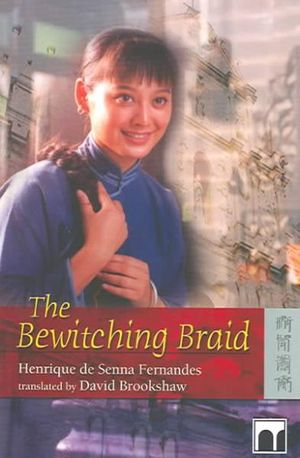
Book 106, Macau: "The Bewitching Braid" by Henrique de Senna Fernandes

Guess what? We're in East Asia! And we're in China, but not in China per se, because if they're going to go around claiming every little island is theirs, I'm going to assert my right to proclaim every disputed and recently returned colonial territory as a distinct country from the mainland.

Thus, Macau. But golly gosh, I'm glad I decided to do this former Portuguese colony, because The Bewitching Braid is loads of fun.


It's fundamentally a romance: boy meets girl and (SPOILER ALERT!) their love triumphs against all odds. The intro notes that the author may be influenced by soapy Cantonese yarns in this respect. But it's written in Portuguese, by a member of the Macanese community: one of the many half-European, half-native mestizo groups the Portuguese empire-builders sired in Goa, Sri Lanka, Melaka, Timor, Brazil.

And it's an interracial love story, too. Thus, we've beautiful details of the privileged 1930s Macanese middle-class world of Handsome Adozindo, playboy about town, as well as the dignified squalor of the Chinese quarter of Cheok Chai Un, where the indomitable Chinese water-seller A-Leng plies her trade. Of course he becomes fascinated with her braid and her spirit, and is determined to seduce her - and yet ends up as her loyal and steadfast husband.

It's not a snap-happy convenient happy ending, mind you: the two are thrown together permanently rather against their will, the boy's family and the girl's community disowning them, leaving them to fend for themselves. Adozindo, being a good-for-nothing, really does look like he's going to become a drunken opium-addled sot at one point.

But they work through it at the end, and by the story closes not with a marriage but with Adozindo's family finally accepting him and his wife and his four children. The point is that it's not comfortable or easy to overcome ostracism and class differences and poverty, but it's possible.

(Btw, I honestly thought there'd be another crisis with the onset of World War Two, but it seems that Portugal was neutral during the war, so Macau ended up being one of the few peaceful refuges during the Japanese Occupation of East Asia.)

Of course, now Macau's gone and become the Las Vegas of the East, and my Hong Kong friends tell me it's hard to find that old, sleepy town they loved so well, a ferry ride over from the hustle and bustle of Kowloon City. More important than ever, then, to have this record of a vanished era.

View Around the World in 80 Books!!! in a larger map

Representative quote:
Adozindo staggered to his feet, his clothes torn, his face and body covered in cuts and bruises. A-Leng swung her weapon of war around to give the boy cover, and urged him to go. She was magnificent, inspiring respect, queen of her territory, beautiful, barefoot, her braid twisting like a whip. Adozindo moved off as speedily as his strength would allow. He was safe and it was a heroic display of love that saved him.

Next book: Xu Xi's History's Fiction, from Hong Kong.

Sunday, January 22, 2012

Book 88, Kuwait: “The Chronicles of Dathra, a Dowdy Girl from Kuwait, Vol I" by Danderma

Good lord. What a horrifying book this is.

I’ve grumbled before about Western fantasies of the oppressed Muslim woman, so I was rather gratified that I’d found a piece of what’s essentially Kuwaiti chick-lit: an insider perspective of the nation, first uploaded onto a blog then self-published via Lulu. And of course I was prepared that it might be badly written and a little shallow – as one trufan was squealing, “Sophie Kinsella watch out!” – but I honestly wasn’t ready for this.


You see, Dathra is written breathlessly – it’s full of typos and subject-verb disagreements and tense malfunctions and exclamation marks! and exclamation marks!! and exclamation marks!!! One charming thing is that it’s also composed in Arablish: mixed up English and Kuwaiti Arabic, spelt in the fashion of text messages, replacing the letter “hair” with 7; the letter “ain” with 3, etc, so that the book’s full of mystifying ejaculations such as “G63!” (disgusting) and ”7arra!” (eat your heart out) and “bo6a6a!” (French fries)

More frighteningly, Dathra herself (the word means “dowdy and unfashionable”) is a 32 year-old rich girl with a severe overeating disorder – and no, this is not a charmingly funny junk food addiction like Liz Lemon’s; it’s a problem that hospitalises her after she cooks and eats two kilos of samosas at a go. She also happens to be incredibly obnoxious – she starts fights and screams and yells and throws food at bewildered service staff and folks in the queue for Pinkberry – and in a bid to reinvent herself, starts spending lavishly on designer items: MAC lipsticks and Hermès scarves and sequined tube tops and stiletto heels that smear and creak and burst against her weight.

She has the mindless consumerism of Cathy and the maniacal violent streak of Hothead Paisan, with the redeeming qualities of neither. No, she’s not a layabout: she has a job that pays a good salary (very little description of women’s rights being limited here*) and spends loads of time on her Blackberry, but we’re not even told what her job is, let alone whether she cares about it or loves it.

And yet we’re called upon to sympathise with her. The whole story’s narrated from her perspective, as she hurtles from one disaster to the next; we’re given moment-by-moment motivations for her to hurl yoghurt and trifle on her cousin’s face. We’re directed to root for her to get back her perfect fiancé, the one she violently dumped because he refused to go to Burger Hub with her (plus he was hogging the stuffed grape leaves).

And such is the nature of chick lit that we – or perhaps it’s just me – I can’t put this freaking book down, even though I’m reading it as an oversized pdf on my Kindle, so most of the bottom lines of each page get cut off unless I blow up the screen and look at each page in sixths. This terrible woman, this monster of consumerism in all its forms, living in a society similarly dominated by relentless consumerism, with no sense of self-awareness whatsoever – she is our protagonist, and her uncontrollable urges parallel mine: she keeps eating and fighting, I keep reading.

(The fact that there are so many descriptions of food is also a guilty stimulant. Big Macs, halloumi, imsabbag zbaidi, tea Estekanas, tabbouleh over rocca salad, rice mixed with marag, mini kibbeh filled with labna and garnished with pomegramate seeds, sheesh tawooq, chocolate covered strawberries, fatayer, mini pizzas, vermicelli crème brulee, falafel sandwiches with hummus and tahini, English breakfast, qaymar…)

Oh, and here’s a spoiler: she has a happy ending by the end of this volume. Can you believe it? Let’s hope that in Volume Two she experiences a dramatic epiphany that turns her into a Nice Person.

*Oh, here’s the one interesting “oppressed woman” tidbit: the back-story of the villainess, Sabkahawa, is that she publicly confessed she was in love with a much older Kuwait University professor while she was just twenty, and this was a no-no: a woman must wait for a man to approach her, or else to be matchmade. To openly have feelings oneself is social suicide.


View Around the World in 80 Books!!! in a larger map

Representative quote:
She turned to face him, all her frustration and apparent humiliation poured out of her as she screamed her lungs out ‘Killa MINIK1! O min Elde3la MORTIK2! THE FRUIT TRIFLES ARE GONE, FINISHED, SOLD OUT! I HAVE ASKED THAT WOMAN TO SELL THEM BACK BUT SHE WON’T GIVE THEM TO ME!’

‘Dathra...’

‘CHUB! LA TETKALAM! WALA KILMA! EVER AGAIN TO ME! NEVER TALK TO ME, EVER! YOU CAUSED THE STUPID ACCIDENT, YOU MADE ME LATE, THE FRUIT TRIFLES INBA3AW1! I WANT THEM O OHOM INBA3AW, RA7AW! I MUST FOLLOW THE WOMAN NOW. MOVE OUT OF MY FACE AND NEVER TALK TO ME AGAIN.’

Next book: Princess, Priestess, Poet : The Sumerian Temple Hymns of Enheduanna, ed. Betty De Shong Meador, from Iraq.

Tuesday, January 10, 2012

Book 85, United Arab Emirates: "The Sand Fish" by Maha Gargash

The UAE - or more specifically, the Emirate of Dubai - has a special significance for us Singaporeans: it's a tiny country that became a late capitalist success story by specifically emulating our path from third world to first world. But of course, ever since the exposé from the Independent came out, we know there's a dark side to this success too: massive income inequities, overdependence on foreign labour, ruthless exploitation of low-paid foreign workers, rampant pollution, complete erasure of heritage.

I haven't been to the country yet (have talked lots to friends who've worked and travelled there, though), so I was pretty interested in reading a non-fiction book explaining the rise of the city-state: Syed Ali's Dubai: Gilded Cage or Jim Crane's City of Gold, maybe. But then I decided I wanted to hear from a voice within the country. Was there an Emirati author out there, published in English? There was.


Maha Gargash actually wrote this in English. She's been educated in the US and London, and now makes documentaries for Dubai Radio and Television, so she's had to scour her country (and others) for exotica, remnant communities who still remember the Emirati way of life before the oil boom.

In the afterword, she talks about how she was inspired to set her tale in the 1950s, right between the dying age of pearl fishing and the rise of the international petroleum trade. She abandoned an early draft which told the story from the pearl fishers' point of view; now the heroine's Noora, a young mountain girl married off as the third wife of a wealthy trader.

Honestly, it's not a fantastic work of fiction. Perfectly acceptable, yes, but not a must-read. There's something oddly generic about the story, even though the author doesn't make completely conventional decisions. Noora's fundamentally a damsel in distress, reactive rather than proactive, abused by the elder wives, afraid of her fat husband, loins burning for the handsome young manservant Hamad. She does nothing truly heroic throughout the story; she doesn't venture beyond the walls of her sheltered harem life. Of course, the author's furnished her with a modicum of spunk and intelligence to make her seem like less of a doormat.

What's really interesting, I suppose, is Gargash's choice in subject matter: how she refrained from describing the chaos of Dubai today and instead mined history for material; even mapped out the old cities and houses to mark out a believable, tactile setting, bringing the past alive again. It's actually a lot like what Singaporean writers like Catherine Lim and Dawn Farnham have been doing: farming the past for treasure, precisely because so little trace of it persists in the present. Their flavours are ultimately very different: Singapore's past is colourful, noisy and violent, while Dubai's is quiet, parched, detached from the hubbub of urban developments. But we both have that desire to use fiction to remember who we are.

No, not who we are. Who we were. The trouble with historical fiction of this sort is that it's escapist: it concentrates on the terrible social problems of yesterday, allowing us to triumphantly declare that they've been fixed. It makes us ignore the terrible social problems that persist today.

The West is happy to fill the gap with its own Emirati fictions - even in film. What are Emiratis talking about amongst themselves?

Oh, and by the way, a sand fish is a kind of skink.


View Around the World in 80 Books!!! in a larger map

Representative quote:
"Listen to you, you do every filthy thing. Then you pretend you didn't." There was spite in his voice now. "I don't know who you are, what you are. Something very different from the Noora I treasured." He threw his arms in the air. "You dug a hole in the sand and filled it with your shame, thinking it will be buried forever. But the sand is soft and the wind never stops blowing. And one day..." He bit his lip and looked away. "You are like a.. a..."

"Sand fish," she mumbled."

Next book: Hugh Miles's Al-Jazeera: The Inside the Story of the Arab News Channel that is Challenging the West, regarding Qatar.

Friday, March 4, 2011

Book 51, Suriname: “Oroonoko” by Aphra Behn

I tried at first to get find some indigenous Dutch writing from Suriname. No dice! So instead, let’s use an early modern colonial text that’s hot in the fields of women’s and cultural studies.


(I may in fact have read this before and forgotten most of it. I was reading a number of androgynous 17th century gals in college for my own edification: Margaret Cavendish, Sor Juana Inés de la Cruz, Catalina de Erauso, Madame de La Fayette.)

Frankly, this book’s bloody strange. A novella written before the age of the novel; a first-person narrator who describes the horrors of slavery and understands nothing about it; even the sexes of the tigers slain by Oroonoko change sex mid-paragraph – these are what the academics call slippages, signals of the competing agendas in Behn’s 77-page yarn.

A guide for the perplexed: Oroonoko is a prince royal of Coramantien, a trading post in what is present-day Ghana. Because Behn knows next to nothing about Africa, the details of his heroic life here are based on medieval romances a la Orlando Furioso: i.e. they bear utterly no resemblance to historical/anthropological fact.

However, he gets captured as a slave and sent to Suriname – and here’s where things get truly interested. Behn had actually lived in this territory with her former husband, so she can describe the native and colonial habits and flora and fauna with some accuracy – there’s even mentions of Inca-style quipus among the indigenous tribes, and a sequence describing an electric eel.

Behn arranges her tale so neither Oroonoko nor his beloved consort Imoinda have to suffer the back-breaking work of enslaved labourers: the European townspeople actually take to them kindly instead upon discovering their noble origins, inviting them regularly for coffee and discoursing with them on Ancient Roman history (I do not kid: there’s a section where they discuss Hannibal).

But certain details are precisely the things you couldn’t make up: the proud scarification marks on the Africans, the imposition of slave-names, the refusal to convert to Christianity, the automatic assumption that any child of an enslaved woman must also be a slave, the escape into the mountains, the savage tortures and executions that awaited those captured.

Behn – and even Oroonoko himself – are pretty cool with the institution of slavery for lesser mortals. He even offers his sympathetic master 300 slaves of his own in return for his manumission. But the horrors of the tragic ending – seriously, it’s grosser than the way Beowulf amputates Grendel – ultimately prove how the author understood something terribly wrong with this institution that allowed us to dehumanise others, to claim men as objects regardless of their dignity.

Puzzling book. Man, we’re dealing with a craploud of books about slavery, aren’t we? Mary Prince, Cambridge, the Arrivants, and then this.


View Around the World in 80 Books in a larger map

Representative quote:
And why, said he, my dear friends and fellow sufferers, should we be the slaves to an unknown people? Have they vanquished us nobly in fight? Have they won us in honourable battle? And are we by the chance of war become their slaves? This would not anger a noble heart, this would not animate a soldier’s soul. No, but we are bought and sold like apes or monkeys, to be the sport of women, fools and cowards and the support of rogues, runagades that have abandoned their own countries for raping, murders, theft and villainies.

Next book: Léon-Gontran Damas’s "Pigments – Névralgies", from French Guiana.

Friday, February 25, 2011

Book 49, Venezuela: "Doña Bárbara" by Rómulo Gallegos

This is going to be a rushed entry, because I’m seriously sleepy. But man oh man, am I proud that I’ve finished this book: the most famous Latin American novel prior to One Hundred Years of Solitude, one of those classics my Spanish literature profesora talked about back in college when it was assumed we were gonna be polyglot intellectuals for life.


(It’s weird. I couldn’t find any Venezuelan authors in Central Lending: I was going to choose between an Edwardian proto sci-fi thriller, a German Enlightenment travel memoir and a Norwegian romance. When I’d decided on this title, I had to Amazon it over to my friend in London – thanks Simon! The above copy was ultimately from the discard heap of the Houston Public Library.)

Doña Bárbara is epic, not just because it’s a sweeping romance of the prairies, complete with rough-and-ready cowboys, crocodile hunting, evil gringo capitalists, drunkards, deadly family feuds and romantic tension between the strapping country-born, city-bred, horse-taming lawyer Santos Luzardo and the gorgeous 15 year-old virgin Marisela.

No, what sticks with everyone is the eponymous character herself, the tempestuous mestiza villainess who’s seduced Luzardo’s cousin out of his fortune, running her ranch like a tyrant, a cacica or female Indian chief. The contemporary soap opera makes her out to be a heroine, a woman before her time, but she’s quite the antagonist in the novel: a destroyer of fine, virtuous men and a witch with regular communications with the Devil.

Oh, but she’s a marvelous figure. Gallegos says in his preface that she’s a mere personification of the savannahs, beautiful and deadly and a deadly threat to civilization itself, but he humanizes her with a past story of heartbreak and betrayal and a tragic infatuation with Luzardo himself, which is all the more fucked-up when the girl who’s really going to get him is her illegitimate daughter, Marisela (who is herself a cousin once removed from Luzardo, which is nuts, but this was the outback. Get over it).

She’s actually perceived as monstrous for her androgynous costume and her ability to do men’s work – her very name means not just Dame Barbara, but also the Barbarous Lady. But on the other hand, she provided a strong female Wild West archetype for Spanish America that's endured to this day. All North America has is Annie Oakley and Dr Quinn, Medicine Woman. I'll take the bad-ass fictional lady over either of those real-life chicks.

Marisela’s pretty fascinating, too. Sure, she has her girlish foolishness as she pines for her man, but she’s discovered by Luzardo living in grunting, mud-smeared poverty in the middle of nowhere, growing into sophistication and beauty as he educates her in the ways of etiquette and grammar. She isn’t just an embodiment of the land to be conquered: we’re reminded time and again of her native intelligence that makes her a matching helpmeet to our hero –
Well, okay, I take it back. She is basically the native who must be civilized, but she’s reared to be an equal, not a servant.

Mind you, my Spanish is rusty and the text is full of 1920s country colloquialisms, so I only understood about, say, four words out of every five. There’s a lot to this book that didn’t get through my skull. There’s an English translation somewhere out there in the world. Maybe I’ll read it someday.


View Around the World in 80 Books in a larger map

In the meantime, enjoy some contemporary music from Venezuelan/American pop star Devendra Banhardt! Man, it's good to be back in South America.

Representative quote: Tal era la famosa doña Bárbara, lujuria y superstición, codicia y crueldad, y allá en el fondo del alma sombría una pequeña cosa pura y dolorosa: el recuerdo de Asdrúbal, el amor frustrado que pudo hacerla buena. Pero aun esto mismo adquiría los terribles caracteres de un culto bárbaro que exigiera sacrificios humanos: el recuerdo de Asdrúbal la asaltaba siempre que se tropezaba en su camino con un hombre en quien valiera la pena hacer presa.

Next book: John Agard’s Lovelines for a Goat-Born Woman, from Guyana. (I think.)

Friday, December 3, 2010

Book 38, US Virgin Islands: "The Governor-General's Lady" by Jean Heyn

I'm a little tired, so I'll give this book a speedy review. It's a lightweight historical romance novel by an obscure American author; not really the kind of thing I'd have picked up if I'd understood what it was properly before reserving it at NLB, nor the kind of thing I'd have checked out if there'd been any better options.


Still, it is informative: it's based on the life of real-life 19th century Virgin Islander icon Anna Heegaard, a descendant of slaves and Danish colonists who passed through the hands of many men before ending up with a comfortable fortune of property and the love of Governor-General Peter von Scholten (of course he had a wife and kids back in Copenhagen, though, so he couldn't actually marry her).

Scholten also ended up emancipating the slaves of the entire island, providing the thrust of the story after Anna's well set up for herself. I'd had no idea of how tricky the business of freeing the unfree was: the different stages in history as slaves began to buy (or whore) themselves out of bondage, some reaching middle-class status on par with the whites, while being forced to carry letters proving their free status for generations in case they were stopped in the street; first a ban on the import of new slaves, then a proclamation that all those newly born to slaves would be free, and the institution of slavery falling in neighbouring island after island, with petition after petition by the Governor to the Danish crown before the proper rebellion broke out, birthing the declaration of freedom.

It's pretty entertaining, too: some bodice-ripping sex scenes, even as Anna and Scholten age into their fifties, and lush descriptions of architecture and clothing, jalousies and coral earrings, and a bit of native dialect too. But it's not truly well written - there's amateurish adverbs and excessively painstaking narration of historical fact in between the saintly portrayal of Ms Heegaard herself as a paragon of history.

Ambitious stuff, nonetheless. Pulp isn't necessarily easy to do. Would that I could write something as sensational.


View Around the World in 80 Books in a larger map

Representative quote: His voice suddenly grew soft and sinister. "These are perilous times, Madam, when accidents easily occur. I swear to you that one way or another, if he sides with the blacks, you will find yourself alone on your hilltop, your home in ruins. And what will you be then? I ask you. Not the respected widow of a Virgin Islands governor. No indeed. You'll be nothing but an elderly black whore! I suggest you use your influence."

Anna clenched her fists in outrage. Her voice was icy cold and carefully controlled as she answered him. "You were quite right, Mr Grimes, when you said your visit need not be long. I suggest you leave at once. Good day, Sir." She turned her back on him. With head held high she walked toward her villa. Not once did she deign to look back.

Next book: Caryl Phillips's Cambridge, from St Kitts and Nevis.