Showing posts with label 1970s. Show all posts

Monday, November 24, 2014

Book 162, Poland: "Collected Poems: 1956-1998" by Zbigniew Herbert

One of my favourite poets in the whole wide world is Polish!

I discovered the works of Nobel Lit Prize Winner Wisława Szymborska as a secondary school kid, back in the nineties – loved them so much; huge influence on me, etc. Unfortunately, her output wasn’t huge, so there wasn’t an extra tome of her works I could check out for this project. And I’d already used Czesław Miłosz - Poland’s other Nobel Lit laureate – for my Lithuania book.

Fortunately, there are lots of famous Polish poets. Such as this guy:
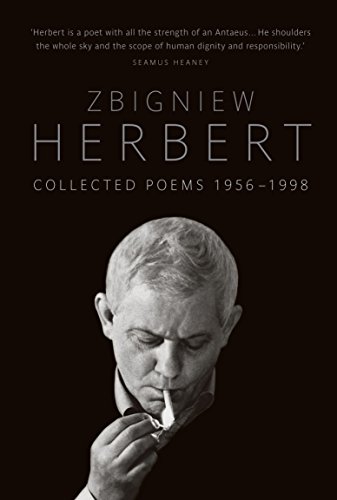

I’d heard his name bantered about amongst my friends, so I figured, yeah, why not read something of his? (Yeah, yeah, he was born in Lwow, which is now part of Ukraine, but it was Polish while he was a kid.)

This was the library’s only volume of his works – ye compleat edition, running to 571 pages. But mirabile dictu, it’s good. So good. (I’d considered abandoning it for Adam Zagajewski’s Eternal Enemies, a convenient, skinny little codex, but when I leafed through that, I found myself longing for the lambent voice of my man Herbert.)

We’ve nine different volumes of his poetry packed into this tome:

Chord of Light (1956)

Hermes, Dog and Star (1957)

Sudy of the Object (1961)

Inscription (1969)

Mr Cogito (1974)

Report from a Besieged City (1983)

Elegy for the Departure (1990)

Rovigo (1992)

Epilogue to a Storm (1998)

So we get to follow this man from a post World War to a post-Cold War era; from youth; from the age of 32 to 78. And over the five decades we see his voice develop, shift from focus to focus, intensify and mourn himself.

And it is the same voice throughout – a melancholy, erudite voice, haunted both by the horrors of his own Communist (and pre-Communist) society and the ghosts of classical history. He invokes Hermes, Apollo, Athena, Marsyas, the Minotaur, Elektra, Claudius, Marcus Aurelius, Nefertiti – also Mary Queen of Scots, George Orwell and the Emperor Meiji, come to think of it – but not in a show-off-how-smart-I-am way, but to invoke archetypes of eternal drama to show that the tyranny and torture of his land (of all lands) have ever been thus.

Loads of specific references to his childhood and his Polish contemporaries, too, which were a little harder to get. He calls himself Mr Cogito (therefore he is?) in the latter half of his career, documenting what he sees as his loserly life. But fundamentally, he’s engaged in the same Szymborska-esque mission of mourning for the entire world, for the whole of history.

That hits me, you know? This is poetry that makes me want to write more poetry. To join in the chorus as a testament. Gah.

(Though I personally do like Szymborska better still, because she also finds joy in the senselessness of the universe. But it’s not a competition. Is it?)


Representative quote:

I probably like his prose poems best, but this piece spoke of nation in a way that resonates a lot with me.

TAIL OF A NAIL

For lack of a nail the kingdom fell
- our nannies’ wisdom teaches us – but in our kingdom
there haven’t been nails for a long time nor will there be
neither those handy little ones used for hanging pictures
on a wall nor the big ones with which coffins are sealed

but in spite of this and perhaps precisely because of it
the kingdom endures and even gains others’ admiration
how is it possible to live without nails paper and string
bricks oxygen freedom and whatever else you like
evidently it is possible because it endures and endures

people in this country live in houses and not in caves
factories smoke in the steppe trains cross the tundra
and on the cold ocean a ship blows its bleating horn
there is an army and police a seal an anthem a flag
on the surface it’s just like the rest of the world

it is only on the surface because this kingdom of ours
is not a creation of nature or a creation of humanity
seemingly enduring built on the bones of mammoths
in reality it is weak as if suspended between
the act and the thought existence and nonexistence

a leaf and a stone fall so do all things real
but ghosts live a long time stubbornly despite
sunrise and sunset revolutions of celestial bodies
on the disgraced earth tears and things fall

Next book: Uladzimir Karatkevich's "King Stakh's Wild Hunt", from Belarus? Or Vladimir Kozlov's "Number Ten: A Novella In Translation"? Not sure yet.

Wednesday, October 15, 2014

Book 159, Hungary: "Fatelessness" by Imre Kertész

So, while bumbling through the train systems of Spain and Portugal, I've been reading this:


It's a novel about the Jewish Holocaust. By an actual concentration camp survivor. Huge bummer. 

And yet and yet and yet... it is worth reading. Kertész is a Nobel Lit Prizewinner, after all (they sure do churn 'em out in central Europe), so this is a tale with a difference, not simply autobiographical and documentarian, but also a commentary on human existence - how we are all, in a way, stuck in concentration camps of our own. (Yes, I know that trivialises the experience of the holocaust. But he has the right to trivialise it if he wants to.)

It follows the experience of a 15 year-old, György Köves, who's living in the Budapest ghetto, viewing the events of his father's deportation to a "work camp", his own placement in a teen bricklaying brigade, and everyone's getting rounded up and placed on trains to Auschwitz, with such a dispassionate, slightly bewildered voice that it startles you - there's no Sturm und Drang at all, no panic, not even when describing the days inside the locked train carriage with nothing to drink and nowhere to piss or shit, the old and the sick dying at their feet, then the separation of healthy and unhealthy into gas chambers and genuine showers, and then the realisation of the survivors as to what had happened, how they had to their surprise been transformed into convicts, as if it were an absurd, laughable magic trick rather than a crime against humanity...

I've no idea how much of this really happened to Kertész (and does it matter?) but the tail end of it involves him genuinely being allowed to recuperate from an infected knee in a concentration camp in Zeitz, which surprised me - I didn't realise any Jews got real medical treatment then.

Also a surprise: how he shows the mingling and hierarchies between different concentration camp internees (Communists, gypsies, etc, who usually got to keep their hair and were a good deal more handsome and human-looking than the starved and shaven Jews) and the divisions between the Jews, who were from dozens of different countries (differentiated by the letters on their yellow triangles - U was for Hungary), and who couldn't even communicate with a common language, not Hebrew since that was a dead language for everyone concerned back then, and even some Yiddish-speaking bastards who refused to interact with other Jews in the camp, telling György, "If you don't speak Yiddish, you must be a Gentile," to which György replies, "Then why I am I here?"

And the horrible way his Hungarianness keeps intersecting with his Jewish identity - how Hungarians treated him with both honour and inhumanity, even trying to persuade those stuck in train carriages to give up their valuables, since, "After all, we're all Hungarians"; how one Polish ghetto kid in the hospital managed to speak to him in Hungarian with great unwillingness, because he didn't like Hungarians, and when György reflects, he realises, yeah, he doesn't have any reason to like Hungarians either.

So when he makes it back as a survivor, all he can feel is detachment, and, when questioned by a journalist, hatred. And yet he can't call what he experienced hell. All he did was survive, and even his Jewish family who didn't get deported can't understand him, can't abide him...

Yeah, it's a mess. But it's just the beginning. Together with Fiasco and Kaddish for an Unborn Child, this forms a trilogy. Do I have the spirit to read them all? Not likely. But I'm glad I read this one.

I mean, I've read and watched lots of holocaust accounts - The Diary of Anne Frank, Schindler's List, Friedrich, even the clownish Life Is Beautiful... I've been to Yad Vashem, too.

But this is a new way to tell the human tragedy, by downplaying it, by making it universal, inescapable, complex.

Yes. Every horror is different. Yes. The complications must be told. 


View Around the World in 80 Books!!! in a larger map

Representative quote: "Before all else, he declared, "you must put the horrors behind you." Increasingly amazed, I asked, "Why should I?" "In order," he replied, "to be able t live," at which Uncle Fleischmann nodded and added, "Live freely," at which the other old boy nodded and added, "One cannot start a new life under such a burden," and I had t admit he did have a point. Except I didn't quite understand how they could wish for something that was impossible, and indeed I made the comment that what had happened had happened, and anyway, when it came down to it, I could not give orders to my memory. I would only be able to start a new life, I ventured, if I were to be reborn or if some affliction, disease, or something of the sort were to affect my mind, which they surely didn't wish upon me, I hoped.

Next book: Peter Pišťanek's Rivers of Babylon, from Slovakia.

Thursday, May 15, 2014

Book 149, Lithuania: "Beginning with My Streets: Essays and Recollections" by Czesław Miłosz


We’re at the last of the Baltic states – and the end of Northern Europe! Woohoo!

Now, I know what you’re thinking. Miłosz is a Polish poet – he wrote in Polish, lived in Warsaw (before his defection to the USA) and was a cultural attaché for Poland, for crying out loud.

But it turns out that he always identified as both a Polish and a Lithuanian. He was born in Vilnius, which he knew as Wilno, at a time when the city was under the Polish government. Polish-speakers and Lithuanian-speakers lived alongside each other in his youth (along with Russian and Hebrew and Yiddish speakers), attending different schools and participating in different communities. And the memory of that city haunted him throughout his entire poetic career.

Miłosz wasn’t an obvious choice, of course. Back in Singapore, I thought I was going to do Ričardas Gavelis’s novel Vilnius Poker; scanning WorldCat in Norwich I thought I’d do an inter-library loan for Selected Lithuanian Short Stories from the University of Essex.

But he was a Nobel Prize winner and one of the Righteous Among the Nations (he saved a bunch of Jews during World War Two), plus I’d never read anything by him before.

And there were loads of other Polish writers I could read for Poland. Why not choose this, a volume of essays named for his memory of his childhood in the boulevards of Vilnius/Wilno?


Well, the reason why not is because the book’s effing boring.

I don’t think I was the right reader for it – it seems to be for die-hard fans of Milosz’s poetry, who want every last scrap of wisdom from his mind, and so are willing to wade through esoteric monologues by him about obscure writers (Dwight Macdonald? Robinson Jeffers? Aleksander Wat?) just because they’re there.

And while the fragments of Miłosz’s poems scattered throughout the volume seem nice enough (I don’t quite grasp their transcendence, but that’s true of my relationship with many a great poet), his prose style is just so ambling and leached of any sense of humour or urgency or passion that I come away from it quite uncharmed.

Not that all the pieces here are without interest. You do get an awful lot of the texture of Vilnius/Wilno from the titular essay, “Beginning With My Streets”, and his dialogue with the Lithuanian poet Tomas Venclova. 

Details of his own life leak through in the various transcripts of interviews with him, in “A Poet Between East and West”, and “The Sand in the Hourglass” – his discomfort with Californian hippie mysticism in the ‘60s and ‘70s; his simultaneous comfort with his role as a university lecturer to the same young Californians; his childhood pathos upon reading a condensed volume of James Fenimore Cooper’s works wherein he saw Natty Bumppo age from being a young vigorous Deerslayer to an old man Leatherstocking, bereft of his friends and the wilderness he loved so well. Also his constant surprise when amongst Nobel Laureates, expecting them to be otherworldly higher beings, as he suddenly remembers that he is one himself.

And some of his literary musings are pretty cool – his insistence that Dostoevsky must have been influenced by Swedenborg (he notes that Svidrigailov from Crime and Punishment has a Lithuanian name). Plus his ruminations on the in-betweenness of culture for Central Europeans during the Cold War, caught between Russification and Americanisation.

Ah, but I suppose it’s his Nobel Lecture which is most moving and lucid. Go read it. In it, he considers this terrible tension in his role as a poet, wherein he desires to describe reality from an abstract distance yet with utter detail, rather as the hero of Nobel laureate Selma Lagerhof’s The Wonderful Adventures of Nils does when he flies above the earth. The brutality of the real world keeps getting in the way, he sighs – the horror of the Holocaust and the double horror that there are still those who deny it; the misery of exile and of the human rights crimes for whom dictators remain unpunished. “I hope you will forgive my laying bare a memory like a wound,” he says. “It is possible that there is no other memory than the memory of wounds.”

Ah, but I won’t leave you with just the pithy bits of Milosz. Here’s the end of his essay “On Creators”, which is both infuriatingly opaque and also inspiring with its last two sentences.


View Around the World in 80 Books!!! in a larger map Representative quote:

Some fifty years ago anyone who took a stand against ritual in praise of ritual, observing that, after all, it would lead only to sterility, to intellectual chaos, would have been labeled a reactionary, a defender of old-fashioned “content”. Alas, today one can prove to oneself experimentally what happens to the language of symbols and myths when it is deprived of its deepest reason for being and yet is honored as if nothing had gone wrong. He pursuit of a truth that is otherwise impossible to express used to be its raison d’être, and whatever names that truth might have borne, however much it may have been valued, a language that speaks to itself, with symbols and myths that mean nothing outside a particular closed system (a poem, a painting), gradually loses all its charm and receives its just deserts: indifference. The indifference of others – let us assume not of the creator himself. Thus, the result of the activity ceases to be its goal (for a result is in some sense objective and thus destined for others); the goal becomes the activity itself. It, too, is supposed to be rewarded by society.

“What then must we do?”
“Rethink everything from the beginning.”

Next book: Goethe’s Sorrows of Young Werther, from Germany.

Friday, June 24, 2011

Book 66, Malawi: "Of Chameleons and Gods" by Jack Mapanje

I’m back in Singapore, and ready to catch up on my reading! Opportunities in South Africa were surprisingly slack – only finished Long Walk to Freedom because my movie monitor malfunctioned during the Emirates flight home, on the leg between Dubai and Colombo.

Back when I was planning the trip, I was wondering if I oughta download development celeb William Kamkwamba's The Boy Who Harnessed the Wind, or else check out Jack Mapanje’s Beasts of Nalunga from the library and stow it along. Then I decided I’d bank on the possibility that I might find some of the first-generation greats in a South African bookstore: David Rubadiri or Frank Chipasula – only to discover that:

1) Books are really expensive in South Africa,

2) The storehands at V&A Waterfront in Cape Town and that hip little university joint in Stellenbosch have little knowledge of African lit (they thought Mia Couto was a woman, sniff sniff).

But back at NLB, I discovered that Central Lending owns this book, which was the first to catapult Mapanje to commercial success when published in 1981 (although his incarceration without charges from 1987-1991 made him famous, if you can call it fame, considering that I’d never heard of him till this project).

And it’s good. Really eloquent, passionate stuff, with a lot of personalized references to friends a la Frank O’Hara, a tinge of the hermeticism and experimentation of Arthur Yap, though never quite as academic and lofty as Wole Soyinka or Edwin Thumboo; plus of course the outrage of the third-world liberationist betrayed that’s so common to postcolonial lit.

He honestly sounds like the kind of guy you’d like as your creative writing teacher. (Maybe I’m thinking like this ‘cos I’m typing on the way to NTU, where I’m delivering a poetry reading and handing in my claim forms for exam marking. Or maybe I just need a mentor myself.)

It’s the vibrancy of Mapanje’s words and symbols that really captivates me. Chameleons, nsolo trees, the murders at Chilombwe, calabashes, dagga, ancestral shields, and the imaginary Chief Kwangala, a Yao word which means dancing frantically. How can we approximate this in Singapore literature?

(Of special interest are the references to Chingwe’s Hole, a hole on the verdant Zomba Plateau where wrongdoers were flung in punishment and the supposed source of the Namitembo River. A whole section of the book is titled “Re-entering Chingwe’s Hole”; confronting the juxtaposition of horror, beauty and fertility that is post-independence Africa.)

I’m less keen, however, about the obligatory “I’m dislocated in London” poems, given that I’ve read a few similar ones now. Or maybe I’m just hungry for exotica? Maybe I just want my writers glowing with Afro anger instead of Euro malaise?


View Around the World in 80 Books!!! in a larger map

Representative quote:

Visiting Zomba Plateau

Could I have come back to you to wince
Under the blur of your negatives,
To sit before braziers without the glow
Of charcoal, to cringe at your rivers
That without their hippos and crocs
Merely trickle gratingly down, to watch
Dragonflies that no longer fascinate and
Puff-adders that have lost their puff?
Where is your charming hyena tail –
Praying mantis who cares for prayers once?
Where is the spirit that touched the hearts
Lightly – chameleon colours of home?
Where is your creation myth? Have I come
To witness the carving and jingling only of
Your bloated images and piddling mirrors?

Next book: Mia Couto’s The Last Flight of the Flamingo, from Mozambique.

Wednesday, May 11, 2011

Book 60, South Africa: "Burger's Daughter" by Nadine Gordimer

Hey look! It's almost exactly a year since I started this reading journey! Sure, it's not 80 books, but 60 ain't bad either.

And South Africa's a good country to be in for our anniversary. Besides the fact that it's an important nation with an epic political and literary history (I've read Alan Paton's Cry, the Beloved Country, Athol Fugard's , and J.M. Coetzee'sWaiting for the Barbarians and Summertime before), I'm actually going to the country in June! Johannesburg, Cape Town and Kruger National Park! How cool is that?


But on to the monumental Burger's Daughter now, a book written in the wake of the Soweto uprising, initially banned in South Africa and requested as prison reading material by Mandela himself.

The Wikipedia article says the book was banned for "propagating Communist opinions", "creating a psychosis of revolution and rebellion", and "making several unbridled attacks against the authority entrusted with the maintenance of law and order and the safety of the state", but 17 years after the fall of apartheid it comes across as far more complex. The truth is, it contains not only the urgent and obvious need to bring down the racist laws of unequal justice but also the contradictions of the characters' ideologies: Lionel Burger and his daughter Rosa are white Communist South African activists (he by conviction, she by inheritance), but their comrades and hangers-on argue over the misplacedness of a white African identity, never mind that your ancestors have been there for 300 years; the impossibility of ever rectifying for the privilege you have by race; and then what about the fact that Communism's worst abuses have been revealed by Solzhenitsyn; what kind of utopia are you chasing after that?

(Really; it just goes to prove again that only the most insecure governments will censor political art. Artis always polysemous, but a narrow-minded policy-maker will be unable to see that.)

It's funny; the story begins with the life imprisonment of Lionel Burger so I thought this was going to be one of the political detention narratives I've been reading so much of recently. But of course the tale's about the eponymous daughter: how she deals with being reared for struggle against the government while not being of a heroine's disposition herself - she knows the system's wrong, she's just very lost as the last of her line.

It resonates. I mean, I've been involved as a volunteer against our own unjust system of government, and people think I'm bad-ass 'cos I wrote poems about it but the truth is I mostly use my ass for sitting on; I could name you about two hundred Singaporeans who do more activism than I do off the top of my head. And I'm not even doing much writing either: just as Rosa spends her time hanging out with dissolute young white academics who build yachts in their backyards or study Spanish literature, or else with passionate activists who accept her as one of their own but argue over her head.

And what does she do to heal herself? She gets a passport (no easy thing for the scion of a political scapegoat) and leaves the country. And is renewed, somehow (the book is terribly rhizomatic, perspectives shifting from first person to third and even to her father's biographer and the state that's investigating her, but there is a wonderful climax) and returns home and things change, maybe not of her own doing, but she seems to have figured out a little more of herself by the end when she's in prison hearing her fellow comrades singing Miriam Makeba's click song (hey, that's a link with the author of our Swaziland stop).

Everyone's telling me I need to do the same. Get off this island and write properly. See how, see how.


View Around the World in 80 Books!!! in a larger map

In the meantime, may I point out that I don't think I've ever seen the experience of a beautiful young woman being presented with such intimacy and complexity by a writer before - a perspective neither defiant nor heroic nor victimised; a clear intelligence that has dignity yet a frustrated agency, haunted by a past that should empower her - a bit of a female Hamlet, really. The book requires patience, but it is quite, quite remarkable.

Representative quote:The middle-aged cosmetic saleswoman and the few customers not too self-absorbed to glance up saw a kaffir-boetie girl being kissed by a black. That's all. They knew no better. That house was closer to reaching a kind of reality through your kind of reality than I understood. You and I argued in the cottage. Sex and death, you said. The only reality.

Next book:Mpho Matsepo Nthunya's Singing Away the Hunger, from Lesotho.

Monday, January 3, 2011

Book 43, Dominica: "Sleep It Off, Lady" by Jean Rhys

Do I know why the Singapore National Library has a first edition of Jean Rhys's last work before her death? No I do not.


But I'm glad all the same, because this is a lovely book - arguably more beautiful than her more famous novel Wide Sargasso Sea, which I only liked on a second read.

There's a distant, interior style, characteristic of an earlier, more genteel age - I kept thinking of Eudora Welty - and indeed, Rhys (it's pronounced Rees) began writing in Paris in the '20s, soaking up the culture of refined Modernism while never quite shedding her Caribbean roots and accent.

Another thing I love is how this series of fictions carries us through the line of Rhys's life, from her childhood in Dominica to her boarding school blues in rural England to her London musical-hall and Parisian demimondaine days, up till her senescence, retirement (and afterlife). The cover sleeve claims the stories are based on her own life, and indeed there are tales narrated in first person, and little mysterious details that cohere more with the randomness of true living than with the ideal contours of plot.

But the truth is, most of the female characters (often mildly to wildly neurotic) have names of their own: the molested Phoebe, the spiteful Daisie, the untouchable Margaret, the obsessive Audrey and the pathetic Miss Verney. So their lives are cut short as each story ends, and we're left with that beautiful sense of mystery as we move into another woman's life.

It's also pretty refreshing to see the tropics portrayed so coolly and dispassionately, by one for whom the experience of snowy England was far more bizarre than a land of rainforests and volcanoes. Sure, there's voodoo and murders and miscegenation, but that was part of the course of life as they viewed through the distant windows of childhood.

Quite different from most colonial narratives. She even makes fun of the exoticisation of the Indies in "The Insect World", which ends up comparing sandflies to London subway passengers in the war, to the ticking biological clock of a single woman in a city about to swallow her whole.


View Around the World in 80 Books in a larger map

Representative quote: Well there was one thing. Now she felt very wise, very grown-up, she could forget these childish worries. She could hardly believe that only a few weeks ago she, like all the others, had secretly made lists of her trousseau, decided on the names of her three children. Jack. Marcus. And Rose.

Now goodbye Marcus. Goodbye Rose. The prospect before her might be difficult and uncertain but it was far more exciting.

Next book: Frantz Fanon's "Black Skin, White Masks", from Martinique.

Wednesday, November 10, 2010

Book 33, Puerto Rico: “Macho Camacho’s Beat” by Luis Rafael Sánchez

Back to some genuine World Literature now: this is one of those novels that that takes the tropes of European modernism and makes them groove (with shocking success) to a more equatorial, phantasmagorical beat.


Written stream-of-conscious style with internal rhyme after rhyme, block repetitions and neologisms and multiple points of view over a single day, by author Sánchez, alias Wico, all to the tune of a genuine musicial guaracha beat. Shame upon shame that they had to alter the original title: La Guaracha de Macho Camacho, which really condenses the rhythms of this wonderful book into a single utterance.

Even though the character of Macho Camacho never appears: he’s merely the author of the song that permeates the airwaves in the story, his rhythms infecting every other character from whose perspective we view life in the brokedown American semicolony of Puerto Rico; neurotic figures like the nymphomaniac megalomaniac Senator Vicente Reinosa (Vince is a prince and his ideas convince); his Donald Duck-tantrum wife Graciela Alcántara y López de Montefrío; their good-for-nothing Ferrari-sexual son Benny; the wise woman cooking tripe on her stove Doña Chon; and of course the idiot boy The Kid, normal at birth but something went wrong, who gets spat on and abused by the other kids, the symbol of Puerto Rico herself.

Once again, as in the case of so many texts in this series, I say: I want to write like this. (Or at the very least, translate like this. Gawd, Gregory Rabassa, how did you do it? Such an epic smoosh of Gabo and Joyce and Spike Lee, hey-prestoed from island dialect to Anglophone noise. Qué padre!)

Many thanks to the Puerto Rican poet Jorge Acevedo for recommending this book to me out of all the Puerto Rican books in the National Library: sorry that we don’t stock Luis Palés Matos’s Selected Poems/Poesía Selecta, which you similarly lauded.


View Around the World in 80 Books in a larger map

That’s it for the Greater Antilles, though: now we progress to the Lesser. Slower progress down the chain of islands.

Representative quote: “The sun like an onion will beg your pardon and do its best to give you a hard-on,” said the Mother: conclusively, going to the door, letting Macho Camacho’s guaracha take up residence in her waist, twisting and twisty, guarachose and triumphant in imaginary cabarets, surrounded by a focus of lights that made the imprecise lines of her vivid makeup precise, guarachose and triumphant and trapped by waves of applause: life is a phenomenal thing, giving the microphone to the MC.

Next book: Robert Louis Stevenson’s Treasure Island, (sort of) from the British Virgin Islands.

Thursday, October 21, 2010

Book 28, Jamaica: “Two Can Play” and “School’s Out” by Trevor Rhone

I’m just back from Kuala Lumpur, and man, I should tell you about the harvest of books I got from Silverfish Bookstore. Plays, essays, and fiction, translated and untranslated from our neighbour/separated sibling up north: A. Samad Said, Amir Muhammad, Zakaria Ariffin, Ouyang Wenfeng, Charlene Rajendran, Farish Noor…

But instead, I’m going to babble a bit about the old book of Jamaican drama I managed to get out of the National Library Repostiory when I got back. No worries: it’s good stuff too.

These two plays are early pieces by Rhone, who was educated in drama in the UK but came back and started his own theatre company, playing with the vernacular, commenting on politics while capturing the real human side of Jamaican life at the same time.

School’s Out (first perf 1976) is ostensibly about a dysfunctional church school where the teachers bicker all the time about the disorder of things, their mutual incompetence and the absence of the headmaster and the impossibility of getting the stinking staff toilet fixed – only to rise against the new teacher, Russ Dacre, who has the moral willpower and chutzpah to try and fix things. It’s terribly specific and believable (triggering mental echoes of Haresh Sharma’s Those Who Can’t Teach, but it also functions as an allegory for the failed state, where the oligarchs rebel against the real reformers. (Weirdly enough, Russ’s pushy, Messianic character has a few things in common with Singapore’s own reformist autocrat, Lee Kuan Yew.)

Two Can Play, (first perf 1982) is less heavy-handed - in fact, it's quite amazing how Rhone manages to blend the stories of the personal and the political here, all within the framework of a realist, mobile production of only two actors. A middle-aged couple, Jim and Gloria, have sent their kids away to the US as illegal immigrants, convinced that Jamaica is no place for them to earn a living. When Jim's father dies, there's nothing to keep them from going after their kids anymore - and this is when chauvinist, cowardly Jim ends up pushing Gloria to get papers to fly to the States, becoming a citizen through a fake marriage, only to discover that this process has pushed her into selfhood, so she now refuses to put up with his crap any longer. Just like Ibsen's A Doll's House, only with a happy ending: they reconcile, Jim's ready to change, and they're ready to believe in Jamaica again.

I have a lot to learn from this guy. If only it was a little easier to find Caribbean drama in this country. And it's a little tricky even to find a known writer from Jamaica who actually stayed in Jamaica: Claude McKay was an émigré, and Marlon James didn't even live in the country...


View Around the World in 80 Books in a larger map

Representative Quote:
ROSCO: Discipline! [Hiss.] You see all the boy mi run out of the class, is only one way to deal with that sort of discipline problem. I wish they would make me Headmaster. I know exactly what I would do do. I would construct a Gun Court in the middle of the play field; and come Monday morning, right after Chapel, I would make the whole school gather right round the wire fence, then I would catch the boy and let the parson administer the last rites. Then I would tie up the boy and call the cadets with the long guns and - bang, bang, bang! Then you would see a little discipline in the school. Boy, I wish they would make me the Headmaster!

Next Book: Dany Laferrière’s Heading South, from Haiti.