Showing posts with label original spanish. Show all posts

Tuesday, April 26, 2011

Book 57, Argentina: "Autobiografía de Irene" by Silvina Ocampo

I'm actually feeling kinda sick, so I'll try to do this quickly. But but but HOORAY, we're done with South America!

And what a pleasant way to go out (I'm honestly feeling guilty about crossing borders and doing Uruguay before Argentina, but it would've sucked to leave the continent with Ariel). This is a collection I actually picked up in Buenos Aires, by one of Borges's lesser-known and barely translated contemporaries.

I've blogged all about this funky lady here.
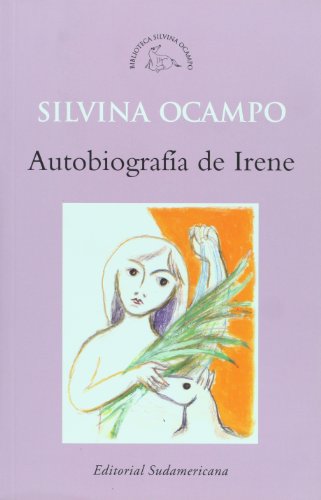


And hurrah: the funky lady does indeed write well. The pieces in this book have the same realm of paradoxical, paranoiac phantasy as the works of Borges or her husband Adolfo Bioy Casares. But they're tenderer, less strictly logic-based - and as much as women continue to appear as objects, they're also subjects.

There's the beautiful Flavia, whose three alternative reactions to the ministrations of her psycho husband Claudio Emilio is the key to Epitafio Romano. There's Kêng-Su, who goes utterly mad when pursued by a vengeful, literate butterfly in La Red. Even El Impostor, which is mostly focussed on its dual male protagonists Heredia and Maidana, involves the agency of the love interest María in its film summary version (why that's in there, I have no clue). And of course, there's the titular story, about a precognitive woman, serenely relieved on her deathbed of the mind-bending contradictions of her gift.

And come to think of it, even Fragmentos del Libro Invisible begins and returns to the womb of the prophet's mother. Yeah, you're getting an idea of how beautifully mad this book is, aren't you? Don't think it's translated yet, but the Spanish is pretty lucid (especially if you have a smartphone translation dictionary at your side).


View Around the World in 80 Books in a larger map

Enough of South America then! You realise that this is only the second continent, after Oceania, that I've actually completed? Lots more to come.

Representative quote:
Pasé por muchas puertas transparentes, como de hielo, en cuyas transparencias se veían ciertos colores que los mortales no alcanzan a ver; por muchas puertas altísimas, silenciosas, cubiertas de follajes, de frutos y de pájaros cuyas alas trémulas irradiaban luz en las maderas labradas. Pasé por muchas puertas horribles - algunas eran diminutas, algunas tenían una mano de jierro o de bronce, a un lado, o la cabeza de un león mordiendo un aro en el centro - antes de hallar el otro mundo en un paisaje complicado, entre edificios y objetos heterogéneos, entre camas, cuadros, armarios, arcos, estatuas, columnas, glorietas, miniaturas, látigos, sistros, tabernáculos, aureolas, espadas, baldaquines, linternas mágicas, barajas, astrolabios, cariátides, mapamundis.

Next book: H.P. Lovecraft's At the Mountains of Madness, from Antarctica.

Friday, February 25, 2011

Book 49, Venezuela: "Doña Bárbara" by Rómulo Gallegos

This is going to be a rushed entry, because I’m seriously sleepy. But man oh man, am I proud that I’ve finished this book: the most famous Latin American novel prior to One Hundred Years of Solitude, one of those classics my Spanish literature profesora talked about back in college when it was assumed we were gonna be polyglot intellectuals for life.


(It’s weird. I couldn’t find any Venezuelan authors in Central Lending: I was going to choose between an Edwardian proto sci-fi thriller, a German Enlightenment travel memoir and a Norwegian romance. When I’d decided on this title, I had to Amazon it over to my friend in London – thanks Simon! The above copy was ultimately from the discard heap of the Houston Public Library.)

Doña Bárbara is epic, not just because it’s a sweeping romance of the prairies, complete with rough-and-ready cowboys, crocodile hunting, evil gringo capitalists, drunkards, deadly family feuds and romantic tension between the strapping country-born, city-bred, horse-taming lawyer Santos Luzardo and the gorgeous 15 year-old virgin Marisela.

No, what sticks with everyone is the eponymous character herself, the tempestuous mestiza villainess who’s seduced Luzardo’s cousin out of his fortune, running her ranch like a tyrant, a cacica or female Indian chief. The contemporary soap opera makes her out to be a heroine, a woman before her time, but she’s quite the antagonist in the novel: a destroyer of fine, virtuous men and a witch with regular communications with the Devil.

Oh, but she’s a marvelous figure. Gallegos says in his preface that she’s a mere personification of the savannahs, beautiful and deadly and a deadly threat to civilization itself, but he humanizes her with a past story of heartbreak and betrayal and a tragic infatuation with Luzardo himself, which is all the more fucked-up when the girl who’s really going to get him is her illegitimate daughter, Marisela (who is herself a cousin once removed from Luzardo, which is nuts, but this was the outback. Get over it).

She’s actually perceived as monstrous for her androgynous costume and her ability to do men’s work – her very name means not just Dame Barbara, but also the Barbarous Lady. But on the other hand, she provided a strong female Wild West archetype for Spanish America that's endured to this day. All North America has is Annie Oakley and Dr Quinn, Medicine Woman. I'll take the bad-ass fictional lady over either of those real-life chicks.

Marisela’s pretty fascinating, too. Sure, she has her girlish foolishness as she pines for her man, but she’s discovered by Luzardo living in grunting, mud-smeared poverty in the middle of nowhere, growing into sophistication and beauty as he educates her in the ways of etiquette and grammar. She isn’t just an embodiment of the land to be conquered: we’re reminded time and again of her native intelligence that makes her a matching helpmeet to our hero –
Well, okay, I take it back. She is basically the native who must be civilized, but she’s reared to be an equal, not a servant.

Mind you, my Spanish is rusty and the text is full of 1920s country colloquialisms, so I only understood about, say, four words out of every five. There’s a lot to this book that didn’t get through my skull. There’s an English translation somewhere out there in the world. Maybe I’ll read it someday.


View Around the World in 80 Books in a larger map

In the meantime, enjoy some contemporary music from Venezuelan/American pop star Devendra Banhardt! Man, it's good to be back in South America.

Representative quote: Tal era la famosa doña Bárbara, lujuria y superstición, codicia y crueldad, y allá en el fondo del alma sombría una pequeña cosa pura y dolorosa: el recuerdo de Asdrúbal, el amor frustrado que pudo hacerla buena. Pero aun esto mismo adquiría los terribles caracteres de un culto bárbaro que exigiera sacrificios humanos: el recuerdo de Asdrúbal la asaltaba siempre que se tropezaba en su camino con un hombre en quien valiera la pena hacer presa.

Next book: John Agard’s Lovelines for a Goat-Born Woman, from Guyana. (I think.)

Saturday, August 28, 2010

Book 21, Nicaragua: "Azul" by Rubén Darío

As you can see, I finally managed to get a copy of Azul from Amazon for US$0.99! From the online edition here, the contents seem to be based on the first edition.


Fyi, Darío's known as the great Nicaraguan poet who invented modernismo in the late 19th century, the first literary movement to begin in the Americas and later spread to Europe.

But a couple of surprises:

1. Although Darío's famous as a poet, Azul(his first collection) is actually mostly made up of short stories, descriptive passages. There's a chunk of poems at the end, though.

2. Modernismo isn't actually very modernist. It's excessively flowery and effusive in praise of love and the beauty of young women and nature and jewels, bordering on Aubrey Beardsley-esque decadence. No sex, though. The poems are still pretty structured, too.

3. Hardly any of these pieces take place in Nicaragua. They're set in places with princesses (Italy?) or underground in the gnome kingdom or in Paris or Valparaíso - in fact, all the descriptive passages are about Chile, where Azul was published. The only piece set in Nicaragua is a weird autobiographical-sounding thang called Palomas Blancas y Garrzas Morenas, which is about him falling in love with his cousin while growing up with her and his grandmother, gawking at her 15 year-old body, with hair as blonde as German, no seriously, by the light of the silvered moon, "la luz de una luna argentina, dulce, una bella luna de aquellas del país de Nicaragua."

I'm honestly not that keen on the book. Sure, it's interesting as a cultural artefact, and some of the pieces are pretty cool - there's El Rey Burgués, a sad fable of the bourgeois king who cages the starving poet in his zoo, and La canción de oro, a crazy intense paean about gold and its effects on man. Also the descriptions of the tiger in his poem Estival. But given the difficulty of reading (my book had bizarre spellings: Js instead of Gs and vice versa, &c), I don't think I got a great payoff.

Didn't learn much about Nicaragua, either. There was a casual reference to the swamp crocodiles he encounters after his wedding in Palomas blancas, but this ain't a very nationalistic book. Which is okay, innit?


View Around the World in 80 Books in a larger map

Representative quote: Ya tenía quince años y medio Inés. La cabellera, dorada y luminosa al sol, era un tesoro. Blanca y levemente amapolada, su cara era una creación murillesca, si veía de frente. A veces, contemplando su perfil, pensaba en una soberbia medalla siracusana, en un rostro de princesa. El traje, corto antes, había descendido. El seno, firme y esponjado, era un ensueño oculto y supremo; la voz clara y vibrante, las pupilas azules, inefables; la boca llena de fragancia de vida y de color de púrpura. ¡Sana y virginal primavera!

Next book: Paul Theroux's The Mosquito Coast, from Honduras.

Monday, July 19, 2010

Book 15, Chile: “Fulgor y muerte de Joaquín Murieta” by Pablo Neruda

Yessss!!! Finally in South America! (Though in the real world, I’m currently in Munich. How did that happen?)

I’m doing an obscure play by Nobel laureate Pablo Neruda in the original Spanish, not to show off my erudition, but simply because I picked up a second-hand copy in Brazil a few months ago, and I’d never finish it otherwise, despite the volume itself being so slim. Truth is, I have doubts about its validity, given that the story mostly takes place in California during the Gold Rush – Murieta himself was a hstorical bandit whose origins may not even have been Chilean, but Mexican.


And yet! Neruda’s piece is so full of patriotism that it hella qualifies. (Plus we’ve got a big opening section about the departure from the port of Valparaíso, a location the miners long for throughout the play – when they’re not talking about their own villages and districts.) And according to Neruda’s account, Murieta was a hero who retaliated to the gringo Americans’ constant lynching of Chileans and Mexicans – specifically to the murder and rape of his wife Teresa – by going on a rampage and slaughtering white guys and gals willy-nilly (that’s the “fulgor”, me hearties), before getting mowed down himself (that’s the “muerte”).

It’s a psychedelic trip – most of the play’s performed as an oratorio, with choruses of men and women in poetry, and for some reason Murieta and Teresa never appear on stage, portrayed only by their voices offstage, refusing to embody the great idols of this legend, until the final scene when Murieta’s decapitated head speaks to us from its resting place on Teresa’s tomb – and then the audience breaks out in pre-distributed song decrying the war in Vietnam (this is another 1960s piece) and how people of colour will overcome. Strange, considering that Chileans themselves are pretty white.

But there’s also surrealism – el Caballero Tramposo, a devious trickster figure, who steals everyone’s watches for the gringo establishment, and even the Galgos (gringos) themselves, who gather in secret to recite a catechism of how they’re uniting to keep the coloured folks at bay. Not subtle, man.


View Around the World in 80 Books in a larger map

And there’s also slapstick, with the hardened miner character of Tresdedos bumping heads with the customs official Reyes, who demands loads of paperwork only to decide none of this matches up to the prospect of gold, leaves his job, and spends the rest of the play (quite sensibly) moaning about when they’re going back to Chile.

Rather fun. Haven’t seen Neruda so political before – all we read is poems by him about how gloriously beautiful women are, or panthers, or artichokes, or socks.

I’ll read Isabel Allende another time. Seriously, though, I haven’t read a single work by her. Shameful.

Representative quote:
Canción masculine

Así como hoy matan negros
antes fueron mexicanos,
así matando chilenos,
nicaragüenses, peruanos,
se desataban los gringos
con instintos inhumanos
hasta que por la vereda
pasa un caballo de seda,
hasta que por los caminos
galopa nuestro destino
y como dos amapolas
se encendieron sus pistolas.
Quién les disputa el terreno
y quién de frente los reta?
Es un bandido chileno!
Es nuestro Joaquín Murieta!

Next book: Some novel by Mario Vargas Llosa from Peru.. Screwed if I know.