Showing posts with label outsider perspective. Show all posts

Sunday, July 28, 2013

Book 131, Falkland Islands: Carlos Gamerro's "The Islands"

Okay. This is weird. I decided to do a mega-detour to South America, because the Falkland Islands now fit my criteria for inclusion in my project. Previously I'd figured they were too sparsely populated, but they're home to 2,932 people, twice as much as Tokelau or Niue. More importantly, I found a really cool book about the country.


Strange how whenever we talk about the Falklands War/Guerra de las Malvinas, we always hear about the British perspective: Margaret Thatcher as a patriotism-stirring warrior queen, et cetera. Carlos Gamerro tells us about the even more messed-up Argentinean side: a world of byzantine power struggles and sociopathic generals and torture victims, and above all an inability to let go of the shameful defeat. As the narrator says, it's not the criminal who returns to the scene of the crime, but the victim.

The War took place in 1982 and the story's taking place in 1992 - not just the 10-year anniversary, but also the 500th year since the colonisation of the Americas by Christopher Columbus. Aforementioned narrator is Felipe Félix, hacker and Falklands War veteran, employed by the mad Sr Tamerlán to track down the witnesses of a murder committed by his son.

And everything's mad in that delightfully Borgesian manner - magical realist but in an urban, technologically-equipped setting: Tamerlán's office has one-way mirrors as floors and ceilings so that the boss on the upper floor can be the master of a Panopticon; fellow veteran Ignacio spends years creating a fabulously detailed scale miniature model of Puerto Argentino/Stanley, supposedly to aid in plans for a counter-attack but in fact for the purposes of turning back the clock; Felipe creates a video game that enables General Verraco to play at winning the war, ending with him being blessed by the Pope in the middle of Buenos Aires and conquering the British Isles, and so on, and so on.

God, I've missed you, South America. And it's an education to learn how awful, how soul-robbing the war was for the Argentineans - the vets really didn't get decent care taken of them by the state - as the story shuttles between 1982 and 1992 like an acid trip or PTSD.

So yes, this was a positive experience. But harrowing. And also a bit of a betrayal to my friend Dmitri Aronov, who was at first delighted that I was reading Laxness at the same time he was, in preparation for a trip to Iceland. Never you mind, I'll be conquering that epic novel while travelling this coming week, in Bali.


View Around the World in 80 Books!!! in a larger map


Representative quote: He began stomping about the classroom cowboy-fashion, with legs akimbo and fist clenched on groin. 'Argentina is an erect prick ready to breed, and the Malvinas, its balls. When we recover them, fertility shall return to our lands and we shall become the great nation our founding fathers once dreamed of! A potent country! Our wheat shall flower anew, and our cattle shall ply our oceans of grass; our trains shall run laden with the produce of the land to every corner of the country. Buenos Aires shall be the new Paris, the envy of all the cities of the globe. The Argentine name of the Argentineans shall ring pristine in the ears of the world with peals of welath and progress! From our recovered Islands an Argentinean sun of unimaginable grandeur shall mark the day on which the former colony becomes the world power we all long for!'

Next book: Halldor Laxness's Independent People, from Iceland. 

Saturday, July 13, 2013

Book 130, Greenland: "The Vinland Sagas"

Apologies to the one (1!!!) person who voted on the blog poll – I’m not doing Eskimo Poems from Canada and Greenland after all. When I surveyed my friends on Facebook, the overwhelming majority of them wanted to hear about the Vinland Sagas.

And why wouldn’t they? I remember hearing about Leif Eiriksson as a kid back in the early 1990s, watching an American edu-tainment program called Encyclopedia: a bunch of Vikings singing about how one of them had discovered America in 1001 CE; a land he’d called Vinland because of the clusters of wild grapevines he found there.

Since then I’ve seen this theme explored in science writing, genealogical studies, speculative fiction. Philip Pullman even references it in His Dark Materials: in his parallel universe, Native Americans are called skraelings, suggesting that the Viking colony succeeded in creating a lasting Euro-American connection there, whereas in actual fact the settlement lasted only 200 years, colonists driven out by worsening weather conditions and angry natives and the general impossibility of managing an overseas empire like that from the reaches of teeny little Iceland.


But the topic of my investigations here is Greenland: discovered by Eirik the Red (Leif’s father) in 981 while fleeing blood debts in Norway, then Iceland. The Icelanders – famously literary folks, both in the past and the present - were fascinated by the notion of this wild western island, which yielded exports of walrus ivory, skins and furs: a snowy frostbitten land where the very act of survival was heroic. They therefore composed several sagas about the lives of people of Greenland. The two in this volume, Grænlendinga Saga and Eirik’s Saga, are only two of them.

There isn’t actually much detail about Greenland here – Eirik’s discovery is described in an oddly perfunctory manner, and many of the scenes taking place here are honestly rather dry compared to the tales of battling the skraelings in Vinland. Still, what does come across are characters and odd anecdotes. Eirik, for instance, is invited by his son to lead the expediton for Vinland, but he protests that he’s too old, and when he gets thrown off his horse on the way to the port he decides it’s a terrible omen, and stays put. Then there’s Bjarni Herjolfsson, who gets blown off course and spies Vinland (or at least Baffin Island and its environs) but is so uncurious that he decides not to check it out, even when urged to do so by his crewmen.

And get this: this is herstory as much as history, as the most vivid and intriguing characters are the women, not the men. Viking women are portrayed as more than just daughters and mothers: there’s Aud the Deep-Minded, an early settler of Iceland and a renowned ancestress; the prophetess Thorbjorg, dressed in a blue mantle and a black lambskin hood lined with white cat’s fur, who leads a circle of women in a ritual singing warlock-songs and is rewarded when she foretells the end of a famine.

And of course Gudrid, sometimes celebrated as the most widely-travelled woman of medieval Europe, who witnesses her first husband’s corpse rise and prophesy her good fortune (Viking zombies are freaky, but relatively benevolent), then goes with her second husband to Vinland and interacts with a mysterious dark-haired shadow woman during a skraeling trading encounter that ends in bloodshed, then finally comes back to Europe and does a pilgrimage to Rome and ends her days as an esteemed anchoress.

And perhaps most infamously, Freydis Eiriksdóttir (Leif’s only sister) who leads a colonization mission to Vinland, hogging the huts and resources for her men while edging out her brothers, then pretending to have been abused at their hands and ordering her husband to have her brothers and their men slaughtered or else she’ll divorce him. When all the men have been killed, her followers won’t kill the women and children, so she does this herself. She also faces down the skraelings by ripping her dress open and smacking the face of a sword against her bare breasts, freaking them out utterly. Did I mention she happened to be pregnant at the time? Why doesn’t every schoolkid learn about this lady?

Of course, the reason why these biographies are important is because of ancestry: the descendants of these pioneers were sponsors of the sagas, both in their composition and their retranscription. The introduction notes that the Icelanders were unique because they formed a republic, not a kingdom – it was they who pioneered the idea that a saga could describe the deeds of common men, not just of gods and kings.

One final note on Greenland - ironically, the Norse colony here would die out in 1500, just after Columbus’s more southerly discovery of the Americas. Now it’s a Danish colony, but it’s trending towards independence, since global warming is allowing the Inuit-Danish native population to finally grow their own damn food. Thank god someone’s going to benefit from the devastation.


View Around the World in 80 Books!!! in a larger map

Representative quote: Then they put to sea, and Karlsefni accompanied them as far as the island. Before they hoisted sail, Thorhall said:

‘Let us head back
To our countrymen at home;
Let our ocean-striding ship
Explore the broad tracts of the sea
While these eager swordsmen
Who laud these lands
Settle in Furudustrands
And boil up whales.’


With that they parted company. Thorhall and his crew sailed northward past Furdustrands and Kjalarness, and tried to beat westward from there. But they ran into fierce headwinds and were driven right across to Ireland. There they were brutally beaten and enslaved; and there Thorhall died.

Next book: Halldor Laxness’s Independent People, from Iceland.

Sunday, July 7, 2013

Book 129, Saint Pierre and Miquelon: "Rumrunners" by J.P. Andrieux

So I decided not to do Québec as a separate country, because they're not oppressed and they probably wouldn't become a nation of their own if they had a referendum. I do feel bad about this, though, since it was a special request that my friend Jean Francois made three years ago. But I did do the Québec-based Haitian author Dany Laferrière, so there's that.

The teensy-tiny twin islands of Saint Pierre et Miquelon do get an entry, however. They're a self-governing overseas collectivity of France - a colony in North America that no-one knows about! - and there is indeed a Kindle-friendly e-book about them/it, covering the sensational period of American Prohibition from 1919 to 1933: when the islands served as a vital port for the smuggling of alcohol from Europe and the Caribbean into the USA and Canada (yes, Canada did some Prohibition too, didja know that?).


But there're two problems at hand.

First, J.P. Andrieux is a terrible writer. Stupidly dull. Lays out the facts textbook-style, with zero delight in the potential of language to entertain, barely seizing any chances to revel in how interesting the details of his topic are. No lush descriptive background given of the town of Saint Pierre - just dry anecdote after anecdote of the smuggling. Megayawns.

Second - well, the subject really isn't that sensational. True, we've got some cool little stories about sailors who hide liquor in their water barrels, confounding their captains who searched the vessel high and low for the substance that was sousing all men on deck, and the big-name smugglers themselves - James McCoy (whose high-quality rum gave birth to the term "the real McCoy", the infamous gangster Al Capone, who gave away his straw hat to a shopkeeper who admired it, and Gertrude Light, one of the few women to sail the Rum Row, armed with a pistol to defend herself against ruffians who mistook her for a lady of negotiable affections.

However, once we get past 1933, we enter dull Canadian territory - there was still plenty of smuggling of booze and cigarettes from the islands to Newfoundland (which wasn't part of Canadian Confederacy until 1948), and Andrieux narrates the gradual crackdown on this by the Royal Canadian Mounted Police with chapters focussing on 1991, 1992 and 1993 individually, dwelling on juries and ever-so-polite Mountie raids, where they'll apologise for making too much noise if they raid the wrong house (quite unlike US cops, who'll usually shoot your dog and then try to sue you if you go the press about it).

Anyway, there doesn't seem to be much smuggling anymore, not that I've been persuaded to care much one way or another. After all, I'm currently in Colombo, Sri Lanka, listening to tales of police harassment of gay people and the horrors of the 26 year-long civil war, which they're recovering from quite nicely, by the way, after it ended four years ago.

Will be reading more while on the go in Jaffna, Anuradhapura, Sigiriya, Dambulla and Kandy! Toodle-pip, my dears.


View Around the World in 80 Books!!! in a larger map


Representative quote: On the day that Prohibition ended, the truckers who had been engaged in transporting the liquor shipments from the docks to the warehouses and vice versa organized a mock funeral parade from one of the liquor warehouses. They paraded throughout the community with a long line of trucks, with the American and French flags at half-mast in mourning, signifying that the great era was all over and tomorrow they would have no more work.

Next book: The Vinland Sagas, from Greenland.

Saturday, April 20, 2013

Book 121, Tokelau: "A Way With Words: Language and Culture in Tokelau Society" by Ingjerd Hoëm

On the plus side, we're finally reading something else by a female author in the Pacific region. On the minus side, she isn't native - she's from Norway. On the even more minus side, she's an anthropologist.

Yesiree, here's one of those dry, brain-numbing, jargon-filled texts (purism? doxic?) that I'd never waste my life reading if I wasn't doing this godforsaken project. It's even marginally about linguistics, which my PhD student sister has proven to be a headache of a pseudoscience, why oh why etc.


But really, this wasn't so bad - except for the bulk of the second half, which consisted of Hoëm consulting every person she could about the meanings of specific Tokelauan terms, from uluifa (spirits that possess people) to fatupaepae (a female authority figure), just to show the imbalance and instability of information between genders and classes. Major snoozefest.

You see, Tokelau's an odd place.  It's a territory of New Zealand, consisting of three atolls, with a combined population of 1,411 (that's today's figures, but the country's always dealt with overpopulation through emigration). Despite that teensy number, they've got a number of feuds and village dialects, exacerbated by the fact that missionaries converted some of them to Catholicism and some to Protestantism (the Catholics allowed more of the indigenous culture to survive, for which I suppose they deserve some thanks).

In the '80s, when the author was conducting her fieldwork, the Tokelauans had only recently adopted a written form of their native language and begun teaching it in schools. They'd previously been using English and Samoan - so they had the weird situation of kids being fluent in a traditional language, their twenty-something year-old parents recommending that they follow their elders for even greater mastery of the tongue, and of course the elders jabbering away in Tokelauan that was infected with Samoan words to begin with...

And that's just the background. The messy politics of how language is used is bewildering: characterised as the shyest of the Polynesian peoples, Tokelauans hold their fono (their ceremonial meetings) in near silence, wary of contradicting people and making enemies, sometimes postponing the most serious issues of each Women's Council or Council of Elders to the next fono, just so no-one's feelings will be hurt. 

(The example given was sorting out a feud so that one island's parents would stop barring their kids from attending school. As an Asian person I believe school is bloody important and they should've just trod on each other's feelings. But that's why I'm not an anthropologist.)

Details of the use of gossip as a sanctioning device, the strange disruptive appearances of older women as clowns, invading official events to mock the hierarchies that keep them bound (yet this is part of the culture that keeps them bound). And the syncretic lyrics of the fatele song and dance shows.

Yet believe it or not, the Tokelauans feel dreadfully insecure about their culture - they feel they're hybrid, westernised folk (many of them have studied or worked in NZ; there's a steady exchange of unruly offspring between Tokelau and the migrant families in Samoa and New Zealand). They even envy the Maoris for the strength of their identity, never mind that Maori culture has been reduced to a superficial display of hakas and carven masks in the midst of a mainstream pakeha culture. (In Tokelau, they call them palagis).

But aren't we in Singapore the same? Weirdly cultured and problematic and unsure if we can be proud of what we have? 

Ah, but Yi-Sheng, the world does not exist for the sake of your reflections. Here's a fatele text.


View Around the World in 80 Books!!! in a larger map

Representative quote:
Fakalogo atu

Fakalogo atu kite leo e sau
Tena e sau
sau mai i ko
pati tokoto ko te toeina
ko te uto kua tini, tini, tini O.

Listen to the sound coming
That is coming
coming from there
applauding [while] lying down, the Elder
The young sprout of the germinating coconut [i.e. the young people] have finished, finished, finished.

Next book: Reverend Joseph King's WG Lawes of Savage island and New Guinea, from Niue.

Sunday, March 24, 2013

Book 119, New Caledonia: "Penelope's Island" by James McNeish

Eastern Heathens has been launched, and it looks fabulous, hurrah! We're planning a Kinokuniya event in 20 or 27 April - no confirmation yet, so stay tuned.

Also, we’re back in the world of good ol’ epic novels: stories of revolution and betrayal, cultures clashing, men and women caught between loyalties and choosing ultimately to do what is right.  And all from a country most of us had no bloody idea existed!


(The author’s a Kiwi, though. Seems he likes to do these stories set in the Pacific islands.)

The Penelope in the title's the narrator - a nature photographer who ends up improbably marrying a Caldoche, one of the white New Caledonians descended from French penal colonists (yeah, it was France's Australia for a while). She herself happens to be Jewish-Hungarian-British by way of Canberra, which seems even more probable. But there's a method to the madness, as we'll soon discover.

The crazy thing is, the guy Penelope marries - a not-very-employed outdoorsman named Felix - is pretty racist, kicking around the house servant Baptiste for no reason, saying awful things about the Kanaks (the natives of the island) as they try to fight for independence. Violent streak, too - shoots his pet deer without a qualm when he hurts his girl, wants to shoot their dog too at a whim. So the reader's thinking getoutgetoutgetout this racist bastard's gonna destroy you.

And then what happens? Well, first we have the Mayor, Dominique, coming by a lot. He's the first Kanak man to hold the post, and Felix treats him civilly, never mind that he's Baptiste's half-brother. Then we gradually realise that Felix is different: he's not as racist as his fellow Caldoches, wasn't even raised among them: was left for useless with his club foot and raised instead among the Kanaks, leaving him with a culture split halfway between deserving white privilege and actually getting precious few of those privileges till this Brit girl married him.

And when the independence movement breaks out - and it really did happen the way the book describes it, it seems, in 1984, with election boycotts by the Kanaks, takeovers of the land, city by city, and the Caldoches retaliating violently, guerrilla-style ambushes on civilians in cold blood, and not even facing trial for their murders - well, Felix has to take sides. Penelope knows she's on the side of the natives, what with her British sense of fair play and her actual memories of having to flee her land as a little girl in WWII. But when Felix changes - seeing what's happened to Baptiste and his other Kanak "friends" - well, he's forced to realise that the business of being a French settler/colonist is just too much bloody-minded awfulness than he can take. And he does what he can for the side of independence.

I suppose it's not giving away too much to note that New Caledonia remains a French Overseas Protectorate, and that they're still doing pretty badly under French colonial rule. Doesn't sound as racially segregated as it used to be, but rural poverty pulls them down, and there doesn't seem to be that same connection to their skull-templed roots as there was in the eighties, when this book was written. (The publishing date is 1990, but it sure doesn't feel like a nineties book - it's got the heaviness and sorrow and anger of the sixties or seventies.)

But back to the title - why use Penelope at all? Why not describe the story of Felix from his own perspective, or else the tribulations of the Kanaks themselves?  Well, in the wake of Chinua Achebe's death, it seems important to consider the relationship between literature and politics, especially when your readers are people living far, far away from the politics you're describing. As privileged, First World folks, we can only understand the way of the Kanaks through the eyes of white people. We can't even understand their oppressors. We've got to find a third party, someone similarly privileged, and bring her close to oppressors, and watch them transform.

Strategies for empathy. Fiction itself.


View Around the World in 80 Books!!! in a larger map


Representative quote: At first I didn't see him because of the mist. He appeared before me like a wraith. Baptiste had a sense of the dramatic and I was not surprised to see him - he would turn up unexpectedly, when he wasn't working for Felix, and often at odd hours. He wore his old khaki shirt and his legs, beneath the skirted pareo, were wet. He's come through the coffee fields, I thought. A scent of gardenia, from the dripping coffee flowers, clung to him.

"Madame," he said, keeping his eyes lowered - and then, for a man who seldom spoke more than a phrase or two at a time, he delivered himself of an oration.

He said that, if we left, the crops would perish. The coffee would die, the valley would be laid waste and the crabs run to the river and be drowned. There would be a great fire. The house would fall down. The crabs would come out from beneath the foundations, the river would rise, the bamboos turn from silver to red and everything would end in the river.

Next book: Futuna: Mo Ona Puleaga Sau, Aux Deux Royaumes, the Two Kingdoms, from the Wallis and Futuna Islands.

Friday, January 25, 2013

Book 114, Palau: "Falling Blossoms" by Hiroshi Funasaka

Really shouldn't be wasting more time on my blog, given that there's still a script and several articles and a lesson plan I should be working on. But this reading list does give me direction, dammit, and those directions take me in awfully surprising places sometimes.

F'rinstance, I can't find a native author from the nation of Palau (independent in 1994, bitches!). But I do know that it's the site of one of the most horrific battles of the Pacific War, one in which the Japanese - rather than other Asian races - ended up doing the most suffering.


There are already established popular history books looking at this war from the American perspective. But who knew that Singapore had published a translation of a Japanese perspective - with a foreword from Yukio Mishima, no less! Seems Hiroshi Funasaka was Mishima's kendo instructor - even gave him the very sword that Mishima used to commit harakiri in 1970.

This book was first released in 1965 as 英霊の絶叫 (Eiri no zekkyo), which actually translates into "scream of remembrance". Indeed, it's this very angst, the rawness and bloodiness of the account that probably drew Mishima to the material. "This is not a novel, nor a literary work, nor even a kind of autobiographical record," he wrote. "It is the manifestation of his cries, the roar of his life proclaiming a long unnoticed reality.

We begin the story with Funasaka's visit to the island of Angaur in 1965, discovering the bones of his comrades still clutching helmets and swords and the flag of the rising sun - then back to 1944, when the Americans are attacking their base on the island while the soldiers strengthen themselves by singing songs of the sakura while the coconut trees around them explode with napalm and machine-gun fire. Over the course of the battle, Sergeant Funasaka gradually loses almost all of his men but three, then loses the functions of his legs and his right arm, then loses even those three comrades, and lies starving and dying of thirst and heat in a cave with the other Japanese, still loyal, still angry, still deadly: able to launch katana and pistol and grenade attacks on American soldiers by crawling up to them through the bushes.

It's awful stuff. And not just because of the gore - the Japanese soldiers are so hungry, they eat the maggots from one another's wounds - but because of the depth of the indoctrination; how Funasaka recounts his drive to exterminate the Americans from the island, regardless of their superiority of numbers and resources and firepower and technology, just because he believes it is shameful to survive, not to return with his friends as ashes in Yasukuni Shrine. (This stuff's narrated in the thick of it, so it's hard to tell till a few paragraphs later that this is an ideology he's actually abandoned now.)

But the hero of the story - at least according to Funasaka - is Corporal Forrest Crenshaw, the American GI who takes care of him after he's captured as a POW. A former truck driver, Crenshaw learned to speak Japanese in the barracks and made a concerted effort to reach out to this guy who was obsessed with accumulating enough matches to go out in a huge suicide attack, trying, trying to bridge their cultures without obligation. The story zips between past and present, so we see them still at loggerheads 20-somethings in one paragraph, and genteel successful 40-somethings visiting the shrines of Kyoto in another. And still trying to bridge differences, to make their ideals understood.

According to this text, Funasaka actually converted to Christianity in 1972 - Crenshaw had bugged him to accept the defeat of Japan as God's will - and I can't help noticing that this was seven years after the book's initial release and two years after Mishima's act of sepukku. Could Mishima have been inspired by the spirit of bushido in this book, missing in capitalistic Japan - and could Funasaka have been driven by this terrible action to absolutely repudiate his culture, turning instead to a foreign god to sever his connection to the Yamato spirit?

Idle speculation. Seriously, though, this book should be put back into print - a wonderful comparative resource for war buffs.


View Around the World in 80 Books!!! in a larger map


Representative quote: I am so close to death, my body is broken and filthy, I thought, but at least I should die with a clean heart. Hana ga sakura, minyen wa bushi. (A warrior among men is like the cherry blossom among flowers.) These are words which I love. Up to the moment I die, I want to live courageously, with a heart free from fear. This is the Way of the Warrior - to give one's life selflessly in the line of duty. I completely believe this. I was going to have to ignore the fact that I was going to die dirty, starving and full of bugs.

Next book: Oliver Sacks's The Island of the Colourblind, from Micronesia.

Wednesday, December 26, 2012

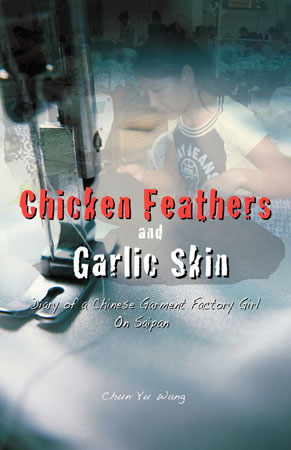
Book 112, Northern Mariana Islands: "Chicken Feathers and Garlic Skin" by Chun Yu Wang

Happy Boxing Day! Oh, I know it's still Christmas for some of you guys in the Western Hemisphere, but I'm well in the East, both physically and literarily. In fact, I've drifted all the way out to the Pacific, back to Oceania, where there's an obscure US territory called the CNMI, full of Chamorro-speakers, known primarily for its nearby trench.   


What most folks don't know is that the biggest island of the Marianas spent the first decade of the 21st century trying to get into the industrial age, importing loads of low-cost Chinese and Filipina women to work in garment factories so they could turn out Osh Kosh B'Gosh products printed "Made in the USA".

Hence the story above: a true-life tale of a 25 year-old Wuxi woman who went to Saipan to spent nine years of her adult life breaking her back over sewing machines. It's a weird kind of memoir: one of those situations in which a guy tries to make the subaltern speak (the initiator and editor of the book is the Jamaican-American-Saipanese journalist Walt F. J. Goodridge).

But Wang (yes, her surname is Wang, not Chun) is no hick either: she left her video-game playing husband in her home country because factory work in the Marianas was marginally better-paying, and took enough English courses to be able to translate her Mandarin manuscript to Goodridge, one-to-one.(He was fascinated by the Chinese idioms she used - the title, of course, is a transliteration of 鸡毛蒜皮 - even though these sound a tad hackneyed, even clichéd, to bilinguals.)

Frankly, the book isn't a must-read. It's an interesting look at the world of contemporary Chinese migrant labour, showing their aspirations and their sweat and their abuse from crooked overseers and their losses from burglars and accidents at home and worthless husbands and cops who claim they'll get them a green card and then disavow ever having received any payment.

Of course Americans are shocked by the suffering. But as a Singaporean, who's descended from and surrounded by migrant Chinese labour, I'm often thinking, "Meh. I've heard worse."

Which is horrible of me of course - recent events have thrust these marginalised workers into the spotlight, and we have to do something about it, if only to show that we're a society that treats people with humanity. But specifically regarding this book: Wang had her own home, free English lessons and the ability to quit her nasty factory jobs and search for new (usually equally bad) ones. Blue-collar foreign workers in Singapore just don't have those rights.

The interesting thing about a situation like this is that it shows how the oppressed masses aren't necessarily just victims. Wang and many other workers protest, walk out, steal and shag around to get what they want. And even when all the factories close (towards the end of the 2000s, costs rose and competitors like Vietnam became more attractive), Wang and her sisters realised they wanted to stay on, because they'd experienced freedom from their families and their obligations on this tiny, tropical island, and even if their sons were waiting for them at home, the only way to live for themselves was to be bad mothers, staying alive in the foreign sun.

Also - unrelated to workers' rights - one does get the sense that Wang isn't a particularly nice person. In her home, and at virtually every workplace, she's fighting with people, she's dissatisfied. Wherever you go, there you are, as they say.


View Around the World in 80 Books!!! in a larger map

Representative quote: Little by little, over the years and because of my trusting and kindness, I have lost most of my money. In all the years I worked, and all the money I earned, I accomplished nothing. In China, we would say, I added frost to snow. Adding frost to snow means "engaging in a futile, meaningless action that adds no visible benefit." That's what all my years of work on Saipan have been.

Next book: Tanya Chargualaf Taimanglo's Attitude 13: A Daughter of Guam's Collection of Short Stories, from Guam.

Monday, December 3, 2012

Book 110, North Korea: "Nothing to Envy" by Barbara Demick

I'd read a couple of books about North Korea before: Guy Delisle's graphic memoir Pyongyang and Hyejin Kim's "novelisation" of defector accounts, Jia. I didn't think I had to read any others, especially not this one. After all, if a Canadian and South Korean had already given me their two cents' worth, what fresh insights could an American have?


Ah, but Barbara Demick's proven me wrong. I've realised that the two above accounts capture only a tiny fragment of the North Korean experience, mostly confined to the capital city, which it seems is a huge Potemkin village, where only good-looking, able-bodied citizens are allowed to roam so that foreign visitors will be impressed.

This book looks instead at the northern factory city of Chongjin, home to gulags and coal mines and party officials and undesirables alike. We follow the lives of six ordinary North Koreans who escape the famine in the nineties, wading their way past the border with China, then flying into South Korea: the rebellious POW-daughter Mi-ran, the rich university student Jun-sang, the party loyalist Mrs Song, her daughter Oak-hee, the street kid Kim Hyuck.

And god, it's heartbreaking. Demick is a master storyteller: she begins with the teenage love story between Jun-sang and Mi-ran, in the blacked-out darkness of their city, bereft of electricity, noting its provenance: Mi-ran was now a prosperous and well-adapted resident of Seoul, married to another man, yet wistful for her innocent past.

The density, maybe length of the story, matters so much. We learn how life is different for insiders and outsiders, what they ate, what they feared, what they sang (the title is a reference to a North Korean children's song, that claims We Have Nothing to Envy in the World). We see disaster unfolding, slowly, as the horrible political realities of Juche creep up on idealistic youngsters and Kim Jong-Il dies and the famine descends with its pellagra and constipation, weird rashes appearing in spectacle-circles around people's eyes, the most virtuous dying first, the old then the children then the men then the women, and the crazy run-around cycle of imprisonments and recaptures that so many people had to go through to finally make it into the promised land of Hanguk.

Come to think of it, it's also important that we're hearing the stories of individuals. So many images of North Korea portray its people as brainwashed masses, or else single out idealised heroines among them (seems a majority of defectors are women, partly because they can sell themselves off as wives or prostitutes). The unique quirks that these people have, the different extents to which they've adapted to South Korean culture (did you know, what strikes the Northerners as weirdest is how South Koreans kiss and hug in public?) are just so compelling, and inspiring - because of all the six, all of them seem to have done okay, in the end.

Also amazing is Demick's discipline in creating this book: she spent six years interviewing over 100 defectors, heaven knows if she speaks Korean, she must by now. I'll be teaching a non-fiction course next semester - how can I convince kids that that kind of investment is worth it?

Bloody amazing, anyway. And I'm glad I finished this before I fly off for the ILGA Conference tomorrow.


View Around the World in 80 Books!!! in a larger map


Representative Quote: Dr Kim looked down a dirt road that led to farmhouses. Most of them had walls around them with metal gates. She tried one; it turned out to be unlocked. She pushed it open and peered inside. On the ground she saw a small metal bowl with food. She looked closer - it was rice, white rice, mixed with scraps of meat. Dr Kim couldn't remember the last time she'd seen a bowl of pure white rice. What was a bowl of rice doing there, just sitting out on the ground? She figured it out just before she heard the dog's bark.

Up until that moment, a part of her had hoped that China would be just as poor as North Korea. She still wanted to believe that her country was the best place in the world. The beliefs she had cherished for a lifetime would be vindicated. But now she couldn't deny what was staring her plainly in the face: dogs in China ate better than doctors in North Korea.

Next book:  Murasaki Shikibu's The Tale of Genji, from Japan.

Friday, May 4, 2012

Book 96, Nepal: "Mountains Painted with Turmeric" by Lil Bahadur Chettri

Not much to say about this book, really. It's an iconic text of modern Nepali literature, mostly by virtue of having been written at a point where there was very little else in print - it actually got put on the lit curriculum of Tribhuvan University within a year of having been written!


Other interesting facts: its author was not in fact Nepali, but a son of Nepali immigrants into Assam - he'd just interviewed loads of hillside villagers when they came to his environs to trade. Also, this translation (with its rather silly title, drawn from a stray line of purple prose in the novella) was probably spurred on by the fact that the book was recently made into a rather successful movie, under its original title Basain. (The word means migration, referring to the fact that the protagonists all get the hell out of the village at the end of the story.)

 Other than that? It's hard to get excited about the book. It's got lush descriptions of village life, but it centres on characters who through little fault of their own end up screwed financially (in the case of the young impoverished farmer Dhané, who is forced off his land by bankruptcy and the landlord's buffalo destroying his crops) and literally (in the case of the virtuous young maiden Jhuma, seduced by a soldier then abandoned). Classic Marxist-influenced third world examination of how the rural economy is fundamentally unjust - shades of Ngugi's The River Between and Minfong Ho's Sing to the Dawn.

 Good translation, though. Lots of local feel, due to the fact that plenty of Nepali terms (e.g. specialised months of the year) have been left in - unobtrusive glossary at the end.

 
View Around the World in 80 Books!!! in a larger map


Representative quote: "The Creator? Is it the Creator who writes our fate?" Today for some reason his small brain was pursuing arguments that were full of hidden revolutionary facts. "Why would fate be so biased? The laborers who wear out their bones in sweat cry out for flour, while those who gather up their bones to suck have other pleasures. Is this what fate really is? No, the Creator is not so unjust! Fate is made by human arrangement. Fate depends on the good order of society, on cooperation in society, on the chances and facilities you can get in society." Today, if he had had even the smallest opportunity, if his society had cared to understand his plight, would his labors not have borne fruit? If society had not been so ready to mock Jhuma's small misdemeanor, would she have left the house today in such desperation? Was the fault hers alone? Was it not the fault of the soldier, who had taken advantage of an innocent girl to gratify his desires? But it is the helpless girl and her family who are punished by society. This was the sum of Dhané's argument with his conscience. Today his heart was rebelling.

  Next book: Rabindranath Tagore's Selected Short Stories, from Bangladesh.

Sunday, August 1, 2010

Book 17, Ecuador: "The Old Man Who Read Love Stories" by Luis Sepúlveda

Couldn't find an Ecuadorian writer at the National Library. Who've we got instead? A Chilean living in Germany. He'll do!


This book is a real treat to read - 131 pages of easily swallowable, widely spaced print: a novella really. And such a beautiful tale - a man who loses his wife in the attempt to settle the Amazon jungle, and ends up going native with the Shuar tribe instead, learning all the secrets of the animals, and then betrayed by old age, the creeping advance of civilisation and a spate of mysterious ocelot attacks...

To tell the truth, I'm not sure if the love stories take centrestage enough in the novel - yet the fact that the man finds solace in reading purple romances set in exotic European cities is the one thing that problematises the anti-urbanisation idyll of co-existence with nature. There's surprisingly little revealed about the novel he's reading - something involving gondoliers kissing maidens in Venice, when he's unfamiliar with gondoliers, Venice and the act of kissing itself.

But then there's journey of self-discovery as he realises he can read, the way these substitute fantasies of love make up for his widowerhood, the way that love is paralleled in the figure of the man-eating female ocelot he hunts (barely any other female figures appear in the book: there's reference to the black prostitute who recommends the romances via the dentist and a schoolmistress with a library and the dead wife and a temporary Shuar wife and a Jibaro lady who vomits at being kissed by a white prospector... but no direct speech from any of these).

Rather sudden ending, too. But I shouldn't give too much away. Shades of Hemingway's "The Old Man and the Sea", quite obviously.


View Around the World in 80 Books in a larger map

Representative quote: Sometimes the snake was quicker than Antonio José Bolívar, but that didn't worry him. He knew he would swell up like a toad and be delirious with fever for a few days, but then his moment of revenge would come. He was immune, and liked to swagger about in front of the settlers showing off his scar-covered arms.

Next book: Laura Restrepo's Delirium from Colombia.