Showing posts with label oceania. Show all posts

Sunday, May 12, 2013

Book 123, Kiribati: "A Pattern of Islands" by Arthur Grimble

So it turns out that if I hadn't already covered Robert Louis Stevenson for the British Virgin Islands, I could've spent this past week reading his travel memoir In the South Seas. Alas! Instead I'm covering yet another British colonial administrator's jottings.


But I'm being facetious - once you get past the early bits about the Oxonian old-boy system of the colonial administration, and about cutting his teeth as an eager young 20something official on Ocean Island, we actually get to something quite remarkable: a thoroughly British man who engaged with the native lore of the Gilbertese to a degree unprecedented among those who didn't actually marry into the tribes. Even got himself ritually initiated into the Karongoa tribe through ritual tattooing without anaesthetic: a serpent going up and down his arms, a 15 year-old virgin on each side of him to scream out on his behalf while he manfully said it did not hurt.

And such stories - shark hunts, cursed stoves, roofs collapsing in on the family during hurricanes, ghost sightings (of both the dead and the not yet dead), mediums who could foresee the end of Japanese tuna trade, barehanded octopus fishing (which was particularly hard on Grimble, aka Kurimbo, as he had a phobia of octopi), fearsome feuds between Catholic and Protestant converts including an island-wide millenarian uprising which resulted in several deaths...

And as before, told with a considerable degree of respect towards the Gilbertese themselves; a condemnation of the heavy-handed missionaries who attempted to destroy their culture, dancing upon the shards of their ancestors' skulls; a trust that colonialism had improved things on the whole (they'd caused the land wars to cease, and Grimble quotes from a 94 year-old lady who is joyful that her great-granddaughters can travel the island without fear of robbery or rape), and that really, all shall be well, all shall be well.

There's also a clear message that colonial life wasn't a bed of roses - out in the islands, there was no fresh food; they had to subsist on breadfruit and tinned beetroot and the native cooks (only men were allowed to serve as cooks) were pretty awful, burning the rack of lamb the Governor brought specially, and making Grimble's wife Olivia weep. And having to build a house from scratch on Beru, when the previous Resident had made off with not only the furniture and the beds but even the verandah itself, and having the roof cave in on them and their three kids during a hurricane... There's even a wistful sonnet about the delights of the tropical sunset not being surpassed by the comforts of England, which is quite lovely.

Of course, this is all describing a fairly early stage of colonisation: during the 1910s, the Great War passing them by at a distance, rubbing shoulders with actual tribal kings and administrators that Robert Louis Stevenson met (he was a particular inspiration, and is referred to simply as RLS). Grimble went on to St Vincent, the Windward Islands and the Seychelles before going back to the UK and becoming a celebrated author and radio presenter, which was in the 1950s, when the empire was in an ineluctable stage of decline.

Given all those shifts of geography and fortune, how can we trust this text as anything genuine? But that's the point of non-fiction as literature, I suppose - the thing isn't the fact but the style, the voice, the way we use language to make things beautiful.

On another topic: one thing that isn't beautiful is my map. I miscalculated the location of my Kiribati marker (the country covers a huge swathe of ocean) so I'm criss-crossing myself, going northwards and westwards on my journey to the east.


View Around the World in 80 Books!!! in a larger map

But no matter - next week we'll be doing a big jump across the rest of the Pacific Ocean to the Americas. Toodle-pip, Oceania! It's been a blast!

Representative quote: So Tanoata had learned an age-old spell called 'The Spoiling of the Oven'. She had been finishing the third performance when I stumbled upon her. Here is a translation of the words she muttered:

I stab them north, I stab them west,
I stab them south, I stab them east,
The ashes of the oven of Mareve,
Spirits of fire, spirits of stone,
I stab, I confuse, I overturn.
Bring stinking, bring anger.
Be sick at the stomach, you Biribo, Birbo! Be enraged!
For the food of Mareve stinks and stinks:
It is tiiki - tiki - tiki

Next book: Dr Florence Goring-Nozza's One and One Is Two: Caribbean Thriller from the Cayman Islands.

Friday, April 26, 2013

Book 122, Niue: "Savage Island" by Basil Thomson

Every now and then, I'm intensely grateful for good writing. It doesn't need to be transcendent: something engaging in some way, something fun, is quite sufficient.

This week, I'd thought I was plum out of luck as I was flipping through an epub version of W.G. Lawes of Savage Island and New Guinea, a miserable hagiography of an early missionary in the Pacific, published in 1909 by the Reverend Joseph King. The title had sounded like a swashbuckler's story - how was I to know it'd be so long and dull? 

I was halfway through when I decided to ditch the bugger and turn over to this other virtual archived text, dating even earlier, to the year 1902:


And boy oh boy, I'm glad I did. Basil Thomson was a civil servant with the Colonial Office - in fact, this book describes an official visit to Niue to arrange for its formal annexation as part of the British Empire, as well as a stop at Tonga to formalise its status as a British Protectorate. But he was also a professional writer, and consequently he knew how to render his descriptions of exotic realms so amusing that even an ardent postcolonialist like myself is delighted at his words.

You see, unlike Rev. Joseph King, Thomson actually accords individual personalities to the people of the Pacific. Of course, he's laughing when he describes the fashion for fatness among the women, and King Tongia's pompous folly in dressing himself in hoop skirts and military hats - a flavour of that half devil and half child colonial mindset of the time. Yet he also acknowledges that these guys have a culture, and real motivations for what they do - e.g. the king had no small talent for being able to convince the elders that they needed a king at all after no-one had occupied the role for 80 years...

Of course, one of the reasons Thomson can afford to make light of the situation is that everything's peaceful. I hadn't known much about this side of colonial history: how some countries would, of their own accord, join the British Empire for the sake of protection, to avoid more destructive invasion and exploitation by the Germans or the French. This is why Tonga, for instance, has been able to hold on to its royal family, one of the few surviving systems of monarchy in the realm.

And then the whole matter of being modern - how these Pacific people, who had been part of a freaking Stone Age civilisation just a couple of generations ago, were now aware of the greater world around them, were consuming its cultural artefacts (Christianity, icons of Queen Victoria, whom they called Vika) and even building themselves Western-style houses. And then their participation in world trade - the Niueans are characterised as the most hardworking of Polynesian races, being actually eager to work overseas, to the detriment of their local industries of growing coconuts and weaving hats out of pandanus leaves. (Seems they've done pretty well for themselves since then - ten years ago, they became the world's first nation to be completely covered by free Internet wifi.)

Add to this the usual staples of colonial travel memoirs: documentation of the flora and fauna (they had crazy plagues of flies and hornets), some notes on national custom and myth (oral history for Niue only goes back 500 years, suggesting that they split off from some other island civilisation before then). Some notation of the music and dance of the islands, too, before a rather abrupt ending.

But once again, I'm bloody glad that this peripatetic journey is bringing me to books that are actually worth digging up and reading. It's not just about going around the world: it's about not having a miserable time doing it.


View Around the World in 80 Books!!! in a larger map

P.S. Why "Savage Island", you ask? Seems that when Captain Cook visited in 1774, the Niueans were one of the few Pacific peoples to refuse to engage in dialogue with him, answering him instead with spears and darts. Smart folks!

Representative quote: "The procession was headed by a dozen men in slop clothes and villainous, billycock hats set at a rakish angle. They all carried spears and paddle-shaped clubs in either hand, and a similar rabble brought up the rear. In the middle of this grotesque bodyguard walked the king and queen, both in petticoats, as befits the sex to which they belonged, for if the queen was a young woman, the king was assuredly an old one. To their united ages of ninety-four His Majesty contributed seventy-six, but what he lacked in youthful elasticity he made up in con- descension, for she had been but a beggar-maid or what corresponds therewith in Niue, where beggary is unknown when he had played Cophetua to her a few months before our visit. She wore a wreath of roses, he the soldier's helmet with the cock's plume, which was all that the officious Samoan teacher would leave him of his military uniform, and from which he refused to be divided, although it assorted ill with his petticoat. To tell the brutal truth, His Majesty was unsexed by the garments that had been chosen for him, and his appearance justified the remark of a friend who, holding the photo- graphs of Their Majesties in his hand and con- fusing them, exclaimed, "Why, the queen's got a beard!"

Next book: Arthur Grimble's A Pattern of Islands, from Kiribati.

Saturday, April 20, 2013

Book 121, Tokelau: "A Way With Words: Language and Culture in Tokelau Society" by Ingjerd Hoëm

On the plus side, we're finally reading something else by a female author in the Pacific region. On the minus side, she isn't native - she's from Norway. On the even more minus side, she's an anthropologist.

Yesiree, here's one of those dry, brain-numbing, jargon-filled texts (purism? doxic?) that I'd never waste my life reading if I wasn't doing this godforsaken project. It's even marginally about linguistics, which my PhD student sister has proven to be a headache of a pseudoscience, why oh why etc.


But really, this wasn't so bad - except for the bulk of the second half, which consisted of Hoëm consulting every person she could about the meanings of specific Tokelauan terms, from uluifa (spirits that possess people) to fatupaepae (a female authority figure), just to show the imbalance and instability of information between genders and classes. Major snoozefest.

You see, Tokelau's an odd place.  It's a territory of New Zealand, consisting of three atolls, with a combined population of 1,411 (that's today's figures, but the country's always dealt with overpopulation through emigration). Despite that teensy number, they've got a number of feuds and village dialects, exacerbated by the fact that missionaries converted some of them to Catholicism and some to Protestantism (the Catholics allowed more of the indigenous culture to survive, for which I suppose they deserve some thanks).

In the '80s, when the author was conducting her fieldwork, the Tokelauans had only recently adopted a written form of their native language and begun teaching it in schools. They'd previously been using English and Samoan - so they had the weird situation of kids being fluent in a traditional language, their twenty-something year-old parents recommending that they follow their elders for even greater mastery of the tongue, and of course the elders jabbering away in Tokelauan that was infected with Samoan words to begin with...

And that's just the background. The messy politics of how language is used is bewildering: characterised as the shyest of the Polynesian peoples, Tokelauans hold their fono (their ceremonial meetings) in near silence, wary of contradicting people and making enemies, sometimes postponing the most serious issues of each Women's Council or Council of Elders to the next fono, just so no-one's feelings will be hurt. 

(The example given was sorting out a feud so that one island's parents would stop barring their kids from attending school. As an Asian person I believe school is bloody important and they should've just trod on each other's feelings. But that's why I'm not an anthropologist.)

Details of the use of gossip as a sanctioning device, the strange disruptive appearances of older women as clowns, invading official events to mock the hierarchies that keep them bound (yet this is part of the culture that keeps them bound). And the syncretic lyrics of the fatele song and dance shows.

Yet believe it or not, the Tokelauans feel dreadfully insecure about their culture - they feel they're hybrid, westernised folk (many of them have studied or worked in NZ; there's a steady exchange of unruly offspring between Tokelau and the migrant families in Samoa and New Zealand). They even envy the Maoris for the strength of their identity, never mind that Maori culture has been reduced to a superficial display of hakas and carven masks in the midst of a mainstream pakeha culture. (In Tokelau, they call them palagis).

But aren't we in Singapore the same? Weirdly cultured and problematic and unsure if we can be proud of what we have? 

Ah, but Yi-Sheng, the world does not exist for the sake of your reflections. Here's a fatele text.


View Around the World in 80 Books!!! in a larger map

Representative quote:
Fakalogo atu

Fakalogo atu kite leo e sau
Tena e sau
sau mai i ko
pati tokoto ko te toeina
ko te uto kua tini, tini, tini O.

Listen to the sound coming
That is coming
coming from there
applauding [while] lying down, the Elder
The young sprout of the germinating coconut [i.e. the young people] have finished, finished, finished.

Next book: Reverend Joseph King's WG Lawes of Savage island and New Guinea, from Niue.

Sunday, March 24, 2013

Book 119, New Caledonia: "Penelope's Island" by James McNeish

Eastern Heathens has been launched, and it looks fabulous, hurrah! We're planning a Kinokuniya event in 20 or 27 April - no confirmation yet, so stay tuned.

Also, we’re back in the world of good ol’ epic novels: stories of revolution and betrayal, cultures clashing, men and women caught between loyalties and choosing ultimately to do what is right.  And all from a country most of us had no bloody idea existed!


(The author’s a Kiwi, though. Seems he likes to do these stories set in the Pacific islands.)

The Penelope in the title's the narrator - a nature photographer who ends up improbably marrying a Caldoche, one of the white New Caledonians descended from French penal colonists (yeah, it was France's Australia for a while). She herself happens to be Jewish-Hungarian-British by way of Canberra, which seems even more probable. But there's a method to the madness, as we'll soon discover.

The crazy thing is, the guy Penelope marries - a not-very-employed outdoorsman named Felix - is pretty racist, kicking around the house servant Baptiste for no reason, saying awful things about the Kanaks (the natives of the island) as they try to fight for independence. Violent streak, too - shoots his pet deer without a qualm when he hurts his girl, wants to shoot their dog too at a whim. So the reader's thinking getoutgetoutgetout this racist bastard's gonna destroy you.

And then what happens? Well, first we have the Mayor, Dominique, coming by a lot. He's the first Kanak man to hold the post, and Felix treats him civilly, never mind that he's Baptiste's half-brother. Then we gradually realise that Felix is different: he's not as racist as his fellow Caldoches, wasn't even raised among them: was left for useless with his club foot and raised instead among the Kanaks, leaving him with a culture split halfway between deserving white privilege and actually getting precious few of those privileges till this Brit girl married him.

And when the independence movement breaks out - and it really did happen the way the book describes it, it seems, in 1984, with election boycotts by the Kanaks, takeovers of the land, city by city, and the Caldoches retaliating violently, guerrilla-style ambushes on civilians in cold blood, and not even facing trial for their murders - well, Felix has to take sides. Penelope knows she's on the side of the natives, what with her British sense of fair play and her actual memories of having to flee her land as a little girl in WWII. But when Felix changes - seeing what's happened to Baptiste and his other Kanak "friends" - well, he's forced to realise that the business of being a French settler/colonist is just too much bloody-minded awfulness than he can take. And he does what he can for the side of independence.

I suppose it's not giving away too much to note that New Caledonia remains a French Overseas Protectorate, and that they're still doing pretty badly under French colonial rule. Doesn't sound as racially segregated as it used to be, but rural poverty pulls them down, and there doesn't seem to be that same connection to their skull-templed roots as there was in the eighties, when this book was written. (The publishing date is 1990, but it sure doesn't feel like a nineties book - it's got the heaviness and sorrow and anger of the sixties or seventies.)

But back to the title - why use Penelope at all? Why not describe the story of Felix from his own perspective, or else the tribulations of the Kanaks themselves?  Well, in the wake of Chinua Achebe's death, it seems important to consider the relationship between literature and politics, especially when your readers are people living far, far away from the politics you're describing. As privileged, First World folks, we can only understand the way of the Kanaks through the eyes of white people. We can't even understand their oppressors. We've got to find a third party, someone similarly privileged, and bring her close to oppressors, and watch them transform.

Strategies for empathy. Fiction itself.


View Around the World in 80 Books!!! in a larger map


Representative quote: At first I didn't see him because of the mist. He appeared before me like a wraith. Baptiste had a sense of the dramatic and I was not surprised to see him - he would turn up unexpectedly, when he wasn't working for Felix, and often at odd hours. He wore his old khaki shirt and his legs, beneath the skirted pareo, were wet. He's come through the coffee fields, I thought. A scent of gardenia, from the dripping coffee flowers, clung to him.

"Madame," he said, keeping his eyes lowered - and then, for a man who seldom spoke more than a phrase or two at a time, he delivered himself of an oration.

He said that, if we left, the crops would perish. The coffee would die, the valley would be laid waste and the crabs run to the river and be drowned. There would be a great fire. The house would fall down. The crabs would come out from beneath the foundations, the river would rise, the bamboos turn from silver to red and everything would end in the river.

Next book: Futuna: Mo Ona Puleaga Sau, Aux Deux Royaumes, the Two Kingdoms, from the Wallis and Futuna Islands.

Wednesday, March 6, 2013

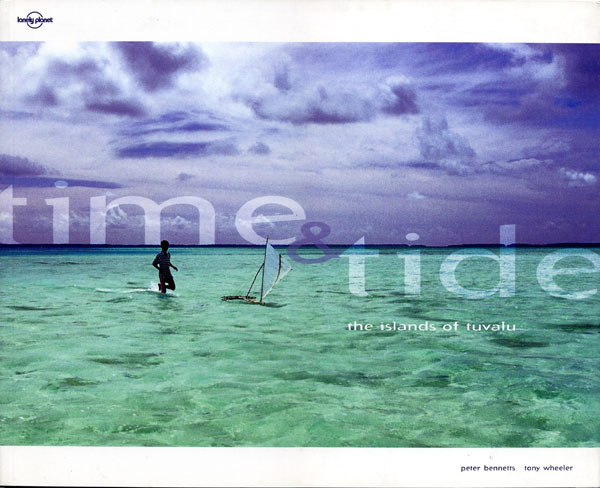
Book 118, Tuvalu: "Time & Tide" by Tony Wheeler

So I couldn't convince the National Library to purchase Philip Ells's Where the Hell Is Tuvalu?. Kein problem - they have their reference section books available for lending at selected branches. Of course, this makes no sense in terms of categories, but I'm not complaining, because I was able to borrow this:


Yes, yes, it is essentially a photo book (credits to Peter Bennett for the images!), but it does also have a substantial amount of written content, rather well crafted, from the king of the Lonely Planet empire himself. Seems that in 2000, the travel writer and the photographer flew over to Funafuti as part of an environmentalist quest, inspired by the anti-global warming rhetoric of then-PM Ionatana Ionatana, determined to document the culture of these low-lying islands that the world stands to lose when the oceans rise.

While Nauru was a dystopia, Tuvalu's described as a utopia - nine atolls of peaceful, not-very-hierarchical people who're still holding on to traditions of family and feasting and feitu (a colonial system of dividing each island into two competitive teams, which seems fairly benign today). A simple diet of fish and coconut and pandan, supplemented by crabs and turtles and papayas and sadly canned food, which is sold in collective convenience stores, not megamarts (community ownership seems to be the only way to do capitalism in this culture). Sun, sand, happiness. Some money coming in, because the sons are prized as merchant sailors across the world. Deep love for children. Deep love for God. Deep love for land.

One-dimensional? Maybe. There are some cool interviews with people who recount trauma: the Peruvian slavers who came in the 19th century, Cyclone Bebe in 1972, a dormitory fire which killed 18 schoolgirls and which inspired national mourning (the country has less than 10,000 people). And of course there's some obesity and litter dumping because of the processed food, and some university grads can't get used to the slow pace of life after experiencing the cosmopolitan delights of Australia and New Zealand and Fiji (?!). But no deep sense of malaise. No, foreboding is reserved for the danger of inundation, of permanent ecological exile.

Not going to be terribly critical. Had a great experience teaching travel writing using this guy's anthology, and am headed to Manila tomorrow using this guy's guidebook. Safe to say I'm pretty much a convert.


View Around the World in 80 Books!!! in a larger map

 Representative quote: In the Tuvaluan language, a person without land is known as fakaalofa, literally, a person deserving of pity. But in a hundred years, all Tuvaluans may well be fakaalofa.

Next book: Lloyd Jones's Mister Pip, from New Caledonia.

Sunday, March 3, 2013

Book 117, Nauru: "Paradise for Sale: A Parable of Nature" by Carl M. McDaniel and John M. Gowdy

Um. A bit preachy, this one. Nor is Nauru really the point: it really is just being used as an exemplar of a nation ecologically destroyed by short-sighted capitalism.

Basically, it's a clumsy version of Jared Diamond's Collapse.

 
We've got three chapters about Nauru - the first about geological/biological history, the second about human history, the third repeating chapter two but with a more pointed environmentalist slant... And then four more chapters looking at the greater problem of how our culture pushes humans to live beyond their resources (see the Viking settlement of Greenland and the decline of the Rapa Nui civilisation on Easter Island; for alternative, sustainable cultures see the Australian Aborigines, the Kalahari !Kung and the Ladakhis of the Himalayas).

I mean, yeah, I get it. There's actually a little travelogue as a coda, because the authors felt bad that they'd written all this without really exploring the culture of Nauru today, so one of 'em stopped by for four weeks and wrote about how it was doing.

And how is it doing? Well, it's almost always been a nice place - it was called Pleasant Island by colonists; the remarkably non-violent native population of about a thousand was living happily off fish, pandanus and coconut and had very little worth exploiting until an Australian guy realised that a doorstopper rock from the island was actually made of guano-compounded phosphate, super-useful as a fertiliser to turn the deserts of his island nation into agricultural fields.

So the Ozzies and Brits and Kiwis came and plundered the hell out of Topside, the mountain of phosphate deposits in the centre of the island. But it wasn't until independence in the 1960s that the Nauruans began to demand a proper cut of this fortune, whereupon they became super-rich and super-fat on an imported diet of Spam. And with this embrace of capitalism and wealth there was a rapid loss of native culture too - no more of the Pacific idyll described by Time Magazine, instead everyone driving around in air-conditioned cars despite the fact that it'd take only four hours to walk around the whole island.

But the phosphate's running out - and it's the island's only resource. They never tried focussing on making it renewable (seems it's possible: if they'd allowed certain areas to lie fallow during independence in 1966 they might have been able to allow the bird poop to replenish itself indefinitely). And after a series of bad investments - including a flop of a West End musical, as the authors never fail to remind us - this ship seems sunk.

Odd thing is, when McDaniel and his wife visited, he found the people were still pretty happy, thriving with their happy-go-lucky culture despite the oncoming tsunami of doom. The authors claimed this is representative of the human condition: we still live on in hope despite the obvious signs that we've cut the gravel from beneath our feet and the big Malthusian end is nigh. But seriously, I thought, if the people are happy, can't you consider that there might be something a little off about your gloomy thesis?

Then I remembered: I actually met a Nauruan girl myself in Makassar, Sulawesi, last year, and she agreed - the whole island's full of unemployed young people, angry and confused at the future of prosperity they've been denied. This book was published in 2000: a dozen years later, the collapse has happened sure enough.

The authors claim the Nauruans never gave up their forager culture: phosphate made life easy even after modernisation so they never had to develop a Protestant work ethic. Seems a little colonial in outlook, but the greater truth is that the idea of constant economic progress is what's dooming Earth right now. Our civilisation is unsustainable. Now what?

Al Gore said in An Inconvenient Truth that in order to make people change their ways you have to inspire people with some promise of better things ahead. Not much of that here. Just dooooooooooom.


View Around the World in 80 Books!!! in a larger map

Representative quote: In North American publications some westerners express moral indignation at the Nauruans' plight: "Here was Nauru with a history of affluence. But having dug out all their island for the phosphate so stupidly, they stupidly spent their money as well. They need to take the blame themselves. They are in a lot of trouble because they have not saved for a rain day," and "Nauru's decline has to do with human nature. It's what happens when incentives are taken away and people don't have to work." But what is the reality of the Nauruans' situation? They did not bring Europeans to their island, nor did they create the market economy that physically destroyed the island and destablized their civilisation. These things happened as a result of two influential beliefs in Western culture: that native cultures are expendable for progress and that natural environments exist for the purposes of making money and supporting progress by feeding the growing market economy. The Nauruans had an enduring pattern of habitation prior to 1800; therefore, these failures should not be ascribed to them but to the market economy.

Nauru has served as a crystal ball in which to view the consequences of beliefs and actions prevalent in our market-based world. We can appreciate how difficult, if not impossible, it would be for the current population of Nauruans to live at this time on their island's impoverished biological and physical resources. It is certainly not prudent to denude the entire earth the way Nauru, Banaba, Beijing, London, Mangaia, Manhattan Island, Mexico City Moscow, Rapa Nui, and so many other places have been denuded.

Next book: Tony Wheeler's Time and Tide, from Tuvalu.

Saturday, February 23, 2013

Book 116, Marshall Islands: "Operation Crossroads: The Atomic Tests at Bikini Atoll" by Jonathan M. Weisgall

This book is bloody comprehensive. Every little detail of the events leading up to the 1946 atomic tests at Bikini Atoll laid out in tedious sequence.

Pardon my ennui - the text isn't badly written by any standard, but it dwells so much on political and military history, in particular the machinations between the competing parties of the US Navy and Air Force, that honestly wasn't terribly interested in a lot of chapters. Quite a bit of military drama though - almost like a sequel to Michener's Tales of the South Pacific.


I've learned a lot of new stuff, though - what a sensation those tests were, with J. Robert Oppenheimer and the other Project Manhattan celebrity scientists gone peacenik and speaking out against them, while the press drummed up fears that it might incinerate the atmosphere (or else prove the Navy obsolete, if the bomb drop ended up sinking all the decommissioned warships around the island). Americans had the words "atomic" and "project" on their lips all day, a French designer hijacked the word "bikini" for his explosive new swimsuit (that outdid the scantiness of an earlier competitor, the "atome").

And the sheer folly behind so much of it - people writing letters of complaint about the animals being tested (goats and pigs), wanting to salvage the not-very-old World War II battleships they'd fought on, the way the US government categorically denied the long-term ill effects of radiation, and then later claimed it was "a very pleasant way to die" (in spite of the fact that US physicists had died in agony protecting others from radiation during experiments). And what a bust so many of the tests were, with the inaccuracy of the bomb drops rendering the majority of the cameras and instruments useless, and other results covered up or destroyed, and journalists fooled by the muckup of the first test into thinking that the bomb wasn't very powerful at all...

Weisgall is, by the way, a lawyer representing the indigenous people of Bikini Atoll, who gave up their land willingly to the US for these tests based on the assurance that they'd be well looked after (they haven't been, of course; they starved on their first replacement island), and that they'd be allowed to eventually return. And they did return in 1978, but the radiation from surrounding nuclear tests had poisoned the soil, turning everything that grew on the island radioactive, from the coconuts to the crustaceans, impossible to live their idyllic island lives, so the island remains lush and untouched, a toxic paradise.

Oddly enough, Weisgall doesn't dwell on the Bikini people very much. The accounts of the atomic tests' other victims are better documented: the radioman of the Japanese tuna fishing boat Lucky Dragon, which got caught by unexpected fallout, the American sailor boys who swabbed the decks of the radioactive battleships, often shirtless and in shorts, unable to comprehend the problem of this invisible radiation that they couldn't scrub clean, and now dying in dozens from strange cancers which the Navy says it can't directly trace to the test sites (they do get medical treatment now; but only because veterans' benefits are more comprehensive now than post-World War II).

So yes, lots of stories. And I've learned plenty. Didja know footage of the Bikini tests was used in both Doctor Strangelove and the original Godzilla? But enough for now. Too many facts; would honestly prefer some literature.


View Around the World in 80 Books!!! in a larger map


Representative quote: Lore Kessibuki stood on deck for hours until the LST had cleared the Eneu channel and he could no longer see any of Bikini's islands. He then composed a song, both sad and hopeful, which remains the Bikinians' anthem today:

No longer can I stay; it's true.
No longer can I live in peace and harmony
And rest of my sleeping mat and pillow.
No longer can I stay on my island;
I must leave all the things there.
The thought overwhelms me and leaves me helpless.
My spirit has to travel, far away, lost
Until it is caught in a great current.
Only then can I find peace.

Next book: Carl N. McDaniel and John M. Gowdy's Paradise for Sale: A Parable of Nature, from Nauru.

Saturday, February 2, 2013

Book 115, Micronesia: "The Island of the Colorblind" by Oliver Sacks

Got an extension on my playwriting project! So I don’t have to feel absolutely guilty about updating here. FYI, we’re now moving into the territory of the subaltern who cannot speak: a region where there are incredibly few internationally available books actually written by citizens/residents of the countries described. 

This, of course, is problematic, but for now I’m going to revel in the opportunity to write about Oliver Sacks, famed neurologist and author of classics such as The Man Who Mistook His Wife for a Hat. (I haven’t read any of his other books, mind you – just read about them on Boing Boing. But I’ve watched his TED talk!)


Seems I oughta read his other books. Sacks is one of those effortlessly eloquent British science boffins who’s not only passionate about his field but about life itself, and the words we use to describe it – in his preamble to this account of his neurological research voyages to the Pacific, he details his early love for explorer narratives: Captain Cook, Magellan, Dampier, Melville, even Professor Challenger and Dr Moreau.

There isn’t even that much science stuffed in here, especially in Book I, which involves his trip to the island of Pingelap in Micronesia, where a 19th century tsunami has left an island inbred enough to harbour a significant population of achromotopes (folks who are completely colourblind, not just the common red-green condition. Only rods in their retinae, no cones).

Easy enough to understand – the story therefore focuses on the pleasures (and occasional displeasures) of flying towards and living on this isolated tropical isle of imported spam and phosphorescent algae; also an unofficial anthropological study of what it means to be an achromotope (they call it “maskun”), aided by the experiences of Knut Nordby, a Norwegian psychologist and fellow achromotope who gasps in delight at finally finding his own tribe, as it were: a population of people who grow up understanding the condition of being oversensitive to light yet being mentally acute in every other way, able to spy the dimmest stars and night and tell which bananas are ripe, not from the colour, but from texture and smell.

There’s more science stuff in Book II: Cycad Island, which talks about a separate trip to Guam to investigate a form of quasi-Parkinson’s disease called lytico-bodig, whose cause has not yet been fully determined (though there’s a high chance it’s to do with eating food baked from the seeds of the cycad plants, which grow in abundance). Because of the medical mystery remaining here, there’s lots of explaining to do.

Consequently or nevertheless, it’s Book I: The Island of the Colourblind that’s more joyous to read – after all, it’s about a community of people who’re technically physically disabled but have little trouble rising above this, versus a story of old folks randomly going paralysed or catatonic (don’t worry too much: no-one born after 1962 seems to get lytico-bodig).

Wonderful little segue as well, when Sacks leaves Pingelap for the larger Micronesian island of Pohnpei, where he and his friends explore the thousand-year old ruins of the civilization of Nan Madol, which I only learned about last year from the forum discussion pages of Civilization V, and how it makes him consider:


Never heard of any of these before. How amazing, no, to excavate these obscure histories? Moments like these, the world seems so fantastically big.


View Around the World in 80 Books!!! in a larger map

Representative quote: Knut took out the cowrie necklace which Emma Edward had given him on Pingelap and, turning it over and over in his hands, started to reminisce about the trip. “To see an entire community of achromats has changed my entire perspective,” he said. “I am still reeling from all of these experiences. This has been the most exciting and interesting journey I will ever make in my life.”

When I asked him what stayed in his mind above all, he said, “The night fishing in Pingelap… that was fantastic.” And then, in a sort of dreamlike litany, “The cloudscapes on the horizon, the clear sky, the decreasing light and deepening darkness, the early luminous surf at the coral reefs, the spectacular stars and Milky Way, ad the shining flying fishes soaring over the water in the light from the torches.”

Next book: Jonathan M. Weisgall’s Operation Crossroads: the Atomic Tests at Bikini Atoll, from the Marshall Islands.

Friday, January 25, 2013

Book 114, Palau: "Falling Blossoms" by Hiroshi Funasaka

Really shouldn't be wasting more time on my blog, given that there's still a script and several articles and a lesson plan I should be working on. But this reading list does give me direction, dammit, and those directions take me in awfully surprising places sometimes.

F'rinstance, I can't find a native author from the nation of Palau (independent in 1994, bitches!). But I do know that it's the site of one of the most horrific battles of the Pacific War, one in which the Japanese - rather than other Asian races - ended up doing the most suffering.


There are already established popular history books looking at this war from the American perspective. But who knew that Singapore had published a translation of a Japanese perspective - with a foreword from Yukio Mishima, no less! Seems Hiroshi Funasaka was Mishima's kendo instructor - even gave him the very sword that Mishima used to commit harakiri in 1970.

This book was first released in 1965 as 英霊の絶叫 (Eiri no zekkyo), which actually translates into "scream of remembrance". Indeed, it's this very angst, the rawness and bloodiness of the account that probably drew Mishima to the material. "This is not a novel, nor a literary work, nor even a kind of autobiographical record," he wrote. "It is the manifestation of his cries, the roar of his life proclaiming a long unnoticed reality.

We begin the story with Funasaka's visit to the island of Angaur in 1965, discovering the bones of his comrades still clutching helmets and swords and the flag of the rising sun - then back to 1944, when the Americans are attacking their base on the island while the soldiers strengthen themselves by singing songs of the sakura while the coconut trees around them explode with napalm and machine-gun fire. Over the course of the battle, Sergeant Funasaka gradually loses almost all of his men but three, then loses the functions of his legs and his right arm, then loses even those three comrades, and lies starving and dying of thirst and heat in a cave with the other Japanese, still loyal, still angry, still deadly: able to launch katana and pistol and grenade attacks on American soldiers by crawling up to them through the bushes.

It's awful stuff. And not just because of the gore - the Japanese soldiers are so hungry, they eat the maggots from one another's wounds - but because of the depth of the indoctrination; how Funasaka recounts his drive to exterminate the Americans from the island, regardless of their superiority of numbers and resources and firepower and technology, just because he believes it is shameful to survive, not to return with his friends as ashes in Yasukuni Shrine. (This stuff's narrated in the thick of it, so it's hard to tell till a few paragraphs later that this is an ideology he's actually abandoned now.)

But the hero of the story - at least according to Funasaka - is Corporal Forrest Crenshaw, the American GI who takes care of him after he's captured as a POW. A former truck driver, Crenshaw learned to speak Japanese in the barracks and made a concerted effort to reach out to this guy who was obsessed with accumulating enough matches to go out in a huge suicide attack, trying, trying to bridge their cultures without obligation. The story zips between past and present, so we see them still at loggerheads 20-somethings in one paragraph, and genteel successful 40-somethings visiting the shrines of Kyoto in another. And still trying to bridge differences, to make their ideals understood.

According to this text, Funasaka actually converted to Christianity in 1972 - Crenshaw had bugged him to accept the defeat of Japan as God's will - and I can't help noticing that this was seven years after the book's initial release and two years after Mishima's act of sepukku. Could Mishima have been inspired by the spirit of bushido in this book, missing in capitalistic Japan - and could Funasaka have been driven by this terrible action to absolutely repudiate his culture, turning instead to a foreign god to sever his connection to the Yamato spirit?

Idle speculation. Seriously, though, this book should be put back into print - a wonderful comparative resource for war buffs.


View Around the World in 80 Books!!! in a larger map


Representative quote: I am so close to death, my body is broken and filthy, I thought, but at least I should die with a clean heart. Hana ga sakura, minyen wa bushi. (A warrior among men is like the cherry blossom among flowers.) These are words which I love. Up to the moment I die, I want to live courageously, with a heart free from fear. This is the Way of the Warrior - to give one's life selflessly in the line of duty. I completely believe this. I was going to have to ignore the fact that I was going to die dirty, starving and full of bugs.

Next book: Oliver Sacks's The Island of the Colourblind, from Micronesia.

Thursday, January 3, 2013

Book 113, Guam: "Attitude 13" by Tanya Chargualaf Taimanglo

I've just flown into Myanmar, where I'll be maintaining the Flying Circus Project Blog for the next two weeks. I'm terribly short of sleep, and I've just learnt that we're not gonna get the chance to meet Aung San Suu Kyi at the Freedom Film Fest.

So let's get this over with, shall we? (I want to invest in a nap now so I can live larger later.)


Honestly, Attitude 13: A Daughter of Guam's Collection of Short Stories isn't that great. The style has a strong whiff of the amateur and the plots tend to end anticlimactically. If I had to grade these, I might give a B+ if I were being kind (some are better than others, though: Chirika's Pepper Plant, which won the author a prize with Latte Magazine, isn't half bad).

But the content is what saves the day. Taimanglo's exploring what it means to be a Guamese Chamorro woman in the 21st century - no longer sarong-clad natives to be studied by anthropologists, but college students in Honolulu, expatriates in Seattle, army officers serving their terms of duty in Afghanistan while their daughters wail for them on their home islands, 88 year-old marathon runners in nursing homes with spiky pink and blue hair. Also explored is the condition of being biracial: the author is Chamorro-Korean, and she's described what it's like to be labelled a Jap in school and denied recognition of your true island heritage in the clumsily titled Yes I Am. And also a rather nice fantasy piece at the beginning: an encounter between a washed-ashore mermaid and a jeep-driving, zori-wearing, culturally deracinated Guamese girl in today's world. (Yes, there are stories about boys and men too, but it's clearly womanhood that takes centrestage.)

I suppose I'm drawn to this cultural testimony - not just because I love how foreign vocabularies collide with English: chenchule', pica, buñuelos aga', dinugan, donne', finadene', Hafa Adai - but also because so many texts from Oceania are written by outsiders. Immigrants, colonists, anthropologists, wayfarers - they have the resources to talk about these cultures, not the natives themselves.

Taimanglo happens to be an emigrant, though - she's lived in San Diego and now she's a military spouse in Washington, if the Internet's to be believed. Well, better brains draining out and speaking out than brains staying mute under scrutiny, I suppose.

Damn, I need sleep. Later!


View Around the World in 80 Books!!! in a larger map

Representative quote: I left the movie theater and the cold Washington air embraced me. It was almost midnight and I was out with my fiancé. This was the 18th movie I watched with a date. You can feel happy for me. This was my own doing. I didn't get to the age of 35, engaged and still a virgin, by accident. I am a Goddess on purpose. I am a beautiful Chamorro woman, on purpose. My fat is no longer my shield. 

Next book: Hiroshi Funasaka's Falling Blossoms, from Palau.

Wednesday, December 26, 2012

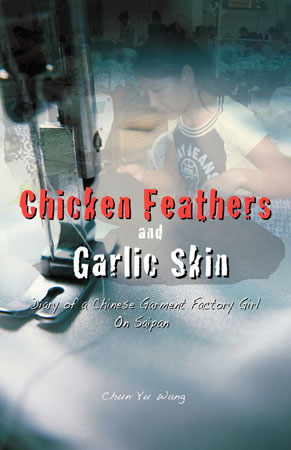
Book 112, Northern Mariana Islands: "Chicken Feathers and Garlic Skin" by Chun Yu Wang

Happy Boxing Day! Oh, I know it's still Christmas for some of you guys in the Western Hemisphere, but I'm well in the East, both physically and literarily. In fact, I've drifted all the way out to the Pacific, back to Oceania, where there's an obscure US territory called the CNMI, full of Chamorro-speakers, known primarily for its nearby trench.   


What most folks don't know is that the biggest island of the Marianas spent the first decade of the 21st century trying to get into the industrial age, importing loads of low-cost Chinese and Filipina women to work in garment factories so they could turn out Osh Kosh B'Gosh products printed "Made in the USA".

Hence the story above: a true-life tale of a 25 year-old Wuxi woman who went to Saipan to spent nine years of her adult life breaking her back over sewing machines. It's a weird kind of memoir: one of those situations in which a guy tries to make the subaltern speak (the initiator and editor of the book is the Jamaican-American-Saipanese journalist Walt F. J. Goodridge).

But Wang (yes, her surname is Wang, not Chun) is no hick either: she left her video-game playing husband in her home country because factory work in the Marianas was marginally better-paying, and took enough English courses to be able to translate her Mandarin manuscript to Goodridge, one-to-one.(He was fascinated by the Chinese idioms she used - the title, of course, is a transliteration of 鸡毛蒜皮 - even though these sound a tad hackneyed, even clichéd, to bilinguals.)

Frankly, the book isn't a must-read. It's an interesting look at the world of contemporary Chinese migrant labour, showing their aspirations and their sweat and their abuse from crooked overseers and their losses from burglars and accidents at home and worthless husbands and cops who claim they'll get them a green card and then disavow ever having received any payment.

Of course Americans are shocked by the suffering. But as a Singaporean, who's descended from and surrounded by migrant Chinese labour, I'm often thinking, "Meh. I've heard worse."

Which is horrible of me of course - recent events have thrust these marginalised workers into the spotlight, and we have to do something about it, if only to show that we're a society that treats people with humanity. But specifically regarding this book: Wang had her own home, free English lessons and the ability to quit her nasty factory jobs and search for new (usually equally bad) ones. Blue-collar foreign workers in Singapore just don't have those rights.

The interesting thing about a situation like this is that it shows how the oppressed masses aren't necessarily just victims. Wang and many other workers protest, walk out, steal and shag around to get what they want. And even when all the factories close (towards the end of the 2000s, costs rose and competitors like Vietnam became more attractive), Wang and her sisters realised they wanted to stay on, because they'd experienced freedom from their families and their obligations on this tiny, tropical island, and even if their sons were waiting for them at home, the only way to live for themselves was to be bad mothers, staying alive in the foreign sun.

Also - unrelated to workers' rights - one does get the sense that Wang isn't a particularly nice person. In her home, and at virtually every workplace, she's fighting with people, she's dissatisfied. Wherever you go, there you are, as they say.


View Around the World in 80 Books!!! in a larger map

Representative quote: Little by little, over the years and because of my trusting and kindness, I have lost most of my money. In all the years I worked, and all the money I earned, I accomplished nothing. In China, we would say, I added frost to snow. Adding frost to snow means "engaging in a futile, meaningless action that adds no visible benefit." That's what all my years of work on Saipan have been.

Next book: Tanya Chargualaf Taimanglo's Attitude 13: A Daughter of Guam's Collection of Short Stories, from Guam.

Wednesday, July 6, 2011

How gauche of me!

I realised the other day that I've been mistakenly calling the nation of Samoa "Western Samoa", even though it changed its name in 1997.


I'm mortified. Why did no-one correct me? It's as if I'd been calling Malawi "Nyasaland", or Zimbabwe "Rhodesia", or the Democratic Republic of Congo "Zaire", or Cambodia "Kampuchea", or actually daring to use the term "Czechoslovakia". (Although to be fair, it seems that American Samoans still say "Western Samoa", just to be contrary.)

Anyway, I've made the amendments. (The web-link will stay as it is, as a marker of my shame.)

Tuesday, July 6, 2010

Book 14, French Polynesia: "Frangipani" by Célestine Hitiura Vaite

Okay, okay, okay: this is another one of those developing-nation-matronly-woman-does-good books, with a Mma Ramotswe-esque main character with lots of earthy folk wisdom to deal with the modernizing changes happening around her. It’s a feel-good, women’s book club-suited novel, written in chapters which could each function as their own separate short story: a clearly patriotic novel that aims to represent its country yet limits itself to the realm of women, an Austenesque inch-length piece of ivory.


But it’s so enjoyable. The main character, the professional cleaner Materena, keeps locking horns with her intellectual daughter Leilani, negotiating the future of Polynesian womanhood. And the culture their lives are steeped in is so seductive – convent schools, discussions about independence and the death penalty, battle feuds, dishes made of breadfruit, rice, tomatoes and onions, American tourists, French gendarmes, superstitions about frangipani trees in the backyard signifying the health of given-away children – and such a liberal attitude towards sex; sex everywhere; the beauty of men and women alike. Materena even warns her daughter not to marry a man until they’ve had at least one child, so she can test whether or not he’s a keeper.

A really fun read. Now we’re going to do the voyage of the Kon-Tiki in reverse: the great voyage from Polynesia to South America (and I’m afraid Pitcairn island will just have to sit this one out, I mean, honestly, you’ve got an adult population of less than a hundred; I’m allowed to exclude you). Thanks Oceania, it’s been swell – and I’m going to look out for a few more of your authors in the future.


View Around the World in 80 Books in a larger map

Representative quote: ‘You’re unbelievable you.’ Cackling, Materena gets up and grabs her purse. She understands that young girls are too embarrassed to buy pads at the Chinese store. Materena even nows grown women who are too embarrassed to buy pads. There are always a lot of relatives at the chnese store and when they see the pads wrapped in newspaper for privacy, the whole population knows you’ve got your period, the whole population can say, ‘Here’s one who’s not going to wash her hair for the next four days.’

Next book: Pablo Neruda’s “Fulgor y Muerte de Joaquin Murieta” from Chile.

Thursday, July 1, 2010

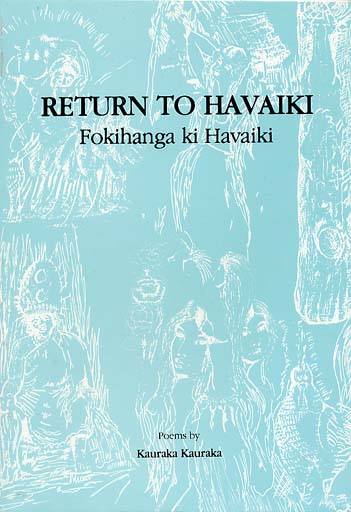
Book 13, the Cook Islands: "Return to Havaiki" by Kauraka Kauraka

Surprisingly, I liked this.


I wasn't expecting to, after the disappointment of "Hingano". This one's another grab from the NUS Library - a slim book of poems in Manihiki and English (the first such bilingual book ever, according to the inside info). Illustrations of gods and heroes on the inside, and a mix of love poetry, mystic poetry and anti-colonial poetry, exhorting us to snap out of our spells of video and New Zealand academic degrees and compete over husking coconuts, drawing power from the memory of the Polynesian ancestral land of Manuhiki/Havaiki, for crying out loud. (If this was written for any race with power out there, it'd be imperialist.)

But the spiritual grounding of Kauraka Kauraka (heehee, what a beautifully tautonymic name) makes up for it - his encomiums to gods ring true, as if he's still in touch with that fount of native culture which other authors like Albert Wendt claim their countries have lost touch with.

(There's also some very cute nursery-rhyme stuff that can only reveal its alliterative genius in Manihiki. "Slippery edible sea slug,/Do you want to eat sea slug?" originally reads as "Pahekeheke te patito,/Ka kai koe i te patito?")

But I think we have the translator to thank for a certain gracefulness of language, a certain wisdom that holds back where other translators would have been too effusive. And though a whole bunch of people are thanked for helping, it does seem as if K Kauraka himself was the principal translator. Hooray for him!

Incidentally, Manhiki words are italicised with footnotes, which is not the ideal solution but turns out to be pretty practical considering how much of such verbiage there is. Gods and goddesses and heroes and plants and animals. Untranslatable beings.

(Ooh, but it turns out that hingano/hinano is basically just pandan.)

View Around the World in 80 Books in a larger map

Representative quote:

MAUI-POKITI

Hey Maui-Pokiti! What are you doing?
I'm weaving me a basket.
What is your basket for?
I'm flying to Manuhiki.

To climb for some coconuts,
to t some puraka
To dive for clam shells,
To trap some titihi
And take them to the sun to be roasted
For the feast of the king of the sky


**
(Maui-Pokiti = a Polynesian demi-god and legendary hero
Manuhiki = the original name of Manihiki Island, the ideal Manihiki society
puraka = an edible tuber
titihi = the "Moorish idol" or butterfly fish, which is most abundant in August)

Next book: Celestine Hitiura Vaite's "Frangipani" from French Polynesia