Showing posts with label west asia. Show all posts

Tuesday, February 7, 2012

Book 89, Iraq: "Princess, Priestess, Poet: The Sumerian Temple Hymns of Enheduanna"

This is the most ancient text I’ve covered so far, and unless groundbreaking archaeological discoveries are made, it’s the most ancient text I’m going to cover in this project, period. It dates from 2300 BCE: the first known text to be accompanied by an author’s name, hailing from Sumer, a civilization was already two millennia old at the time of composition; arguably the very civilization that invented writing, in fact. Fascinatingly, it’s written by a woman: the daughter of Sargon, builder of the world’s first empire, High Priestess of the Moon God Nanna at Ur.


But oh lordy. It’s the wrong book. I made the National Library order this because it looked like the most up to date, complete version of Enheduanna’s corpus, and what do I discover halfway through? That the princess’s most famous works which I’ve heard quoted here and there as evidence for her genius and even her lesbianism, her hymns to the goddess Inanna – they’re her devotional hymns, compiled in an earlier book.

The Temple Hymns are quite a different matter. They’re a political work: one hymn written for every temple in Sargon’s new patchwork of conquered empires. What Enheduanna did to forge their unity was to sing praises to each of their local gods and goddesses, denying none of them, crafting a holy text that would endure as canonical scripture, copied and recopied on cuneiform blocks through the centuries. Note also that the different regions didn’t even speak the same language, but this was ok: she spoke both Akkadian from her dad’s side and Sumerian from her mum.

Mind you, the sum and significance of these works is terribly interesting, but ploughing through Betty de Shong Meador’s work tests one’s patience a little – she’s an academic as well as a literary translator, and there’s pages of annotations and explications after each hymn; no way you can read this casually. Even if you skim the hymns themselves, they get a bit repetitive after a while: they’re not narrative, like the anonymously authored Epic of Gilgamesh; they’re fragmentary gasps of glory. Yeah, sometimes they’re studded with dazzling imagery, but even brilliant oohs and aahs can provoke zzzs after a while.

Of course, the annotations do pay off sometimes: without them, I’d never have known that Sumerian religious culture was so, shall we say, womanist; there are notes about female warriors, female religious scribes, female kings, female viziers; gipars (convents for priestesses; monasteries did not exist) and goddesses with tremendous sexual agency: how Ereshkigal of the Underworld sentences the warrior god Nergal to the worlds below to be executed for his intransigence but seduces him instead; bridal songs about erect nipples and throbbing vulvas. And of course, Inanna herself, “the lady of largest heart”, a savage lion battering a wild bull, bearing seven maces, washing her weapons in the blood of battle. Makes the bacchanalian Greeks look positively Puritan.


View Around the World in 80 Books!!! in a larger map

I was going to reproduce a hymn to Inanna for you guys, but on second thoughts, there’s another more intriguing piece dedicated to Nisaba, the goddess of writing, she of the gold or silver stylus. Hers is the temple that ends the sequence, allowing Enheduanna to punctuate the entire corpus with her own name.

Representative text:

Temple Hymn 42
The Erest Temple of Nisaba
Ezagin

this shining house of stars bright with lapis stones
has opened itself to all lands
a whole mix of people in the shrine every month
lift heads for you Eresh
all the primeval lords

soapwort the very young saba on your platform
great Nanibgal Nisaba Lady of Saba

brought powers down from heaven
added her measure to your powers
enlarged the shrine set it up for praising

faithful woman exceeding in wisdom
opens [her] mouth [to recite] over lined tablets
always consults lapis tablets
[and] gives strong council to all lands

true woman of the pure soapwort
born of the sharpened reed
who measures the heavens by cubits
strikes the coiled measuring rod on the earth

praise be to Nisaba

13 lines for the house of Nisaba in Eresh

the person who bound this tablet together
is Enheduanna
my kind something never before created
did not this one give birth to it

the incipit: é-u-nir
the count of its lines is altogether 548

Next book: Al-Ghazzali’s Deliverance from Error and The Beginning of Guidance, from Iran.

Sunday, January 22, 2012

Book 88, Kuwait: “The Chronicles of Dathra, a Dowdy Girl from Kuwait, Vol I" by Danderma

Good lord. What a horrifying book this is.

I’ve grumbled before about Western fantasies of the oppressed Muslim woman, so I was rather gratified that I’d found a piece of what’s essentially Kuwaiti chick-lit: an insider perspective of the nation, first uploaded onto a blog then self-published via Lulu. And of course I was prepared that it might be badly written and a little shallow – as one trufan was squealing, “Sophie Kinsella watch out!” – but I honestly wasn’t ready for this.


You see, Dathra is written breathlessly – it’s full of typos and subject-verb disagreements and tense malfunctions and exclamation marks! and exclamation marks!! and exclamation marks!!! One charming thing is that it’s also composed in Arablish: mixed up English and Kuwaiti Arabic, spelt in the fashion of text messages, replacing the letter “hair” with 7; the letter “ain” with 3, etc, so that the book’s full of mystifying ejaculations such as “G63!” (disgusting) and ”7arra!” (eat your heart out) and “bo6a6a!” (French fries)

More frighteningly, Dathra herself (the word means “dowdy and unfashionable”) is a 32 year-old rich girl with a severe overeating disorder – and no, this is not a charmingly funny junk food addiction like Liz Lemon’s; it’s a problem that hospitalises her after she cooks and eats two kilos of samosas at a go. She also happens to be incredibly obnoxious – she starts fights and screams and yells and throws food at bewildered service staff and folks in the queue for Pinkberry – and in a bid to reinvent herself, starts spending lavishly on designer items: MAC lipsticks and Hermès scarves and sequined tube tops and stiletto heels that smear and creak and burst against her weight.

She has the mindless consumerism of Cathy and the maniacal violent streak of Hothead Paisan, with the redeeming qualities of neither. No, she’s not a layabout: she has a job that pays a good salary (very little description of women’s rights being limited here*) and spends loads of time on her Blackberry, but we’re not even told what her job is, let alone whether she cares about it or loves it.

And yet we’re called upon to sympathise with her. The whole story’s narrated from her perspective, as she hurtles from one disaster to the next; we’re given moment-by-moment motivations for her to hurl yoghurt and trifle on her cousin’s face. We’re directed to root for her to get back her perfect fiancé, the one she violently dumped because he refused to go to Burger Hub with her (plus he was hogging the stuffed grape leaves).

And such is the nature of chick lit that we – or perhaps it’s just me – I can’t put this freaking book down, even though I’m reading it as an oversized pdf on my Kindle, so most of the bottom lines of each page get cut off unless I blow up the screen and look at each page in sixths. This terrible woman, this monster of consumerism in all its forms, living in a society similarly dominated by relentless consumerism, with no sense of self-awareness whatsoever – she is our protagonist, and her uncontrollable urges parallel mine: she keeps eating and fighting, I keep reading.

(The fact that there are so many descriptions of food is also a guilty stimulant. Big Macs, halloumi, imsabbag zbaidi, tea Estekanas, tabbouleh over rocca salad, rice mixed with marag, mini kibbeh filled with labna and garnished with pomegramate seeds, sheesh tawooq, chocolate covered strawberries, fatayer, mini pizzas, vermicelli crème brulee, falafel sandwiches with hummus and tahini, English breakfast, qaymar…)

Oh, and here’s a spoiler: she has a happy ending by the end of this volume. Can you believe it? Let’s hope that in Volume Two she experiences a dramatic epiphany that turns her into a Nice Person.

*Oh, here’s the one interesting “oppressed woman” tidbit: the back-story of the villainess, Sabkahawa, is that she publicly confessed she was in love with a much older Kuwait University professor while she was just twenty, and this was a no-no: a woman must wait for a man to approach her, or else to be matchmade. To openly have feelings oneself is social suicide.


View Around the World in 80 Books!!! in a larger map

Representative quote:
She turned to face him, all her frustration and apparent humiliation poured out of her as she screamed her lungs out ‘Killa MINIK1! O min Elde3la MORTIK2! THE FRUIT TRIFLES ARE GONE, FINISHED, SOLD OUT! I HAVE ASKED THAT WOMAN TO SELL THEM BACK BUT SHE WON’T GIVE THEM TO ME!’

‘Dathra...’

‘CHUB! LA TETKALAM! WALA KILMA! EVER AGAIN TO ME! NEVER TALK TO ME, EVER! YOU CAUSED THE STUPID ACCIDENT, YOU MADE ME LATE, THE FRUIT TRIFLES INBA3AW1! I WANT THEM O OHOM INBA3AW, RA7AW! I MUST FOLLOW THE WOMAN NOW. MOVE OUT OF MY FACE AND NEVER TALK TO ME AGAIN.’

Next book: Princess, Priestess, Poet : The Sumerian Temple Hymns of Enheduanna, ed. Betty De Shong Meador, from Iraq.

Friday, January 20, 2012

Book 87, Bahrain: "Voices: an Annotated Anthology of Contemporary Bahraini Poetry" ed. Hasan Marhamah

Yo! So I’m writing this on the plane to New Zealand, where I’m spending a week’s holiday with my parents. (They’re evidently non-traditional enough to want to escape the comfort of relatives during Chinese New Year, which surprises me.) I’ve spent the flight watching a Chinese martial arts movie and a Danish documentary on a Japanese inventor, while occasionally dipping into my e-book of Bahraini poetry:


Yeah, it’s a dowdy cover, but as it turns out, the contents aren’t half bad. There’s a timeless, infinite, declarative air to Bahraini poetry – which may well be a feature of Arabic poetry in general, though I can’t tell, having only read Mahmud Darwish and bits of the Sufi mystics in the past.

Certainly it’s very different from a Singaporean poetry anthology, which would be full of minute descriptions of circumstance, society, geography, autobiography – the influence of Western traditions, surely. The Bahrainis are from a tiny, recently developed island nation like ourselves, and yet when they write, it feels like they’re calling out to the desert, it feels like they’re calling out to the sea.

The translator/editor spends a lot of time in his intro guiding us through the different eras of Bahraini poetry: 1) the Classical Movement, composed by princes and influenced by Nabatean; 2) the Neo-Classical Movement, which fused that style with the emergent anti-colonial Nationalism of the early 20th century; 3) the Romantic Movement, obsessed with P. B. Shelley as the epitome of passion, patriotism and rebellion; 4) the Neo-Realists and Modernists, now comprising many middle-class intellectuals, including many women, inspired by late 20th century Arab politics, byzantine imagery, and oddly enough, T.S. Eliot. (There’s even a reference to Hollow Men in one of the poems.)

The actual collection is all 20th century stuff, and we only hear a couple of poems per poet, so it’s a comfortable, jaunty survey, unified by the voice of the translator despite variations in subject matter and structure. Footnotes point out references to Palestine, to imprisonment, to Bahraini symbology of the palm tree and wine, to various tales of the Quran (e.g. Balqis, the Queen of Sheba who took on Solomon’s religion; e.g. Iqlima and Luza; ugly and beautiful; the wives of Cain and Abel respectively; the sisters of Abel and Cain also respectively. Surprisingly, there’s also a fair bit of referencing to Sumerian history and legend (Bahrain, then Delmon, was the source of the Epic of Gilgamesh, says the translator), and even a feminist piece called the Wanderings of Scheherezade. What a culture, no?

Quite beautiful, and unexpectedly so. Hurrah for the talents of tiny nations.


View Around the World in 80 Books!!! in a larger map
Representative quote:

An Invitation to a Forbidden Party
-Ahmad al-Shamlan

My apology to you my good friends:
My party is poor
For I spent what I earned on my future journeys.
Exhausted, I arrived carrying my drowned guitar
With a melody you have heard before.
When it was captive
And you were the lyrics in the depressing jails,
While the thug gurgled his anger;
His crushed nails tortured my guitar and continued in a small party.

****

I fetched you tonight palm wine,
Do you like dates?
I possess nothing but the vintage liquor;
I stole it,
It is condensed but genuine;
Those who sold its tree never became intoxicated,
But I was intoxicated by an infant.
What shall I say?
In my eye there was an impossible question,
Wandering through long nights but never fulfilled…
A candle in a beautiful one-time party.
But they have changed my home address;
My home is a melody tonight,
A distracted in a small dream
And I fear the street guards.

The street guards have plotted against me,
They have changed my home address.
My friends,
Come in,
I have for you
Liquor
Reproach
And joy.

Next book: Dandera’s The Chronicles of Dathra, a Dowdy Girl from Kuwait, from Kuwait.

Monday, January 16, 2012

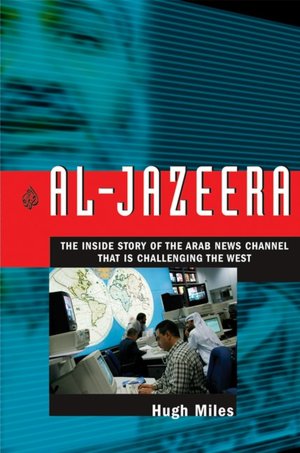
Book 86, Qatar: "Al-Jazeera: the Inside Story of the Arab News Channel that is Challenging the West" by Hugh Miles

Holy crap, this was a good read. Found it hard to put it down, which is not what I expected of a 400-page book on new media in the Middle East.

Truth is, I wasn't sure if I'd pick it up at first, given that it's published in 2005, a year before Al-Jazeera English was launched - behind the times, much? But the alternatives didn't seem quite good enough - Josh Rushing's Mission Al-Jazeera talks about life as a reporter for the English channel but only after a huge blather about his life as a good ol' American Marine (also, the huge font looked insulting) while Philip Selb's The Al-Jazeera Effect seemed a wee bit too academic (I'm an intellectual snob, but I also read for fun, darling).

Can't say the cover attracted me much:


But the story - oh, what a story. First, the setup: Qatar is a tiny country with a citizen population of less than 300,000 people (Emiratis joke that they could fit all of them into one of their hotels). Their brand of Islam is Wahhabi, their system of government is near-absolute monarchy and their royal family was known as the "thugs" of the Gulf, due to their often violent successions. This hasn't improved much in recent history: the regnant Sheikh Hamad deposed his father while the latter was on holiday. (It's said that he collapsed in a fit of laughter when, as a young man in the UK, he first learned the concept of democracy.)

Pretty stereotypically backward Arab state, hein? But as soon as Hamad took power in '95, he abolished the Ministry of Information (which in fact was the Ministry of Censorship) and enshrined freedom of the press into the Constitution. Unheard of among Arab states. Then he used his vast fortune to found Al-Jazeera, drawing an international pool of foreign-educated Arab reporters to Doha, impressing upon them his guarantee of a truly modern Arabic news station.

Seems that back then, Arabic news was in the Jurassic age: newsreaders merely read out press releases from the Ministries and the social lives of the Mubaraks: Al-Jazeera drew people in with real investigative journalism, real debates between antagonistic opinions on The Opposite Direction, surprisingly liberal fatwas on Shariah and Life, and eventually the in-depth coverage of the Second Intifada and the US invasion of Afghanistan (especially in-depth in the latter case since Al-Jazeera was the only news station with reporters actually inside the country). Satellite transmission was free, sustained not by advertising but by the Sheikh's payouts, so that even the poorest Arab speakers could tune in - today, Miles tells us, nomadic Bedouin weddings no longer involve a dowry of jewellery, but the gift of a satellite dish instead, so that the newlywed couple can watch the news together.

And let's face it: this is a story with heroes and villains. Plucky little Al-Jazeera, its office compared to a matchbox by an incredulous Mubarak, has managed to deliver some of the most balanced news reportage in the world despite constant abuse and threats from Saudi Arabia, from Kuwait, from Jordan, from the USA and the UK. (The stories of how reporters and cameramen were arrested, abused, tortured, even strategically murdered by Coalition forces with no investigations following, are quite horrifying.)

Of course, hardly anyone believes it's balanced: in the Middle East there are so many agendas that any attempt to tell both sides of the story (it was the first Arab station to actually show Israelis speaking on the air!) is doomed to misunderstanding. It's been called pro-Israeli, pro-Hamas, pro-America, pro-Al Qaeda... pro-Qatari of course, but Miles assures us that the station openly criticises the government's policies, especially the fact that it houses the American air base from which the Coalition conducted the invasion of Iraq.

It's a fascinating story - more intriguing, I'd argue, than what's happened in Dubai, because it's about the explosion of information, not wealth; it's about rising up for free speech at the same time as America's clamped down on its objective reporting. It's about a transformation of consciousness, and it started from a tiny irrelevant country which only got rich in the '90s, after people figured out how to extract its natural gas reserves. (Not sure if it can be argued that it engendered the Arab Spring, though. Probably not.)

Also of interest are the tidbits about Qatari society: how the people have been given hefty payouts and sinecures and are so wealthy they can retire in their thirties; how they've been pushed by the Sheikh to liberalise, sending their kids abroad to study and get their minds blown by Western democracy; how the Sheikh's second wife has become a spokesperson in her own right for children's rights, a phenomenon almost unknown in the Arab world.

Yep, there's some benefits to reading stuff by foreigners. Would a Qatari have fessed up to all these obvious details? Not so sure.


View Around the World in 80 Books!!! in a larger map


Representative quote: Since then [i.e. the invasion of Afganistan] it has often been glibly stated that Al-Jazeera and the rest of the Arab media is shaping Arab public opinion towards the West for the first time. But Arabs have already been mulling over the pros and cons of democracy for almost two hundred years: what is meant is that today Arab public opinion matters for the first time.

Next book: "Voices: An Annotated Anthology of Contemporary Bahraini Poetry", edited by Marhamah Hasan Marhamah.

Tuesday, January 10, 2012

Book 85, United Arab Emirates: "The Sand Fish" by Maha Gargash

The UAE - or more specifically, the Emirate of Dubai - has a special significance for us Singaporeans: it's a tiny country that became a late capitalist success story by specifically emulating our path from third world to first world. But of course, ever since the exposé from the Independent came out, we know there's a dark side to this success too: massive income inequities, overdependence on foreign labour, ruthless exploitation of low-paid foreign workers, rampant pollution, complete erasure of heritage.

I haven't been to the country yet (have talked lots to friends who've worked and travelled there, though), so I was pretty interested in reading a non-fiction book explaining the rise of the city-state: Syed Ali's Dubai: Gilded Cage or Jim Crane's City of Gold, maybe. But then I decided I wanted to hear from a voice within the country. Was there an Emirati author out there, published in English? There was.


Maha Gargash actually wrote this in English. She's been educated in the US and London, and now makes documentaries for Dubai Radio and Television, so she's had to scour her country (and others) for exotica, remnant communities who still remember the Emirati way of life before the oil boom.

In the afterword, she talks about how she was inspired to set her tale in the 1950s, right between the dying age of pearl fishing and the rise of the international petroleum trade. She abandoned an early draft which told the story from the pearl fishers' point of view; now the heroine's Noora, a young mountain girl married off as the third wife of a wealthy trader.

Honestly, it's not a fantastic work of fiction. Perfectly acceptable, yes, but not a must-read. There's something oddly generic about the story, even though the author doesn't make completely conventional decisions. Noora's fundamentally a damsel in distress, reactive rather than proactive, abused by the elder wives, afraid of her fat husband, loins burning for the handsome young manservant Hamad. She does nothing truly heroic throughout the story; she doesn't venture beyond the walls of her sheltered harem life. Of course, the author's furnished her with a modicum of spunk and intelligence to make her seem like less of a doormat.

What's really interesting, I suppose, is Gargash's choice in subject matter: how she refrained from describing the chaos of Dubai today and instead mined history for material; even mapped out the old cities and houses to mark out a believable, tactile setting, bringing the past alive again. It's actually a lot like what Singaporean writers like Catherine Lim and Dawn Farnham have been doing: farming the past for treasure, precisely because so little trace of it persists in the present. Their flavours are ultimately very different: Singapore's past is colourful, noisy and violent, while Dubai's is quiet, parched, detached from the hubbub of urban developments. But we both have that desire to use fiction to remember who we are.

No, not who we are. Who we were. The trouble with historical fiction of this sort is that it's escapist: it concentrates on the terrible social problems of yesterday, allowing us to triumphantly declare that they've been fixed. It makes us ignore the terrible social problems that persist today.

The West is happy to fill the gap with its own Emirati fictions - even in film. What are Emiratis talking about amongst themselves?

Oh, and by the way, a sand fish is a kind of skink.


View Around the World in 80 Books!!! in a larger map

Representative quote:
"Listen to you, you do every filthy thing. Then you pretend you didn't." There was spite in his voice now. "I don't know who you are, what you are. Something very different from the Noora I treasured." He threw his arms in the air. "You dug a hole in the sand and filled it with your shame, thinking it will be buried forever. But the sand is soft and the wind never stops blowing. And one day..." He bit his lip and looked away. "You are like a.. a..."

"Sand fish," she mumbled."

Next book: Hugh Miles's Al-Jazeera: The Inside the Story of the Arab News Channel that is Challenging the West, regarding Qatar.

Monday, January 2, 2012

Book 84, Saudi Arabia: The Quran

Happy New Year! So after over a month, I'm finally done with al-Quran Qadim!

Yessir, I knew I could've gone with easier choices like Rania al-Baz's Disfigured (socially significant and pretty well written), Rajaa Alsanea's Girls of Riyadh (revolutionary but badly written, according to most critics), and Jean Sasson's Princess (still don't trust its veracity). But I wanted something really iconic, a jewel of world literature. a book worth the boasting rights. Why not a book written (or transcribed) by the most influential man in history, a figure whose name I dare not utter without a pbuh and whose face I dare not upload at all?


And the truth is, there are several reasons why this wasn't an entirely good idea.

I still remember having to read bits of the book for my Contemporary Civilization class during sophomore year; we were guided by an Arabic-speaking Jewish girl who gushed over the sheer poetry of the text, and all the Americans oohed and aahed over how much more liberal and enlightened some of the laws are compared to Deuteronomy or Leviticus. Whereas I was distressedly thinking how all the Muslims I knew (especially in Singapore) were more liberal and enlightened than even that. (Yes, imprisonment for female adultery [an alternative reading of "stoning"] is less draconian than death, but in the 21st century?)

Still, I figured maybe reading the whole thing would give me some context. My friends recommended the rather beautifully archaic Abdullah Yusuf Ali translation for my enjoyment. And now I'm finished, I've ended up delaying my post for three days, so nervous am I about how to appear as both a critical humanist and a non-Islamophobe.

Yet at the risk of incurring the wrath and legal action of everyone in Singapore, I'm going to make a list of 4 reasons why reading the Quran alone isn't a great way to fall in love with Islam.

1. The surahs are super confusing.

The Quran, as you probably know, is a series of divine revelations: each one of them is meant to be a stand-alone insight into spirituality. So they're free to meander as they like from topic to topic, rather than staying focussed on a single issue - e.g. Surah 4, an-Nisa, is supposedly all focussed on women but after 25 verses it goes into more generalised, abstract ethics. Pretty difficult for study, no?

2. The stories are scattered all over the place.

The Book contains all these references to tales of prophets from the Old and New Testaments: Adam, Noah, Lot, Abraham, Moses, Zakariya, Mary, Jesus; also non-Biblical stories like Saleh and the Companions of the Elephant. But these are mostly told in fragments, so that you need a concordance or annotations to piece everything together - plus, a few key details are repeated in sura after sura, while others in the Biblical versions are left out. Thus you'll get pretty damn tired of the Pharaoh yelling at Moses, but no mention is made of the colourful variety of plagues he visited on Egypt. The versions of the stories in the Hebrew and Christian Bibles are patently more accessible and rounded out.

3. The order doesn't help.

I'm not complaining about chronological order here - I know it'd be next to impossible to trace their history, so I can't blame the original redactors for placing them in order of length. But currently, the surahs are arranged from longest to shortest. That's really frustrating for a novice reader: we have to plough through the long, bifurcating thought processes of Surahs 2 through 40 before we start seeing some surahs with the sheer, crystalline focus of secular poems. (Yes, there are wonderful poetic moments in longer surahs, but they get gobbled up in the range of topics covered.) Imagine if they were arranged from shortest to longest: then people would be hooked in by the concise poetry of the early suras and keep reading all the way to the end.

Hmmm. In retrospect, this might not be a good idea. Most of the laws are laid out in the longer suras; they're important.

4. And yes, I know this will be controversial: there's a lot of hellfire.

The Quran does mention tolerance and how Allah is all-merciful, but it's really hard for a non-believer to swallow this when so many of the suras (especially the longer suras) mention fire and punishment for us in some way. We're told we'll be cast into the fiery pit and forced to eat of the tree of Zaqqum; there are also constant invocations of prophets at Warners of the end of the world, when our very bones shall testify against us. It gets really exasperating. Maybe fear works as a conversion tactic for some people, but us freethinker skeptics? You'll catch more flies with honey than vinegar. (It was actually the act of reading the Old Testament that made me stop being a Christian ten years ago.)

Thus I do think it's understandable why some Muslims end up as terrorists, because the Quran contains so much condemnation of unbelievers and polytheists and those who ignore the Signs. While there are commandments for tolerance of other religions - People of the Book, that is - they make up a much smaller total portion of the book.

What does this mean? Well, basically that the Quran is a supremely slippery text, and it's not immediately accessible to outsiders; perhaps not even to insiders. It's quite different from most books of the Bible; in fact, it recalls the compilations of Zhuang Zi in some respects - how nonlinear and poetic it is, and how strange. Obviously Muslims pair it with the Hadith and the writings of religious scholars who've interpreted the Book.

It also means that the best strategy to make people conceive of Islam as a positive force in the world is for Muslims to be positive forces in the world themselves - boasting about the roots of your religion isn't going to be so effective when the roots are so tangled. Let's hope the bits of the Quran that are especially venerated from now on are the ones that celebrate tolerance, science, co-operation, social justice

As for me, I don't know what to think. Sure, I've got minor boasting rights for getting to the end of a book, but do I understand Islam any better than I did before? Damned if I know.


View Around the World in 80 Books!!! in a larger map


Representative quote: And such are the Parables We set forth for mankind, but only those understand them who have knowledge. (29:43)

Next book: Maha Gargash's The Sand Fish, from the United Arab Emirates

Thursday, December 1, 2011

Progress update

I'm only about a quarter of the way through the Quran, which I'm actually reading off a .pdf file on my iPhone, so I'm temporarily leaving you with this TED talk from another, more committed Quran reader:


Incidentally I'm also in India with my mother: we're currently in an obscenely lovely heritage hotel that would quite probably coincide with the Muslim vision of paradise. Lucky us!

Tuesday, November 15, 2011

Book 82, Yemen: "I Am Nujood, Age 10 and Divorced" by Nujood Ali

And thus we begin West Asia, with a little light reading! And before you think I'm being facetious about the terribly serious issue of child marriage, I'll have you know that this book is (quite appropriately, when you think about it) written as if targeted towards children, written by proxy to explain every single aspect of Yemeni everyday life to foreigners aged 10 or above: the recipe for ful, the rituals of Ramadan, the wording of Al-Fatiha.


Of course I'm suspicious of the agenda: first published as Moi Nojoud, 10 ans, divorcée, it rehearses plenty of clichés of protecting oppressed Asian women from evil Asian men, made all the more insidious by the ventriloquising tactics of "co-author" Delphine Minoui, who writes through the voice of the oppressed rather than overtly exposing herself as the outsider. (Yes, yes, I know how easily interviewees' words can be crafted to fit a desired image; I've done it myself as a reporter, frequently.)

But then it manages to elude some of those clichés - it's not white people saving Nujood, it's the nice Muslim judges and the nice women's rights lawyer Shada Nasser, the foreign journalists come in only later, and pretty much all the urbane Yemenis she tells her story to are appalled. Plus, there's an intro and outro in Minoui's voice, delicately explaining the background of the nation and Nujood's later quandaries (she wasn't able to stay in her new aid organisation-funded school because of family troubles; her dad still can't find work, her mum is still depressed beyond functionality, her brothers still blame her for shaming the family).

And hell, Nujood's a heroine. Seriously, how many little girls in her position have the guts to run away from their rape and abuse and name their oppressors in court? Plus, she's inspired other girls to follow suit, and has influenced changes in law. Plus, it seems she's been terribly sweet-spirited all through the process.

You'll have to excuse my earlier skepticism. You see, Singapore's undergone social turmoil because of the Western world's moral panic over child brides: namely the case of Maria Hertogh, the Dutch girl adopted into a Muslim Indonesian family and married to her apparent satisfaction and consent at the age of 13, when she'd had her menses and everything already (which Nujood had not). Hertogh's birth mother found her again and successfully sued to get her back into Christendom, against her will. Age of consent and marriageability is a culturally determined thing, dammit; raising both reduces the chances of abuse but there are loads of other factors causing the abuse in the first place.

Ah, there's a lot to blabber on about this issue. Need to get some sleep.


View Around the World in 80 Books!!! in a larger map

Representative quote: Yes, I've made up my mind. When I grow up, I'll be a lawyer, like Shada, to defend other little girls like me. If I can, I'll propose that the legal age for marriage be raised to eighteen. Or twenty. Or even twenty-two! I will have to be strong and tenacious. I must learn not to be afraid of looking men right in the eye when I speak to them. In fact, one of these days I'll have the courage to tell Aba that I don't agree with him when he says that, after all, the Prophet married Aisha when she was only nine years old. Like Shada, I will wear high heels and I will not cover my face. That niqab - you can't breathe under it! BUt first things first: I will have to do my homework well. I must be a good student, so that I can hope to go to college and study law. If I work hard, I'll get there.

Next book: Christiane Bird's The Sultan's Shadow, regarding Oman.

Thursday, February 17, 2011

Attack of the Scareveils!

A bit more than halfway through Doña Bárbara now, and can't rush it because I'm trying to meet deadlines. Still, there's time for a bit of WTFery about something I saw in a bookstore at the Abu Dhabi Airport:


Just look at it! An entire shelf of Oppressed Muslim Women, testifying against the atrocities of their patriarchal cultures! Clockwise from top left: Jasvinder Sanghera's Daughters of Shame, Souad's Burned Alive, Betty Mahmoody's Not Without My Daughter, Jean Sasson's Mayada, Daughters of Arabia, Princess, Siba Shakib's Samira & Samir, Jean Sasson's Desert Royal. (No, I don't know what Jack Hight's Siege is doing in there.)

Pretty much all these books are from the same publisher, Bantam. And while a good lot of them may be legit (they're all allegedly non-fiction books), there's a fair number that have been exposed as complete fakes: Burned Alive is pretty clearly a hoax, and Jean Sasson's whole Saudi Princess Sultana series has been accused of plagiarism and fictionalisation on several counts, too. (Bantam was also the publisher that first won the bid to publish the religiously taboo potboiler, The Jewel of Medina.)

How am I supposed to feel about this? Should I be awed at the UAE's liberalness in allowing these books to be sold at all in their country? Impressed at the bookstore's enterprising attitude, given that these are exactly the kind of demonising fairy tales the West wants to hear from the Muslim world?

The truth is, of course, that I'm creeped out by how a single Euro-American publisher can corner the market on exploitation exotica, published regardless of fact-checking procedures and accountability, and how an institution in the UAE can lap this up, presenting these stories in the absence of context.

Conservative Islamic culture as practised today does indeed produce human rights nightmares: honour killings and religiously justified rape and abuse and slavery all really do happen. But, lumping the lies together with the truths produces a monstrous, unreal image of the Evil Muslim Man, from whom the pitiful Muslim Woman must be rescued by the West. Gayatri Spivak and Edward Said have said loads about this kind of thing.

And of course, there are genuine, intelligent Muslim female voices speaking out against human rights abuses beyond victim narratives: figures like Irshad Manji, Dina Zaman, Marina Mahathir and Shirin Ebadi. They're the folks the bookstore should stock, right next to the cover jackets of oppressed veiled women, I suppose.

Yeah, it's ironic that I'm addressing issues of authenticity on a blog that mainly deals with fiction. I just freaking hate it when people deliberately misrepresent exotic cultures for their own benefit.

Abu Dhabi Airport

Aside from that, Abu Dhabi Airport is pretty cool, and Etihad Airways is a great way to fly.

See you again on the blog in less than a week, hopefully.