Showing posts with label non-fiction. Show all posts

Sunday, September 21, 2014

Book 157, Liechtenstein: "Liechtenstein: A Modern History" by David Beattie

Sometimes doing this blog is more of a ritual than anything else...

 So, Liechtenstein. Principality of 35,000 people. How many writers amongst them? One prominent one, in fact: Prince Hans Adam II himself, who's scribbled out a rather well regarded text called The State in the Third Millennium.

In retrospect, I should've ordered myself an ebook version, because what I ended up with instead was dry dry book on history and constitutional law and economy:


Was there anything worth remembering from my couple of hours skimming through this book? Well:

a Roman soldier’s helmet has been discovered on Liechtenstein's territory, bearing his name (not mentioned) but not, alas, his legion,

 during the Middle Age witch-hunts, out of a population of 3,000 people in the principality, 300 were tortured and executed,

 the many Jewish immigrants involved in the banking industry fled before WW2, which was a shame because they would have been pretty safe. Liechtenstein never capitulated to the Nazis, remaining resolutely neutral, avoiding an Anschluss (Hitler once grumbled that he never wanted to hear words Liechtenstein and Switzerland again “because the people there hate me") and a Nazi putsch,

 after the war, Communist Czechoslovakia insisted that the Liechtenstein royal family were Germans and had to hand over their land in their territory, when in fact they were only kinda culturally German the way many German Czechs like Kafka were,

 during the 1968 referendum, separate votes were held amongst men and women to decide whether or not to allow women’s suffrage. Most men – and most women - voted against it. (This kind of direct democracy is quite feasible in such a small country.)

it's naturally hard to figure out what holds the country together culturally (a third of the residents are non-citizens, though they're mostly Germans and Austrians), but a lot of it's the royal family,

• also, the country's "economic miracle" is thanks not only to banking (the author was very forgiving of the whole tax avoidance and money laundering thing), but also to high industrialisation - they had an early hydroelectric dam, plus manufacturing bases for false teeth.

Yeah, I think that's about it. Most of the book was really fawning over the princes - and yeah, that's all of them on the cover, from Karl I who bought the area in 1608 to Hans Adam who's still there right now. The author's a former British ambassador to Switzerland and Liechtenstein. Maybe he had a crush of Hans, who is quite the silver fox.

There was also a bit about the Princes' extensive art collection, which has been on show at the Met and Singapore (he once sold a Franz Hals to help with state finances, not that there's any public debt now). And in fact I was thinking of reading one of these art catalogues for this entry, but I felt, well, it's kinda awkward when the princes and the art aren't actually housed in Liechtenstein itself.

For a nice fun intro to this country, I'd recommend the chapter on the microstate from George Mikes's Switzerland for Beginners. Not that reading it was a total bore - interesting resonances for a Singaporean to read about this weird little mega-rich nation's survival, prosperity and uncertain future.


View Around the World in 80 Books!!! in a larger map

Representative quote:
“In 2006 the Pinricpality of Liechtenstein will commemorate the 200th anniversary of its full state sovereignty. It is younger than the USA but older than the modern states of Belgium, Greece, Italy, Germany and many others. In the heart of Europe, it is the diversity of Europe. Its people, its traditions, its institutions and its economy give it much to hope for. Amid their justified celebration of the past and heir optimistic anticipation of the future, many Liechtensteiners will reflect on the much-quoted words of Peter Kaiser, their first historian, the country’s representative at the German National Assembly in Frankfrut in 1848-1849 and one of those who defined Liechtenstein identity:

'If we understand our advantage correctly, we may present ourselves as a small nation that endangers nobody but commands respect from all. Life is short; but an honourable name remains and serves down to the latest posterity for an example and for emulation.'”

Next book: Elfriede Jelinek's The Piano Teacher, from Austria.


Saturday, July 13, 2013

Book 130, Greenland: "The Vinland Sagas"

Apologies to the one (1!!!) person who voted on the blog poll – I’m not doing Eskimo Poems from Canada and Greenland after all. When I surveyed my friends on Facebook, the overwhelming majority of them wanted to hear about the Vinland Sagas.

And why wouldn’t they? I remember hearing about Leif Eiriksson as a kid back in the early 1990s, watching an American edu-tainment program called Encyclopedia: a bunch of Vikings singing about how one of them had discovered America in 1001 CE; a land he’d called Vinland because of the clusters of wild grapevines he found there.

Since then I’ve seen this theme explored in science writing, genealogical studies, speculative fiction. Philip Pullman even references it in His Dark Materials: in his parallel universe, Native Americans are called skraelings, suggesting that the Viking colony succeeded in creating a lasting Euro-American connection there, whereas in actual fact the settlement lasted only 200 years, colonists driven out by worsening weather conditions and angry natives and the general impossibility of managing an overseas empire like that from the reaches of teeny little Iceland.


But the topic of my investigations here is Greenland: discovered by Eirik the Red (Leif’s father) in 981 while fleeing blood debts in Norway, then Iceland. The Icelanders – famously literary folks, both in the past and the present - were fascinated by the notion of this wild western island, which yielded exports of walrus ivory, skins and furs: a snowy frostbitten land where the very act of survival was heroic. They therefore composed several sagas about the lives of people of Greenland. The two in this volume, Grænlendinga Saga and Eirik’s Saga, are only two of them.

There isn’t actually much detail about Greenland here – Eirik’s discovery is described in an oddly perfunctory manner, and many of the scenes taking place here are honestly rather dry compared to the tales of battling the skraelings in Vinland. Still, what does come across are characters and odd anecdotes. Eirik, for instance, is invited by his son to lead the expediton for Vinland, but he protests that he’s too old, and when he gets thrown off his horse on the way to the port he decides it’s a terrible omen, and stays put. Then there’s Bjarni Herjolfsson, who gets blown off course and spies Vinland (or at least Baffin Island and its environs) but is so uncurious that he decides not to check it out, even when urged to do so by his crewmen.

And get this: this is herstory as much as history, as the most vivid and intriguing characters are the women, not the men. Viking women are portrayed as more than just daughters and mothers: there’s Aud the Deep-Minded, an early settler of Iceland and a renowned ancestress; the prophetess Thorbjorg, dressed in a blue mantle and a black lambskin hood lined with white cat’s fur, who leads a circle of women in a ritual singing warlock-songs and is rewarded when she foretells the end of a famine.

And of course Gudrid, sometimes celebrated as the most widely-travelled woman of medieval Europe, who witnesses her first husband’s corpse rise and prophesy her good fortune (Viking zombies are freaky, but relatively benevolent), then goes with her second husband to Vinland and interacts with a mysterious dark-haired shadow woman during a skraeling trading encounter that ends in bloodshed, then finally comes back to Europe and does a pilgrimage to Rome and ends her days as an esteemed anchoress.

And perhaps most infamously, Freydis Eiriksdóttir (Leif’s only sister) who leads a colonization mission to Vinland, hogging the huts and resources for her men while edging out her brothers, then pretending to have been abused at their hands and ordering her husband to have her brothers and their men slaughtered or else she’ll divorce him. When all the men have been killed, her followers won’t kill the women and children, so she does this herself. She also faces down the skraelings by ripping her dress open and smacking the face of a sword against her bare breasts, freaking them out utterly. Did I mention she happened to be pregnant at the time? Why doesn’t every schoolkid learn about this lady?

Of course, the reason why these biographies are important is because of ancestry: the descendants of these pioneers were sponsors of the sagas, both in their composition and their retranscription. The introduction notes that the Icelanders were unique because they formed a republic, not a kingdom – it was they who pioneered the idea that a saga could describe the deeds of common men, not just of gods and kings.

One final note on Greenland - ironically, the Norse colony here would die out in 1500, just after Columbus’s more southerly discovery of the Americas. Now it’s a Danish colony, but it’s trending towards independence, since global warming is allowing the Inuit-Danish native population to finally grow their own damn food. Thank god someone’s going to benefit from the devastation.


View Around the World in 80 Books!!! in a larger map

Representative quote: Then they put to sea, and Karlsefni accompanied them as far as the island. Before they hoisted sail, Thorhall said:

‘Let us head back
To our countrymen at home;
Let our ocean-striding ship
Explore the broad tracts of the sea
While these eager swordsmen
Who laud these lands
Settle in Furudustrands
And boil up whales.’


With that they parted company. Thorhall and his crew sailed northward past Furdustrands and Kjalarness, and tried to beat westward from there. But they ran into fierce headwinds and were driven right across to Ireland. There they were brutally beaten and enslaved; and there Thorhall died.

Next book: Halldor Laxness’s Independent People, from Iceland.

Sunday, July 7, 2013

Book 129, Saint Pierre and Miquelon: "Rumrunners" by J.P. Andrieux

So I decided not to do Québec as a separate country, because they're not oppressed and they probably wouldn't become a nation of their own if they had a referendum. I do feel bad about this, though, since it was a special request that my friend Jean Francois made three years ago. But I did do the Québec-based Haitian author Dany Laferrière, so there's that.

The teensy-tiny twin islands of Saint Pierre et Miquelon do get an entry, however. They're a self-governing overseas collectivity of France - a colony in North America that no-one knows about! - and there is indeed a Kindle-friendly e-book about them/it, covering the sensational period of American Prohibition from 1919 to 1933: when the islands served as a vital port for the smuggling of alcohol from Europe and the Caribbean into the USA and Canada (yes, Canada did some Prohibition too, didja know that?).


But there're two problems at hand.

First, J.P. Andrieux is a terrible writer. Stupidly dull. Lays out the facts textbook-style, with zero delight in the potential of language to entertain, barely seizing any chances to revel in how interesting the details of his topic are. No lush descriptive background given of the town of Saint Pierre - just dry anecdote after anecdote of the smuggling. Megayawns.

Second - well, the subject really isn't that sensational. True, we've got some cool little stories about sailors who hide liquor in their water barrels, confounding their captains who searched the vessel high and low for the substance that was sousing all men on deck, and the big-name smugglers themselves - James McCoy (whose high-quality rum gave birth to the term "the real McCoy", the infamous gangster Al Capone, who gave away his straw hat to a shopkeeper who admired it, and Gertrude Light, one of the few women to sail the Rum Row, armed with a pistol to defend herself against ruffians who mistook her for a lady of negotiable affections.

However, once we get past 1933, we enter dull Canadian territory - there was still plenty of smuggling of booze and cigarettes from the islands to Newfoundland (which wasn't part of Canadian Confederacy until 1948), and Andrieux narrates the gradual crackdown on this by the Royal Canadian Mounted Police with chapters focussing on 1991, 1992 and 1993 individually, dwelling on juries and ever-so-polite Mountie raids, where they'll apologise for making too much noise if they raid the wrong house (quite unlike US cops, who'll usually shoot your dog and then try to sue you if you go the press about it).

Anyway, there doesn't seem to be much smuggling anymore, not that I've been persuaded to care much one way or another. After all, I'm currently in Colombo, Sri Lanka, listening to tales of police harassment of gay people and the horrors of the 26 year-long civil war, which they're recovering from quite nicely, by the way, after it ended four years ago.

Will be reading more while on the go in Jaffna, Anuradhapura, Sigiriya, Dambulla and Kandy! Toodle-pip, my dears.


View Around the World in 80 Books!!! in a larger map


Representative quote: On the day that Prohibition ended, the truckers who had been engaged in transporting the liquor shipments from the docks to the warehouses and vice versa organized a mock funeral parade from one of the liquor warehouses. They paraded throughout the community with a long line of trucks, with the American and French flags at half-mast in mourning, signifying that the great era was all over and tomorrow they would have no more work.

Next book: The Vinland Sagas, from Greenland.

Saturday, April 20, 2013

Book 121, Tokelau: "A Way With Words: Language and Culture in Tokelau Society" by Ingjerd Hoëm

On the plus side, we're finally reading something else by a female author in the Pacific region. On the minus side, she isn't native - she's from Norway. On the even more minus side, she's an anthropologist.

Yesiree, here's one of those dry, brain-numbing, jargon-filled texts (purism? doxic?) that I'd never waste my life reading if I wasn't doing this godforsaken project. It's even marginally about linguistics, which my PhD student sister has proven to be a headache of a pseudoscience, why oh why etc.


But really, this wasn't so bad - except for the bulk of the second half, which consisted of Hoëm consulting every person she could about the meanings of specific Tokelauan terms, from uluifa (spirits that possess people) to fatupaepae (a female authority figure), just to show the imbalance and instability of information between genders and classes. Major snoozefest.

You see, Tokelau's an odd place.  It's a territory of New Zealand, consisting of three atolls, with a combined population of 1,411 (that's today's figures, but the country's always dealt with overpopulation through emigration). Despite that teensy number, they've got a number of feuds and village dialects, exacerbated by the fact that missionaries converted some of them to Catholicism and some to Protestantism (the Catholics allowed more of the indigenous culture to survive, for which I suppose they deserve some thanks).

In the '80s, when the author was conducting her fieldwork, the Tokelauans had only recently adopted a written form of their native language and begun teaching it in schools. They'd previously been using English and Samoan - so they had the weird situation of kids being fluent in a traditional language, their twenty-something year-old parents recommending that they follow their elders for even greater mastery of the tongue, and of course the elders jabbering away in Tokelauan that was infected with Samoan words to begin with...

And that's just the background. The messy politics of how language is used is bewildering: characterised as the shyest of the Polynesian peoples, Tokelauans hold their fono (their ceremonial meetings) in near silence, wary of contradicting people and making enemies, sometimes postponing the most serious issues of each Women's Council or Council of Elders to the next fono, just so no-one's feelings will be hurt. 

(The example given was sorting out a feud so that one island's parents would stop barring their kids from attending school. As an Asian person I believe school is bloody important and they should've just trod on each other's feelings. But that's why I'm not an anthropologist.)

Details of the use of gossip as a sanctioning device, the strange disruptive appearances of older women as clowns, invading official events to mock the hierarchies that keep them bound (yet this is part of the culture that keeps them bound). And the syncretic lyrics of the fatele song and dance shows.

Yet believe it or not, the Tokelauans feel dreadfully insecure about their culture - they feel they're hybrid, westernised folk (many of them have studied or worked in NZ; there's a steady exchange of unruly offspring between Tokelau and the migrant families in Samoa and New Zealand). They even envy the Maoris for the strength of their identity, never mind that Maori culture has been reduced to a superficial display of hakas and carven masks in the midst of a mainstream pakeha culture. (In Tokelau, they call them palagis).

But aren't we in Singapore the same? Weirdly cultured and problematic and unsure if we can be proud of what we have? 

Ah, but Yi-Sheng, the world does not exist for the sake of your reflections. Here's a fatele text.


View Around the World in 80 Books!!! in a larger map

Representative quote:
Fakalogo atu

Fakalogo atu kite leo e sau
Tena e sau
sau mai i ko
pati tokoto ko te toeina
ko te uto kua tini, tini, tini O.

Listen to the sound coming
That is coming
coming from there
applauding [while] lying down, the Elder
The young sprout of the germinating coconut [i.e. the young people] have finished, finished, finished.

Next book: Reverend Joseph King's WG Lawes of Savage island and New Guinea, from Niue.

Wednesday, March 27, 2013

Book 120, Wallis and Futuna: "Futuna: Mo Ona Puleaga Sau", eds. Elise Huffer and Petelo Leleivai

I need to be frank about the folly of this project. You know how much I spent on this book? US$36, which is S$45, thank you very much. Shipped here all the way from the University of the South Pacific in Suva, Fiji, which, come to think of it, is probably closer to my part of the world than New York.


It's not even a great read, though it's purportedly the first book ever to be written by Futunans: 12 authors (though though I'm counting 11, plus the female editor maybe), and each of them are writing about different aspects of the island's history and culture: the mythology, the 18th century civil wars, the traditional architecture, the kava-drinking ceremony.

Pretty dry and disconnnected, though it does admittedly read much more beautifully in French than English. (Although this book's title is in Futunan, the contents were written in French, and are accompanied by an English translation. The sub-subtitle is "Les deux royaumes/the two kingdoms", since the island's divided into the kingdoms of Alo and Sigavé, both of which are administered from Wallis Island way in the northeast, which itself is administered by France. Why didn't I read the whole thing in French? Because life is short, I'm afraid.)

There is interesting stuff in here, though. Look at the legendary origins of the monarchy: a visit by the handsome fisherman Faniutasi to the world of the gods, where he weds a heavenly princess and comes back Futuna to rule as the island's first divinely ordained king, only he sleeps around with another gal and the princess leaves him, leaving the two mortals to sire the Saufekai, aka the Cannibal King, whose dynasty wreaks havoc on the valley.

And did the king have any kids with the princess, you may ask? Yeah, sure, he was abandoned and adopted and named Ufigaki. And then this happens:

"When he became an adult, he began to work wonders but everybody hated him instead of loving him. He eventually disappeared, sinking voluntarily into the earth."

You could base an entire soap opera on this tale. But no, we've gotta move on to another essay on emigration to New Caledonia, or monarchic hierarchy, or the transition from being a protectorate to an overseas territory. Yawn.

Another complaint: in the cultural sections, there's way too much Futunan jargon for readers to keep up with. I can only remember than ago means saffron; how am I supposed to digest a sentence that follows, describing the process of the Lautilo evaluating how many workers, tama and kumete he'll need?

But of course, this is a book that's created for the sake of academia, not for pleasure-seeking fools like myself. The lives and cultures of other people do not exist for my amusement.


View Around the World in 80 Books!!! in a larger map

Representative quote: Tous ces produits artisanaux sont vendus sure place par les du pays. Les clients les achètent pour les offrir à leurs amis. Ils se vendent bien à Wallis, car seul Futuna possède les matières premières. On les exporte également à Tahiti pour les expositions artisanales. C'est une source de revenus pour la plupart des personnes qui essaient d'en exporter le plus possible en métropole ou à l'étranger. Ces produits font la plus grande richesse du pays. Cependant, beaucoup envisagent de ne plus vendre les siapo, tapa et produits artisanaux à l'extérieur afin d'attirer clients et touristes étrangers qui viendraient découvrir nos richesses. Ce serait une occasion de faire connaître notre île au monde entier.

All these handicrafts are sold locally. Customers buy them as gifts for their friends. Handicrafts also sell well in Wallis because the raw materials are only found in Futuna. They are often exported to Tahiti for handicraft fairs. They are a source of income for many people who try to export as many as possible to France and overseas and are the country's greatest treasures. However, many people are contemplating not selling siapo, tapa and other handicrafts overseas so that they can attract customers and tourists to Futuna. The latter would then discover our treasures. For us, it would be an opportunity to make our island known to the world.

Next book: Ingjerd Hoem's A Way with Words, from Tokelau.

Wednesday, March 6, 2013

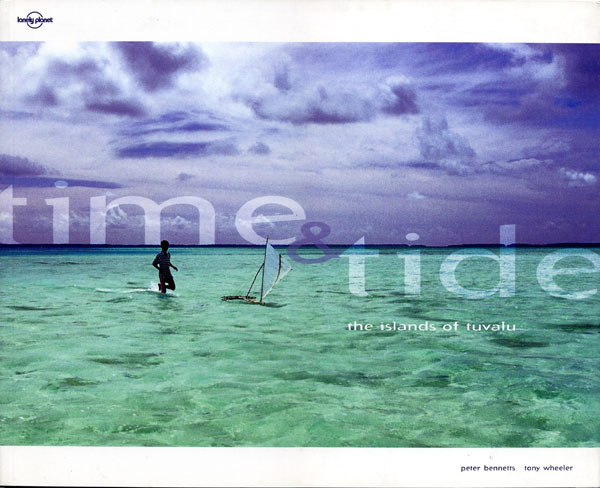
Book 118, Tuvalu: "Time & Tide" by Tony Wheeler

So I couldn't convince the National Library to purchase Philip Ells's Where the Hell Is Tuvalu?. Kein problem - they have their reference section books available for lending at selected branches. Of course, this makes no sense in terms of categories, but I'm not complaining, because I was able to borrow this:


Yes, yes, it is essentially a photo book (credits to Peter Bennett for the images!), but it does also have a substantial amount of written content, rather well crafted, from the king of the Lonely Planet empire himself. Seems that in 2000, the travel writer and the photographer flew over to Funafuti as part of an environmentalist quest, inspired by the anti-global warming rhetoric of then-PM Ionatana Ionatana, determined to document the culture of these low-lying islands that the world stands to lose when the oceans rise.

While Nauru was a dystopia, Tuvalu's described as a utopia - nine atolls of peaceful, not-very-hierarchical people who're still holding on to traditions of family and feasting and feitu (a colonial system of dividing each island into two competitive teams, which seems fairly benign today). A simple diet of fish and coconut and pandan, supplemented by crabs and turtles and papayas and sadly canned food, which is sold in collective convenience stores, not megamarts (community ownership seems to be the only way to do capitalism in this culture). Sun, sand, happiness. Some money coming in, because the sons are prized as merchant sailors across the world. Deep love for children. Deep love for God. Deep love for land.

One-dimensional? Maybe. There are some cool interviews with people who recount trauma: the Peruvian slavers who came in the 19th century, Cyclone Bebe in 1972, a dormitory fire which killed 18 schoolgirls and which inspired national mourning (the country has less than 10,000 people). And of course there's some obesity and litter dumping because of the processed food, and some university grads can't get used to the slow pace of life after experiencing the cosmopolitan delights of Australia and New Zealand and Fiji (?!). But no deep sense of malaise. No, foreboding is reserved for the danger of inundation, of permanent ecological exile.

Not going to be terribly critical. Had a great experience teaching travel writing using this guy's anthology, and am headed to Manila tomorrow using this guy's guidebook. Safe to say I'm pretty much a convert.


View Around the World in 80 Books!!! in a larger map

 Representative quote: In the Tuvaluan language, a person without land is known as fakaalofa, literally, a person deserving of pity. But in a hundred years, all Tuvaluans may well be fakaalofa.

Next book: Lloyd Jones's Mister Pip, from New Caledonia.

Sunday, March 3, 2013

Book 117, Nauru: "Paradise for Sale: A Parable of Nature" by Carl M. McDaniel and John M. Gowdy

Um. A bit preachy, this one. Nor is Nauru really the point: it really is just being used as an exemplar of a nation ecologically destroyed by short-sighted capitalism.

Basically, it's a clumsy version of Jared Diamond's Collapse.

 
We've got three chapters about Nauru - the first about geological/biological history, the second about human history, the third repeating chapter two but with a more pointed environmentalist slant... And then four more chapters looking at the greater problem of how our culture pushes humans to live beyond their resources (see the Viking settlement of Greenland and the decline of the Rapa Nui civilisation on Easter Island; for alternative, sustainable cultures see the Australian Aborigines, the Kalahari !Kung and the Ladakhis of the Himalayas).

I mean, yeah, I get it. There's actually a little travelogue as a coda, because the authors felt bad that they'd written all this without really exploring the culture of Nauru today, so one of 'em stopped by for four weeks and wrote about how it was doing.

And how is it doing? Well, it's almost always been a nice place - it was called Pleasant Island by colonists; the remarkably non-violent native population of about a thousand was living happily off fish, pandanus and coconut and had very little worth exploiting until an Australian guy realised that a doorstopper rock from the island was actually made of guano-compounded phosphate, super-useful as a fertiliser to turn the deserts of his island nation into agricultural fields.

So the Ozzies and Brits and Kiwis came and plundered the hell out of Topside, the mountain of phosphate deposits in the centre of the island. But it wasn't until independence in the 1960s that the Nauruans began to demand a proper cut of this fortune, whereupon they became super-rich and super-fat on an imported diet of Spam. And with this embrace of capitalism and wealth there was a rapid loss of native culture too - no more of the Pacific idyll described by Time Magazine, instead everyone driving around in air-conditioned cars despite the fact that it'd take only four hours to walk around the whole island.

But the phosphate's running out - and it's the island's only resource. They never tried focussing on making it renewable (seems it's possible: if they'd allowed certain areas to lie fallow during independence in 1966 they might have been able to allow the bird poop to replenish itself indefinitely). And after a series of bad investments - including a flop of a West End musical, as the authors never fail to remind us - this ship seems sunk.

Odd thing is, when McDaniel and his wife visited, he found the people were still pretty happy, thriving with their happy-go-lucky culture despite the oncoming tsunami of doom. The authors claimed this is representative of the human condition: we still live on in hope despite the obvious signs that we've cut the gravel from beneath our feet and the big Malthusian end is nigh. But seriously, I thought, if the people are happy, can't you consider that there might be something a little off about your gloomy thesis?

Then I remembered: I actually met a Nauruan girl myself in Makassar, Sulawesi, last year, and she agreed - the whole island's full of unemployed young people, angry and confused at the future of prosperity they've been denied. This book was published in 2000: a dozen years later, the collapse has happened sure enough.

The authors claim the Nauruans never gave up their forager culture: phosphate made life easy even after modernisation so they never had to develop a Protestant work ethic. Seems a little colonial in outlook, but the greater truth is that the idea of constant economic progress is what's dooming Earth right now. Our civilisation is unsustainable. Now what?

Al Gore said in An Inconvenient Truth that in order to make people change their ways you have to inspire people with some promise of better things ahead. Not much of that here. Just dooooooooooom.


View Around the World in 80 Books!!! in a larger map

Representative quote: In North American publications some westerners express moral indignation at the Nauruans' plight: "Here was Nauru with a history of affluence. But having dug out all their island for the phosphate so stupidly, they stupidly spent their money as well. They need to take the blame themselves. They are in a lot of trouble because they have not saved for a rain day," and "Nauru's decline has to do with human nature. It's what happens when incentives are taken away and people don't have to work." But what is the reality of the Nauruans' situation? They did not bring Europeans to their island, nor did they create the market economy that physically destroyed the island and destablized their civilisation. These things happened as a result of two influential beliefs in Western culture: that native cultures are expendable for progress and that natural environments exist for the purposes of making money and supporting progress by feeding the growing market economy. The Nauruans had an enduring pattern of habitation prior to 1800; therefore, these failures should not be ascribed to them but to the market economy.

Nauru has served as a crystal ball in which to view the consequences of beliefs and actions prevalent in our market-based world. We can appreciate how difficult, if not impossible, it would be for the current population of Nauruans to live at this time on their island's impoverished biological and physical resources. It is certainly not prudent to denude the entire earth the way Nauru, Banaba, Beijing, London, Mangaia, Manhattan Island, Mexico City Moscow, Rapa Nui, and so many other places have been denuded.

Next book: Tony Wheeler's Time and Tide, from Tuvalu.

Saturday, February 23, 2013

Book 116, Marshall Islands: "Operation Crossroads: The Atomic Tests at Bikini Atoll" by Jonathan M. Weisgall

This book is bloody comprehensive. Every little detail of the events leading up to the 1946 atomic tests at Bikini Atoll laid out in tedious sequence.

Pardon my ennui - the text isn't badly written by any standard, but it dwells so much on political and military history, in particular the machinations between the competing parties of the US Navy and Air Force, that honestly wasn't terribly interested in a lot of chapters. Quite a bit of military drama though - almost like a sequel to Michener's Tales of the South Pacific.


I've learned a lot of new stuff, though - what a sensation those tests were, with J. Robert Oppenheimer and the other Project Manhattan celebrity scientists gone peacenik and speaking out against them, while the press drummed up fears that it might incinerate the atmosphere (or else prove the Navy obsolete, if the bomb drop ended up sinking all the decommissioned warships around the island). Americans had the words "atomic" and "project" on their lips all day, a French designer hijacked the word "bikini" for his explosive new swimsuit (that outdid the scantiness of an earlier competitor, the "atome").

And the sheer folly behind so much of it - people writing letters of complaint about the animals being tested (goats and pigs), wanting to salvage the not-very-old World War II battleships they'd fought on, the way the US government categorically denied the long-term ill effects of radiation, and then later claimed it was "a very pleasant way to die" (in spite of the fact that US physicists had died in agony protecting others from radiation during experiments). And what a bust so many of the tests were, with the inaccuracy of the bomb drops rendering the majority of the cameras and instruments useless, and other results covered up or destroyed, and journalists fooled by the muckup of the first test into thinking that the bomb wasn't very powerful at all...

Weisgall is, by the way, a lawyer representing the indigenous people of Bikini Atoll, who gave up their land willingly to the US for these tests based on the assurance that they'd be well looked after (they haven't been, of course; they starved on their first replacement island), and that they'd be allowed to eventually return. And they did return in 1978, but the radiation from surrounding nuclear tests had poisoned the soil, turning everything that grew on the island radioactive, from the coconuts to the crustaceans, impossible to live their idyllic island lives, so the island remains lush and untouched, a toxic paradise.

Oddly enough, Weisgall doesn't dwell on the Bikini people very much. The accounts of the atomic tests' other victims are better documented: the radioman of the Japanese tuna fishing boat Lucky Dragon, which got caught by unexpected fallout, the American sailor boys who swabbed the decks of the radioactive battleships, often shirtless and in shorts, unable to comprehend the problem of this invisible radiation that they couldn't scrub clean, and now dying in dozens from strange cancers which the Navy says it can't directly trace to the test sites (they do get medical treatment now; but only because veterans' benefits are more comprehensive now than post-World War II).

So yes, lots of stories. And I've learned plenty. Didja know footage of the Bikini tests was used in both Doctor Strangelove and the original Godzilla? But enough for now. Too many facts; would honestly prefer some literature.


View Around the World in 80 Books!!! in a larger map


Representative quote: Lore Kessibuki stood on deck for hours until the LST had cleared the Eneu channel and he could no longer see any of Bikini's islands. He then composed a song, both sad and hopeful, which remains the Bikinians' anthem today:

No longer can I stay; it's true.
No longer can I live in peace and harmony
And rest of my sleeping mat and pillow.
No longer can I stay on my island;
I must leave all the things there.
The thought overwhelms me and leaves me helpless.
My spirit has to travel, far away, lost
Until it is caught in a great current.
Only then can I find peace.

Next book: Carl N. McDaniel and John M. Gowdy's Paradise for Sale: A Parable of Nature, from Nauru.

Saturday, February 2, 2013

Book 115, Micronesia: "The Island of the Colorblind" by Oliver Sacks

Got an extension on my playwriting project! So I don’t have to feel absolutely guilty about updating here. FYI, we’re now moving into the territory of the subaltern who cannot speak: a region where there are incredibly few internationally available books actually written by citizens/residents of the countries described. 

This, of course, is problematic, but for now I’m going to revel in the opportunity to write about Oliver Sacks, famed neurologist and author of classics such as The Man Who Mistook His Wife for a Hat. (I haven’t read any of his other books, mind you – just read about them on Boing Boing. But I’ve watched his TED talk!)


Seems I oughta read his other books. Sacks is one of those effortlessly eloquent British science boffins who’s not only passionate about his field but about life itself, and the words we use to describe it – in his preamble to this account of his neurological research voyages to the Pacific, he details his early love for explorer narratives: Captain Cook, Magellan, Dampier, Melville, even Professor Challenger and Dr Moreau.

There isn’t even that much science stuffed in here, especially in Book I, which involves his trip to the island of Pingelap in Micronesia, where a 19th century tsunami has left an island inbred enough to harbour a significant population of achromotopes (folks who are completely colourblind, not just the common red-green condition. Only rods in their retinae, no cones).

Easy enough to understand – the story therefore focuses on the pleasures (and occasional displeasures) of flying towards and living on this isolated tropical isle of imported spam and phosphorescent algae; also an unofficial anthropological study of what it means to be an achromotope (they call it “maskun”), aided by the experiences of Knut Nordby, a Norwegian psychologist and fellow achromotope who gasps in delight at finally finding his own tribe, as it were: a population of people who grow up understanding the condition of being oversensitive to light yet being mentally acute in every other way, able to spy the dimmest stars and night and tell which bananas are ripe, not from the colour, but from texture and smell.

There’s more science stuff in Book II: Cycad Island, which talks about a separate trip to Guam to investigate a form of quasi-Parkinson’s disease called lytico-bodig, whose cause has not yet been fully determined (though there’s a high chance it’s to do with eating food baked from the seeds of the cycad plants, which grow in abundance). Because of the medical mystery remaining here, there’s lots of explaining to do.

Consequently or nevertheless, it’s Book I: The Island of the Colourblind that’s more joyous to read – after all, it’s about a community of people who’re technically physically disabled but have little trouble rising above this, versus a story of old folks randomly going paralysed or catatonic (don’t worry too much: no-one born after 1962 seems to get lytico-bodig).

Wonderful little segue as well, when Sacks leaves Pingelap for the larger Micronesian island of Pohnpei, where he and his friends explore the thousand-year old ruins of the civilization of Nan Madol, which I only learned about last year from the forum discussion pages of Civilization V, and how it makes him consider:


Never heard of any of these before. How amazing, no, to excavate these obscure histories? Moments like these, the world seems so fantastically big.


View Around the World in 80 Books!!! in a larger map

Representative quote: Knut took out the cowrie necklace which Emma Edward had given him on Pingelap and, turning it over and over in his hands, started to reminisce about the trip. “To see an entire community of achromats has changed my entire perspective,” he said. “I am still reeling from all of these experiences. This has been the most exciting and interesting journey I will ever make in my life.”

When I asked him what stayed in his mind above all, he said, “The night fishing in Pingelap… that was fantastic.” And then, in a sort of dreamlike litany, “The cloudscapes on the horizon, the clear sky, the decreasing light and deepening darkness, the early luminous surf at the coral reefs, the spectacular stars and Milky Way, ad the shining flying fishes soaring over the water in the light from the torches.”

Next book: Jonathan M. Weisgall’s Operation Crossroads: the Atomic Tests at Bikini Atoll, from the Marshall Islands.