Showing posts with label british perspective. Show all posts

Sunday, September 21, 2014

Book 157, Liechtenstein: "Liechtenstein: A Modern History" by David Beattie

Sometimes doing this blog is more of a ritual than anything else...

 So, Liechtenstein. Principality of 35,000 people. How many writers amongst them? One prominent one, in fact: Prince Hans Adam II himself, who's scribbled out a rather well regarded text called The State in the Third Millennium.

In retrospect, I should've ordered myself an ebook version, because what I ended up with instead was dry dry book on history and constitutional law and economy:


Was there anything worth remembering from my couple of hours skimming through this book? Well:

a Roman soldier’s helmet has been discovered on Liechtenstein's territory, bearing his name (not mentioned) but not, alas, his legion,

 during the Middle Age witch-hunts, out of a population of 3,000 people in the principality, 300 were tortured and executed,

 the many Jewish immigrants involved in the banking industry fled before WW2, which was a shame because they would have been pretty safe. Liechtenstein never capitulated to the Nazis, remaining resolutely neutral, avoiding an Anschluss (Hitler once grumbled that he never wanted to hear words Liechtenstein and Switzerland again “because the people there hate me") and a Nazi putsch,

 after the war, Communist Czechoslovakia insisted that the Liechtenstein royal family were Germans and had to hand over their land in their territory, when in fact they were only kinda culturally German the way many German Czechs like Kafka were,

 during the 1968 referendum, separate votes were held amongst men and women to decide whether or not to allow women’s suffrage. Most men – and most women - voted against it. (This kind of direct democracy is quite feasible in such a small country.)

it's naturally hard to figure out what holds the country together culturally (a third of the residents are non-citizens, though they're mostly Germans and Austrians), but a lot of it's the royal family,

• also, the country's "economic miracle" is thanks not only to banking (the author was very forgiving of the whole tax avoidance and money laundering thing), but also to high industrialisation - they had an early hydroelectric dam, plus manufacturing bases for false teeth.

Yeah, I think that's about it. Most of the book was really fawning over the princes - and yeah, that's all of them on the cover, from Karl I who bought the area in 1608 to Hans Adam who's still there right now. The author's a former British ambassador to Switzerland and Liechtenstein. Maybe he had a crush of Hans, who is quite the silver fox.

There was also a bit about the Princes' extensive art collection, which has been on show at the Met and Singapore (he once sold a Franz Hals to help with state finances, not that there's any public debt now). And in fact I was thinking of reading one of these art catalogues for this entry, but I felt, well, it's kinda awkward when the princes and the art aren't actually housed in Liechtenstein itself.

For a nice fun intro to this country, I'd recommend the chapter on the microstate from George Mikes's Switzerland for Beginners. Not that reading it was a total bore - interesting resonances for a Singaporean to read about this weird little mega-rich nation's survival, prosperity and uncertain future.


View Around the World in 80 Books!!! in a larger map

Representative quote:
“In 2006 the Pinricpality of Liechtenstein will commemorate the 200th anniversary of its full state sovereignty. It is younger than the USA but older than the modern states of Belgium, Greece, Italy, Germany and many others. In the heart of Europe, it is the diversity of Europe. Its people, its traditions, its institutions and its economy give it much to hope for. Amid their justified celebration of the past and heir optimistic anticipation of the future, many Liechtensteiners will reflect on the much-quoted words of Peter Kaiser, their first historian, the country’s representative at the German National Assembly in Frankfrut in 1848-1849 and one of those who defined Liechtenstein identity:

'If we understand our advantage correctly, we may present ourselves as a small nation that endangers nobody but commands respect from all. Life is short; but an honourable name remains and serves down to the latest posterity for an example and for emulation.'”

Next book: Elfriede Jelinek's The Piano Teacher, from Austria.


Thursday, August 28, 2014

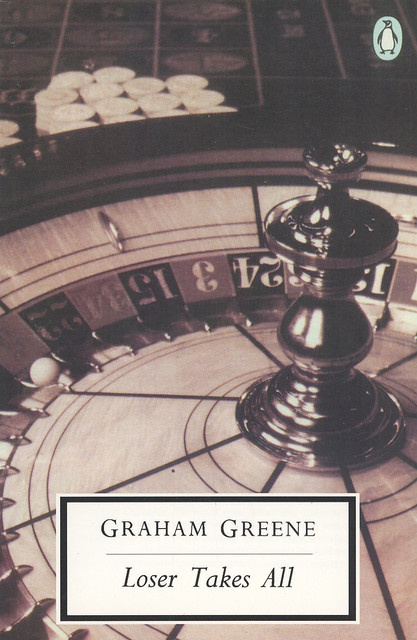
Book 155, Monaco: "Loser Takes All" by Graham Greene

Guess what? I decided that I *would not* let a second month go by wherein I'd only read one book for this blog. So I hitched a ride with my dad over to Jurong East Regional Library, and lo and behold, procured this:


It's a novella about Bertram, a 40 year-old London assistant manager of accounting and a bit of a loser - except that he's about to marry a sweet 20 year-old girl named Cary at a quiet church ceremony. Then, through the off-handed magnanimity of the major shareholder in his company, he ends up having the ceremony in Monte Carlo, Monaco - but when they're stranded at the hotel without the cash to pay their way any further, what can they do? Gamble their way into millions, that's what! And encounter all the ups and downs of riches while that takes place.

Now, I've only read one other Graham Greene novel, The Quiet American, which happens to have been published in 1955, the very same year this came out. And I can't help but be struck by the similarities between the two. Both feature:

1. A middle-aged, unremarkable first-person protagonist who is British and male,

2. and who also happens to be with an innocent 20 year-old (in The Quiet American, her name's Phuong) who appears bubble-headed and flighty but is in reality utterly devoted and surprisingly canny about the ways of life,

3. although there's an awful middle-aged woman involved - in The Quiet American it's Fowler's existing wife who won't grant him a divorce so he can remarry; in Loser Takes All it's Bertram's cheating sexpot of a deceased wife, plus a lady he picks up in the casino just to make Cary feel jealous.

4. Oh yes, and there's a handsome young man around who makes the protagonist jealous (the eponymous quiet American in The Quiet American; a young gambler named Philippe in Loser Takes All), but who does not deserve the girl, dammit.

5. And there's also machinations of power in the background - it's the Vietnam War in The Quiet American; it's the battles for money and power amongst the shareholders in Loser Takes All.

6. Plus, they both take place in exotic locations most Brit readers could only dream of visiting - Monaco! Vietnam! Not so much unlike an Ian Fleming novel after all. (Although it is remarkable that Loser Takes All was published a year before Grace Kelly's wedding to Prince Rainier - hence, it's set in the dowdy days of Monaco, before its great glamorisation.)

Of course, the two books are different, in substantial ways. First off, this one's just a novella, 110 pages long in fairly large print. And second, while The Quiet American is about the corruption of war and imperialism and all, Loser Takes All is about the corruption of wealth and greed - the money spoils everything, and Cary's the only one who can see that clearly.

And yes, this was a hell of a fun read. Probably useful for my writing, too. Although I do still feel bad about losing my copy of The Ruling House of Monaco. Will have to cough up some cash for that.


View Around the World in 80 Books!!! in a larger map


Representative quote: There are so many faces in streets and bars and buses and stores that remind one of Original Sin, so few that carry permanently the sign of Original Innocence. Cary's face was like that - she would always until old age look at the world with the eyes of a child. She was never bored: every day was a new day: every grief was eternal and every joy would last for ever. 'Terrible' was her favourite adjective - it wasn't in her mouth a cliché - there was terror in her pleasures, her fears, her anxieties, her laughter - the terror of surprise, of seeing something for the first time. 

Next book: Johanna Spyri's Heidi, from Switzerland.

Monday, December 9, 2013

Book 139, Northern Ireland: "Death of a Naturalist" by Seamus Heaney

One of the great things about having access to a university library is the fact that I can read a lot of poetry in its original collections, not in Compleat Works or Selected With Annotations stuff. I kinda wanna see how a writer's oeuvre was originally presented to the public, warts and all.

The Spirit Level is of course widely available - but after I'd picked it up, I realised:

1) I might've read it before, back when I first started getting curious about Heaney.

2) It wasn't actually written while Heaney was living in Northern Ireland (where he did in fact spend the first thirty-three years of his life).

3) I just wasn't connecting with the poems. 

Call me shallow, but the pieces in The Spirit Level all seemed messy and disperse and referring to incidents and people I wasn't familiar with, which is in itself not an unfamiliar sensation during this project. But I do want to honour great writers by saying nice things about their work, and to have a good time reading myself.

So I've decided to go back to the volume that started everything off: Heaney's very first collection, published by Faber and Faber back in 1966:


It's easy to like Death of a Naturalist. Most of these poems are these wonderfully earthy things, reflecting on what it means to be a poet who's grown up in the country as the son of a farmer, hence you've got schoolkid classics like Digging, wherein he imagines himself digging with his pen into his heritage, just as his forefathers dug with their spades for potatoes. Also the scary frogspawn of the titular poem, his mother's dairy alchemy in Churning Day, the tragedy of a child's death in Mid-Term Break, the assumption of adulthood and responsibility around the horse-plough of Follower. And of course the weird Thomas Wyatt-esque loss of innocence in Blackberry-Picking, another piece we kept on seeing on our literature worksheets, and which someone told me actually referred to the Eucharist.

All very sensual, all very real, all very lovely on the ears and accessible. In fact, quality actually goes sideways towards the end of the book when we just start getting fluffy love songs and nature poems, whose depth can in no way compare to the stuff in the first half. But if I'd wanted depth, I'd have gone with The Spirit Level, no? My own damn fault for being stupid and impatient.

Since we're on the topic of Northern Ireland, however, we've gotta mention The Troubles. And though the violence only peaked in the seventies (during which time Heaney wrote works like Wintering Out, which I personally find a tad forgettable), we do actually have a threatening yet thoroughly human figure of a Protestant activist whose "fist would drop a hammer on a Catholic" in The Docker. "Oh yes, that kind of thing could start again", the poet says, and sure enough it did.

Things have been peaceful enough since the nineties, thank god, and I'm planning to visit Belfast next year. Still, it did drive Heaney to Dublin, where he spent the rest of years until his death in April (which I shamefully didn't remark upon in this blog). What's the relationship between Northern and Republic of today? I've heard of people switching nationalities just to get their university fees slashed. Will find out through travel, not literature, I dare say.

Anyhow, Singapore's experiencing troubles of its own right now. Not sure how I could (should?) turn that into literature.


View Around the World in 80 Books!!! in a larger map

Representative quote: 


"From A Potato Digging"
III.

Live skulls, blind-eyed, balanced on
wild higgledy skeletons
scoured the land in "forty-five,"
wolfed the blighted root and died.

The new potato, sound as stone,
putrefied when it had lain
three days in the long clay pit.
Millions rotted along with it.

Mouths tightened in, eyes died hard,
faces chilled to a plucked bird.
In a million wicker huts
beaks of famine snipped at guts.

A people hungering from birth,
grubbling, like plants, in the bitch earth,
were grafted with a great sorrow.
Hope rotted like a marrow.

Stinking potatoes fouled the land,
pits turned pus into filthy mounds:
and where potato digger are
you still smell the running sore.

Next book: Sir Walter Scott's Waverley, from Scotland. Or shall I do Robert Burns?

Monday, October 14, 2013

Book 135, Guernsey: "The Guernsey Literary and Potato Peel Pie Society" by Mary Ann Schaffer and Annie Barrows

I've decided, with some regret, not to do Wales, Scotland, Northern Ireland and England as separate entities. We do not have a majority of citizens in these regions calling for independence (not even in Scotland!). Also, if I did all four countries within the UK, I'd logically also have to do all seven emirates in the UAE. All fifty states in the US might be pleasant, but Emirati writing still has a long way to go.


But we're on Guernsey now! One of the two Channel Islands - and you'll see on the map below how close they are to France, and thus how understandable it is that they're regarded as a separate from the UK. Also understandable is how they were occupied by the Nazis during WWII, the Brits tactically abandoning them for the sake of their own behinds.

The Guernsey Literary and Potato Pie Society is a description of that occupation, narrated through the letters and telegrams of the single, thirty-something year-old writer Juliet Ashton in 1946. She's a London girl, the recipient of recent fame and success after the publication of her humorous wartime newspaper columns - because people did need humour during the war - and now on track for her next book. 

One day she receives a letter from a certain Dawsey Adams, a Guernsey fisherman who's very much enjoyed a second-hand copy of Charles Lamb's Selected Essays of Elia which once belonged to her. He mentions the existence of the eponymous literary club during the war - at first an excuse to explain to the Germans why they were out so late during curfew, but later a coping mechanism (the pie being another such coping mechanism). The two commence a correspondence, and gradually Juliet comes to realise her destiny is to go to Guernsey and chronicle the experience of the war there.

It's honestly rather lovely to read an epistolary novel of this sort, recalling a time before e-mail and Whatsapp (though I really have no idea how one-sentence letters exchanged on the same day work - these people do not have footmen, after all). Principal author Mary Ann Shaffer has a wonderful range of voices, vivacious and folksy and prissy, bringing to life the cast of her novel. 

And what a cast it is. On the island, there's the poultice-brewing wise woman Isola Pribby, the haughty Adelaide Addison, the worried half-Jewish butler John Booker - and off the island, there's the frighteningly charismatic American publisher Markham V. Reynolds, and of course the terribly fun Juliet herself. Plus the unseen figure of Elizabeth - this young independent woman who invented the ruse of the literary club and was eventually arrested by the Nazis towards the end of the war, and who ends up being the subject of Juliet's book.

Mind you, this isn't high literature, by certain standards. The cover above shows how marketable it is as  pure and simple chick-lit - period too! An adaptation of Pride and Prejudice's love story: Dawsey is Darcy and Markham is Wickham. But it is so full of story, and texture, and joy, which is why it was a bestseller, and what I'm having so much trouble with in my own writing.

One final note: Shaffer was the original author of the book - wrote it as her first complete novel when she was an old woman, years after being stranded in a bookshop during a foggy Guernsey excursion and learning all about the occupation. However, once the novel had been optioned, changes were suggested - and she was seriously sick - so her niece, Annie Barrows, stepped in and filled her shoes, recreating the familiar style of storytelling she'd heard so much during family visits. I rather like that. Two women, one beginning a story, the other ending it. But there'll no more Shaffer novels, I'm afraid: she's dead and gone as of 2008, just before the book was published in its current form.

I actually finished this book last week - have been trying to keep up with my own reading in the meantime. It's a quick read, as is my next book, so I'll probably have my next update up pretty damn quick.


View Around the World in 80 Books!!! in a larger map

Representative quote: As the mail boat lurched into the harbour, I saw St Peter Port rising up from the sea, with a church at the top like a cake decoration, and I realised that my heart was galloping. However much I tried to persuade myself it was the thrill of the scenery, I knew better. All those people I've come to know and even love a little, waiting to see - me. And I, without any paper to hide behind. Sidney, in these past two or three years, I have become better at writing than living - and think what you do to my writing. On the page, I'm perfectly charming, but that's just a trick I've learnt. It has nothing to do with me.

Next book: Gerald Durrell's Menagerie Manor, from Jersey.

Sunday, May 12, 2013

Book 123, Kiribati: "A Pattern of Islands" by Arthur Grimble

So it turns out that if I hadn't already covered Robert Louis Stevenson for the British Virgin Islands, I could've spent this past week reading his travel memoir In the South Seas. Alas! Instead I'm covering yet another British colonial administrator's jottings.


But I'm being facetious - once you get past the early bits about the Oxonian old-boy system of the colonial administration, and about cutting his teeth as an eager young 20something official on Ocean Island, we actually get to something quite remarkable: a thoroughly British man who engaged with the native lore of the Gilbertese to a degree unprecedented among those who didn't actually marry into the tribes. Even got himself ritually initiated into the Karongoa tribe through ritual tattooing without anaesthetic: a serpent going up and down his arms, a 15 year-old virgin on each side of him to scream out on his behalf while he manfully said it did not hurt.

And such stories - shark hunts, cursed stoves, roofs collapsing in on the family during hurricanes, ghost sightings (of both the dead and the not yet dead), mediums who could foresee the end of Japanese tuna trade, barehanded octopus fishing (which was particularly hard on Grimble, aka Kurimbo, as he had a phobia of octopi), fearsome feuds between Catholic and Protestant converts including an island-wide millenarian uprising which resulted in several deaths...

And as before, told with a considerable degree of respect towards the Gilbertese themselves; a condemnation of the heavy-handed missionaries who attempted to destroy their culture, dancing upon the shards of their ancestors' skulls; a trust that colonialism had improved things on the whole (they'd caused the land wars to cease, and Grimble quotes from a 94 year-old lady who is joyful that her great-granddaughters can travel the island without fear of robbery or rape), and that really, all shall be well, all shall be well.

There's also a clear message that colonial life wasn't a bed of roses - out in the islands, there was no fresh food; they had to subsist on breadfruit and tinned beetroot and the native cooks (only men were allowed to serve as cooks) were pretty awful, burning the rack of lamb the Governor brought specially, and making Grimble's wife Olivia weep. And having to build a house from scratch on Beru, when the previous Resident had made off with not only the furniture and the beds but even the verandah itself, and having the roof cave in on them and their three kids during a hurricane... There's even a wistful sonnet about the delights of the tropical sunset not being surpassed by the comforts of England, which is quite lovely.

Of course, this is all describing a fairly early stage of colonisation: during the 1910s, the Great War passing them by at a distance, rubbing shoulders with actual tribal kings and administrators that Robert Louis Stevenson met (he was a particular inspiration, and is referred to simply as RLS). Grimble went on to St Vincent, the Windward Islands and the Seychelles before going back to the UK and becoming a celebrated author and radio presenter, which was in the 1950s, when the empire was in an ineluctable stage of decline.

Given all those shifts of geography and fortune, how can we trust this text as anything genuine? But that's the point of non-fiction as literature, I suppose - the thing isn't the fact but the style, the voice, the way we use language to make things beautiful.

On another topic: one thing that isn't beautiful is my map. I miscalculated the location of my Kiribati marker (the country covers a huge swathe of ocean) so I'm criss-crossing myself, going northwards and westwards on my journey to the east.


View Around the World in 80 Books!!! in a larger map

But no matter - next week we'll be doing a big jump across the rest of the Pacific Ocean to the Americas. Toodle-pip, Oceania! It's been a blast!

Representative quote: So Tanoata had learned an age-old spell called 'The Spoiling of the Oven'. She had been finishing the third performance when I stumbled upon her. Here is a translation of the words she muttered:

I stab them north, I stab them west,
I stab them south, I stab them east,
The ashes of the oven of Mareve,
Spirits of fire, spirits of stone,
I stab, I confuse, I overturn.
Bring stinking, bring anger.
Be sick at the stomach, you Biribo, Birbo! Be enraged!
For the food of Mareve stinks and stinks:
It is tiiki - tiki - tiki

Next book: Dr Florence Goring-Nozza's One and One Is Two: Caribbean Thriller from the Cayman Islands.

Friday, April 26, 2013

Book 122, Niue: "Savage Island" by Basil Thomson

Every now and then, I'm intensely grateful for good writing. It doesn't need to be transcendent: something engaging in some way, something fun, is quite sufficient.

This week, I'd thought I was plum out of luck as I was flipping through an epub version of W.G. Lawes of Savage Island and New Guinea, a miserable hagiography of an early missionary in the Pacific, published in 1909 by the Reverend Joseph King. The title had sounded like a swashbuckler's story - how was I to know it'd be so long and dull? 

I was halfway through when I decided to ditch the bugger and turn over to this other virtual archived text, dating even earlier, to the year 1902:


And boy oh boy, I'm glad I did. Basil Thomson was a civil servant with the Colonial Office - in fact, this book describes an official visit to Niue to arrange for its formal annexation as part of the British Empire, as well as a stop at Tonga to formalise its status as a British Protectorate. But he was also a professional writer, and consequently he knew how to render his descriptions of exotic realms so amusing that even an ardent postcolonialist like myself is delighted at his words.

You see, unlike Rev. Joseph King, Thomson actually accords individual personalities to the people of the Pacific. Of course, he's laughing when he describes the fashion for fatness among the women, and King Tongia's pompous folly in dressing himself in hoop skirts and military hats - a flavour of that half devil and half child colonial mindset of the time. Yet he also acknowledges that these guys have a culture, and real motivations for what they do - e.g. the king had no small talent for being able to convince the elders that they needed a king at all after no-one had occupied the role for 80 years...

Of course, one of the reasons Thomson can afford to make light of the situation is that everything's peaceful. I hadn't known much about this side of colonial history: how some countries would, of their own accord, join the British Empire for the sake of protection, to avoid more destructive invasion and exploitation by the Germans or the French. This is why Tonga, for instance, has been able to hold on to its royal family, one of the few surviving systems of monarchy in the realm.

And then the whole matter of being modern - how these Pacific people, who had been part of a freaking Stone Age civilisation just a couple of generations ago, were now aware of the greater world around them, were consuming its cultural artefacts (Christianity, icons of Queen Victoria, whom they called Vika) and even building themselves Western-style houses. And then their participation in world trade - the Niueans are characterised as the most hardworking of Polynesian races, being actually eager to work overseas, to the detriment of their local industries of growing coconuts and weaving hats out of pandanus leaves. (Seems they've done pretty well for themselves since then - ten years ago, they became the world's first nation to be completely covered by free Internet wifi.)

Add to this the usual staples of colonial travel memoirs: documentation of the flora and fauna (they had crazy plagues of flies and hornets), some notes on national custom and myth (oral history for Niue only goes back 500 years, suggesting that they split off from some other island civilisation before then). Some notation of the music and dance of the islands, too, before a rather abrupt ending.

But once again, I'm bloody glad that this peripatetic journey is bringing me to books that are actually worth digging up and reading. It's not just about going around the world: it's about not having a miserable time doing it.


View Around the World in 80 Books!!! in a larger map

P.S. Why "Savage Island", you ask? Seems that when Captain Cook visited in 1774, the Niueans were one of the few Pacific peoples to refuse to engage in dialogue with him, answering him instead with spears and darts. Smart folks!

Representative quote: "The procession was headed by a dozen men in slop clothes and villainous, billycock hats set at a rakish angle. They all carried spears and paddle-shaped clubs in either hand, and a similar rabble brought up the rear. In the middle of this grotesque bodyguard walked the king and queen, both in petticoats, as befits the sex to which they belonged, for if the queen was a young woman, the king was assuredly an old one. To their united ages of ninety-four His Majesty contributed seventy-six, but what he lacked in youthful elasticity he made up in con- descension, for she had been but a beggar-maid or what corresponds therewith in Niue, where beggary is unknown when he had played Cophetua to her a few months before our visit. She wore a wreath of roses, he the soldier's helmet with the cock's plume, which was all that the officious Samoan teacher would leave him of his military uniform, and from which he refused to be divided, although it assorted ill with his petticoat. To tell the brutal truth, His Majesty was unsexed by the garments that had been chosen for him, and his appearance justified the remark of a friend who, holding the photo- graphs of Their Majesties in his hand and con- fusing them, exclaimed, "Why, the queen's got a beard!"

Next book: Arthur Grimble's A Pattern of Islands, from Kiribati.

Wednesday, March 6, 2013

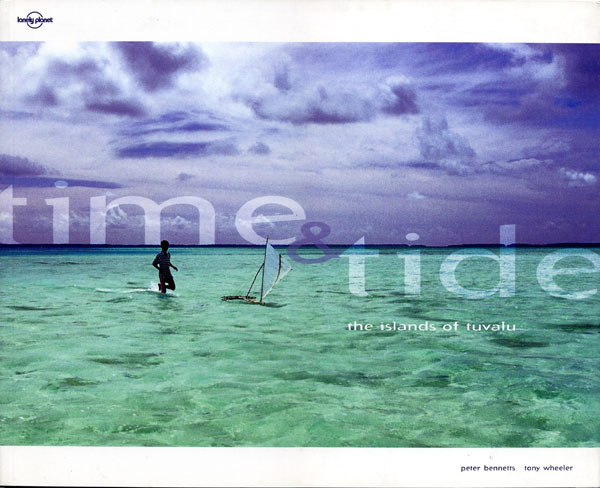
Book 118, Tuvalu: "Time & Tide" by Tony Wheeler

So I couldn't convince the National Library to purchase Philip Ells's Where the Hell Is Tuvalu?. Kein problem - they have their reference section books available for lending at selected branches. Of course, this makes no sense in terms of categories, but I'm not complaining, because I was able to borrow this:


Yes, yes, it is essentially a photo book (credits to Peter Bennett for the images!), but it does also have a substantial amount of written content, rather well crafted, from the king of the Lonely Planet empire himself. Seems that in 2000, the travel writer and the photographer flew over to Funafuti as part of an environmentalist quest, inspired by the anti-global warming rhetoric of then-PM Ionatana Ionatana, determined to document the culture of these low-lying islands that the world stands to lose when the oceans rise.

While Nauru was a dystopia, Tuvalu's described as a utopia - nine atolls of peaceful, not-very-hierarchical people who're still holding on to traditions of family and feasting and feitu (a colonial system of dividing each island into two competitive teams, which seems fairly benign today). A simple diet of fish and coconut and pandan, supplemented by crabs and turtles and papayas and sadly canned food, which is sold in collective convenience stores, not megamarts (community ownership seems to be the only way to do capitalism in this culture). Sun, sand, happiness. Some money coming in, because the sons are prized as merchant sailors across the world. Deep love for children. Deep love for God. Deep love for land.

One-dimensional? Maybe. There are some cool interviews with people who recount trauma: the Peruvian slavers who came in the 19th century, Cyclone Bebe in 1972, a dormitory fire which killed 18 schoolgirls and which inspired national mourning (the country has less than 10,000 people). And of course there's some obesity and litter dumping because of the processed food, and some university grads can't get used to the slow pace of life after experiencing the cosmopolitan delights of Australia and New Zealand and Fiji (?!). But no deep sense of malaise. No, foreboding is reserved for the danger of inundation, of permanent ecological exile.

Not going to be terribly critical. Had a great experience teaching travel writing using this guy's anthology, and am headed to Manila tomorrow using this guy's guidebook. Safe to say I'm pretty much a convert.


View Around the World in 80 Books!!! in a larger map

 Representative quote: In the Tuvaluan language, a person without land is known as fakaalofa, literally, a person deserving of pity. But in a hundred years, all Tuvaluans may well be fakaalofa.

Next book: Lloyd Jones's Mister Pip, from New Caledonia.

Saturday, February 2, 2013

Book 115, Micronesia: "The Island of the Colorblind" by Oliver Sacks

Got an extension on my playwriting project! So I don’t have to feel absolutely guilty about updating here. FYI, we’re now moving into the territory of the subaltern who cannot speak: a region where there are incredibly few internationally available books actually written by citizens/residents of the countries described. 

This, of course, is problematic, but for now I’m going to revel in the opportunity to write about Oliver Sacks, famed neurologist and author of classics such as The Man Who Mistook His Wife for a Hat. (I haven’t read any of his other books, mind you – just read about them on Boing Boing. But I’ve watched his TED talk!)


Seems I oughta read his other books. Sacks is one of those effortlessly eloquent British science boffins who’s not only passionate about his field but about life itself, and the words we use to describe it – in his preamble to this account of his neurological research voyages to the Pacific, he details his early love for explorer narratives: Captain Cook, Magellan, Dampier, Melville, even Professor Challenger and Dr Moreau.

There isn’t even that much science stuffed in here, especially in Book I, which involves his trip to the island of Pingelap in Micronesia, where a 19th century tsunami has left an island inbred enough to harbour a significant population of achromotopes (folks who are completely colourblind, not just the common red-green condition. Only rods in their retinae, no cones).

Easy enough to understand – the story therefore focuses on the pleasures (and occasional displeasures) of flying towards and living on this isolated tropical isle of imported spam and phosphorescent algae; also an unofficial anthropological study of what it means to be an achromotope (they call it “maskun”), aided by the experiences of Knut Nordby, a Norwegian psychologist and fellow achromotope who gasps in delight at finally finding his own tribe, as it were: a population of people who grow up understanding the condition of being oversensitive to light yet being mentally acute in every other way, able to spy the dimmest stars and night and tell which bananas are ripe, not from the colour, but from texture and smell.

There’s more science stuff in Book II: Cycad Island, which talks about a separate trip to Guam to investigate a form of quasi-Parkinson’s disease called lytico-bodig, whose cause has not yet been fully determined (though there’s a high chance it’s to do with eating food baked from the seeds of the cycad plants, which grow in abundance). Because of the medical mystery remaining here, there’s lots of explaining to do.

Consequently or nevertheless, it’s Book I: The Island of the Colourblind that’s more joyous to read – after all, it’s about a community of people who’re technically physically disabled but have little trouble rising above this, versus a story of old folks randomly going paralysed or catatonic (don’t worry too much: no-one born after 1962 seems to get lytico-bodig).

Wonderful little segue as well, when Sacks leaves Pingelap for the larger Micronesian island of Pohnpei, where he and his friends explore the thousand-year old ruins of the civilization of Nan Madol, which I only learned about last year from the forum discussion pages of Civilization V, and how it makes him consider:


Never heard of any of these before. How amazing, no, to excavate these obscure histories? Moments like these, the world seems so fantastically big.


View Around the World in 80 Books!!! in a larger map

Representative quote: Knut took out the cowrie necklace which Emma Edward had given him on Pingelap and, turning it over and over in his hands, started to reminisce about the trip. “To see an entire community of achromats has changed my entire perspective,” he said. “I am still reeling from all of these experiences. This has been the most exciting and interesting journey I will ever make in my life.”

When I asked him what stayed in his mind above all, he said, “The night fishing in Pingelap… that was fantastic.” And then, in a sort of dreamlike litany, “The cloudscapes on the horizon, the clear sky, the decreasing light and deepening darkness, the early luminous surf at the coral reefs, the spectacular stars and Milky Way, ad the shining flying fishes soaring over the water in the light from the torches.”

Next book: Jonathan M. Weisgall’s Operation Crossroads: the Atomic Tests at Bikini Atoll, from the Marshall Islands.

Tuesday, June 19, 2012

Book 99, Maldives: "A Hero In Time" by Royston Ellis

So I'm back from Makassar, and am illuminated by the glory of Eastern Indonesian culture. (Honestly, we always talk about Java and Bali, sometimes Sumatra or Borneo or even West Papua, but never Sulawesi.) Hopefully I'll find some time to divulge what I learned about bissus and lontaras and the epic of La Galigo. But not now: I'm flying off in another few hours to attend my friend's wedding in Long Island. Yessir, I'm a travellin' man, island to island to island, that's me.


On the topic of island nations: the UK and Maldives! I've finished this historical novel by a lesser-known British beat poet, published in Singapore, chronicling the life and adventures of Mohamed Thakurufaanu, the 16th century Maldivian nobleman who fought off an eight-year Portuguese occupation of the islands and founded the Utheem Dynasty.

Frankly, it's not a must-read. Nothing distinctive about the prose, nothing profound about the ideas, nor anything terribly captivating about the characters, who're portrayed as mostly paragons of virtue or black-hearted villains. But Ellis claims his narrative is based on the oral traditions regarding this 400 year-old national hero: methinks he wants to translate the spirit of these little-known legends rather than modernise or subvert them.

(It is of course interesting to observe the slippages between our ideas of virtue and Mohamed's. There's this whole bigamous romance going on, with his courtship of Princess Sitti Mava to be his second wife, but Ellis makes his first wife an active force in fostering this union so we won't feel she's being oppressed. Then there's Mohamed's desire to rid the entire land of infidels, slitting the throats of anyone dares to drink wine or who doesn't speak Dhivehi. Author puts a lot of effort into making us side with a genocidal fundamentalist freedom fighter, fo' sho'.)

There's very little Maldivian history on the Internet; you'd think their proximity to India and their tourist dollars would've given them the resources to pour out their souls online. So I can't actually tell how much Ellis has made up and how much is genuine legend: did the widow queen Kamba Aisha really strike the fatal blow that killed the would-be-usurper Tuffashana? Googling the names only turns up a review of this novel, here.

Okey-dokey, enough blabbering. Must pack. Ah, but if only someone chronicled Singapore's pre-colonial/colonial history this way! Methinks Isa Kamari did so in Malay, but his Infopedia article doesn't say much.


View Around the World in 80 Books!!! in a larger map

Representative quote:  Kamba Aisha grabbed the sword from his hand and pulled him off balance as he tried to turn. He stumbled; she raised the sword and drove it between his shoulder blades. Pushing on it with all her might, she forced him down on his face until the sword was buried in his back, up to its hilt. He died skewered to the sand.

I could not die at the hands of a traitor," she said to his body. "I have saved our country and our innocent people from you."

She turned as a Portuguese soldier burst into the room, his sword drawn. "Ah," she said, a smile spreading over her face. "I die at the infidel's hand. God is great."

 Next book: Michael Ondaatje's Anil's Ghost, from Sri Lanka.

Monday, January 16, 2012

Book 86, Qatar: "Al-Jazeera: the Inside Story of the Arab News Channel that is Challenging the West" by Hugh Miles

Holy crap, this was a good read. Found it hard to put it down, which is not what I expected of a 400-page book on new media in the Middle East.

Truth is, I wasn't sure if I'd pick it up at first, given that it's published in 2005, a year before Al-Jazeera English was launched - behind the times, much? But the alternatives didn't seem quite good enough - Josh Rushing's Mission Al-Jazeera talks about life as a reporter for the English channel but only after a huge blather about his life as a good ol' American Marine (also, the huge font looked insulting) while Philip Selb's The Al-Jazeera Effect seemed a wee bit too academic (I'm an intellectual snob, but I also read for fun, darling).

Can't say the cover attracted me much:


But the story - oh, what a story. First, the setup: Qatar is a tiny country with a citizen population of less than 300,000 people (Emiratis joke that they could fit all of them into one of their hotels). Their brand of Islam is Wahhabi, their system of government is near-absolute monarchy and their royal family was known as the "thugs" of the Gulf, due to their often violent successions. This hasn't improved much in recent history: the regnant Sheikh Hamad deposed his father while the latter was on holiday. (It's said that he collapsed in a fit of laughter when, as a young man in the UK, he first learned the concept of democracy.)

Pretty stereotypically backward Arab state, hein? But as soon as Hamad took power in '95, he abolished the Ministry of Information (which in fact was the Ministry of Censorship) and enshrined freedom of the press into the Constitution. Unheard of among Arab states. Then he used his vast fortune to found Al-Jazeera, drawing an international pool of foreign-educated Arab reporters to Doha, impressing upon them his guarantee of a truly modern Arabic news station.

Seems that back then, Arabic news was in the Jurassic age: newsreaders merely read out press releases from the Ministries and the social lives of the Mubaraks: Al-Jazeera drew people in with real investigative journalism, real debates between antagonistic opinions on The Opposite Direction, surprisingly liberal fatwas on Shariah and Life, and eventually the in-depth coverage of the Second Intifada and the US invasion of Afghanistan (especially in-depth in the latter case since Al-Jazeera was the only news station with reporters actually inside the country). Satellite transmission was free, sustained not by advertising but by the Sheikh's payouts, so that even the poorest Arab speakers could tune in - today, Miles tells us, nomadic Bedouin weddings no longer involve a dowry of jewellery, but the gift of a satellite dish instead, so that the newlywed couple can watch the news together.

And let's face it: this is a story with heroes and villains. Plucky little Al-Jazeera, its office compared to a matchbox by an incredulous Mubarak, has managed to deliver some of the most balanced news reportage in the world despite constant abuse and threats from Saudi Arabia, from Kuwait, from Jordan, from the USA and the UK. (The stories of how reporters and cameramen were arrested, abused, tortured, even strategically murdered by Coalition forces with no investigations following, are quite horrifying.)

Of course, hardly anyone believes it's balanced: in the Middle East there are so many agendas that any attempt to tell both sides of the story (it was the first Arab station to actually show Israelis speaking on the air!) is doomed to misunderstanding. It's been called pro-Israeli, pro-Hamas, pro-America, pro-Al Qaeda... pro-Qatari of course, but Miles assures us that the station openly criticises the government's policies, especially the fact that it houses the American air base from which the Coalition conducted the invasion of Iraq.

It's a fascinating story - more intriguing, I'd argue, than what's happened in Dubai, because it's about the explosion of information, not wealth; it's about rising up for free speech at the same time as America's clamped down on its objective reporting. It's about a transformation of consciousness, and it started from a tiny irrelevant country which only got rich in the '90s, after people figured out how to extract its natural gas reserves. (Not sure if it can be argued that it engendered the Arab Spring, though. Probably not.)

Also of interest are the tidbits about Qatari society: how the people have been given hefty payouts and sinecures and are so wealthy they can retire in their thirties; how they've been pushed by the Sheikh to liberalise, sending their kids abroad to study and get their minds blown by Western democracy; how the Sheikh's second wife has become a spokesperson in her own right for children's rights, a phenomenon almost unknown in the Arab world.

Yep, there's some benefits to reading stuff by foreigners. Would a Qatari have fessed up to all these obvious details? Not so sure.


View Around the World in 80 Books!!! in a larger map


Representative quote: Since then [i.e. the invasion of Afganistan] it has often been glibly stated that Al-Jazeera and the rest of the Arab media is shaping Arab public opinion towards the West for the first time. But Arabs have already been mulling over the pros and cons of democracy for almost two hundred years: what is meant is that today Arab public opinion matters for the first time.

Next book: "Voices: An Annotated Anthology of Contemporary Bahraini Poetry", edited by Marhamah Hasan Marhamah.