Showing posts with label nineteenth century. Show all posts

Saturday, November 26, 2016

Book 166, Ukraine: "The Collected Tales of Nikolai Gogol"

I'm still here!!!

Yeah, I've been terrible about keeping this blog. But I'm still reading furiously (as you'll see from my Instagram tag), and about a week ago I got round to finishing this:


Gogol was ethnically Russian. He wrote in Russian and enjoyed literary success in St Petersburg, Russia. Most of his best-known stories are set in Russia, too, such as The Diary of a Madman, The Portrait and The Nose.

Yet he was born and raised in Ukraine, and that's what he drew on when he published his first short story collections, Evenings on a Farm Near Dikanka and Mirgorod. In Richard Pevear's preface, he explains that these stories are exotica, in many ways, following a fashion of the times for stories of "Little Russia", a part of Ukraine which was then being Russianised. They're not super-accurate: Gogol often claims stories he dreamt up himself are old folktales, and he had to write back to his mother for all those luscious ethnographic details which he'd failed to note when he was actually resident in Ukraine. Nevertheless, these yarns of Cossacks and witches and ancient curses and fat landowners have nonetheless been embraced by Ukrainians as part of their heritage—as is Gogol himself to this day.

And damn, this stuff is fun. Some of it is straight up Gothic horror, like The Terrible Vengeance and Viy (which has been turned into a movie recently!), though there are also comic supernatural tales with blessed fools like The Night Before Christmas and Austenesque minor nobility stories like Old World Landowners and The Story of How Ivan Ivanovich Quarreled with ivan Nikiforovich. Tall tales of the outback, the margins of the empire where anything can happen.

And what's fascinating to me is how, as a 19th century writer, Gogol straddles both genre horror and surreal modernist slipstream—the The Nose and The Overcoat presage Kafka in their portrayal of how the dehumanisation of big city life can only be expressed through stories of the impossible. Meanwhile, the ravings of insane clerks and artists in "Diary of a Madman", "The Portrait" and Nevsky Prospekt feel like the miracles of the margins, transposed into modern settings that can only medicalise them...

And I love it, since I'm trying to write magical realism in a first world country, drawing on our third world roots of folk horror. I'll end with a quote from "Viy".


Representative quote:
He paused for a minute. In the middle, as ever, stood the motionless coffin of the terrible witch. "I won't be afraid, by God, I won't be afraid!" he said, and, again drawing a circle around himself, he began recalling all his incantations. The silence was dreadful; the candles flickered, pouring light all over the church. The philosopher turned one page, then another, and noticed that he was not reading what was in the book at all. In fear he crossed himself and began to sing. This cheered him somewhat: the reading went ahead, and pages flashed by one after another. Suddenly... amidst the silence... the iron lid of the coffin burst with a crack and the dead body rose. It was still more horrible than the first time. Its teeth clacked horribly, row against row; its lips twitched convulsively, and, with wild shrieks, incantations came rushing out. Wind whirled through the church, icons fell to the floor, broken glass dropped from the windows. The doors, tore from their hinges, and a numberless host of monsters flew into God's church. A terrible noise of wings and scratching claws filled the whole church. Everything flew and rushed about, seeking the philosopher everywhere.

Next book: Bessarabian Nights, by Stela Brinzeanu, from Moldova.

Saturday, June 18, 2016

Book 164, Russia: "War and Peace", by Leo Tolstoy

Guess what? I'm reviving my blog after a year and a half of inactivity! Because I've finally finished this bloody tome.


(I've decided on a new format for the pictures, btw—instead of just covers, I'm using the Instagram images I've posted at #yishreads. New year, new apps, y'know?)

Why did it take me so long to finish this? Hard to say. Part of it is that it moves really really slowly, so slowly that one forgets names and attributes and events.  It's hard to really feel like one's making progress, though the division into fifteen separate books and an epilogue helps—there's little dramas that begin and finish within an individual book.

There's no obvious main character either, which is why I suspect it would've been easier to get through Anna Karenina. The closest thing we've got is the innocent Pierre, who starts off as an impoverished illegitimate twenty-something.

Then he inherits money and a title, becomes a fat, cuckolded aristocrat who's scorned by all good society (and can't even exercise his well-intentioned reforms on his peasants without them suffering for it). And then the French invade, and he sees the city of Moscow collapse utterly, and he fails so utterly in his foolhardy attempt to assassinate Napoleon that the French see him as a loyal friend, but then he tries to save a girl from rape and gets captured as a prisoner-of-war and is marched through the steppes in deadly bitter frost before finally coming back into his title and comfort in the end, a better man for his suffering...

That's about the only plot I can hold onto. There's loads of other characters, but the only one I've got a strong impression of is Natasha, a foolish girl who plans to elope with a scoundrel but is saved when someone tells her he's already married. Pierre buys his silence. It sounds like a trivial little tale, but it's pretty vivid.

And you can tell from the contrast of these tales that this literally is a book about war and peace—it's got the horrors of a war diary (there are intense descriptions of the battlefield, limbs being torn off and everything), and the very next chapter may well be princesses in palaces worrying about gossip and respectability, and each is treated with equal importance. It's Pride and Prejudice meets Saving Private Ryan, I tell you.

We've seen some of this before in Walter Scott's Waverley, but that was a romance. This is a beast of a different nature—also a historical novel, but with a philosophy based on the randomness of history rather than some great narrative of the rise and fall of Scottish culture. Tolstoy has whole chapters of theory mixed in with the fiction, pointing out the folly of historians for telling the story of history as led by Great Men, or by the ideas of the intellectuals of the time, when really, in battles, everyone's just scrabbling around with no idea what they're doing, and every individual person's exercising his or her own will all the time.

He even punctures the popular myth of Muscovites burning their own city rather than letting the French have it by pointing out that any city with wooden houses, if left unattended in a battle, is going to be in danger of a mass conflagration. Not a romantic at all.

I think you can tell that I am fond of this book. It's nuts that it's so long and so disperse, but it does have great ideas and great moments embedded into it. Was it worth the time? I don't know. At least when I boasted about having finished this text, folks got that it was a big deal. More obscure texts just don't register.

Honestly, however, another reason this took a long time is because I borrowed the book from the library and kept having to return it, then switched over to the Kindle edition (which felt even more interminable, since you can't see the pages moving), only discovering a month or so ago that I actually had a copy on the shelves of my house....

And part of it was because once you stop trying to finish a book every week, you kind of enjoy being open to loads of other reading options, and going back to your original goal is kind of a chore. So I'm no longer going to force myself to read one book every week. I'll just update this site whenever I please.


Representative quote: "People speak of misfortune and suffering," remarked Pierre, "but if at this moment I were asked, 'Would you rather be what you were before you were taken prisoner, or go through all this again?' then for heaven's sake let me have captivity and horseflesh! We imagine that when we are thrown out of our usual ruts all is lost, but it is only then that what is new and good begins. There is much, much before us."

Next book: German Sadulaev's I Am a Chechen!, from Chechnya.

Friday, September 5, 2014

Book 156, Switzerland: "Heidi" by Johanna Spyri

I've spent a month in Switzerland before, so I've read some of its literature - Friedrich Durenmatt's The Visit and The Physicists and Max Frisch's Homo Faber, for instance. Yet I hadn't, until now, read the most clichéd work of Swiss literature in existence:


Ah, Heidi. I got an illustrated Kindle version off Project Gutenberg. No idea if it was the best translation, but a lot of modern translations seem to be adaptations for younger readers.

And honestly, I can see why they'd target younger readers. The tale is soppy as all hell - Heidi is just five when she enters the scene, and she's all sweetness and light and innocent virtue, never once selfish or rebellious the way actual children are.

She's an orphan: her dad died in a logging accident and her mum died of grief as a result, and her cousin Deta is dumping her on their cranky old grandfather 'cos she's got herself a decent-paying job as a maid in Frankfurt. Never mind that her grandfather, the Alm-Uncle, is famously cranky and solitary and lives all alone in the cold mountains with only his two goats, and everyone in the village thinks she's committing reckless child neglect by placing her in his hands.

But ah, little Heidi is a miracle-worker! She charms the Alm-Uncle into loving her, and is utterly content with only having goat milk and cheese and bread for food and sleeping on a bale of hay, and spends all her days hanging out with Peter, the 11 year-old goatherd, playing with the goats and marvelling at the beauty of the sunrise and sunset and the flowers and the grass and the pines and the everything that you'd think a little Swiss village girl would just see as part of the landscape.

But then we've got the big conflict: Deta returns and asks her to come to Frankfurt to become a friend to Clara, an 8 year-old invalid daughter of the rich Mr Sesseman. The story thus turns into a narrative contrasting the oppressiveness of the German cityscape with the glory of the Swiss countryside.

You see, Heidi creates a huge ruckus in the household with her innocent country ways - she offers to take in an entire litter of kittens from a guy who guards a clock tower, at one point, and freaks out her governess with the surfeit of meowing kittens overflowing from her pockets. But she wins over Clara and Sebastian the butler and rich Mr Sesseman, because she's so pure of heart.

But Frankfurt's all wrong for her, and she gets skinny and sickly and starts sleepwalking, so Mr Sesseman sends her back to the Alps, and eventually sends Clara as well for a holiday. And Clara's so invigorated by the fresh mountain air and the goats' milk and the flowers that she actually starts walking again. Seriously, now.

So yes, it's a sappy story. But it was a pleasure to read - even knowing the ending, I was amused at the exact manner in which the miracle was executed, and how gradually, and how almost believably it came about. And it's fun to enjoy things ironically. Nonetheless, I've a few questions that bug me:

1) Isn't this all a little exploitative? I mean, we're romanticising the lives of the poor here. And their relationship with the rich is one of utter harmony - the Sessemans fall over their feet in their eagerness to bestow gifts unto Heidi's community, and are thanked for it. It's not a problem that some of our characters go barefoot and some ride around on silk cushions, apparently...

2) The levels of Christianity are too damn high. The only good things Heidi gets out of her stay in Frankfurt are the ability to read, and a new understanding of prayer and the ways of God, with which she's able to convince her bitter old grandfather to start going to church again. Really, the preaching is laid on pretty damn thick - not sure how much they preserve this in today's versions.

3) Is Peter an asshole? I wanted to declare him one as I read the story and watched him get rabidly jealous of anyone who became friends with Heidi, because he wanted to be her bestest and only friend aside from the goats - he has a habit of shaking his little fists at the sky, and even pushes Clara's wheelchair down the mountain at the end (without her in it, mind). So he is an incredible brat compared to our heroine. But then he's human - he's the one who actually acts the way a poor kid should act in the presence of the 19th century über-rich, which is to get mad and get smashing.

And a couple of factoids. First, the sequels to this book - Heidi Grows Up and Heidi's Children - weren't written by Johanna Spyri but by her translator. And second, Heidi isn't even her real name. It's Adelheid, which is an actual Christian name, whereof Heidi is a corruption, confusing the proper folks in Frankfurt no end.


View Around the World in 80 Books!!! in a larger map


Representative quote: 
"Grandmama told me that God would make everything much better than I could ever dream. I shall always pray from now on, the way grandmama taught me. When God does not give me something I pray for, I shall always remember how everything worked out for the best this time. W'll pray every day, grandfather, won't we, for otherwise God might forget us."

"And if somebody should forget to do it?" murmured the old man.

"Oh, he'll get on badly, for God will forget him , too. If he is unhappy and wretched, people don't pity him, for they will say: 'he went away from God, and now the Lord, who alone can help him, has no pity on him.'"

Next book: Johann Kraftner's Princely treasures from the House of Liechtenstein, from Liechtenstein.

Friday, March 28, 2014

Book 146, Finland: "The Kalevala" by Elias Lönnrot

Aaaaaah!!!  The last week of classes is approaching! (Which does mean more time to do blogging and research and writing, I suppose. But also less discipline.) 

And I'm finally un-distracted enough to finish reading the great epic poem of Finland, forged together in the 19th century from bits of folksong and mythology collected all over the land on a journey of skis and horses, all in a mad bid to create a genuine national identity. 

But you know what? It worked! Today there's streets and paintings and people and even a whole national holiday in Finland named after the epic. It was a major influence for JRR Tolkien's Silmarillion, and even inspired an Estonian epic of the same ilk, The Kalevipoeg. And a Donald Duck comic, believe it or not.


And no wonder - this book is *nuts*. It starts off with the creation of the world from the shards of a duck egg and the weary, submerged, pregnant woman Ilmatar, and the birth of the hapless bard-hero Väinämöinen (it's pronounced "Viner-mer-nun", if this site's correct). Then we get cycle after cycle after cycle, showing how this hero's unable to woo a wife because he isn't good-looking, while the mage-smith Ilmarinen is beating out animals and miracles in his forge (even a genuine gold and silver Realdoll at one point) and Lemminkäinen drowns in a River of Death chasing a black swan only for his bits and pieces to be reanimated by his mother, because she can just DO THAT, and of course the mad blond super-strong boy Kullervo who does everything wrong, e.g. if you tell him to build a fence, he chops down a whole forest to make an unusable fence without doors that towers over the village, and if you give him a baby to sit he'll gouge out the baby's eye, and when he gets sold as a serf to Ilmarinen's wife she bakes him bread with a stone in it, and he's so mad when the stone breaks his father's knife that he drowns all her cattle, and turns a whole pack of wolves and bears into cattle, so that when she goes to milk her cattle for butter she finds them turning on her, ripping apart her beautiful face, pulling apart the sinews in her ankles, snapping her legs in two...

Yes, the story is quite graphic. This is all in strictly metrical poetry, by the way.

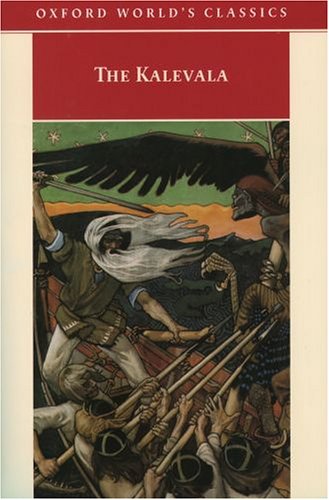
And presiding over everything is the dread Witch Queen of the Northland, Louhi, who has a number of beautiful daughters whom the heroes woo; who transforms herself into a bird and fights Väinämöinen for the magical artefact, the Sampo.  That's what's being portrayed in the painting on the book cover, by the way.

Strange to consider the position of women in this tale. Women hardly get a say in The Iliad, but pretty much every later epic lends them a voice. And here, while they're being married off or just stolen, they do wail and complain and even cheat on their would be husband-rapists and get turned into seagulls. So there's some proactivity going on.

And intriguingly, women begin and end the tale. Marjatta, like Ilmatar, is a mother. In Canto 50, she appears as a Virgin Mary figure who becomes mysteriously pregnant after eating a lingonberry (watch out, Ikea food-lovers!) and gives birth to the infant King of Karelia, who can speak at the age of two weeks, admonishing Väinämöinen for his lack of respect to his better. And Väinämöinen wanders off into exile, grumpily, signalling that the age of heroes is past.

Ah, but is it? This poem is a celebration of poets and poetry: the heroes *sing things into other things*, i.e. they can sing a man deeper into the ice to kill him, or sing a wolf into the shape of a cow. The power of words, of imagination. And though Väinämöinen rescues the sun and dispels the demons of illness with the invention of the sauna, his greatest achievement is the invention of the kantele, a zither-like instrument inspired by the bones of the pike.

If poets still live, then are the heroes dead?

Someone oughta gather all the urban ghost stories in Singapore and see if we can make an epic poem out of that.


View Around the World in 80 Books!!! in a larger map

Representative quote:

The old man quickly christened
and briskly baptized the child
king of Karelia
guardian of all power. At that
Väinämöinen was angry -
he was angry and ashamed
and he stepped away
towards the shore of the sea
and there he started singing
sag for the last time -
sang a copper boat
a coppery covered craft
and he sits down in the stern
he cast off on the clear main
and eh uttered as he went
declared as he departed:
'Just let time pass
one day go, another come
and again I'll be needed
looked for and longed for
to fix a new Sampo, to
make a new music
convey a new moon
set free a new sun
when there's no moon, no daylight
and no earthly joy.'

Then the old Väinämöinen
goes full speed ahead
in the copper boat
in the coppery punt
to where mother earth rises
and heaven descends
and there he stopped with his craft
with his boat he paused; but he
left the kantele behind
the fine music for Finland
for the folk eternal joy
the great songs for his children.

Next book: Unt Mati's Things in the Night, from Estonia.

Friday, February 28, 2014

Book 144, Sweden: "Miss Julie and Other Plays" by August Strindberg

Ah Sweden. Home of the Nobel Prize for Literature, and eight laureates thereof (they do have home advantage, after all). Also birthplace of Stieg Larsson's The Girl With the Dragon Tattoo, Maj Sjöwall and Per Wahlöö's Martin Beck detective series, John Ajvide Lindqvist's Let the Right One In and Astrid Lindgren's Pippi Longstocking.

And who do I choose for this blog? A psychotic misogynistic 19th century playwright whose stuff is mostly unstageable. Ladies, I give you: August Strindberg!


Ooh, but isn't that a pretty cover?

There's five plays in here, performed between 1887 and 1907. They're The Father, Miss Julie, The Dance of Death I, A Dream Play and The Ghost Sonata. They're supposed to represent his progression from naturalism - i.e. a social realism that hinges on biological premises of naturally inherited traits of femininity, psychosis, etc - to radical experimentalism.

But the truth is, even in his earlier works, I have no idea what's going on. Is the Captain really nuts in The Father, or is his wife Laura just goading him on, and does that mean that he was going crazy to begin with anyway so she had every right to send him to the loony bin? Seriously, it's quite possible to read the women he wants you to hate as strong but broken women.

This is probably why Miss Julie still gets so much play. It's a two-act piece, a three-hander, between the noblewoman Miss Julie, her manservant and lover Jean, and the servant-girl Kristin, and the big dynamic is about the dominance of Jean over Julie - and yet Kristin's level-headed sense seems to make her the ultimate moral compass of the piece, never mind that Strindberg dismisses her in his infamous preface as a "female slave", the lowest of them all. (This is seriously the only play of his in which I could be pretty sure I knew what was happening.)

It's my second time reading A Dream Play and The Ghost Sonata - and I guess they are worth a reread. While there is very little linearity in these tales, there are such striking images that one wonders if Strindberg was visited by a time-travelling surrealist - the daughter of a god freeing a man imprisoned in a castle, the lovers doomed to fall out of bliss by the paralysis of a quarantine, a Sunday child student who can see ghostly milkmaids, a vampirical servant woman, a living mummy, phantasmagorical hyacinths... and no clear endings, because it was the twentieth century now, and structure be damned.

A Dance of Death I is somewhere in between. I think I know what's going on (but did the Captain's wife and Kurt actually sleep together or what?), yet that's not the point - the entire point is the mood of foreboding that casts its pall over everything...

I suppose my main worry after reading all this is whether I've made the best use of my eyeball-time. I should be reading works that'll improve my writing - what can I learn from these strangenesses?


View Around the World in 80 Books!!! in a larger map


Representative quote: from Miss Julie:

JEAN Don't think, don't think! You're taking all my strength away too, and making me a coward- What's that? I thought the bell moved!- No! Shall we stop it with paper? - - To be so afraid of a bell! - Yes, but it's not just a bell - there's somebody behind it - a hand sets it in motion - and something else sets that hand in motion - but if you stop your ears - just stop your ears! Yes, but then he'll go on ringing even louder - and keep on ringing until someone answers - and then it's too late! Then the police will come - and then...

Two loud rings on the bell.

JEAN: [cringes, then straightens himself up]. It's horrible! But there is no other way!-Go!

Next book: Sally Salminen's Katrina, from the Åland Islands.

Sunday, February 16, 2014

Book 143, Norway: “Hedda Gabler” by Henrik Ibsen

I’m in Paris now! Accompanying my mother on a little excursion. And while she’s been shopping in the Rue du Fauborg St Honoré, I’ve been sitting around reading stuff like this:


Yeah, I know I said I’d do An Enemy of the People, which is relevant to Singapore because it’s about a man trying to convince people that the very system of capitalism that their community runs on is poisonous. But I did so want to check out a book from the library with a properly illustrated cover, instead of the dreary cloth hardbacks that UEA tends to stock.

And Hedda Gabler... well, I've heard about it for years. My old playwriting mentor Robin Loon told us in Writers Lab how beautifully she manipulates other people; my old drama club teacher Nicola Perry played her in a production by the Stage Club; I've even read a book on directing way back that cited a version of the play in which she rides a colossal pistol like a mechanical bull.

And you know what? The story lives up to the hype. Almost sad I didn't watch it on stage first. It's a classic drawing room drama, with all the action set in the salon of her villa on the western side of Kristiania (now Oslo). She's just come back from her honeymoon with her new husband, the mediocre medieval material cultures academic George (Jørgen) Tesman, who's fully expecting to receive a professorship that will enable him to pay off the debts he's incurred to buy and redecorate said mansion, just so he can please his glamorous twenty-nine year-old wife, whose life as a General's daughter has been parties and libertinism, who wants a place where she may entertain guests and live out a little more of her fading glories...

But that's a much too romantic portrait of Hedda. She is a great Freudian neurotic, according to the Wikipedia article about the play, and the truth is that she loves Tesman not at all, and has already lost her fascination with the house, and now the only pleasure she can find in life is to seek power over others, and so when it seems Tesman may not get the professorship after all, as his former rival Eljert Løvborg has bounced back with a brilliant publication, Hedda glides into malicious action, destroying, burning, blasting...

God, it's so wonderfully dramatic. Everyone talks about A Doll's House when they speak of Ibsen, but the fact is that Nora is quite in possession of her senses, even when she's dancing the tarantella, and her tale of feminine liberation is a little out of date today. Hedda's firing off her pistols in the garden, boom boom, feeding pages of manuscript into the fire. She's whacko. She's the madwoman who's in the living room but is dying to rise up to the attic.

I've actually read a fair bit of Ibsen for a Modern Drama class at Columbia - we read A Doll's House, Ghosts, The Wild Duck, and the crazy-weird-wonderful Peer Gynt. And this seems to have been the last of his major works, and it's possibly one of the most thrilling, for its brilliant depiction of nihilism in corsets. But I'm honestly feeling a tad guilty for selecting just this one play, rather than a collection to wade through. The Lady From the Sea, The Master Builder, and of course An Enemy of the People... ah, why do libraries not simply stock the volumes one hasn't yet read in the same book?

Anyhow, next week we'll have our hands on another great nineteenth century dramatic portrait of a lady from Scandinavia. Can it stand the comparison? We'll see.


View Around the World in 80 Books!!! in a larger map

Representative quote: 

MRS. ELVSTED: You've got some reason for all this, Hedda!

HEDDA: Yes I have. For once in my life I want to feel that I control a human destiny.

MRS. ELVSTED: But surely you do already?

HEDDA: I don't, and I never have done.

MRS. ELVSTED: But what about your husband?

HEDDA: Yes, that would really be something, wouldn't it. Oh, if only you knew how destitute I am. And you're allowed to be so rich! [She passionately grips MRS EVLSTED in her arms.] I think I'll burn your hair off after all.

Next book: August Strindberg's Miss Julie, from Sweden.

Thursday, January 2, 2014

Book 140, Scotland: "Waverley" by Walter Scott

And ther's a hand, my trusty fiere, 
And gie's a hand o' thine;
We'll tak' a right good willie-waught,
For auld lang syne... 

A Happy New Year and a joyous Hogmanay to you all! And verily, 'tis a shame that I'm not doing Robert Burns's poems - read out a good portion of Tam O'Shanter to my partner at the Fengshan Centre hawker stalls, though.

Instead, I chose to get ahead with my readings for my Novel History class at UEA by reading what's arguably the world's first ever historical novel - a work by an author so worshipped in his native land that they built the world's largest literary monument to him; a novel so successful that it launched an entire line of Scots-themed novels and a flood of English tourism to the previously deserted Scottish highlands and an entire genre of tartan-wrapped myth-making Hibernomania that's culminated in Mel Gibson and Pixar movies; a novel so influential that the Edinburgh railway station is named after it!


Yessir, I'm talking about Waverley, that colossal and no-longer-very-popular novel in two volumes that's now overshadowed by Scott's other works like Rob Roy and Ivanhoe, the latter of which is generally considered to be the most readable of his novels, despite not being about Scotland at all.

And indeed, there's something not very Scottish about Waverley itself. Sure enough, the story's set in Scotland - the entire first volume is basically a travelogue: an excursion from lowlands to highlands, with scenic views of peasants and robber barons and lairds and lords on the way, with commentaries on the hearty nature of Scottish breakfasts (mostly based on an abundance of oatcakes, from what I gathered). The second volume even follows the fate of the Jacobite Rebellion, wherein the Bonnie Prince Charlie, descendant of the Scots-descended Stuart throne overthrown by the Hanovers in the Glorious Revolution, battles to regain kingship of the United Kingdom, reinforced by his Scots allies.

But here's the thing: the eponymous character of the book, Edward Waverley of Waverley-Honour, is English. He's the son of the Lord of Waverley, and a captain in the army of King George, posted to Dundee, only wandering off to explore the countryside and encountering its colourful, kilt-arrayed inhabitants while on leave. Of course, due to some mixups, he's accused of desertion (this only happens at the end of Book One, as the plot takes a helluva long time to develop) and ends up in the care of the fiery laird Fergus MacIvor, allied to the Young Pretender (i.e. Prince Charlie), so that he's able to show his valour in the battles against his own army, on the side of the Scotsmen, all the while feeling guilty and conflicted but knowing that the men he's fighting for are stout-hearted and noble and true...

Honestly? This is exotica. We've seen the same tropes in Dances With Wolves, The Last Samurai, Avatar. TV Tropes calls it Going Native; I call it the insertion of a white (or more ethnonormative) protagonist into a non-white (non-ethnonormative) cultural struggle in order to make that conflict relatable to an audience that's been trained to only identify with white guys on screen. Despite its apparent intentions of expanding empathy, it supports a racist cultural status quo which white guys are always cast as the heroes, even when they're battling against the system their people established.

Waverley himself is a colourless everyman - said to be handsome and charming and invincible in battle only when he's swapped out his trousers for a kilt patterned with the Glennaquoich colours, but romantic and absent-minded otherwise, not unlike your prototypical English reader. He's young and moral and pure and not very rich until the end, Meanwhile, the Scots are foolish or impetuous and proud and wild, especially in their feminine apotheosis as the raven-haired, fiercely patriotic Flora MacIvor, whom we see early on in the novel reciting translations of Gaelic poetry to our hero while accompanying herself on the harp in the mountains, making his poor heart ache...

[SPOILER ALERT!!!] He doesn't get this girl, surprisingly, but does end up boffing another Scots noblewoman, the more subdued and innocent and tender-hearted Rose Bradwardine, who, like the conquered Scots territory, may be tamed and educated and improved until she's as sweet and noble as an English rose.[SPOILERS END.]

Didn't realise I'd do quite as postcolonial a reading on this as I did, but it's bleeding obvious. Still, it's  honestly a little reassuring to realise that the game of Orientalism goes back two hundred years (exactly!!!), when the colonial game was really only starting to get properly into its stride. And sure, Walter Scott was Scottish himself - a lowlander, not a highlander, though - and he was really just trying to inspire appreciation for his nation's romantic history. But the idea that this is what you have to do as a good ambassador for your country is hella creepy - that if you love your motherland, you've gotta pimp it.

Gah. But this wasn't actually a bad read, given that I could skim the Project Gutenberg e-book (there were even pictures!), and I was expecting far worse given the bad press that the Edinburgh Book Lovers Tour guide gave it. One less political note I should supply is that it sounded very Austen-esque at times. Shouldn't have been a surprise, given that she was Scott's contemporary, but the bad Latin and French-spouting numbskull Baron of Bradwardine and the way Flora turns down love with the supremest of rational logic had me definitely thinking of Pride and Sense and Prejudice and Sensibility and Persuasion and Lady Emma Susan Mansfield Northanger Park Abbey.

And thus ends my tour of the British Isles! Can't believe it's taken more than a whole semester to explore. Btw, I'd actually considered doing another previously completed item of coursework for Scotland - an example of tartan noir from my crime fiction class. Despite that omission, I'd still thoroughly recommend Denise Mina's The End of the Wasp Season. This country's got a lot of good writing in it.


View Around the World in 80 Books!!! in a larger map


Representative quote: While, plunged in the sad reflections which the scene excited, he was looking around for some one who might explain the fate of the inhabitants, he heard a voice from the interior of the building singing, in well-remembered accents, an old Scottish song:—

They came upon us in the night,
And brake my bower and slew my knight;
My servants a' for life did flee,
And left us in extremitie.

They slew my knight, to me sae dear;
They slew my knight, and drave his gear;
The moon may set, the sun may rise,
But a deadly sleep has closed his eyes.

Next book: Isak Dinesen's Anecdotes of Destiny, from Denmark.

Monday, September 30, 2013

Book 134, Isle of Man: "The Manxman" by Hall Caine

UEA’s library isn’t quite as voluminous as some I’ve seen, but it does contain some nice surprises. I was originally planning to read some book of folklore for the Isle of Man (which is actually classified as a separate entity from the UK). While searching the catalogue, I also happened to come across a biography of an eminent Victorian named Hall Caine – a bestselling author and playwright, a companion of Dante Gabriel Rosetti, and a proud Manxman.

Once a recognizable face on both sides of the Atlantic, Caine is largely forgotten today. This online biography suggests that his greatest work was The Scapegoat, but the library offered me a copy of The Manxman instead: 29th edition, printed in the 1920s. Sadly, I dropped it - the librarians will have some gumming together of spines to do after this – and resorted to reading an online edition for the remainder of the week.


But heavens, this is good stuff. It’s fundamentally the tale of a love triangle: simple Pete, his smart half-cousin Philip, and the fair Kate. But the story follows them from birth to childhood to adolescence to tumultuous adulthood, their drama playing out against the charming backdrop of Sulby, a coastal village alive with superstition and fishermen’s rebellions and Christian extremism and ridiculous codes of honour – Philip and Pete, for instance, are both the grandsons of the old Deemster, a high-born judge in his castle, but the father of the first was disowned when he married a common-born girl and the second was the fruit of an affair with his mother paid off in cash for her shame. There’s this stupid, stupid taboo against marrying below or above your station – it’s something a gentleman simply cannot do if he wants to continue receiving the respect of the tiny island community.

But I suppose it’s character that really drives the tale. Philip's a social climber, guilt-tripped by the memory of his late father whose ambitions were ruined by his love for his lower-class, equipped with the intelligence and the personality for a rising career in law and politics, ultimately becoming a Deemster, or a judge for the island. He falls in love with Kate, who used to be Pete's sweetheart, before Pete set off for the diamond mines of Kimberley for five years, so he could earn a fortune worthy of her hand. The guilt of this tortures him utterly - and it tortures Kate too. Meanwhile, Pete's just the most big-hearted, loving man possible, unaware that his every forgiveness of Kate and his kindness to Philip just tortures them further.

Basically, this is a story of adultery in which everyone involved is actually a good person - sure, they do terrible things sometimes, but they feel horribly guilty about it (mind you, they're the sort of folks who feel guilty even when they do good). And it works. We're thrust into the minds of all three protagonists, and we struggle with them, feeling for them. (Me particularly: I'm in a weird halfway state in my relationship to a very good person, and I'm not sure where how it's all going to end up.)

But there's also a huge level of absurdity to the characters' quandaries - their values, their conceptions of sin that outweigh any considerations of social achievement, are very un-Asian (or perhaps un-21st century, or simply unworldly). It's a little mad, how a successful young man with a rising career, a credit to his race, et cetera, should be in agony over the thought of marrying a "fallen woman" - or indeed, that any woman should consider herself fallen at all.

Messy thoughts today. Also on my mind is the fleetingness of Caine's fame - he peddled his exotic status as the "Bard of Manxland" in a manner that presages the workings of "world literature" as a contemporary genre, but because he was only a geographical minority, not a racial of gender one, he's fallen quite out of the Canon. Plus, his irrelevance to my current course: it'd be unwise for me to emulate his maudlin histrionics, no matter how effective they may still be.

Plenty more reading for me to do for school. If, however, you'd like to spend just a couple of hours with the story, you could check out the film version, directed by no less than Alfred Hitchcock!


View Around the World in 80 Books!!! in a larger map

Representative quote:
That night Philip dreamt a dream. He was sitting on a dais with a wooden canopy above him, the English coat of arms behind, and a great book in front; his hands shook as he turned the leaves; he felt his leg hang heavily; people bowed low to him, and dropped their voices in his presence; he was the Deemster, and he was old. A young woman stood in the dock, dripping water from her hair, and she had covered her face with her hands. In the witness-box a young man was standing, and his head was down. The man had delivered the woman to dishonour; she had attempted her life in her shame and her despair. And looking on the man, the Deemster thought he spoke in a stern voice, saying, "Witness, I am compelled to punish her, but oh to heaven that I could punish you in her place! What have you to say for yourself?" "I have nothing to say for myself," the young man answered, and he lifted his head and the old Deemster saw his face. Then Philip awoke with a smothered scream, for the young man's face had been his own.

Next book: Mary Ann Shaffer and Annie Barrows's The Guernsey Literary and Potato Peel Pie Society, from Guernsey.

Sunday, September 16, 2012

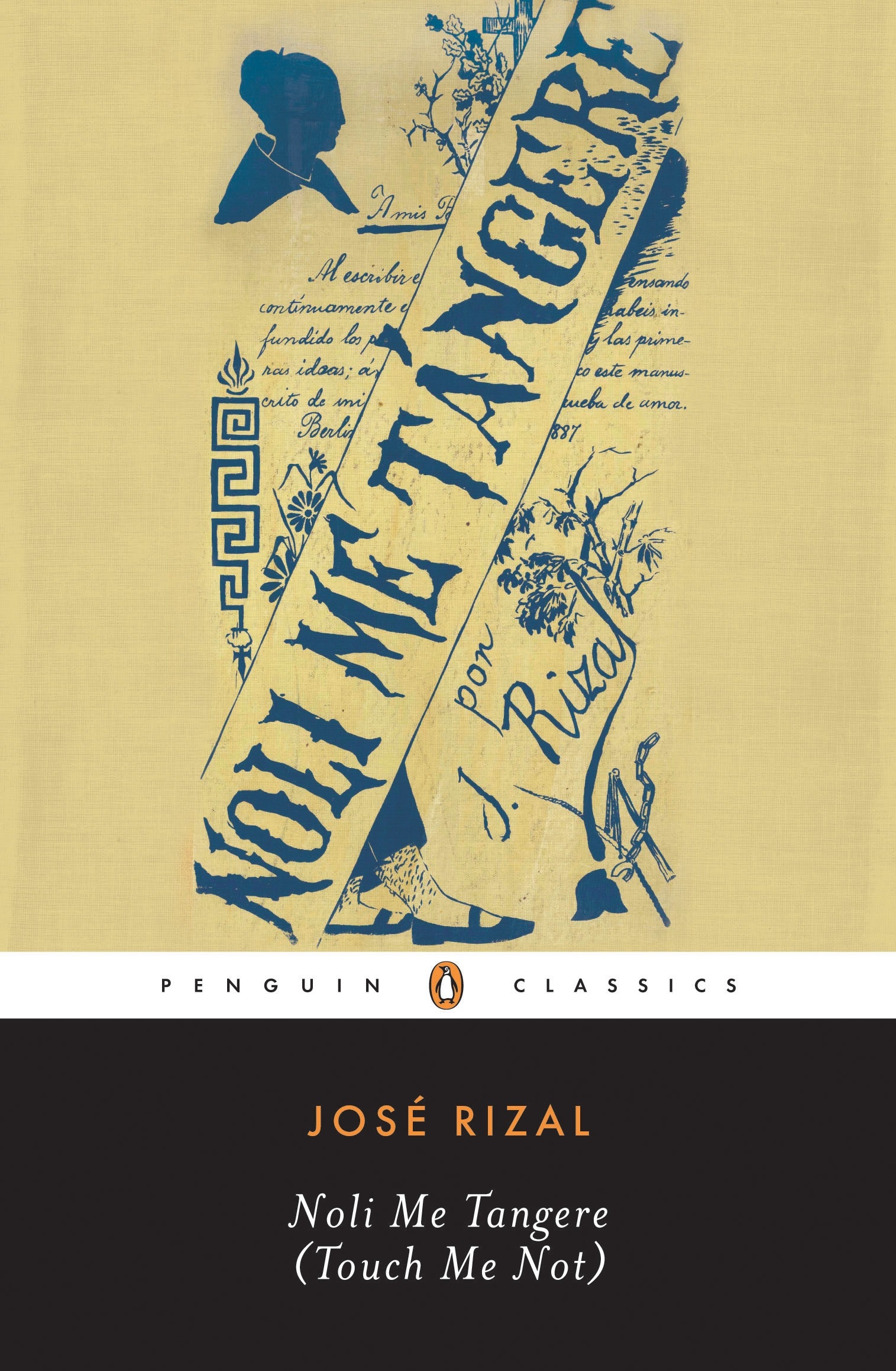
Book 105, the Philippines: "Noli Me Tangere" by José Rizal

In case you haven't heard of José Rizal, well, he was a freakin' genius, that's who he was. Look him up. Lived in Spain's most backwater colony in the 19th century but nonetheless learned 22 languages; found employ as "an ophthalmologist, sculptor, painter, educator, farmer, historian, playwright and journalist"; while also dabbling in "architecture, cartography, economics, ethnology, anthropology, sociology, dramatics, martial arts, fencing and pistol shooting".

Oh, and he did that all before he was executed at the age of 35 on 30 December 1896, thus igniting the Philippine Revolution. Way more than just a martyr: he was one of the great modern thinkers of Asia, in the league of Sun Yat-Sen and Tagore. Amazing. 


The way he fomented his ideas, of course, was through his novels, which are studied by every kid in the Philippines today (in English or Tagalog translation from the original Spanish). And the wonderful thing is that the Noli ages well: because he published it in Europe for the benefit of those who didn't know about colonial abuses, what he does is he provides a thorough ethnographic sketch of his homeland at the time, which is just as fascinatingly foreign to us 21st century people as it would've been to the Iberians. 

Y'see, seems that the Philippines was a friarocracy - its priests outranked the Spanish colonial officers in practice if not on paper. Rizal (an atheist!) highlights the crazy hypocrisy that this birthed: sales of indulgences, inflated fees for sermons in languages the laity can't understand, an utter lack of interest in uplifting the population in any way through education, and a sense of being an invulnerable caste - you don't tip your hat to them in the street, they excommunicate you, and the rest of the sheep-like population looks upon you with scorn.

No idea if the Franciscans and Dominicans and Jesuits were really as nasty as described in the book, but absolute power corrupts absolutely, so I've a feeling the answer's yup. 

There's deep shades of Uncle Tom's Cabin here: from the stock characters (the noble hero Don Crisostomo Ibarra, the virtuous heroine María Clara, the evil priests Father Dámaso and Fray Sibyla, the revolutionary Elías) to the sheer purpleness of the prose when tragedy strikes. But there's also a Dickensian joy in descriptions of the follies of people (Doña Victorina, who pretends to be Spanish and murders the language whenever she speaks it, and takes it all out on her actually Spanish husband by pulling the false teeth from his mouth). Also maybe a Wilkie Collins-esque touch of melodrama - the nail-biting death scenes, the apparition of the ragged nun on the convent rooftop - and remember, Rizal, the genius bugger, probably read all these guys and digested them.

Lor, no wonder the Philippines is so creative. If only our country was founded on the bulletwound of a polymath poet. One last note: this book is good, but it ain't light reading - might be a while till I move on to the sequel, El Filibusterismo.


View Around the World in 80 Books!!! in a larger map

Representative quote: "You're right, Elías, but man is a creature of circumstance. I was blind then, disgusted, what did I know! Now misfortune has ripped off my blinders. Solitude and the misery of prison have shown me. Now I see the horrible cancer gnawing at this society, rotting its flesh, almost begging for a violent extirpation. They opened my eyes, they made me see the sores and forced me to become a criminal! And so, just what they wanted, I will become a subversive, but a true subversive. I will call together all the downtrodden people, everyone who feels a heart beating in his heart, those how sent you to me... No, I won't be a criminal, you aren't a criminal when you fight for your country, just the opposite! For three centuries we have held out our hand to them, asked them for love, eager to call them brothers, and how do they answer us? With insults and mocking, denying us even the status of human beings. There is no God, no hope, no humanity, nothing more than the rights of power!"

Next book:  Henrique de Senna Fernandes's The Bewitching Braid, from Macau.

Sunday, July 8, 2012

Book 102, Thailand: "The Story of Phra Abhai Mani" by Sunthorn Phu

The real Phra Abhai Mani is a 30,000-line epic poem that took 20 years to write: this is only a 111-page prose translation (available online!) that ends with suspicious abruptness. I shouldn't be doing it, really - I've tried to steer myself away from abridged texts, mostly because they don't feel real.

On the other hand, this translation was done by a Thai Prince, Prem Burachat, in 1952. My copy of the book was even printed in Thailand. So it's definitely authentically Thai, more so than stuff by recent emigres and expats. And it feels important to incorporate something pre-modern into my Southeast Asian reading list: something that shows that we had a culture even before the imported invention of the novel.


And by golly gosh, I'm glad I decided to read this. This story is trippy, no doubt about it. It's set in a magical timeless fantasy world wherein our princely hero Phra Abhai Mani, wanders from island to island, falling ridiculously in love with various hot women (a sea giantess, a mermaid and two warrior princesses, one of whom also does a stint as a nun).

He's armed only with his handsomeness and his magical ability to make everyone fall asleep when he plays his flute. (Don't pour scorn on this skill; it's extremely useful against invading armies.) He's also assisted by his two prodigious sons, Sin Samudr and Sud Sakorn, of giantess and mermaid stock respectively. They're pictured as ten year-old boys each with the strength of ten men: Sud Sakorn actually rides a magical beast with the face and tail of a dragon and the body of a horse, upon which he slays giant man-eating butterflies. Ripping stuff!

The crazy thing is, this book isn't from an antique age: it was composed from the 1820s to the 1840s, same time as Europe was colonising our part of the world and undergoing an Industrial Revolution and Byron was writing mock-epics like Don Juan and Mary Shelley was writing Frankenstein. Should we consider this extended court poem as a work of modern fantastika?

There's evidence of the modern in the text: the island of castaways includes "Chinese, Brahmins, Indians, Thai, Javanese, Englishmen, Hollanders and other Europeans", and even the princess Suvarnamali is threatened by an English pirate named Surang. Then there's all this interest in sciences and skills and cunning which allows the heroes to triumph over their enemies - no bloody duke-em-out battles here, as in The Iliad or Fengshen Bang. (Or is that modern? Plenty of sailing around and outsmarting people in The Odyssey and The Seven Voyages of Sindbad, too.)

But quibbling aside, here's what gets up my hackles: if this book is so good, so good that there are monuments and movies and comics and waxwork exhibitions and beach megaliths to commemorate it, then why isn't there a full-length English translation of the work yet? And why isn't the work more widely known outside Thailand? The country's full of people who speak English well; why can't they follow in the learned prince's footsteps and disseminate their culture to the world of earnest world literature junkies like myself?

I suppose the reason is the scale of the work - The Tale of Khun Chang Khun Phaen (which I believe Sunthorn contributed to) was translated two years ago, and that book's 984 pages long! That baby deserves a place on my reading list too, I suppose. Lord have mercy.


View Around the World in 80 Books!!! in a larger map

Representative quote: Once more, the hermit came to the aid of his ward. There was a deafening sound. Sud Sakorn looked up and saw the old man descending astride a rainbow. Gathering the bruised body of the boy up in his arms, the hermit took him aloft and gently laid him ont he mountain top. He then proceeded to teach the boy thus: "Put not your trust in any mortal, for their wiles are immeasurable. Even the most tortuous creepers round the hoariest tree are not as crooked as a man's heart. True love among mortals is only to be found in the love of a father or mother. The only support you can rely upon is yourself. So you must be careful and wise, my boy. There is no better armour than knowledge. Now you must go and recover your magic stick." As soon as he had said this, the hermit vanished from sight.


Next book: A Samad Said's The Morning Post, from Malaysia.

Wednesday, May 23, 2012

Book 97, Bangladesh: "Selected Short Stories" by Rabindranath Tagore

As you know, Tagore was an amazing poet: made the Europeans swoon with his Gitanjali. (Left me a bit ho-hum, to tell the truth: I am not a truly mystical soul.)


I'm here to report that he was also a master of the short story form. These pieces are some of the first literary short stories ever written in Bengali, composed while he was looking after his ancestral states in East Bengal (now Bangladesh) in the 1890s, reflecting on the nature of Indian village life which he'd seldom encountered in Calcutta and Sussex. The intro says that he was only driven to write these 'cos the magazine editors wanted 'em - a lot of critics back then didn't like 'em, in fact; said they were unrealistic, overwrought.

The way I see it, they're wonderful admixtures of poetry, realism and fantasy - and, yes, fantasy: he has Poe-like horror pieces like The Hungry Stones and Skeleton; fables like Wishes Granted in which a fictional Goddess of Desires descends to make a boy and his father swap places. Even in the social realist pieces, there's that wonderful sense of destiny and fate and spirituality looming over everything - the heartbreaking reappearances of vanished sons in Little Master Returns, Wealth Surrendered, Son-sacrifice, and the curse averted in The Gift of Sight...

Oh and I should warn you that Tagore is prepared to do horrible things to his characters. No Dickensian jolly opportunities for reform here; instead the Catherine Lim-esque ironies bounce back on these folks and ruin the very purpose of their lives. This is the Kaliyuga, after all: the age of the fallen. But speaking of ages, it's incredible to think these are tales from two centuries ago: the concerns are identical to those of South Asia today: religious divides, caste, bride prices, oppression of women, a culturally denatured generation of middle-class intellectuals. It's only when they mention that they're riding horse carriages rather than Tata Nanos that you realise how ancient this is.

Interesting thing about my earlier concerns about whether this is a Bangladeshi text, since the characters aren't Muslim. There are indeed Muslims, but they're marginal, sometimes exotic figures - an ancient Mughal princess in False Hope, a murderous but kindly sweetmeat seller in Kabuliwallah, a secret mistress of a Brahmin land-owner in A Problem Solved

What makes this Bangladeshi for me is the call of the river Padma: the flooding waters that strand lovers on islands and swallow up firstborn sons. Floods are very Bangladeshi indeed.


View Around the World in 80 Books!!! in a larger map

Representative Quote: from Guest.

 Early monsoon clouds formed in the sky. The village-river had been dried up for weeks; there was water only in holes here and there; small boats lay stuck in these pools of muddy water, and the dry river-bed was rutted with bullock-cart tracks. But now, like Parvati returning to her parents' home, gurgling waters returned to the empty arms of the village; naked children danced and shouted on the river-bank, jumped into the water with voracious joy as if trying to embrace the river; the villagers gazed at the river like a dear friend; a huge wave of life and delight rolled through the parched village. There were boats big and small with cargoes from far and wide; in the evening the ghat resounded with the songs of foreign boatmen. The villages along the river had spent the year confined to their own small worlds: now, with the rains, the vast outside world had come in its earth-coloured watery chariot, carrying wondrous gifts to the villages, as if on a visit to its daughters. Rustic smallness was temporarily subsumed by pride of contact with the world; everything became more active; the bustle of distant cities came to this sleepy region, and the whole sky sang.

  Next book: Theater of Memory: The Plays of Kalidasa.

Monday, May 7, 2012

It's Rabindranath Tagore's birthday!

His 151st birthday, to be precise. And I'm reading his short stories!


He was born on 7 May 1861 and died on 7 August 1941, as I learned from Wikipedia. First Asian winner of a Nobel Prize, too.

And as you can see, he was a FOX. Like a cross between Jesus and Santa Claus, only Hindu. That's him acting in one of his plays, The Genius of Valmiki:


The truth is, I'm feeling pretty guilty about using Tagore for Bangladesh. He lived in British Bengal, and was born and died in the bit that's currently in India. Plus, he was Hindu, and wrote about Hindus, while Bangladesh is Muslim.

On the other hand, Bangladesh venerates him as a national hero and uses one of his songs as its national anthem. Tagore also happened to write most of his short stories while managing his ancestral estates in Shelaidaha, in present-day Bangladesh.

 I was pretty sure Mr Tagore was my best choice (there aren't, sadly, a lot of internationally famous Bangladeshi writers around today), until I realised I could do books by the inventor of microfinance and founder of Grameen Bank, Mohammad Yunus:


Also a Nobel Prize Winner! For peace, though. Does that count?

If any of you strongly believe I should ditch Tagore and read Banker to the Poor or Creating a World Without Poverty, do leave me some comments.

Wednesday, November 17, 2010

Book 35, Bermuda: "The History of Mary Prince, A West Indian Slave" by Mary Prince

Surprise! I decided to skip the US Virgin Islands for the time being and instead head north, to a country that's Caribbean only in the loosest sense of the word.

Wasn't gonna do it at first, since the only books I could find about Bermuda were snorkeling manuals, scuba detective novels and Bermuda triangle conspiracy screeds. (Incidentally, there've been no disappearances in the Bermuda triangle since they invited GPS. Guess we finally outwitted the Cthulhu-worshipping aliens. Score one for science!)

But then, while surfing the Kindle store, I discovered this:


It's the world's first slave narrative by a woman - and the UK's first autobiography of a black woman. It was published in 1831, before Frederick Douglass, before Hannah Crafts, before Harriet Jacobs (and of course before Harriet Beecher Stowe). It's a canonical text in Black History and Diasporic African Literature. And its author, Mary Prince, was born and raised in Bermuda.

It's a great read. Not just because it's short, and not just because its publication was actually instrumental in drumming up local support for the UK's Anti-Slavery Society. No, what moves me is the graphic brutality of the abuses that Prince describes - nothing quite like this in the more genteel Douglass and Jacobs - floggings with cowskin whips, suspensions in the air while the master's son pierces your foot with a bayonet, being forced to work in the salt ponds of Turks and Caicos Islands causing blisters on your legs, wounds eating your flesh to the bone, full of maggots.

And all in this eloquent, measured 19th century English - "To be free is very sweet," she says. To be sure, she didn't write the whole text herself, being partially literate, but it was copied down almost verbatim, so the Anti-Slavery Society says, putting in footnotes to explain what she means when she calls white folks Buckras.

And here's the other thing. It's also moving to skim the editor's supplement to her own narrative, showing how much work the Buckras of the Anti-Slavery Society put in to prove Prince's credibility as a witness, arguing eloquently against the slander of her former master whom she left (he'd brought her to London despite slavery being outlawed in the UK itself, expecting that she'd never have the will to run away).

God bless these white folks who recognised the horrors of 19th century capitalism, and who worked so hard to end them. God bless Thomas Pringle, the author of the supplement and her subsequent employer; God bless her friend Susanna Strickland, who transcribed her story; God bless also the white washerwomen who took pity on her and helped her with her chores when they saw how sick she had fallen under her master's abuses.

And God damn *us*, for daring to live in a world where there are more slaves than in any other period in history, and doing so little about it.


View Around the World in 80 Books in a larger map

Representative quote: Oh the horrors of slavery!--How the thought of it pains my heart! But the truth ought to be told of it; and what my eyes have seen I think it is my duty to relate; for few people in England know what slavery is. I have been a slave--I have felt what a slave feels, and I know what a slave knows; and I would have all the good people in England to know it too, that they may break our chains, and set us free.

Next book:
by Robert and Melinda Blanchard's Live What You Love, from Anguilla.

Monday, November 15, 2010

Book 34, British Virgin Islands: “Treasure Island” by Robert Louis Stevenson

Yes, I’m a hypocrite. I made fun of Shelbi for doing Dracula for her Romanian book, and now I, too, am interpreting a country through the Victorian fantasy thereof. What to do? I scoured the library and Kindle catalogues and couldn’t find a single writer who was a British Virgin Islander him/herself.

Stevenson never actually visited the Caribbean, but he based the story off his mariner uncle's tales of Norman Island and Charles Kingsley's memoir, At Last: Christmas in the West Indies. So it kinda counts. And anyway, I’ve never read me this classic. The only film version I’ve seen is Disney’s Treasure Planet (haven’t even seen the Muppet Treasure Island!). And this is ur-text for pirate lore itself: the fount of peglegs, parrots yelling pieces of eight and yohoho and a bottle of rum.


It’s a marvelous distraction, surprisingly better toilet reading than New Malaysian Essays 2 (although maybe it’s the Kindle that makes it so convenient to dip into), and man do I love all that archaic language and elevated, unself-conscious prose - after all, it's narrated by the virtuous yet bad-assedly heroic teenage boy Jim Hawkins, with occasional interjections by the Doctor Livesey, both of whom believe ardently in the virtuous of good Christian faith and the damnededness of rum.

Of course, having watched Pirates of the Caribbean: Dead Man's Chest, you do have to give some leeway for the fact that in this book swashbuckling hadn't yet been pushed to its psychedelic, octopus-bearded limits. I mean, all the pirates get spooked out about on Skeleton Island is a single skeleton and the voice of the half-idiotic Ben Gunn (ah, the wild man archetype!). On the other hand, the book presses home the fact that it is by no means easy for Long John Silver to get about as a middle-aged man on a wooden leg - he stumbles on uneven ground and roars at the Captain when he refuses to give him a hand up when they're both sitting on the sand - a touch of realism which isn't quite grit, but which makes bloody sense.

Another thing about Long John Silver. He's perhaps the only really Caribbean character of the lot, given that it's mentioned that his wife is "a woman of colour". (I'd thought this was perhaps an idiom of the time for a scolding wife, a woman of choler, as it were, but later on Jim says "I dare say he met his old Negress, and perhaps still lives in comfort with her and [his parrot] Captain Flint. It is to be hoped so, for his chances of comfort in another world are very small."

There really is very little mention of Caribbean culture in the book, other than the name of the ship (HISPANIOLA) and a stopover in Spanish America, where young Jim is "immediately surrounded by shore boats full of Negroes and Mexican Indians and half-bloods selling fruits and vegetables and offering to dive for bits of money. The sight of so many good-humoured faces (especially the blacks), the taste of the tropical fruits, and above all the lights that began to shine in the town made a most charming contrast to our dark and bloody sojourn on the island." They take on a few hands there, but the ones we meet on the journey are all Englishmen, picked up on the docks themselves.

On the other hand, there is that old ruse of the dangers of the tropics - the pirates' great misstep is camping out in a malarial bog, after all. Bah, not completely inclined to do an entire post-colonial reading of the book. Though it does bear mentioning that this is the same guy who wrote, in A Child's Garden of Verses:

Little Indian, Sioux or Crow,
Little frosty Eskimo,
Little Turk or Japanee,
O! Don’t you wish that you were me?


The poem's deliberately ironic. Let's the embrace hipster culture and love it for being so.


View Around the World in 80 Books in a larger map

Representative quote: "The score!" he burst out. "Three goes o'rum! Why, shiver me timbers, if I hadn't forgotten my score!"

And falling on a bench, he laughed until the tears ran down his cheeks. I could not help joining, and we laughed together, peal after peal, until the tavern rang again.

"Why, what a precious old sea-calf I am!" he said at last, wiping his cheeks. "You and me should get on well, Hawkins, for I'll take my davy I should be rated ship's boy. But come now, stand by to go about. This won't do. Dooty is dooty, messmates."

Next book: Jean Heyn's The Governor-General's Lady, from the US Virgin Islands.

Saturday, August 28, 2010

Book 21, Nicaragua: "Azul" by Rubén Darío

As you can see, I finally managed to get a copy of Azul from Amazon for US$0.99! From the online edition here, the contents seem to be based on the first edition.


Fyi, Darío's known as the great Nicaraguan poet who invented modernismo in the late 19th century, the first literary movement to begin in the Americas and later spread to Europe.

But a couple of surprises:

1. Although Darío's famous as a poet, Azul(his first collection) is actually mostly made up of short stories, descriptive passages. There's a chunk of poems at the end, though.

2. Modernismo isn't actually very modernist. It's excessively flowery and effusive in praise of love and the beauty of young women and nature and jewels, bordering on Aubrey Beardsley-esque decadence. No sex, though. The poems are still pretty structured, too.

3. Hardly any of these pieces take place in Nicaragua. They're set in places with princesses (Italy?) or underground in the gnome kingdom or in Paris or Valparaíso - in fact, all the descriptive passages are about Chile, where Azul was published. The only piece set in Nicaragua is a weird autobiographical-sounding thang called Palomas Blancas y Garrzas Morenas, which is about him falling in love with his cousin while growing up with her and his grandmother, gawking at her 15 year-old body, with hair as blonde as German, no seriously, by the light of the silvered moon, "la luz de una luna argentina, dulce, una bella luna de aquellas del país de Nicaragua."

I'm honestly not that keen on the book. Sure, it's interesting as a cultural artefact, and some of the pieces are pretty cool - there's El Rey Burgués, a sad fable of the bourgeois king who cages the starving poet in his zoo, and La canción de oro, a crazy intense paean about gold and its effects on man. Also the descriptions of the tiger in his poem Estival. But given the difficulty of reading (my book had bizarre spellings: Js instead of Gs and vice versa, &c), I don't think I got a great payoff.

Didn't learn much about Nicaragua, either. There was a casual reference to the swamp crocodiles he encounters after his wedding in Palomas blancas, but this ain't a very nationalistic book. Which is okay, innit?


View Around the World in 80 Books in a larger map

Representative quote: Ya tenía quince años y medio Inés. La cabellera, dorada y luminosa al sol, era un tesoro. Blanca y levemente amapolada, su cara era una creación murillesca, si veía de frente. A veces, contemplando su perfil, pensaba en una soberbia medalla siracusana, en un rostro de princesa. El traje, corto antes, había descendido. El seno, firme y esponjado, era un ensueño oculto y supremo; la voz clara y vibrante, las pupilas azules, inefables; la boca llena de fragancia de vida y de color de púrpura. ¡Sana y virginal primavera!

Next book: Paul Theroux's The Mosquito Coast, from Honduras.