Thursday, July 21, 2016

Multicultural Singapore? Really?, 23 July 2016

So I'm still diligently reading Nikolai Gogol (which is fun, since his Ukrainian stories are ripping stuff). But I figured I might as well fill you in on one of the events I'll be doing:


Date: Sat 23 July, 2016
Time: 2pm-8pm
Venue: The Projector, 6001 Beach Road #05-00 Golden Mile Tower, Singapore 199589
Tickets: $40 from The Projector

Cultural diversity has long been a hallmark of Singapore society. We boast about being a bustling global city with a multiracial and multireligious society. But just how deep is our cultural diversity?

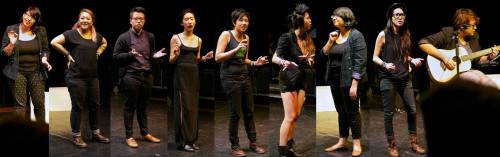
To what extent do our different groups and cultures understand and accommodate each other? Do our daily intercultural encounters lessen or harden social prejudices? Join us for a thought-provoking day with heartfelt poetry, insightful discussion and a screening of the award-winning film, Dheepan.

Keynote Speaker:
Assoc. Prof Daniel PS Goh

Panellists:
Asst. Prof Imran bin Tajudeen
Assoc. Research Fellow Mr. Pravin Prakash

Poets:
Divya Victor
Karisa Poedjirahardjo
Ng Yi-Sheng
Shivram Gopinath

Schedule:
1.45pm: House opens
2pm - 3.15pm: Poetry Reading
3.15pm - 3.30pm: Intermission
3.30pm - 4pm: Lecture
4pm - 4.45pm: Panel Discussion
4.45pm - 5.15pm: Audience Q&A
5.15pm - 6pm: Intermission
6pm - 8pm: Screening of “Dheepan”

Another event organised by the Singapore Advocacy Awards. Find us at https://www.facebook.com/SingaporeAdvocacyAwards/.

Sunday, June 26, 2016

Book 165, Chechnya: "I Am a Chechen!" by German Sadulaev

I know Chechnya isn't a recognised state by any international bodies. But while Russia and the UN don't recognise self-determination, that's no reason I shouldn't.

And anyway, this book is amazeballs.


Interesting fact: German Sadulaev didn't even mention the Chechens in his first book, Radio Fuck. And why should he have? He was a lawyer in St Petersburg, writing in his first language, Russian. He passed as Russian; indeed, his mother's ethnically Russian.

But he was born in Shali, a village in Chechnya. And he only escaped the violence there because he'd gone off to study in Leningrad at the age of 16. From a distance, he watched his idyllic hometown descend into war and chaos, brought on by the onslaught of heartless Russian bombers...

It's hard what to make of the text, actually. The first few chunks are written as dreamlike memoirs, clearly using autobiographical material, but with tonnes of magical realism thrown in: he claims all these portents of madmen and bleeding cattle that foretold the destruction; empathises with the agony of the swallows who saw their nests bombed to bits (the souls of unborn children, according to Chechen tradition), associates the race of the Chechens with the kshatriyas who were expelled from India in the age of the Upanishads... yet always returning to the detail of the "I" whose biography corresponds with that of his own: half-Chechen, half-Russian, suffering from the survivor's guilt and the weight of traditional machismo that prevents him from weeping out his pain.

And as the book progresses, we get more into the realm of fiction: in "When the Tanks Awoke", he confesses to the common childhood fantasy of having a twin, which eventually develops into a tale of himself as two boys, Zelik and Dinka, one with a Russian father and a Chechen mother, one with a Chechen father and a Russian mother, playmates and rivals who eventually end up facing one another on the battlefield. Later, clear fictions: "Victory Day", about an old Chechen World War II Soviet soldier who beats up a Neo-Nazi in Lithuania; "Snuff", about a phantom lover in New Orleans.

But always the sadness, always the sense of exile, always the sense of a kingdom lost—not just the Shali of his childhood, but the Soviet Union that he grew up proud to be part of.

It's strange to be reading this as Chechen literature, really. He's from Chechnya but not part of it, able to separate himself from the horrors of the war. But his family has suffered through it, been nearly killed by the sniper fire; he's had to demand that Russian flight crew allow his paralysed sister the right to stay on a plane because Russians have only read the state media that claim only terrorists have been attacked, when in reality, it's everyone, all the innocents, all those who once believed they were one people.


Representative quote: In the combat report from the front I heard that during the battle of Urus-Martan the Shali tank regiment had been eliminated. An enemy formation. When Russians die, they talk of 'losses', or even say they've 'fallen'. When Chechens die, they describe them as 'eliminated'. Because Chechens are the enemy. I too am Chechen: the enemy. And when I die, they'll describe me as 'eliminated'.

Next book: The Collected Tales of Nikolai Gogol, from Ukraine.

Saturday, June 18, 2016

Book 164, Russia: "War and Peace", by Leo Tolstoy

Guess what? I'm reviving my blog after a year and a half of inactivity! Because I've finally finished this bloody tome.


(I've decided on a new format for the pictures, btw—instead of just covers, I'm using the Instagram images I've posted at #yishreads. New year, new apps, y'know?)

Why did it take me so long to finish this? Hard to say. Part of it is that it moves really really slowly, so slowly that one forgets names and attributes and events.  It's hard to really feel like one's making progress, though the division into fifteen separate books and an epilogue helps—there's little dramas that begin and finish within an individual book.

There's no obvious main character either, which is why I suspect it would've been easier to get through Anna Karenina. The closest thing we've got is the innocent Pierre, who starts off as an impoverished illegitimate twenty-something.

Then he inherits money and a title, becomes a fat, cuckolded aristocrat who's scorned by all good society (and can't even exercise his well-intentioned reforms on his peasants without them suffering for it). And then the French invade, and he sees the city of Moscow collapse utterly, and he fails so utterly in his foolhardy attempt to assassinate Napoleon that the French see him as a loyal friend, but then he tries to save a girl from rape and gets captured as a prisoner-of-war and is marched through the steppes in deadly bitter frost before finally coming back into his title and comfort in the end, a better man for his suffering...

That's about the only plot I can hold onto. There's loads of other characters, but the only one I've got a strong impression of is Natasha, a foolish girl who plans to elope with a scoundrel but is saved when someone tells her he's already married. Pierre buys his silence. It sounds like a trivial little tale, but it's pretty vivid.

And you can tell from the contrast of these tales that this literally is a book about war and peace—it's got the horrors of a war diary (there are intense descriptions of the battlefield, limbs being torn off and everything), and the very next chapter may well be princesses in palaces worrying about gossip and respectability, and each is treated with equal importance. It's Pride and Prejudice meets Saving Private Ryan, I tell you.

We've seen some of this before in Walter Scott's Waverley, but that was a romance. This is a beast of a different nature—also a historical novel, but with a philosophy based on the randomness of history rather than some great narrative of the rise and fall of Scottish culture. Tolstoy has whole chapters of theory mixed in with the fiction, pointing out the folly of historians for telling the story of history as led by Great Men, or by the ideas of the intellectuals of the time, when really, in battles, everyone's just scrabbling around with no idea what they're doing, and every individual person's exercising his or her own will all the time.

He even punctures the popular myth of Muscovites burning their own city rather than letting the French have it by pointing out that any city with wooden houses, if left unattended in a battle, is going to be in danger of a mass conflagration. Not a romantic at all.

I think you can tell that I am fond of this book. It's nuts that it's so long and so disperse, but it does have great ideas and great moments embedded into it. Was it worth the time? I don't know. At least when I boasted about having finished this text, folks got that it was a big deal. More obscure texts just don't register.

Honestly, however, another reason this took a long time is because I borrowed the book from the library and kept having to return it, then switched over to the Kindle edition (which felt even more interminable, since you can't see the pages moving), only discovering a month or so ago that I actually had a copy on the shelves of my house....

And part of it was because once you stop trying to finish a book every week, you kind of enjoy being open to loads of other reading options, and going back to your original goal is kind of a chore. So I'm no longer going to force myself to read one book every week. I'll just update this site whenever I please.


Representative quote: "People speak of misfortune and suffering," remarked Pierre, "but if at this moment I were asked, 'Would you rather be what you were before you were taken prisoner, or go through all this again?' then for heaven's sake let me have captivity and horseflesh! We imagine that when we are thrown out of our usual ruts all is lost, but it is only then that what is new and good begins. There is much, much before us."

Next book: German Sadulaev's I Am a Chechen!, from Chechnya.

Sunday, January 11, 2015

If You Like This Book By A Man, You’ll Love This Book By A Woman

Came across this wonderful Buzzfeed article by Jennifer Schaffer. I especially appreciate the multicultural selection of authors:

1. Jonathan Safran Foer, Extremely Loud & Incredible Close → NoViolet Bulawayo, We Need New Names


2. F. Scott Fitzgerald, The Great Gatsby → Dorothy Parker, Complete Stories


5. Vladimir Nabokov, Lolita → Marguerite Duras, The Lover


8. James Joyce, Ulysses → Doris Lessing, The Golden Notebook


10. D. H. Lawrence, Lady Chatterley’s Lover → Anais Nin, The Unexpurgated Diary


11. John Steinbeck, The Grapes of Wrath → Chimamanda Ngozi Adichie, Half Of A Yellow Sun


13. Justin Torres, We The Animals → Julie Otsuka, The Buddha in the Attic


15. David Mitchell, Cloud Atlas → Octavia Butler, Parable of the Sower


21. Art Spiegelman, Maus → Alison Bechdel, Fun Home


22. Haruki Murakami, 1Q84 → Eleanor Catton, The Luminaries


Someday, maybe I'll read only women for a year, just to find out what it's like...


Saturday, January 3, 2015

Happy New Year! On #sgreads

It's a New Year! I suppose I should be making up new resolutions about how I'm going to save money, write in a more disciplined way, and generally be more focussed about achieving my long-term goals.

But I think I'll just begin a habit of tweeting every new book I finish instead. Here's my first for the year:

I'm not a big user of Twitter, but I have been using the app to publicise my (sadly rare) sightings of people reading books on Singaporean public transport.


It's a trend started by the Straits Times journalist Corrie Tan aka @corrietan, and every tweet is hashtagged #sgreads. 


If you wanna join in, please, be my guest - I hardly ever take any MRT line but the East-West one, and my pickings have been decidedly slim.

(No idea why more people don't read on the bus. Do you?)

Friday, December 26, 2014

My Book of the Year

Just a quick little entry to mention that I submitted a nomination for Book of the Year at the Singapore Poetry Website.

There's 26 different respondents - check 'em out. Weirdly enough, though some of us nominated foreign books, most of us (me included) stuck to choosing stuff by our fellow countrymen. Patriotism, or parochialism? Or just plain old nepotism?

Ah, what the hell. I just went with what touched me most.


Thursday, December 18, 2014

On Queer Singapore Lit!

Confession: I haven't started reading War and Peace. I've downloaded it onto my Kindle and dipped into the reader-friendly preface (carting this thousand-page tome around in hard copy did not seem to be a wise decision), but what's been occupying my intellectual space recently has been the literature of Singapore.

Specifically, the queer literature of Singapore. I've been invited to contribute an article for an academic journal on the subject. And even though there are multiple wikis about it, and numerous essays (including one I wrote as part of the introduction of GASPP: a Gay Anthology of Singapore Poetry and Prose), I've found them to be woefully incomplete.


For instance, if you want to talk about the first queer Singaporean work, then you run into some murky ground. Most people say it was Chay Yew's short play, As If He Hears, in 1988.

But then what about the highly successful 1987 play Army Daze by Michael Chiang, which features a flamboyantly effeminate ensemble character, Kenny Pereira, with a heartstring-tugging monologue about how much his parents are forcing him to be a real man? What about Wei Tongque's Mandarin short story Mei Jiang/媚将, which won the Golden Point Short Story Competition in 1986? What about the codedly queer poem gaudy turnout by Arthur Yap, published in 1977? And what about James Eckhardt's Singapore Girl, a memoir of a young American's passionate love affair with a Singaporean transwoman, scribbled down in 1975 and left unpublished until 2007? And what about the weirdly homoerotic Michael and the Leaf of Time by Gregory Nalpon, which could've been written anytime between the 1950s and the author's death in 1978 - and which wasn't published until 2013?


Should we incorporate these works into any kind of queer Singaporean canon, given that they're either oblique or written by straight people?

Even after queer people started writing openly queer books, there's weird gaps in the academic record. These two books, for example were mainstream publishing successes:


But today they're not only out of print - you can't even find them in the National Library's reference section. I had to get a Temporary Readers' Permit for the National University of Singapore Central Library to hunt those two down.

(They're Joash Moo's Sisterhood: The Untold Story - a collection of short stories inspired by the lives of transwomen, published 1990; and Bonny Hicks's Discuss Disgust, a semi-autobiographical novel, published 1992. I'm not sure if the second book has queer content, but Hicks was quite open about her bisexuality in her 1990 memoir, Excuse Me, Are You a Model?)

And of course there's all the unpublished plays, and all the new books published in the last four years, and all the new live poets who're gracing the stage, being loudly and proudly lesbian (or bisexual, or pansexual, or queer), as so few Singaporean writers were before.


Basically, there's a lot of ground to cover. And I am fiendishly late with getting started on the actual writing.

Story of my life. Tolstoy will have to wait.