Thursday, October 27, 2011

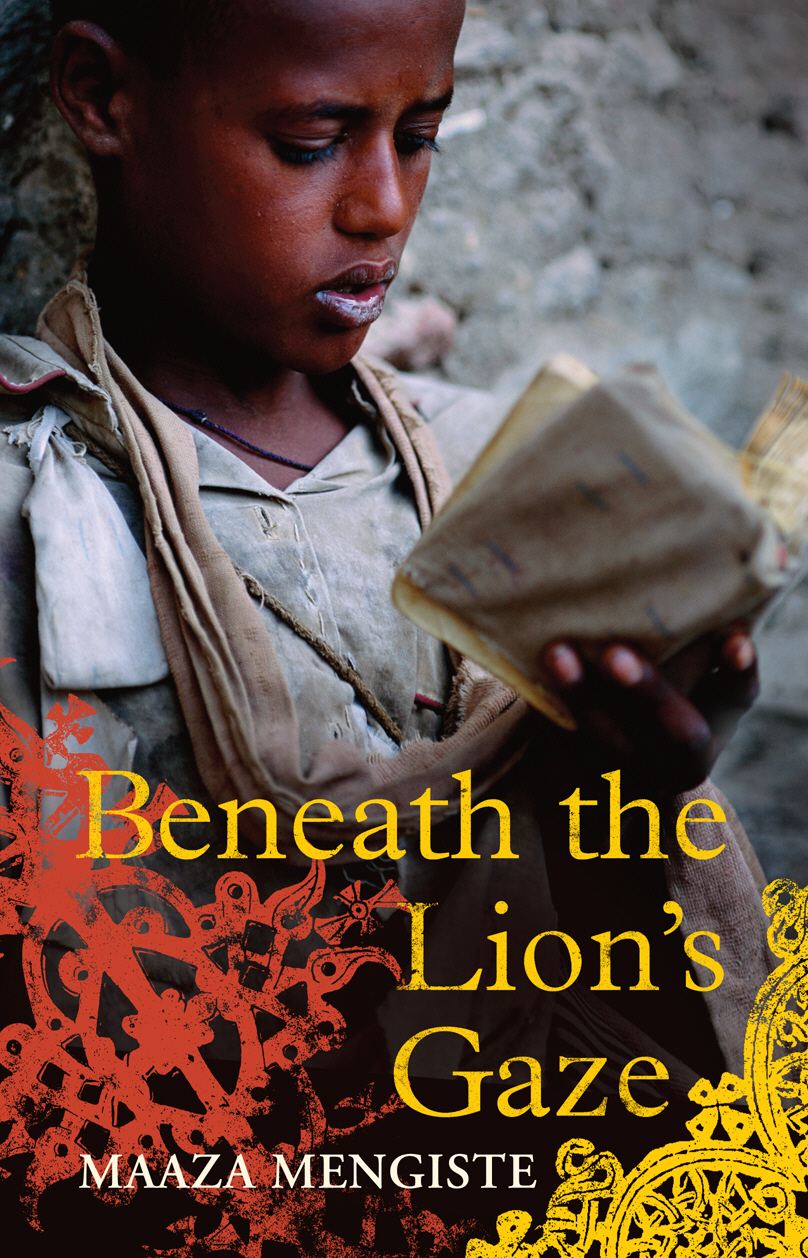
Book 79, Ethiopia: "Beneath the Lion's Gaze" by Maaza Mengiste

Of course the great text of Ethiopia is the Kebra Nagast, the Glory of Kings, the 14th century chronicle of royals from Sheba and Solomon down to medieval times (also the main holy book of the Rastafarians). Sadly, the library only stocks the following:


But I'm being unnecessarily melodramatic, because this novel is awesome. No, seriously, it's superbly well written, really capturing the horror of the Ethiopian Revolution in 1974 and the purges of the Derg: exquisite language, vivid dream sequences, and all following a middle-class family, too, so there's that soap-opera quality that makes it actually enjoyable beach reading.

I actually finished it on Tuesday night, but have been busy with the Singapore Writers Festival and teaching, etc (I'm hosting the Moving Words launch on Saturday now! Just got asked), and come to think of it, I'm pretty tired, so I'll just make two main points:

1. Horrible to admit this, but the author's NYU polished English style plus the fact that the characters are urban intellectuals means that the story doesn't feel like typical African fiction at all: you actually forget the characters are black.

This makes the tale more relatable than ever: you feel yourself inside the skins of these jeans-wearing, stethoscope-toting secular professionals, whose political traumas could've happened in Maoist China or Pol Pot's Cambodia or Stalin's USSR or Bush and Obama's Iraq, really. Odd how that happened. No conscious attempts to whitewash them, as far as I know.

2. The author's created the fictional character of dictator General Guddu for the story. Why? It's based on Mengistu Haile Mariam, so why not just give him that name - she admits to stretching the facts in her afterword, and she did a marvellous job narrating from the viewpoint of a doomed Haile Selassie in the Jubilee Palace.

I suspect she made the change 'cos Mengistu's name sounds too much like hers, and she didn't want to have to field unpleasant questions from dumb folks about whether she was a descendant. Cheating? Yeah, but a sane decision.


View Around the World in 80 Books!!! in a larger map

Representative quote: How would Emperor Haile Selassie later describe the moon that night? Voluminous, as thick as milk, a thousand melted stars that sliced the sky with razor-sharp edges. Even in the dark, from his window, he could make out the outlines of trees shivering in the breeze. A truck with squealing brakes pulled up and a barking order, followed by the confused mutterings of soldiers, made the emperor move back to his cot. There was nothing here that we would want to see. Lying on the bed, he raked his fingers over the spider-bite scabs that dotted his arms, picked at one, and took comfort in the tiny pinch of a peeling wound. This was evidence, he reminded himself, that he was still alive. They hadn't killed him yet.

Next book: Hannah Pool's My Father's Daughter, from Eritrea.

Monday, October 24, 2011

Singapore Writers Festival Stuff!

Sorry to segue yet again, but it's unlikely that I'll finish Beneath the Lion's Gaze by Tuesday. Plus, there's events to be advertised.

1. I've been published in the wonderful Singaporean literary journal CERIPH, edited by Lee Wei Fen and Amanda Lee.


This is its 4th edition, branded as the white issue, launched last Saturday at the Singapore Writers Festival. I've got a poem to open each of the five themed sub-chapbooks in the journal (they like to monkey a lot with design): a poem on ivory, a poem on wheat, a poem on amber shift, a poem on cosmic latte, a poem on sleet.

Copies are $20 from BooksActually and the Select Books store at the Festival Pavilion, over at the SMU Green. You should totally pick one up.


2. I'm also being published in the mono-titular anthology Coast, edited by Lee Wei Fen and Daren Shiau.


Mono-titular means that every single story and poem in the book has the title "Coast". Contributors include every significant Singapore writer from Edwin Thumboo to Alfian Sa'at to Pooja Nansi to Theophilus Kwek. (My contribution is fiction, for once!!!)

Don't know how much it costs yet, but it'll be launched at the following free Singapore Writers Festival event:

date : 26 October 2011, Wednesday (Deepavali)
time : 2 pm ~ 3 pm
venue : Singapore Management University (Festival Pavilion, Campus Green)

Be there or be square.


3. I'm also hosting an event at SWF: the screening and discussion of the short film Civic Life: Tiong Bahru. I'll be interviewing co-director Joe Lawlor, bookstore owner Kenny Leck and someone else.

Tiong Bahru Trailer from Desperate Optimists on Vimeo.


The timing of the event is:

date : 30 October 2011, Sunday
time : 2 pm ~ 3 pm
venue : National Museum Gallery Theatre

Right now, the free advance tickets have been snapped up, but further tickets will be available at 1pm on the day itself from the Museum Box Office. More info here.

Monday, October 17, 2011

Book 78, Somalia: "Maps" by Nuruddin Farah

Good lord. Finally finished this book. And I’m sad to say that after all that trouble it took to get a hold of a copy, Maps has turned out to be one of those terribly acclaimed works of literature that I don’t like very much.


Even though it’s not obviously long like A House For Mr Biswas and Pynter Bender, it drags. The narrative’s more theme-based than plot-based: we spiral around moments and symbols in the orphan Askar's life: blood, lots of it; eventually maps as well; impenetrable dreams; women's bodies; amputations, etc.

And it's true what they say about Somalis being unstereotypical of the African continent, because Farah is ruthlessly intellectual: Askar's a prodigy to begin with, and then he's matched up with Mogadishu elites like his Uncle Hilaal and his Aunt Salaado who debate the historicity of ethnicity and civilisation and barbarianism until after a while you don't care how beautiful the prose is, you just wanna finish and go home to sleep.

Yeah, I'm tired. How'd you guess?

I suppose there's plenty worth learning in here: how Farah dares to jump around from first person to second person to third person in his narrative; how a story centred on a young man can actually end up being centred more on his nursemaid Misra, the utterly oppressed Ethiopian servant who gave him her everything and is still sacrificed to the mobs in the aftermath of the war; how one can be unapologetically brainy, invoking Freud and Plath and Kierkegaard even in the midst of inter-clan murder happening in the third world villages right next door.

But mostly, I'm amazed that the public laps this stuff up. How do they put up with it? Gawd.


View Around the World in 80 Books!!! in a larger map

Representative quote: I hid my inner torment behind the silence I stood in - my hands behind my back, my body upright, my mind alert, my thoughts stirring within me echoes of conversations I had with Misra years agto, with Cusmaan who was my tutor some nine or so years ago, with Salaado - and with myself. Somehow, I felt I had to betray one of them. I had to betray either Misra, who had been like a mother to me, or my mother country. However, part of me was worried - worried that a curse would be placed on my head by either. And I couldn't help remembering dreams in which I saw an old man with a girl's face and features, or another in which the dreamer, a young man who imagined he had envied a woman's menstruation, menstruated.

Next book: Maaza Mengiste's Beneath the Lion's Gaze, from Ethiopia.

Sunday, October 9, 2011

Eastern Heathens: An Anthology of Fiction Based on Asian Folklore

Guess what? National Library managed to track down their apparently "lost" copy of "Maps", so I'm reading it quite happily now. Not your typical African novel at all.

In the meantime, I'll advertise my own project:


Dear Writers,

We love Asian folklore. We grew up listening to Chinese legends, Arab fairy tales, Malay ghost stories and Indian sacred epics, and their fabulous images have continued to inhabit our imaginations ever since.

But as adults, we’re sometimes bugged by the moralistic, simplistic way these fables are told. We’re aching to hear these tropes subverted, perverted or simply adapted to reflect our times.

So, we’ve decided to reinvent our heritage. We’re putting together ‘Eastern Heathens’: an anthology of short stories based on folklore from our continent. We're looking for intelligent, imaginative myths, retold for adult connoisseurs.

We’d like you to base your story on a pre-existing Asian folktale. To help you out, we’ve included a list of our favourite traditional stories and sagas at http://easternheathens.tumblr.com. (Do feel free to interpret a story that’s from a culture other than your ‘own’.)

Our deadline is 31 January 2012. Entries should be in prose; poetry will not be accepted. Please include your name and your contact information in your submission. Also include the title of the original folktale that’s inspired your story, as well as a brief summary of that folktale for our reference.

Please e-mail easternheathens@gmail.com for enquiries and submissions.

Yours sincerely,


Amanda Lee and Ng Yi-Sheng
Editors

P.S. Both of us editors are based in Singapore, but we welcome international submissions.

Saturday, October 1, 2011

WTH happened to the Woodlands Library copy of "Maps"?

So I reserved a copy of Nuruddin Farah's Maps last Monday or Tuesday. Usually these reservations get processed in three days' time.

Now, not only is my reservation still "pending", but the borrowable copy of Maps no longer even appears in the online catalogue. It's bizarre - if the copy was lost, usually they'd say it was lost.

So do I read the 259-page autographed reference section copy, shelved in the closed stacks? Or do I just read something else by this Somalian author? Am kind of holding on to the idea of reading this, since it's considered one of 100 Best African Books of the 20th Century.

Sunday, September 25, 2011

Book 77, Kenya: "Devil on the Cross" by Ngũgĩ wa Thiong'o

Finally finished this book! Hard for me to figure out why it took so long; once I started it properly it really pulled me in.


Basically, it's excellent: the International Herald Tribune quote on the cover don't lie: way better than Ngũgĩ's English language novel The River Between (which was used as a rather stiff educational text here in Singapore), or indeed his somewhat didactic play The Black Hermit.

One big difference is that the story was written in Gikuyu - in fact, this is the first modern novel written in that language; the legendary piece he composed on prison toilet paper while serving out his jail sentence. This means we're importing quite a quite different set of vocabulary and proverbs - "Only a fool sucks at his dead mother's tit - plus the bits which originally appeared in English and Swahili and Latin are italicised, which provides a completely new take on the lexicon.

Ah, but what seduces me is the whole magical realist style (terrible how this has become a throwaway term, when what's possible under this classifier is so divergent). Our beleaguered heroine Wariinga has dreams and hallucinations along with her misfortunes; she has a dialogue with the devil, even. But what's happening in the non-supernatural world is just as strange, as a huge Feast of International Thieves and Robbers is taking place in a cave in Ilmorog, presided over by the greatest exploitative capitalists from the USA, Europe and Japan, while Kenyan millionaires compete for the title of the greatest thief in the nation - proposing nightmarish schemes of how they can exploit the workers of post-independence Africa even further, binding them closer than ever to their former colonial masters...

Yes, it's didactic again: Ngũgĩ sure doesn't like capitalism, and indeed the business shenanigans of many of his neo-colonial bosses are completely legal, completely justifiable in our Friedmanated world; he's mad at the way folks bought up the newly free land and sold it at a profit to the poor, even. It's sobering to realise how far we fall from the Marxian ideal that our forefathers fought for when they cried uhuru and merdeka back in the 1960s. Maybe that's why we don't study this in school - the way things have turned out with globalised capitalism hits too close to home.

(He sure hates religion, too. See how the title turns Christianity on its head? Churches and mosques and parables of investing talents just perpetuate the problem of exploitation, he says, preventing the workers from rising up against those who would control their minds as well as bodies.)

Oh but back to the language; the sheer poetry (yes, he mixes poetry and song and monologue into the fiction). This is what makes the book so good; what makes it completely believable when the author boasts that oral storytellers began memorising the tale and extemporising on it for non-literate audiences: a modern-day Homer or Valmiki or Narada, making the literary arts folk art rather than vice versa.

Thoroughly recommended - and there's a hell of an ending, too. Should go read his most recent Gikuyu novel, the monumental 700-ish page Wizard of the Crow, as well. Or maybe I'll save that for my bucket list.


View Around the World in 80 Books!!! in a larger map

Representative quote: After three days, there came other dressed in suits and ties, who, keeping clsoe to the wall of darkness, lifted the Devil down from the Cross. And they knelt before him, and they prayed to him in loud voices, beseeching him to give them a portion of his robes of cunning. And their bellies began to swell, and they stood up, and they walked towards Wariinga, laughing at her, stroking their large bellies, which had now inherited all the evils of the world..."

Next book: Nuruddin Farah's "Maps", from Somalia.

Tuesday, September 20, 2011

A dialogue

(My boyfriend is pretty well read.)

YS: What books would you recommend by Ngugi wa'Thiongo?

Mohan: Huh? What Ah Tiong?

(Turns out he's read Chinua Achebe, but not Ngugi. My mistake.)