Wednesday, May 21, 2014

Book 150, Germany: "The Sorrows of Young Werther" by Johann Wolfgang von Goethe

Guess what? We're now in Western Europe! And with a blessedly short book, too!

For a while I'd been thinking of doing Hannah Arendt's The Origins of Totalitarianism, as my Read the World... Proportionally! post recommended. But that's 576 pages, in three volumes in the UEA Library. 

Given that I'm cultivating my fiction writing now, how much better to go with a classic of the Romantic era, Goethe's big breakout novel, the one that turned him into an overnight celebrity and inspired a slew of copycat suicides in yellow pants and blue jackets... 

Seriously, some sociologists call it the Werther Effect. Trigger warnings may be necessary.


The story's presented as a profile of a dysfunctional young man, collated by an invisible narrator, consisting of his letters, arranged by date, accompanied by a final series of notes surrounding the circumstances of his suicide.

Werther himself is an upper-class young man who's just secured a position in court. He's also a poet, of a rather excitable nature - his opening sentences are, "How happy I am to be away! My dear friend, what a thing is the heart of Man!" And he's spending some time in the village of Garbenheim, revelling in the serenity of the rural surroundings, delighting in the simplicity of the peasants and their children, declaring that he needs no other books to stimulate his soul than Homer and Ossian.

But of course, he's invited to a stately home where he falls in love a pretty dark-haired girl named Lotte, although he's been expressly told not to, since she's already engaged. (Yeah, he's a bit of an idiot.)

The rest of the book is mostly him going nuts over this girl. It actually has a surprising amount in common with Nikolai Gogol's Diary of a Madman. He goes around explaining his philosophy of Romanticism and the sensations to all the well-tempered Enlightenment folks around him, including Lotte's fiancé, Albert, whom I do not blame for lending him a set of pistols at the end of the story. (He'd seen Werther experimenting with the guns in suicidal contexts before, mind you.)

What I do wonder is how satirical a figure Werther is supposed to be. Is his justification of suicide a thought experiment on Goethe's behalf, or is he a genuine mouthpiece for Goethe's own thoughts? It's said that the novella was written really quickly - so was it written in the heat of passion, giving voice to emotions he had felt unable to express in polite society? None of which precludes a self-consciousness, an awareness that one is being absurd.

I've recently watched Kyle Kallgren's Brows Held High review of Baz Luhrmann's Romeo + Juliet, and he was pointing out that Shakespeare's success with R+J is that he manages to make the giddy-headedness of teenage passion feel genuine - not that he validates it, with all the bloodshed that ensues. And I guess that's what this book does.

And on a side note - how sensible is Lotte? One of the first things we see her do is calming everyone when a thunderstorm surrounds the house party: all the ladies are scared out of their wits, but she forces them to play a counting game, in which anyone who loses count has their ears boxed. Which is a weirdly violent way of establishing order, but it works, and she admits herself that she was one of the most frightened (did they not understand how thunderstorms work?).

Why on earth would a level-headed woman like that put up with Werther? At the end of the book, after his suicide, it's stated that there are fears for her life. Did she pick up hysteria from her gentleman friend? Though I suppose a lot of people would be nervous wrecks if someone they knew shot themselves in their house. Even now.

My fellow UEA coursemate Dani Redd assured me that this would be a good read, by the way. I guess it is - but more in a freak show kind of way. Romantics, man. They so crazy.


View Around the World in 80 Books!!! in a larger map


Representative quote:
'Ah, you sensible people,' I cried, with a smile. 'Passions! Intoxication! Insanity! You are so calm and collected, so indifferent,  you respectable people, tut-tutting about drunkenness and holding unreasonable behaviour in contempt, passing by like the priest and thanking God like the Pharisee that you are not as other men. I have been intoxicated more than once, my passions have never been far off insanity, and I have no regrets: because I have come to realize, in my own way, that people have always felt a need to decry the extraordinary men who accomplish great things, things that seemed impossible, as intoxicated and insane. How intolerable it is in everyday life, too, to hear them say, the moment anyone does something remotely free or noble or out of the ordinary, "The fellow's drunk, he's off his head!" You should be ashamed of yourselves, you sensible people, you sages!'

Next book: Harry Mulisch's The Discovery of Heaven, from the Netherlands.

Thursday, May 15, 2014

Book 149, Lithuania: "Beginning with My Streets: Essays and Recollections" by Czesław Miłosz


We’re at the last of the Baltic states – and the end of Northern Europe! Woohoo!

Now, I know what you’re thinking. Miłosz is a Polish poet – he wrote in Polish, lived in Warsaw (before his defection to the USA) and was a cultural attaché for Poland, for crying out loud.

But it turns out that he always identified as both a Polish and a Lithuanian. He was born in Vilnius, which he knew as Wilno, at a time when the city was under the Polish government. Polish-speakers and Lithuanian-speakers lived alongside each other in his youth (along with Russian and Hebrew and Yiddish speakers), attending different schools and participating in different communities. And the memory of that city haunted him throughout his entire poetic career.

Miłosz wasn’t an obvious choice, of course. Back in Singapore, I thought I was going to do Ričardas Gavelis’s novel Vilnius Poker; scanning WorldCat in Norwich I thought I’d do an inter-library loan for Selected Lithuanian Short Stories from the University of Essex.

But he was a Nobel Prize winner and one of the Righteous Among the Nations (he saved a bunch of Jews during World War Two), plus I’d never read anything by him before.

And there were loads of other Polish writers I could read for Poland. Why not choose this, a volume of essays named for his memory of his childhood in the boulevards of Vilnius/Wilno?


Well, the reason why not is because the book’s effing boring.

I don’t think I was the right reader for it – it seems to be for die-hard fans of Milosz’s poetry, who want every last scrap of wisdom from his mind, and so are willing to wade through esoteric monologues by him about obscure writers (Dwight Macdonald? Robinson Jeffers? Aleksander Wat?) just because they’re there.

And while the fragments of Miłosz’s poems scattered throughout the volume seem nice enough (I don’t quite grasp their transcendence, but that’s true of my relationship with many a great poet), his prose style is just so ambling and leached of any sense of humour or urgency or passion that I come away from it quite uncharmed.

Not that all the pieces here are without interest. You do get an awful lot of the texture of Vilnius/Wilno from the titular essay, “Beginning With My Streets”, and his dialogue with the Lithuanian poet Tomas Venclova. 

Details of his own life leak through in the various transcripts of interviews with him, in “A Poet Between East and West”, and “The Sand in the Hourglass” – his discomfort with Californian hippie mysticism in the ‘60s and ‘70s; his simultaneous comfort with his role as a university lecturer to the same young Californians; his childhood pathos upon reading a condensed volume of James Fenimore Cooper’s works wherein he saw Natty Bumppo age from being a young vigorous Deerslayer to an old man Leatherstocking, bereft of his friends and the wilderness he loved so well. Also his constant surprise when amongst Nobel Laureates, expecting them to be otherworldly higher beings, as he suddenly remembers that he is one himself.

And some of his literary musings are pretty cool – his insistence that Dostoevsky must have been influenced by Swedenborg (he notes that Svidrigailov from Crime and Punishment has a Lithuanian name). Plus his ruminations on the in-betweenness of culture for Central Europeans during the Cold War, caught between Russification and Americanisation.

Ah, but I suppose it’s his Nobel Lecture which is most moving and lucid. Go read it. In it, he considers this terrible tension in his role as a poet, wherein he desires to describe reality from an abstract distance yet with utter detail, rather as the hero of Nobel laureate Selma Lagerhof’s The Wonderful Adventures of Nils does when he flies above the earth. The brutality of the real world keeps getting in the way, he sighs – the horror of the Holocaust and the double horror that there are still those who deny it; the misery of exile and of the human rights crimes for whom dictators remain unpunished. “I hope you will forgive my laying bare a memory like a wound,” he says. “It is possible that there is no other memory than the memory of wounds.”

Ah, but I won’t leave you with just the pithy bits of Milosz. Here’s the end of his essay “On Creators”, which is both infuriatingly opaque and also inspiring with its last two sentences.


View Around the World in 80 Books!!! in a larger map Representative quote:

Some fifty years ago anyone who took a stand against ritual in praise of ritual, observing that, after all, it would lead only to sterility, to intellectual chaos, would have been labeled a reactionary, a defender of old-fashioned “content”. Alas, today one can prove to oneself experimentally what happens to the language of symbols and myths when it is deprived of its deepest reason for being and yet is honored as if nothing had gone wrong. He pursuit of a truth that is otherwise impossible to express used to be its raison d’être, and whatever names that truth might have borne, however much it may have been valued, a language that speaks to itself, with symbols and myths that mean nothing outside a particular closed system (a poem, a painting), gradually loses all its charm and receives its just deserts: indifference. The indifference of others – let us assume not of the creator himself. Thus, the result of the activity ceases to be its goal (for a result is in some sense objective and thus destined for others); the goal becomes the activity itself. It, too, is supposed to be rewarded by society.

“What then must we do?”
“Rethink everything from the beginning.”

Next book: Goethe’s Sorrows of Young Werther, from Germany.

Wednesday, May 7, 2014

Broken Telephone, Saturday 14 June, 7:30pm

I'm reading at UEA Live in Norwich tomorrow!


UEA LIVE: THE NINTH
Thursday 8th May, 7.15pm
Epic Studios, 112-114 Magdalen Street, Norwich, NR3 1JD


But since I imagine rather few of my readers are in Norwich, I'd also like to take the opportunity to advertise this event in London:


Poetry about (mis)communication, (mis)understanding, (mis)interpretation and human (mis)connections. What can go wrong, will go wrong.

Featuring words by Aaron Maniam, Jasmine Cooray, Jerrold Yam, Ng Yi-Sheng & Tania De Rozario.

This event runs in conjunction with Ghost on the Wire, curated by Gavin Maughfling and Suzanne De Emmony.


For some reason, all of us involved are from Singapore or, in the case of Jasmine Cooray, have recently taken part in residencies in Singapore.

Broken Telephone
Saturday, 14 June, 7:30pm
Bermondsey Project Space, 46 Willow Walk, London, SE1 %SF
Tube: London Bridge Burrow
Event page here


Tuesday, April 29, 2014

Gabriel García Márquez (6 March 1927 – 17 April 2014)

I know I'm two weeks late, but I want to say something about the death of Gabriel García Márquez.


I first picked up One Hundred Years of Solitude while I was in the army. I can't remember why I did - probably it was a recommendation from Alfian Sa'at, or something like that. And boy, what a ride that was: following the rise and fall of the Buendía family and their town, Macondo, in an unknown Latin American country where anything could, and frequently did, happen.

That book taught me two things right off the bat:

1) I knew nothing about Latin America. Seriously, this was before Latinos became big in Hollywood and MTV, and I was all the way over in Singapore. Experiencing Latin culture through literature was a huge eye-opener - an awareness of the fact that there was a whole continent and a half of culture I had not been informed of.

I'd been brought up on a distinction between the East and the West, where Eastern things were traditional and mysterious, and Western things were modern and sensible. The discovery of Latin American folk belief exploded that. Furthermore:

2) It was possible to write mythically in the modern age. In his memoirs, Gabo says reading Kafka's Metamorphosis was what gave him licence to write in a magical realist vein. But the fantasy of Hundred Years wasn't just a parable or a thought experiment: it was turning back and embracing folklore and legends as casually true.


And the weird thing is, I immediately recognised his mythic style from the tales my dad told me about growing up in his kampung in the fifties and sixties, where ghosts were just part of the landscape. (We had ghosts in our house then too, and continued to until we renovated it in 2006.)

In other words, I learned that I had grown up in Macondo. That was the only way to describe the weirdness of the world that surrounded me (and it was very weird growing up as a young upper-middle-class gay man in a slowly liberalising Singapore). I'd actually write emails to my sister with the title line, "Letter from Macondo".

I read pretty much everything by Gabo after that revelation - Love in the Time of Cholera, The Autumn of the Patriarch (which was very applicable to Singapore), Innocent Erendira and Other Stories, etc. At Columbia, I read him in the original Spanish, lectured by a prof who explained the book's place in the Latin American Boom, possibly one of the first moments when a whole tradition of literature of the developing world became mainstream in the western world.


I also studied Mo Yan, the Chinese author who'd been influenced by him - I wrote a post about that on East is Everywhere. I did a thesis about the two of them, comparing Hundred Years to a 2003 novel by Mo Yan called 41 Bombs, now translated as POW!

But now... well, I'm in a writing course, but the stories I write don't show his influence in the same way. They're speculative fiction, but have more in common with Neil Gaiman's 21st century Gothic. And I feel a little sad about that, because I feel Gabo is a literary ancestor of mine.

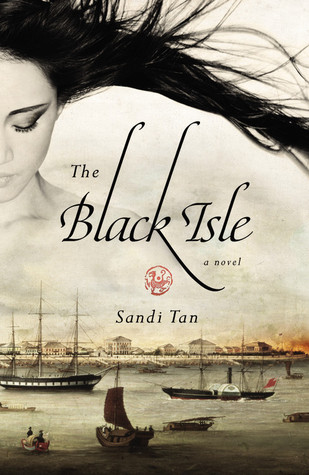
I don't really know how possible it is to write in Gabo's mythic style about today's Singapore - easier to do so in historical fiction, and I do believe that's what Sandi Tan did in The Black Isle. But that runs the risk of auto-exotica.


I guess this is the bit where I pray to the newly ascended St Gabriel, asking for his advice.

But that's cheating, isn't it? The only voice I can trust, in the end, is my own.

Monday, April 21, 2014

Book 148, Latvia: "Selected Poems" by Aleksandrs Čaks

So the copy of this book I found at the UEA Library is pint-size. Small as the palm of my hand, and published back in 1979, when Latvia was still part of the Soviet Union! Still, it's got a decent number of poems in it, along with a helpful intro, so it should serve our purposes for discussion.

Some background: Aleksandrs Čaks (how do you pronounce that last name?) was born in 1901 and was active mostly in the 1920s and '30s, influenced by revolutionary Russian poets like Mayakovsky. Prior to him, pretty much all Latvian poetry had centred on the countryside: he diverted attention instead to the capital city of Riga instead, its income divide, its beauty and its squalor, and its later recovery from the ravages of World War Two.

The Soviets investigated him in 1949, which was ironic, because he'd always thought socialism was cool. He died in 1950. :(

But the poems themselves!


Oddly enough, most of these are horny-boy love poems - they're pieces written to beautiful bourgeois women, complaining that they won't look at him since he's a penniless poet, and are instead gonna go shag handsome aristos in tail coats instead. 

There's some wonderful leaps of the imagination in these love-songs, as in "My Ensemble of Cockroaches", in which he promises to "go to Tibet as an ass" for his love, and says he's bought her twelve cockroaches to give her a thrill, while she just smiles and keeps filing her nails. But there's a certain kind of romantic earnestness in all of them that doesn't chime well with my cynical sensibilities.

Ah, but it's not all affairs of the heart. There's descriptions of the city - as in "City Night", where he tells of "old tyres and perished rubber lie about lie firewood in the yard/and send their smell aloft on every breeze...At times the watchman, loudly sighing, unlocks/with jangling keys/for people late at night returning here,/and now and then/a car goes rushing by, a tea-rose shining either side in front,/and with a red carnation at its rear." He's got a lovely human sketch in "The Sailor With Patent Leather Shoes", and a hymn to the revival of the city after the war in "Riga". Loads and loads of things about trams.

A few poems about nature, too, oddly enough. He describes in "Nature", one of the last poems in this collection, how "There came a summer/When my heart felt prodigiously strange,/And I left for the country... For days on end/I wandered through meadows and forests/Drinking from puddles/Feeding on bilberries,/And the soles of my feet grew coarse like the bark of an oak..."

But perhaps it's just a metaphor? A number of the pieces here are just ways of speaking about the creative process. Will leave you with one such piece.


View Around the World in 80 Books!!! in a larger map

Representative quote:


THREE BOOKS

I published a beautiful book
on eternity
    art
        and the sol,
I published it, but
all the bookshops
in unison
sternly
rejected
my book.

Did I plunge into grief?
No!

I published another,
written with frvour -
a book
on brotherhood,
    helping one's neighbour,
        the grandeur of cutlure,
            and the future of man.

In vain
did I look for it, though,
in the bookshop's windows,
among novels sumptuously bound,
modernistic inkstands
and lean-limbed stars of the screen,
in vain.
And then,
When I entered the shop
and asked for my book
which I wrote with such fervour,
the salesgirl, fragrant
like a noble cigar
and with gentle madonna-liek featured,
smiled:
"Mister, this isn't a charity
nor a society for the protection of animals."

And then,
on that foggy autumnal evening
when under the lime-trees on boulevards
no longer the flowers
but streetwalkers
scented the air,
when cars rushed out of the dark,
two shimmering suns on their fronts,
I,
coming home,
pulled off my boots and threw them out of the window,
and sold my coat to the landlady
in lieu of rent for my room,
and sat down
and
started to write:
    "Practical hints
        for men who rob the exchequer,
            murders,
                couples living in sin,
                    inexperienced writers,
                        students who fail their exams,
                            drivers of cars,
                                and people awkward at dancing."

Twenty tycoons
fought as bitterly over my book
as over a government grant.

And when it was published
thousands
of bright
lights
proclaimed its title
to all the nation.

Side by side
with world-famous Dunlop tyres,
excitign Houbigant powder
and Chlorodont toothpaste,
n every corner and hoarding,
in every showcae,
there loomed before you
my face
shrunken and lean
from sleepless nights
and meals only eaten in dreams.

The publisher's agents
promoting my book
shouted:
"Three cheers!"

Seeing my picture,
idlers and schoolboys
wondered: "Is he a yogi,
has he broken all hunger-strike records,
is he wanted for murder,
or is he a boxer, a Japanese
who'll be fighting Jack Dempsey?"
While all the girls sighed:
"He is the saviour, ah, of our souls!"

But
a progressive
tobacco firm
put on the market
a high-grade cigar
made of their poorest tobacco
and gave it my name.

Next book: Czesław Miłosz's Beginning with My Streets: Essays and Recollections, from Lithuania.

Sunday, April 13, 2014

Book 147, Estonia: "Things In the Night" by Mati Unt

So, Estonia!

... I know next to nuts about Estonia. Aside from the fact that it’s a Baltic former Soviet state that’s now doing pretty well for itself.

Translator Eric Dickens gives a little background to the culture of the country in this book’s afterword. He mentions, for instance, that the land’s best-known writer is actually the poet Jaan Kaplinski, and that Unt (a playwright-novelist of the baby boomer sixties generation)’s most famous novel is actually Autumn Ball, a 1979 experimental tour of the lives of six people in a Tallinn suburb who are destined to meet only at the end of the book: a poet, a technocrat futurist architect, a misanthropic barber, a TV-addicted woman and her kid son.

Yeah, he does seem to do a lot of that classic Eastern European head-scratchy stuff. But he also does stuff about vampires and werewolves too (okay, the latter refers to And If We Are Not Dead, We Are Alive Right Now, and I cannot find a link to an appropriate source, so I'll just add this awkward parenthesis instead).


Things in the Night, however, is about… well, I’m not sure what it’s about.  It begins with its narrator/main character, who also seems to be a writer, obsessed over the strange nature of electricity, travelling to destroy a power station in Liikola, but then he returns and wanders in woods seeking mushrooms, losing all sense of time, thinking about wild pigs who might eat his corpse, cacti and cannibalism and apocalypse, while ex-classmates like Tissen and functionaries like Yablochkov pop up and address him with long monologues about not very much at all…

Oh, and there’s a power cut at the end of the story, making the narrator’s apartment go cold, so cold he starts burning bottles of cognac for warmth, and no-one turns up for his birthday party, so he goes out and finds the streets deserted, until he gets to the cemetery, where everyone’s gathered, singing…

Plus, the whole thing’s addressed to a girlfriend named Susie, whom we never actually see. Who knows what that means?

Perhaps what’s most striking to me is how this book was published in 1990, just a year before independence, after which the country kind of blossomed into what’s pretty much Human Development Index paradise. Because the icy, grungy, collectivist Soviet-administered world it’s describing isn’t just a dystopia – it’s a world with no hope, no prospect of salvation.

So the night’s darkest just before the dawn? Not at all, in the eyes of Unt. He complained in a 2003 article, two years before his own death, that Estonians had been voraciously literate during the Soviet era, gobbling down Thackeray and Smollett and Voice of America, but now they had abandoned high culture in favour of commercialism. So there’s no pleasing some people. He’s a dyed-in-the-wool Camus-style absurdist, as he himself confesses.

I realise I’m making the book sound unreadable. And it’s not quite that – it’s frustrating if you’re looking for a plot, but it’s not bad if you’re just dipping in now and then as I was: a dreamy divagation here and there, with utterances in Russian and French and German, curious chapter headings, the occasional poem: a hazy stroll through one man’s stoic, everyday, unexcruciating hell.

Not quite sure if I can stand a whole lot more novels written in this style, though. Hoping for better luck in Latvia.


View Around the World in 80 Books!!! in a larger map
Representative quote: 
My own sense of reason and powers of perception told me nothing more than that the whole town was cold and dark.
Because judging by the arc of what I could see from the window, there were no electric lights switched on anywhere.
There was no glow above the city some distance away.
The radiators were cold.
Thee electric stove would not heat up.
The coffee machine and the electric razor had stopped working.
And if anyone were to ask wheat else wasn’t working then I could simply say: just about everything except us.

And above the huge apartment buildings the moon, about which some learned men have once said, if in fact they did, but clearly they did, that the Moon reminds one of our Earth when viewed from the cosmos. There is the Man in the Moon, a very lonely man, and no one else, and we today on this Earth are just as lonely, and the Moon acts like a vacuum cleaner, a very quiet one, a silent suction pump, an utterly mute machine that sucks up our energy. It is dangerous to stand too long t the window. Your heart will be empty and turn to ice.

Next book: Aleksandrs Čaks's Selected Poems, from Latvia.

Saturday, April 5, 2014

Read the world... Proportionally!

I recently got ticked off over a "Read the World" list that was still really centred on Western books. Then I started thinking: what if there were a reading list of 100 books that reflected the actual demographics of the world population of 7.152 billion people right now?

Thus, behold my Listchallenge.


 Here are:

19 books from China;
17 from India;
4 from the US;
3 from Indonesia, Brazil and Pakistan;
2 from Nigeria, Bangladesh, Japan and Mexico, and
1 each from the Philippines, Vietnam, Ethiopia, Egypt, Germany, Iran, Turkey, DRC, Thailand, France, UK, Italy, Burma, South Africa, South Korea, Colombia, Spain, Ukraine, Tanzania, Kenya, Argentina, Algeria, Poland, Sudan, Uganda, Canada, Iraq, Morocco, Peru, Uzbekistan, Malaysia, Saudi Arabia, Venezuela, Nepal, Afghanistan, Yemen, North Korea, Ghana, Mozambique, Australia and Taiwan.

50 books are by men. 49 are by women.1 is a work of divine revelation.

Authors (roughly) reflect the ethnic makeup of their nations – e.g. the South African author is Black, not white; the Malaysian author is Malay, not Chinese; one of the PRC authors is non-Han Chinese; one of the American authors is non-white.

I've tried to represent a range of historical periods and the most acclaimed writers in each section. Writers presented are those widely available in English - this is why Ding Ling, Zhang Yueran and Akka Mahadevi weren't featured: because it's really hard to find their work. Also, a writer is only of a nationality if s/he's got/had citizenship of the area at some point - i.e. Jhumpa Lahiri is American, not Indian.

Sure, I know this list is problematic – smaller countries, like those of the Caribbean and Oceania, are kind of wiped out. But I'm open to change this. So send in your suggestions for changes if you’ve got them!

And remember: if you're gonna read the world, you might as well do it RIGHT.

Full list of books:

CHINA
The Analects of Confucius
The Tao Te Ching of Lao Zi
The Art of War by Sun Zi
The Poems of Li Qingzhao
The Journey to the West by Wu Cheng En
Dream of the Red Chamber by Cao Xueqin
The Romance of the Three Kingdoms by Shi Naian
Selected Stories of Lu Xun
Rickshaw Boy by Lao She
The Dyer’s Daughter by Xiao Hong
Love in a Fallen City by Eileen Chang
Soul Mountain by Gao Xingjian
The Republic of Wine by Mo Yan
The Girl Who Played Go by Shan Sa
Red Azalea by Anchee Min
The Song of Everlasting Sorrow by Wang Anyi
Daughter of the River by Hong Ying
Wild Swans by Jung Chang
The Good Women of China by Xinran

INDIA
The Ramayana of Valmiki
The Mahabharata by Vyasa
The Dhammapada of Buddha
The Kural of Tiruvalluvar
The Story of My Experiments With Truth by Mohandas K. Gandhi
Midnight’s Children by Salman Rushdie
A Suitable Boy by Vikram Seth
The Great Indian Novel by Shashi Tharoor
Five Point Someone: What Not to Do at IIT by Chetan Bhagat
A River Sutra by Gita Mehta
The God of Small Things by Arundhati Roy
Breast Stories by Mahasweta Devi
Fasting, Feasting by Anita Desai
Inheritance of Loss by Kiran Desai
The Palace of Illusions by Chitra Banerjee Divakaruni 
Spouse: The Truth About Marriage by Shobhaa De 
Moving On by Shashi Deshpande

USA
The Poems of Emily Dickinson
The Adventures of Huckleberry Finn by Mark Twain
The Great Gatsby by F. Scott Fitzgerald,
Beloved by Toni Morrison

INDONESIA

Letters from A Javanese Princess by Raden Adjeng Kartini
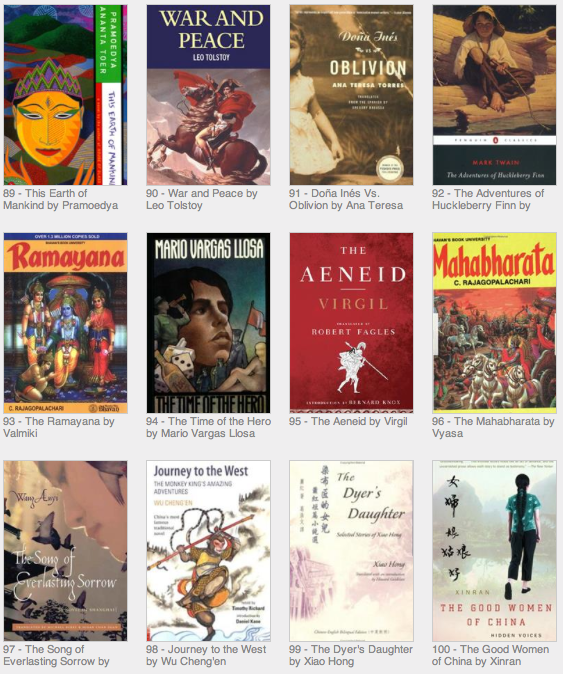
This Earth of Mankind by Pramoedya Ananta Toer
Saman by Ayu Utami

BRAZIL
Dom Casmurro by Joaquim Maria Machado de Assis
Dona Flor and her Two Husbands by Jorge Amado
The Hours of the Star by Clarice Lispector

PAKISTAN
Songs of Blood and Sword by Fatima Bhutto
The Reluctant Fundamentalist by Mohsin Hamid
A Case of Exploding Mangoes by Mohammed Hanif

NIGERIA
Wole Soyinka’s Death and the King’s Horseman
Half of a Yellow Sun by Chimamande Ngozi Adichie

BANGLADESH
Gitanjali by Rabindranath Tagore
The Good Muslim by Tahmima Anam

RUSSIA
War and Peace by Leo Tolstoy
The Poems of Anna Akhmatova

JAPAN

The Pillow Book of Sei Shonagon
Norwegian Wood by Haruki Murakami

MEXICO
The Death of Artemio Cruz by Carlos Fuentes
Like Water for Chocolate by Laura Esquivel

PHILIPPINES
Ilustrado by Miguel Syjuco

VIETNAM
When Heaven and Earth Changed Places by Le Ly Hayslip

ETHIOPIA
Beneath the Lion’s Gaze by Maaza Mengiste

EGYPT
Palace Walk by Naguib Mahfouz

GERMANY
The Origins of Totalitarianism by Hannah Arendt

IRAN
Persepolis by Marjane Satrapi

TURKEY
My Name Is Red by Orhan Pamuk

DEMOCRATIC REPUBLIC OF THE CONGO
The Congo: From Leopold to Kabila: A People's History by Georges Nzongola-Ntalaja

THAILAND
Letters from Thailand by Botan

FRANCE
Madame Bovary by Gustave Flaubert

UK
Pride and Prejudice by Jane Austen

ITALY
The Aeneid by Virgil

BURMA
Letters from Burma by Aung San Suu Kyi

SOUTH AFRICA
Long Walk to Freedom by Nelson Mandela

SOUTH KOREA
Please Look After Mother by Kyung Sook Shin

COLOMBIA
Love in the Time of Cholera by Gabriel Garcia Marquez

SPAIN
The Life of St Teresa of Avila by Herself 

UKRAINE
The White Guard by Mikail Bulgakhov

TANZANIA
Paradise by Abdulrazak Gurnah

KENYA
Devil on the Cross by Ngugi wa’Thiongo

ARGENTINA
The Topless Tower by Silvina Ocampo 

ALGERIA
Fantasia: An Algerian Calvacade by Assia Djebar

POLAND
The Poems of Wislawa Szymborska

SUDAN
Season of Migration to the North by Tayeb Salih

UGANDA
Song of Lawino and Song of Ocol by Okot p’Bitek

CANADA
The Blind Assassin by Margaret Atwood

IRAQ
The Poems of Rabia Basri

MOROCCO
Hope and Other Dangerous Pursuits by Laila Lalami

PERU
The Time of the Hero by Mario Vargas Llosa

UZBEKISTAN
The Dancer from Khiva by Bibish

MALAYSIA
Kampung Boy by Lat

SAUDI ARABIA
The Quran

VENEZUELA
Doña Inés vs. Oblivion by Ana Teresa Torres

NEPAL
The End of the World by Sushma Joshi

AFGHANISTAN
The Kite Runner by Khaled Hosseini

YEMEN
I Am Nujood, Age 10 and Divorced by Nujood Ali

NORTH KOREA
Eyes of the Tailless Animals by Soon Ok Lee

GHANA
Changes by Ama Ata Adoo

MOZAMBIQUE
Neighbours: A Story of a Murder by Lília Momplé

AUSTRALIA
Picnic at Hanging Rock by Joan Lindsay

TAIWAN
Notes of a Desolate Man by Chu Ti'en-Wen