Sunday, September 22, 2013

Book 133, Ireland: "Ulysses" by James Joyce


Yes!!!! I’ve finally finished this classic of world literature, one day before my classes start! Read it half through a paperback copy (which got wet in my bag, which made its cover to tear off when I later dropped it), and half via Kindle (which cost US$0.99 and a great deal of headscratching over whether certain Unicode symbols were scanning errors or modernist experiments).

I’ve been called to read this so many times – once as a child, when I happened across an encyclopaedia of the English language in a bookstore which exhibited the weird drafting process of Mr Joyce; once in university, when I learned that this had been part of the original CoreCurriculum syllabus but had been replaced for political reasons with Virginia Woolf’s To The Lighthouse; once when Kenny at BooksActually was announcing a Bloomsday event.

And now I’ve finally finished it. Whoop huzzah!


As for understanding it, that’s a entirely different matter.

The first chapter is surprisingly digestible: it’s the young intellectual Stephen Daedalus having a chat with his friend in the morning, them throwing around literary references like nobody’s business – but I get that; that’s how I talk to my sister sometimes. Sure, it’s weird, but that’s more or less the point – you don’t come to Joyce expecting stories written in plain English. (This was perhaps why I couldn’t see the point of Dubliners.)

Once we enter the world of the middle-aged quasi-Jewish retiree Leopold Bloom, however, I get pretty lost – how is this character related to Stephen? Who are all these other characters, anyway? My friend Rachel Westbrook actually recommended that I read the SparkNotes on the book simultaneously, and I did refer to them a little on my smartphone. (I’d heard that each section corresponded to a different period of English literature, and I was picking up on a few references to the Odyssey, but the Hamlet parallels had eluded me.) This casual 3G business became more difficult once I travelled overseas, of course.
Now that I’ve finished, though, a few things stick in my mind:

1) This book is very dirty.

No wonder it got accused of obscenity! Molly Bloom’s sexual fantasies/recollections are quite shockingly explicit, and Leopold’s recollections/fantasies are as scatologically perverse as Joyce's own fart-obsessed correspondence. Although the charge does turn out to be over Bloom's masturbation scene over 20 year-old Gerty's legs in the park, which I totally did not get.

2) The book is surprisingly global.

I'd known, of course, that this was an encapsulation of the whole of the western tradition, but I'd forgotten how much of the east and the south had leaked into the west by the Edwardian era, partly because of the hugeness of the British Empire, which Ireland was the very first building block of (unless you count Scotland and Wales, I suppose). Sailors showing off Chinese tattoos, faces that look like Indian gods, Japanese attending imaginary socialist conferences, veterans of the Boer Wars, the word "nigger" thrown around to talk about straw hats or lips or hair or cannibalism, a reference to Zarathustra and Buddha.

And even the Italian waiters hanging around, and Bloom's Hungarian heritage. Dublin might've seemed like a cold nowhere town, but there was stuff happening there, the world streaming in. Search for keywords on the html version, if you don't believe me.

3) The book is of its time.

Of course every book is, but we think of epics as timeless, so it's strange to be reminded of how this is all taking place on the specific date of 16 June 1904, in the wake of Parnell's failed struggle for Irish independence, when Yeats was the only literary Irish giant; ten years before Joyce would start working on this and twenty before it was published in America, a time span in which Joyce aged from Stephen Daedalus's twentysomethingness to Bloom's fat forties.

And all the references to Jews, and the casual antisemitism - sobering to think that this was written before the Holocaust, indeed during the Great War which would lay the foundations for the Third Reich.

And now Ireland's had its prosperity, risen and fell as a Celtic Tiger, had the resources to celebrate its great literary heritage. (I suppose I ought to honour the memory of Seamus Heaney here, even though I always thought of him as Northern Irish.)  It's a different land, and yet this relic of a novel from an age of pessimism is such a prize in the nation's treasure trove, because it's so rich, because it's so daring, because it's so strange.

Oh it's tempting now to conjecture how one could write a Singaporean Ulysses, drawing the craziness of Asia and the West together on a trek down Armenian Street. But how true would it be? Would it be an attempt not to create something great, but to create something for the sake of greatness?


View Around the World in 80 Books!!! in a larger map

Representative quote:

THE BISHOP OF DOWN AND CONNOR: I here present your undoubted emperor-president and king-chairman, the most serene and potent and very puissant ruler of this realm. God save Leopold the First!
ALL: God save Leopold the First!
BLOOM: (In dalmatic and purple mantle, to the bishop of Down and Connor, with dignity) Thanks, somewhat eminent sir.
WILLIAM, ARCHBISHOP OF ARMAGH: (In purple stock and shovel hat) Will you to your power cause law and mercy to be executed in all your judgments in Ireland and territories thereunto belonging?
BLOOM: (Placing his right hand on his testicles, swears) So may the Creator deal with me. All this I promise to do.
MICHAEL, ARCHBISHOP OF ARMAGH: (Pours a cruse of hairoil over Bloom's head) Gaudium magnum annuntio vobis. Habemus carneficem. Leopold, Patrick, Andrew, David, George, be thou anointed!
(Bloom assumes a mantle of cloth of gold and puts on a ruby ring. He ascends and stands on the stone of destiny. The representative peers put on at the same time their twentyeight crowns. Joybells ring in Christ church, Saint Patrick's, George's and gay Malahide. Mirus bazaar fireworks go up from all sides with symbolical phallopyrotechnic designs. The peers do homage, one by one, approaching and genuflecting.)
THE PEERS: I do become your liege man of life and limb to earthly worship.
(Bloom holds up his right hand on which sparkles the Koh-i-Noor diamond. His palfrey neighs. Immediate silence. Wireless intercontinental and interplanetary transmitters are set for reception of message.)
BLOOM: My subjects! We hereby nominate our faithful charger Copula Felix hereditary Grand Vizier and announce that we have this day repudiated our former spouse and have bestowed our royal hand upon the princess Selene, the splendour of night.
(The former morganatic spouse of Bloom is hastily removed in the Black Maria. The princess Selene, in moonblue robes, a silver crescent on her head, descends from a Sedan chair, borne by two giants. An outburst of cheering.)
JOHN HOWARD PARNELL: (Raises the royal standard) Illustrious Bloom! Successor to my famous brother!
BLOOM: (Embraces John Howard Parnell) We thank you from our heart, John, for this right royal welcome to green Erin, the promised land of our common ancestors.

Next book: Hall Caine's The Manxman, from the Isle of Man.

Saturday, September 14, 2013

I'm in the UK!

And I'm now reading Ulysses on the Kindle!

Admittedly, it's odd to be now surveying world literature from a centre of hegemonic production. I actually take pride in being on the margins, commenting on the rest of the world. Zero authority, zero responsibility, zero blame.


Some friends have compared my project to A Year of Reading the World, which the UK writer Ann Morgan did over 2012, in conjunction with the London Olympics. I always liked to point out the differences: she focussed only on fiction from the UN's independent nations, written/translated into English - even had some writers writing stuff specially for her. I thought my multipolar, multigenre, sorta multilingual project was *better* in some way.

But no matter now. I have left the periphery and am now the centre!

Friday, September 6, 2013

The Deal with My Year Abroad

Well, I'm just under halfway through Ulysses. Which means there's no way I'll finish it before leaving Singapore this coming Thursday, 12 September.

As I've mentioned before, I'm spending a year at the University of East Anglia to pursue an M.A. in Creative Writing (Prose). My course starts in Norwich on the 23rd; in between I'll be doing a bunch of settling in, some finishing up of articles, some preparatory writing, some reading.

But after that? Well, that's the big question. I'm going to UEA with the specific ambition of training myself to become a more rigorous, disciplined writer, which means fewer distractions. Which means that I'm not sure how much time I should allow myself to nance about with random artefacts of world literature. Which means that this blog might become even less regularly updated than it already is.

It's odd, the thought of abandoning this project, even temporarily. It's become one of the few constants in my life over the past few years. And it might not happen.

Just giving everyone a heads up, just in case.

Thursday, August 29, 2013

IndigNation's end approacheth.

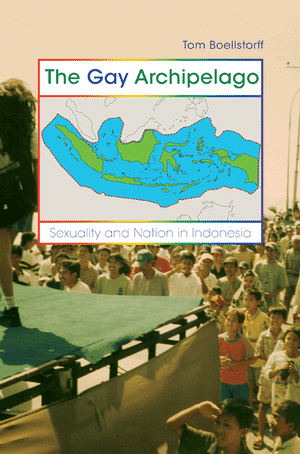
And free time for reading Joyce cometh only after. Been preparing instead for Southeast Gaysia, a talk on LGBT culture and rights in Southeast Asia, by reading this:


Among other resources.

Southeast Gaysia
TheatreWorks, 72-13 Mohamed Sultan Road, Singapore 239007
4pm, Sat 31 August.


Also prepping for ContraDiction, our annual queer literary evening! Here's my lineup of writers!


ContraDiction

TheatreWorks, 72-13 Mohamed Sultan Road, Singapore 239007
7:30pm, Sat 31 August.

Might not be done with Joyce before I leave Singapore. Ah well, I suppose he helps put one to sleep on aeroplanes.

Wednesday, August 21, 2013

Book 132, Iceland: "Independent People" by Halldór Laxness

And I've finally finished this book! Despite early declarations that I'd be opening my European journey with this Nobel Prize-winner's masterwork, I honestly had my doubts - tried reading the collected Viking poetry of the Poetic Edda, but realised pretty soon that its obscure references were just gonna make my head hurt.


Reason I tried switching over to that book was because I wasn't having such a great time with this one. Sure, my friend Dmitri loved it, and I rather liked the opening paragraph too, with its invocation of the curse of the cannibal witch Gunnvor who has cursed the land in collaboration with the demon Kolumkilli (who is, according to Wikipedia, actually Saint Columba).

But then we enter the real world, and there isn't a single character to empathise with. Bjartur of Summerhouses, our newly debt-free peasant farmer protagonist, is an absolute bull-headed asshole with his desire to be an Independent Person, spouting Icelandic poetry on the spot to show off his cleverness and refusing helping hands from anyone. Meanwhile, his new wife Rosa is always mooning around and doing nothing in her depression - sure, she's enduring horrible squalor and hardship in the dump of a farm she's stranded in, but she just lies there sleeping in instead of actually struggling. [SPOILER ALERT!!!] When she died in childbirth, I thought, well, good riddance. [SPOILERS END.]

It's only in Part Two that we start getting some likeable characters - Bjartur's second wife and kids and mother-in-law, who have to suffer under the affable tyranny of their pioneer dad who deprives them of schooling and meat and milk. There's a particularly moving dramatisation of his daughter Asta Sollija's sexual awakening, the shame and desire wrapped up in this, and her severely compromised liberation in the end. Not a comforting closure at all: everything's about the doom of striving to be independent under unfair capitalist structures, and the sheer stupidity of idealising the lives of oppressed peasants (which quite a few Icelandic writers did!).

There's also an awful lot of nationalism wrapped up in this - the whole story is set around the 1890s to the 1920s, at the very birth of the Icelandic independence movement. But economics forms the centre of the tale: debt bondage, the rise of cooperatives, the financial boom caused by demand for Icelandic mutton and wool during World War I, the bust and the labour strikes that came afterwards. Shades of the prosperity of the Cod Wars followed by the 2008 economic crisis - cycles of riches and poverty, loans and mortgages, comfort and cold.

So yeah, this is a pretty interesting book in terms of the info and ideas presented. But while the cover blurbs talk about writers loving it for its sardonic wit et cetera, I'm just not that much of a fan. It's just another rambling epic novel of the common man. So what?

I'm actually pretty disappointed, because there's so much else in lit that Iceland should have to offer - they say that one out of every five persons there has written a book. And the country's pretty trippy as well - visited back in 2005 with my sister, and I'd love to go back. Maybe I will when I'm doing my UK course.


View Around the World in 80 Books!!! in a larger map


Representative quote: In foreign books there is a holy story which tells of a man who was fulfilled by sowing his enemy's field one night. Bjartur of Summerhouses' story is the story of a man who sowed his enemy's field all his life, day and night. Such is the story of the most independent man in the country. Moors; more moors. From the ravine there came an eerie echoing rumble as the headstone crashed its way down, and the bitch sprang to the brink and stood there barking wildly.

Next book: James Joyce's Ulysses, from Ireland.

Tuesday, August 13, 2013

IndigNation 2013!

Not yet done with Iceland yet, but since a post is due, I'm gonna talk about the various literary and political events I'm doing in August for the IndigNation LGBT Pride Festival. (Click here for the full calendar!)


THURSDAY 15 AUG // 8PM
Gaylien Invasion : A Night of LGBT Science Fiction (Facebook)

Imagine what queer life might look like in the future… or on different planets… or with robots! Join us for readings of new short stories by local writers like Amanda Lee, Joel Tan, JY Yang and Jeremy Tiang. Curated and hosted by Ng Yi-Sheng.

Venue: Select Books, 51 Armenian Street


FRIDAY 23 AUG // 8PM (SOLD OUT!)
Akka (அக்கா): a reading of Singapore’s first queer Tamil play


Organised by Avant Theater and The Purple Alliance. In 1990, the playwright G. Selvanathan wrote and starred in Akka, a short play in Tamil about the life of a transgender woman. Join us for a staged reading of this play, followed by a discussion on language, race and gender. English subtitles will be provided.

Venue: Artistry, 17 Jalan Pinang


SATURDAY 24 AUG // 6PM

In July, the Russian parliament adopted legislation banning the dissemination of information on “non-traditional” sexuality. The government claims that the law is meant to protect children and young people from information and propaganda that are harmful to their well-being and development. There has also been widespread increase in the number of violent incidents, assaults, harassment and bullying of Russian LGBT people and their allies. A few days ago, a young man died as a result of being tortured by an anti-gay group.

Join us at Hong Lim Park to take a stand against the homophobia that is sweeping across Russia and express solidarity and support to our LGBT comrades there. There will be speeches from activists, poetry readings and the signing of a petition which will be submitted to the Russian embassy in Singapore. Come with a placard, or a message and let your voice be heard!

Venue: Hong Lim Park


SATURDAY 31 AUG // 4PM
Southeast Gaysia! 

Organised by Sayoni. We all know about LGBT problems in Singapore, but have you heard about the queer rights revolutions happening in Cambodia, Vietnam and other Southeast Asian nations? Jean Chong and Ng Yi-Sheng, members of the ASEAN SOGI CAUCUS (sexual orientation and gender identity) group, will talk about different regional trends in queer rights.

Venue: 72-13, 72-13 Mohamed Sultan Rd


SATURDAY 31 AUG // 7:30PM
ContraDiction: an evening of LGBT literature

Our annual reading of LGBT Singaporean writing is back to close IndigNation 2013! We’ll be featuring poetry, fiction, drama, essays and more from an eclectic bunch of Singapore’s queer writers! Curated by Ng Yi-Sheng and Jasmine Seah.

Venue: 72-13, 72-13 Mohamed Sultan Rd


Ooh, and one extra thing that only got just added to the calendar: a queer art exhibition!


THURSDAY 15 AUG  // 6PM OPENING... EXHIBITION UNTIL SAT 31 AUG
No Approval

Grey Projects presents 'No Approval', an exhibition in conjunction with Indignation 2013. Works by Ezzam Rahman, Khai Rahim, Sarah Choo, Guo Yixiu, Marla Bendini, Loo Zihan, Ghazi Alqudcy, Elvin Ching, Lee Gwo Yinn, Farah Ong, Angela Guo, Felicia Low. Please see our Facebook page () and our website for directions and hours.

Venue: 6B Kim Tian Road,  Tiong Bahru,  Singapore 169246

Monday, August 5, 2013

Falling Blossoms

A while ago I blogged about a Japanese WWII memoir called Falling Blossoms. Last month, out of nowhere, I got a follow-up e-mail about the book:

Sir,

I saw your blog mentioned the book Falling Blossoms by Hiroshi Funasaka. I have been trying to find this book for many years. Do you know how i might get a copy (or photocopy or electronic version)? I am the translator. Just before the book published i became a monk in a remote monsatery. now i do not have a copy and really love the book. Can you help?

Jeff Rubin


Dear Jeff,

It's an honour to be in contact with you. Thank you for translating such a fascinating book.

I got my copy through the Singapore National Library, which has a lendable copy in its Repository Used Book Collection. I'm not sure if any copies exist for sale anymore. Perhaps I should photocopy the book and send you the copies?

Ng Yi-Sheng


Dear Mr. Ng,

I would be eternally indebted to you. perhaps you can scan it and email it. Or any way you like to do it. Please tell me whatever expenses would be involved and i will reimburse you.

It was so many years ago that Hiroshi and I worked on that book in his tiny office facing Shibuya Square in Tokyo. My desk was under a giant photograph of Yukio Mishima staring down with great intensity. I felt Mishima's presence there unmistakeably, and no wonder as Mishima was Hiroshi's sword student. before publishing, Hiroshi had handed the manuscript of Eirei no Zekyo (from which Falling Blossoms was based) and Mishima wrote the introduction, which we translated. As a token of gratitude, Mr. Funasaka gave Mishima a valuable antique samurai sword. It was with this sword that Mishima later committed ritual suicide in public a few years later.


I think Falling Blossoms meant something absolutely different to Hiroshi and I than what it did to Mishima - the spirit of humanity transcends the cult of the sword.The reality of building friendship with Crenshaw his "captor" in the POW camp eclipses "honorable death" The lesson is still valuable for our world today.

Regards,

Jeff


Hi Jeff,

Yes, I got that sense too, reading the work. It must have been heartbreaking for Mr Funasaka to see his work and his sword abused in such a manner.

Do you know how the book came to be published in Singapore?

I'll be making photocopies and posting them to you, as scanning an entire book would prove difficult. Could you give me a postal address?

Ng Yi-Sheng


Yes My Funasaka felt deep pain on that account, but he was not one to easily reveal his sorrow. He was a true hero, but really there are no celebrated Japanese war heroes. The world would agree, and even most Japanese would agree that that is all for the good, but still it makes it hard for people to understand his mind.

As to why we published in Singapore - I first went to NY to find a publisher. My agent said she cried for the first time in 20 years after reading the book. But at that time, it was hard to sell a book in which the "hero" of a WW II story was not an American. The publishers couldn't see the message that Hiroshi was not portraying himself as the"good guy" and the Americans were the "bad guys" . Rather everyone was facing life and death. But the surface stereotype was too much for the publishers in the US at that time. Perhaps now it might have been a bit different. Anyway, we found the publisher in Singapore.

My address where I am staying is [redacted]

Thank you for all the trouble you are taking on my behalf.

Jeff


Only just posted it! (UPDATE: Thanks to my friend Jeff Mishler for blanking out the address.)

Unfortunately, the photocopying process ended up cracking the spine of the National Library's copy, turning all the pages into loose leaves.

Never mind - I am serving the text, not the codex! Hopefully we'll see this volume in publication again in the very near future.