Thursday, January 3, 2013

Book 113, Guam: "Attitude 13" by Tanya Chargualaf Taimanglo

I've just flown into Myanmar, where I'll be maintaining the Flying Circus Project Blog for the next two weeks. I'm terribly short of sleep, and I've just learnt that we're not gonna get the chance to meet Aung San Suu Kyi at the Freedom Film Fest.

So let's get this over with, shall we? (I want to invest in a nap now so I can live larger later.)


Honestly, Attitude 13: A Daughter of Guam's Collection of Short Stories isn't that great. The style has a strong whiff of the amateur and the plots tend to end anticlimactically. If I had to grade these, I might give a B+ if I were being kind (some are better than others, though: Chirika's Pepper Plant, which won the author a prize with Latte Magazine, isn't half bad).

But the content is what saves the day. Taimanglo's exploring what it means to be a Guamese Chamorro woman in the 21st century - no longer sarong-clad natives to be studied by anthropologists, but college students in Honolulu, expatriates in Seattle, army officers serving their terms of duty in Afghanistan while their daughters wail for them on their home islands, 88 year-old marathon runners in nursing homes with spiky pink and blue hair. Also explored is the condition of being biracial: the author is Chamorro-Korean, and she's described what it's like to be labelled a Jap in school and denied recognition of your true island heritage in the clumsily titled Yes I Am. And also a rather nice fantasy piece at the beginning: an encounter between a washed-ashore mermaid and a jeep-driving, zori-wearing, culturally deracinated Guamese girl in today's world. (Yes, there are stories about boys and men too, but it's clearly womanhood that takes centrestage.)

I suppose I'm drawn to this cultural testimony - not just because I love how foreign vocabularies collide with English: chenchule', pica, buñuelos aga', dinugan, donne', finadene', Hafa Adai - but also because so many texts from Oceania are written by outsiders. Immigrants, colonists, anthropologists, wayfarers - they have the resources to talk about these cultures, not the natives themselves.

Taimanglo happens to be an emigrant, though - she's lived in San Diego and now she's a military spouse in Washington, if the Internet's to be believed. Well, better brains draining out and speaking out than brains staying mute under scrutiny, I suppose.

Damn, I need sleep. Later!


View Around the World in 80 Books!!! in a larger map

Representative quote: I left the movie theater and the cold Washington air embraced me. It was almost midnight and I was out with my fiancé. This was the 18th movie I watched with a date. You can feel happy for me. This was my own doing. I didn't get to the age of 35, engaged and still a virgin, by accident. I am a Goddess on purpose. I am a beautiful Chamorro woman, on purpose. My fat is no longer my shield. 

Next book: Hiroshi Funasaka's Falling Blossoms, from Palau.

Wednesday, December 26, 2012

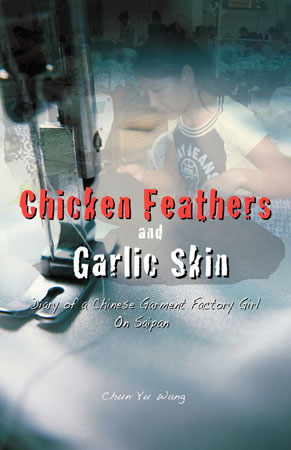
Book 112, Northern Mariana Islands: "Chicken Feathers and Garlic Skin" by Chun Yu Wang

Happy Boxing Day! Oh, I know it's still Christmas for some of you guys in the Western Hemisphere, but I'm well in the East, both physically and literarily. In fact, I've drifted all the way out to the Pacific, back to Oceania, where there's an obscure US territory called the CNMI, full of Chamorro-speakers, known primarily for its nearby trench.   


What most folks don't know is that the biggest island of the Marianas spent the first decade of the 21st century trying to get into the industrial age, importing loads of low-cost Chinese and Filipina women to work in garment factories so they could turn out Osh Kosh B'Gosh products printed "Made in the USA".

Hence the story above: a true-life tale of a 25 year-old Wuxi woman who went to Saipan to spent nine years of her adult life breaking her back over sewing machines. It's a weird kind of memoir: one of those situations in which a guy tries to make the subaltern speak (the initiator and editor of the book is the Jamaican-American-Saipanese journalist Walt F. J. Goodridge).

But Wang (yes, her surname is Wang, not Chun) is no hick either: she left her video-game playing husband in her home country because factory work in the Marianas was marginally better-paying, and took enough English courses to be able to translate her Mandarin manuscript to Goodridge, one-to-one.(He was fascinated by the Chinese idioms she used - the title, of course, is a transliteration of 鸡毛蒜皮 - even though these sound a tad hackneyed, even clichéd, to bilinguals.)

Frankly, the book isn't a must-read. It's an interesting look at the world of contemporary Chinese migrant labour, showing their aspirations and their sweat and their abuse from crooked overseers and their losses from burglars and accidents at home and worthless husbands and cops who claim they'll get them a green card and then disavow ever having received any payment.

Of course Americans are shocked by the suffering. But as a Singaporean, who's descended from and surrounded by migrant Chinese labour, I'm often thinking, "Meh. I've heard worse."

Which is horrible of me of course - recent events have thrust these marginalised workers into the spotlight, and we have to do something about it, if only to show that we're a society that treats people with humanity. But specifically regarding this book: Wang had her own home, free English lessons and the ability to quit her nasty factory jobs and search for new (usually equally bad) ones. Blue-collar foreign workers in Singapore just don't have those rights.

The interesting thing about a situation like this is that it shows how the oppressed masses aren't necessarily just victims. Wang and many other workers protest, walk out, steal and shag around to get what they want. And even when all the factories close (towards the end of the 2000s, costs rose and competitors like Vietnam became more attractive), Wang and her sisters realised they wanted to stay on, because they'd experienced freedom from their families and their obligations on this tiny, tropical island, and even if their sons were waiting for them at home, the only way to live for themselves was to be bad mothers, staying alive in the foreign sun.

Also - unrelated to workers' rights - one does get the sense that Wang isn't a particularly nice person. In her home, and at virtually every workplace, she's fighting with people, she's dissatisfied. Wherever you go, there you are, as they say.


View Around the World in 80 Books!!! in a larger map

Representative quote: Little by little, over the years and because of my trusting and kindness, I have lost most of my money. In all the years I worked, and all the money I earned, I accomplished nothing. In China, we would say, I added frost to snow. Adding frost to snow means "engaging in a futile, meaningless action that adds no visible benefit." That's what all my years of work on Saipan have been.

Next book: Tanya Chargualaf Taimanglo's Attitude 13: A Daughter of Guam's Collection of Short Stories, from Guam.

Thursday, December 20, 2012

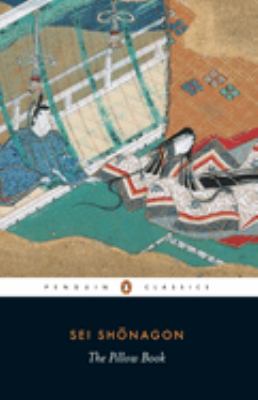
Book 111, Japan: "The Pillow Book" by Sei Shonagon


I’m back in Singapore! ILGA and the Scandinavian winter were amazing, consciousness-expanding experiences – I’ve written about some bits of ‘em on the ILGA Blog, and I might upload my e-mails to my folks to my personal site, The Paradise of Flowers and Fruit. Doing this project turned out to be pretty useful for socialising too - if I met a guy from Samoa, why, I could just mention that I'd read Albert Wendt and we'd have something to talk about straight off.

As for The Pillow Book, oh my: it took me all holiday to read. Surprising, considering how lightweight it is as a text, but Kindle for Mac had me clicking the screen all the time for the endnotes – it’s not a conducive medium to skimming at all.

But it was rather nice, absorbing these Japanese aesthetics of nature and seasonal change while trundling through the snow-covered mountainscapes of Norway. As much as Sei delights (this is a word used often) in the floral colours of court dress, she’s also in love with the images of winter: the snow on a gentleman visitor’s cloak, a lady holding a lighted coal to a letter to read it in the darkness.

Much has been made of the lists in this book – refined and elegant things, things that make your heart beat fast, things that make you nostalgic – but as translator/annotator Meredith McKinney notes, the literary form was quite established by 994, when Sei received the gift of paper which formed The Pillow Book. In fact, she deviates from standard lists, distracted by personal memories and commentaries.

And so much of this text is made of memories: little episodes in court that show off the pageantry of Emperor Ichijo and Empress Teishi, that are evidence of her wit as she bests the male courtiers in their games of quoting the Chinese classics – though a refined woman was not supposed to be able to read Chinese; thus her exhibitionism was necessarily veiled by sly self-effacement.

And what a strange world for women this was: where it was proper for court ladies to remain behind screens when addressing men, yet extra-marital affairs were not frowned upon. (A disproportionate number of these East Asian texts I’m reading are by women; have you noticed?)

Of course the whole work’s made more poignant because you know this gilded world was not to persist: Teishi fell from favour and died two days after childbirth, after which Sei left the court and by tradition died an impoverished crone; a couple of centuries later and the empire was transformed into the wartorn battlefield of The Tale of the Heike.

But for a while, this beauty, this perfection. And how grand that these moments of delight were captured well enough to remain on the shelf of world literature, perennial amidst the changing seasons.


View Around the World in 80 Books!!! in a larger map

Representative quote: 
[71] Rare things – a son-in-law who’s praised by his wife’s father. Likewise, a wife who’s loved by her mother-in-law.

A pair of silver tweezers that can actually pull out hairs properly.

A retainer who doesn’t speak ill of his master.

A person who’s without a single quirk. Someone who’s superior in both appearance and character, who’s remained utterly blameless throughout his long dealings with the world.

You never find an instance of two people living together who continue to be overawed by each other’s excellence and always treat each other with scrupulous care and respect, so such a relationship is obviously a great rarity.

Copying out a tale or a volume of poems without smearing any ink from the book you’re copying from. If you’re copying it from some beautiful bound book, you try to take immense care, but somehow you always get ink on it.

Two women, let alone a man and a woman, who vow themselves to each other forever, and actually manage to remain on good terms to the end.

Next book: Chun Yu Wang's Chicken Feathers and Garlic Skin: Diary of  Chinese Garment Factory Girl on Saipan, from the Marianas.

Tuesday, December 11, 2012

I'm at the ILGA World Conference in Stockholm!

That's International Lesbian and Gay (and Bisexual and Transgender and Intersex and Queer) Association. I'm an official blogger - check us out over here.


We're a really international team, from Argentina, Burkina Faso, Colombia, Italy, Lebanon, Singapore, St Lucia, Sweden, Syria, Trinidad & Tobago and Zimbabwe. In fact, because of the liberalism of the Swedish government, this is going to be the ILGA Conference with the most representation from Africa, Asia, the Middle East and the Caribbean, ever.

As for what I'm reading currently - well, I couldn't find my dad's Kindle before I left home (it was found as soon as I reached the airport), so I'm doing The Pillow Book via Kindle for Mac. It's taking longer than I expected, partly 'cos I keep clicking on the annotations.

But one must always carry a hard copy book (e.g. for those moments on the plane when all electronic devices must be turned off), so I'm ploughing through Thant Myint-U's The River of Lost Footsteps: A Personal History of Burma.


I bought this before the Ubud Writers Festival 2009, when he was in attendance (can't remember if I actually managed to talk to him). Figured it'd be good prep for both my creative non-fiction class and my upcoming Flying Circus Project trip to Myanmar. But despite all the bestseller bleah, it's pretty slow going. Too much historical fact so far, not quite enough drama.

Have been dipping into both since I began the trip in Bergen, Norway: might not be done with either by the time I lift off again in Helsinki, Finland. See how.

Monday, December 3, 2012

Book 110, North Korea: "Nothing to Envy" by Barbara Demick

I'd read a couple of books about North Korea before: Guy Delisle's graphic memoir Pyongyang and Hyejin Kim's "novelisation" of defector accounts, Jia. I didn't think I had to read any others, especially not this one. After all, if a Canadian and South Korean had already given me their two cents' worth, what fresh insights could an American have?


Ah, but Barbara Demick's proven me wrong. I've realised that the two above accounts capture only a tiny fragment of the North Korean experience, mostly confined to the capital city, which it seems is a huge Potemkin village, where only good-looking, able-bodied citizens are allowed to roam so that foreign visitors will be impressed.

This book looks instead at the northern factory city of Chongjin, home to gulags and coal mines and party officials and undesirables alike. We follow the lives of six ordinary North Koreans who escape the famine in the nineties, wading their way past the border with China, then flying into South Korea: the rebellious POW-daughter Mi-ran, the rich university student Jun-sang, the party loyalist Mrs Song, her daughter Oak-hee, the street kid Kim Hyuck.

And god, it's heartbreaking. Demick is a master storyteller: she begins with the teenage love story between Jun-sang and Mi-ran, in the blacked-out darkness of their city, bereft of electricity, noting its provenance: Mi-ran was now a prosperous and well-adapted resident of Seoul, married to another man, yet wistful for her innocent past.

The density, maybe length of the story, matters so much. We learn how life is different for insiders and outsiders, what they ate, what they feared, what they sang (the title is a reference to a North Korean children's song, that claims We Have Nothing to Envy in the World). We see disaster unfolding, slowly, as the horrible political realities of Juche creep up on idealistic youngsters and Kim Jong-Il dies and the famine descends with its pellagra and constipation, weird rashes appearing in spectacle-circles around people's eyes, the most virtuous dying first, the old then the children then the men then the women, and the crazy run-around cycle of imprisonments and recaptures that so many people had to go through to finally make it into the promised land of Hanguk.

Come to think of it, it's also important that we're hearing the stories of individuals. So many images of North Korea portray its people as brainwashed masses, or else single out idealised heroines among them (seems a majority of defectors are women, partly because they can sell themselves off as wives or prostitutes). The unique quirks that these people have, the different extents to which they've adapted to South Korean culture (did you know, what strikes the Northerners as weirdest is how South Koreans kiss and hug in public?) are just so compelling, and inspiring - because of all the six, all of them seem to have done okay, in the end.

Also amazing is Demick's discipline in creating this book: she spent six years interviewing over 100 defectors, heaven knows if she speaks Korean, she must by now. I'll be teaching a non-fiction course next semester - how can I convince kids that that kind of investment is worth it?

Bloody amazing, anyway. And I'm glad I finished this before I fly off for the ILGA Conference tomorrow.


View Around the World in 80 Books!!! in a larger map


Representative Quote: Dr Kim looked down a dirt road that led to farmhouses. Most of them had walls around them with metal gates. She tried one; it turned out to be unlocked. She pushed it open and peered inside. On the ground she saw a small metal bowl with food. She looked closer - it was rice, white rice, mixed with scraps of meat. Dr Kim couldn't remember the last time she'd seen a bowl of pure white rice. What was a bowl of rice doing there, just sitting out on the ground? She figured it out just before she heard the dog's bark.

Up until that moment, a part of her had hoped that China would be just as poor as North Korea. She still wanted to believe that her country was the best place in the world. The beliefs she had cherished for a lifetime would be vindicated. But now she couldn't deny what was staring her plainly in the face: dogs in China ate better than doctors in North Korea.

Next book:  Murasaki Shikibu's The Tale of Genji, from Japan.

Wednesday, November 28, 2012

I'm back from Penang!

The Georgetown Literary Festival was awesome, by the way. Lovely food, beautiful architecture, extraordinarily passionate people, almost all of them committed to activism in some way in their own countries. Turned out they liked my performance poetry style, too! Loads of new friends. Lots of photos if you click the link.

Penang itself is going through a remarkable moment in its history. Its heyday was the 1860s to 1920s - since then it's gone through a period of (relatively benign) neglect and decay. But in 2008, the city/state scored twice: it gained its coveted UNESCO Heritage Site status and elected DAP politician Lim Guan Eng as Chief Minister. Now, with the rise of the tourist trade and the economy and the arts, there's a wonderful sense of optimism rolling through the land, a feeling that KL-ites and Singaporeans both envy and identify with, 'cos we know it's happening too, quietly, on our own turf.

Lim was at the festival opening, btw, where he championed the arts and freedom of expression - even sat smiling throughout my expletive-riddled version of Sandra Cisneros's You Bring Out the Mexican in Me,  titled You Bring Out the Hokkien in Me.

His endorsement of the arts means that Georgetown is finding its feet as a new city for secular humanism for the whole of Malaysia. At ChinaHouse, where several of our events were held, there was a semi-political art exhibition from Sabah, of all places. Probably half of the festival attendees were KL-ites, eager to kick-start culture in this city (even though it's Malaysia's second-biggest city, there really is pitifully little nightlife as it is).

So we may be seeing more theatre performances, more music, more poetry, flowing up from Singapore and KL to that island to the northwest. Excited? I sure am. Can't wait to pig out on that laksa and nasi kandar again.

Oh, but I've another reason I'm uploading this now: I've decided that Songs of the Dragons Flying to Heaven simply cannot qualify as a North Korean text. So I'm reading something else, in the precious little time I have on this island before I fly off again. Stay tuned!

Tuesday, November 20, 2012

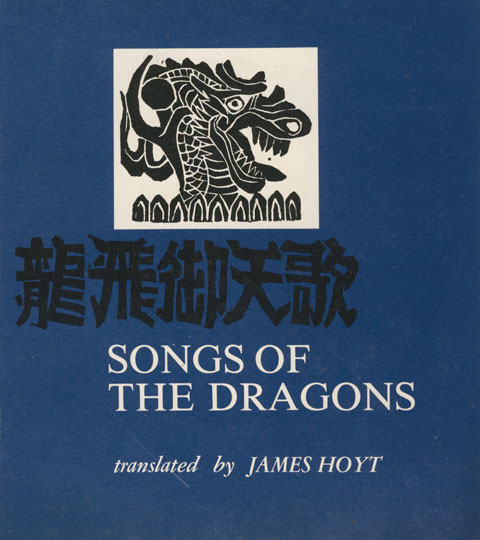
North Korea: "Songs of the Dragons Flying to Heaven"

Update: I have decided to disqualify this book as my North Korean text. Previously, it was listed as Book 110.

Well, this is embarrassing. I wanted to buck the traditional representation of North Korea as a Communist dystopia (which it is) by focussing on its glorious past. It used to be the more developed bit of the Korean peninsula, doncha know; the centre of a whole lotta history. But now I'm bussing out of Singapore to Penang overnight and I've just realised the great Korean epic  Yongbieocheonga was in fact compiled by Sejong the Great in the city of Hanseong, better known today as Seoul.


Alamak! But not to worry. The songs in this 15th century work are composed in praise of Sejong's ancestors: they're the six dragons of the title, Mokjo, Ikjo, Dojo, Hwanjo, Taejo, Taejong. And they did indeed wander through what's now North Korea, before conquering the hell out of the Goryeo Dynasty and setting up the Joseon.

Quick explanation: we don't know who wrote these 125 brief cantos. But we do know their purpose: they were written both to glorify the roots of the scholar-emperor as well as to instruct him on the proper paths to take into future (yep, literati get to tell the emperor what to do! This was the age of Neo-Confucianism).

The poems are also the first ever text written in Hangul, invented specially by Sejong. It's a moment of transition: the annotations were inscribed in the scholarly language of Chinese, as were many of the words within the poems. Pretty much all the allusions being made are to Chinese history: other emperors of the Zhou and the Han and the Tang - these guys are trying, almost for the first time, to build up their own culture, and they need to resort to crutches to do so.

The reason why you don't see this selling in airport bookstores is that it's actually quite difficult to read: the brief poems contain such allusions to specific incidents in history that you've got to switch over to the annotations all the time to understand them, breaking up any sense of reading rhythm (me, I just skipped them on a first read and looked at them later).

What makes things even worse is the fact that there are no names involved - it's the annotations that tell you whether we're talking about Taizong of China or Taejong of Korea, that the false claimant is the usurper King Sinchang of Goryeo.

Oh, but if you do read the annotations, such fun! These kings are pimps: shooting down magpies, two at a time with a single arrow, and being honoured by snakes; getting their armies rescued when they encounter gods in the forms of white-haired old women and white-bearded old men; shooting black dragons out of the sky when they're battling white dragons after being warned by dreams (yes, archery is a big theme here; it's also used for fortune-telling); fending off Red Turbans and Japanese pirates. Even the queens get into the action, handing their husbands armour and feigning sickness so as to meet with them and warn them of developing conspiracies.

But I've no more time to go on babbling; I have a boyfriend to meet and a bus to catch.

[Insert a link to Songdo, where in 1399 a white dragon with fish-scales shining in the sun appeared on the roof of Taejong's submerged palace, foretelling his elevation to the throne.]

Representative quote: 

CANTO CX

The Four Ancestors knew no rest.
In how many places did they swell?
How many rooms
Did their houses contain?
Living in multi-storied palaces,
Enjoying halcyon days,
Let Your Majesty not forget this!

Next book: The Pillow Book of Sei Shonagon, from Japan.