Thursday, October 11, 2012

Holiday stash!

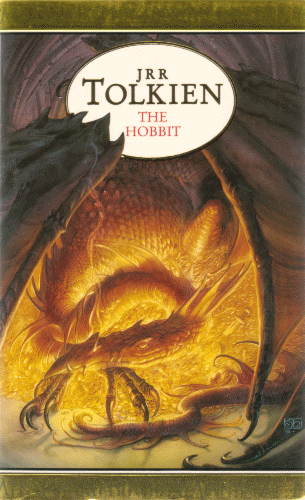
Haven't moved on to my Taiwanese book yet because I've gotta write an article about The Hobbit movie for the children's newspaper I work for. Trying to read the original novel in a hurry.


Of course, this just means it's a good time to take stock of the books I've accumulated over recent travels. A recent bus ride up to KL had me at Silverfish Books, where I was promoting the poetry collection I translated, The New Village. Also popped over to the Annexe at Sentral Market for Art For Grabs.

Here's my harvest after the events:


Look at 'em!

Silverfish Malaysian Classics Series: 
1. Marong Mahawangsa: The Kedal Annals
2. Sejarah Melayu
3. The Epic of Bidasari (and other tales)
4. Malaysian Fables, Folktales & Legends

Farish Noor's essays:
5. The Other Malaysia
6. From Majapahit to Putrajaya
7. From Inderapura to Darul Makmur: A Deconstructive History of Pahang
(-). What Your Teacher Didn't Tell You (actually I bought this ages ago, but added it to complete the set)

+
8. Salleh ben Joned's Adam's Dream
9. Bernice Chauly's Growing Up With Ghosts
10. Afi Noor's Ten Poems

I have rather fewer books from Laos, because of the bigger language divide. One British lady resident in Luang Prabang (who ran a book exchange) even told me there's a serious dearth of Lao literature, pre-colonial and contemporary, because they just aren't a very literate culture. Folks go back to the village and forget all the English they learned, she said; they even forget their own Lao alphabet.

Anyhow, Monument Books did supply me with a couple of treasures:


1. Outhine Bounyavong's Mother's Beloved
2. Steven Jay Epstein's Lao Folktales (published in Thailand)

There was even a book of condensed Lao epics, Volume 2 - but this was wafer-thin and the writing just wasn't very good. I figured I'd bug the National Library to buy Volume 1, or else just wait for a proper publication to come out.

In other news, I finished an awesome novel over the hols: Zhang Yueran's The Promise Bird, translated by my friend Jeremy Tiang. But that deserves a post of its own.
Wednesday, October 3, 2012

Book 107, Hong Kong: "The Unwalled City" by Xu Xi

I'm currently on holiday in Laos, and on holiday from my reading project. But three hours before I left, I managed to finish off my Hong Kong book! Of course I considered Jin Yong (since he's probably HK's most successful writer), but none of his swordfighting novels take place in the city. Also Eileen Chang, but she only spent a couple of years there, it seems - she was essentially Shanghainese.

But Xu Xi's as Hong Kong as Hong Kong noodles - born and bred and teaches at the university there, though she's hopped around Asia and North America in the course of her career. First met her at the Man Hong Kong Literary Festival in 2007; read her Daughters of Hui and really liked it. 


Wrote to her to ask her which one of her works she'd recommend for this project. Of course, she had to suggest the only one which the National Library doesn't stock. Read this on the Kindle, which I didn't want to run the risk of losing or breaking while backpacking.

But I had trouble with this book at first - truth is, the characters float from scenario to scenario with little visible motive force. They're all these lost, good-looking privileged men and women, living in Hong Kong on the cusp of the 1997 handover. They're not even particularly scared of the prospect of going back to Red China. If I were marking this for my creative writing class, I'd have been asking where the thrust was, what made us *care* for these characters.

Still, as time wore on, the story grew on me. It's interesting reading this in the wake of The Bewitching Braid, or that classic Hong Kong romance The World of Suzie Wong, both of which are about race and class relations clashing, then becoming happily reconciled in an age of colonialism. The Unwalled City is determinedly postcolonial - no, that word fails to encapsulate the theme: it is post-postcolonial, occupying a world where global capitalism has collapsed the importance of race and gender.

Look at Colleen, a white Bostonian who speaks Mandarin and Cantonese, married to a Hong Kong Chinese guy but having affairs with loads of men, white and Asian. Look at Gail Szeto, divorcee offspring of an American pilot and a Hong Kong prostitute who's climbed her way to the top of the corporate ladder, caring for her senile mother and more Chinese-than-ever son Gu Kwun. Look at Vince, the Brooklyn photographer and low-caste expat who goes from being an HK newbie to a Cantonese-spouting old hand; Andanna/Lei You Fun who dumps her jazz career to become a Cantopop singer.

These figures whose lives intersect, whose actions frustrate one another (Xu Xi will shift perspectives from one character to the next without warning, so that the follies and misperceptions of the characters are clearly visible to us). They have affairs and dates and epiphanies, but nothing happens, not really, we don't know where their lives are going by the closing chapter as Andanna sings on the stage of the handover ceremony.

The story drifts. We drift. The characters drift, even geographically, from Wan Chai to Singapore to Shanghai to New York. Is this how tales are told today? With no deaths, no marriages, no births, with only pre-planned unhistorical historical events? I'm thinking aloud, of course. Just wondering how people do it - put enough words together, call it a novel. 

Me, I can't finish writing anything right now. Ah well. Maybe the nights in Laos will inspire me.


View Around the World in 80 Books!!! in a larger map
Representative quote: "You are privileged to be here in our city at this moment of historical change." Albert spoke as if he were some kind of elder statesman for Hong Kong, with a possessiveness that conferred distinction to utterances on high. "In a way, Vincent, you are in a slightly better position than some to appreciate it because you originate from a city that once almost defined a new order for what a city was and should be. Of course, New York is somewhat passé now."

Proclaimed not as an opinion but as a fact.

Next book: Chu T'ien-wen's Notes of a Desolate Man, from Taiwan.

Tuesday, September 25, 2012

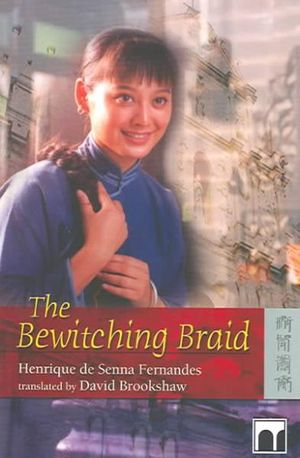
Book 106, Macau: "The Bewitching Braid" by Henrique de Senna Fernandes

Guess what? We're in East Asia! And we're in China, but not in China per se, because if they're going to go around claiming every little island is theirs, I'm going to assert my right to proclaim every disputed and recently returned colonial territory as a distinct country from the mainland.

Thus, Macau. But golly gosh, I'm glad I decided to do this former Portuguese colony, because The Bewitching Braid is loads of fun.


It's fundamentally a romance: boy meets girl and (SPOILER ALERT!) their love triumphs against all odds. The intro notes that the author may be influenced by soapy Cantonese yarns in this respect. But it's written in Portuguese, by a member of the Macanese community: one of the many half-European, half-native mestizo groups the Portuguese empire-builders sired in Goa, Sri Lanka, Melaka, Timor, Brazil.

And it's an interracial love story, too. Thus, we've beautiful details of the privileged 1930s Macanese middle-class world of Handsome Adozindo, playboy about town, as well as the dignified squalor of the Chinese quarter of Cheok Chai Un, where the indomitable Chinese water-seller A-Leng plies her trade. Of course he becomes fascinated with her braid and her spirit, and is determined to seduce her - and yet ends up as her loyal and steadfast husband.

It's not a snap-happy convenient happy ending, mind you: the two are thrown together permanently rather against their will, the boy's family and the girl's community disowning them, leaving them to fend for themselves. Adozindo, being a good-for-nothing, really does look like he's going to become a drunken opium-addled sot at one point.

But they work through it at the end, and by the story closes not with a marriage but with Adozindo's family finally accepting him and his wife and his four children. The point is that it's not comfortable or easy to overcome ostracism and class differences and poverty, but it's possible.

(Btw, I honestly thought there'd be another crisis with the onset of World War Two, but it seems that Portugal was neutral during the war, so Macau ended up being one of the few peaceful refuges during the Japanese Occupation of East Asia.)

Of course, now Macau's gone and become the Las Vegas of the East, and my Hong Kong friends tell me it's hard to find that old, sleepy town they loved so well, a ferry ride over from the hustle and bustle of Kowloon City. More important than ever, then, to have this record of a vanished era.

View Around the World in 80 Books!!! in a larger map

Representative quote:
Adozindo staggered to his feet, his clothes torn, his face and body covered in cuts and bruises. A-Leng swung her weapon of war around to give the boy cover, and urged him to go. She was magnificent, inspiring respect, queen of her territory, beautiful, barefoot, her braid twisting like a whip. Adozindo moved off as speedily as his strength would allow. He was safe and it was a heroic display of love that saved him.

Next book: Xu Xi's History's Fiction, from Hong Kong.

Monday, September 24, 2012

"Furikake" by Stephen Black

I've only got ten more pages to go with The Bewitching Braid, but I didn't bring the book with me to KL. So I'm just going to take this opportunity to promote a Kindle e-book by my friend, Singapore-based American writer/artist Stephen Black.


He's been bugging all of us to buy the e-book via Amazon, partly 'cos he has this dream of getting to the bestseller list while pricing his book at the same level as Stephen King novels: $9.99. So get out your credit card and start a-clickin'.

What's the book about? Is it any good? I have no idea. I've downloaded it but haven't had time to read it. Still, when a friend wants something this bad, I might as well do something to appease him.

The crazy thing is, there are days you can download his books for free. The schedule's up here.

KL is awesome by the way. Will post more another time.

Sunday, September 16, 2012

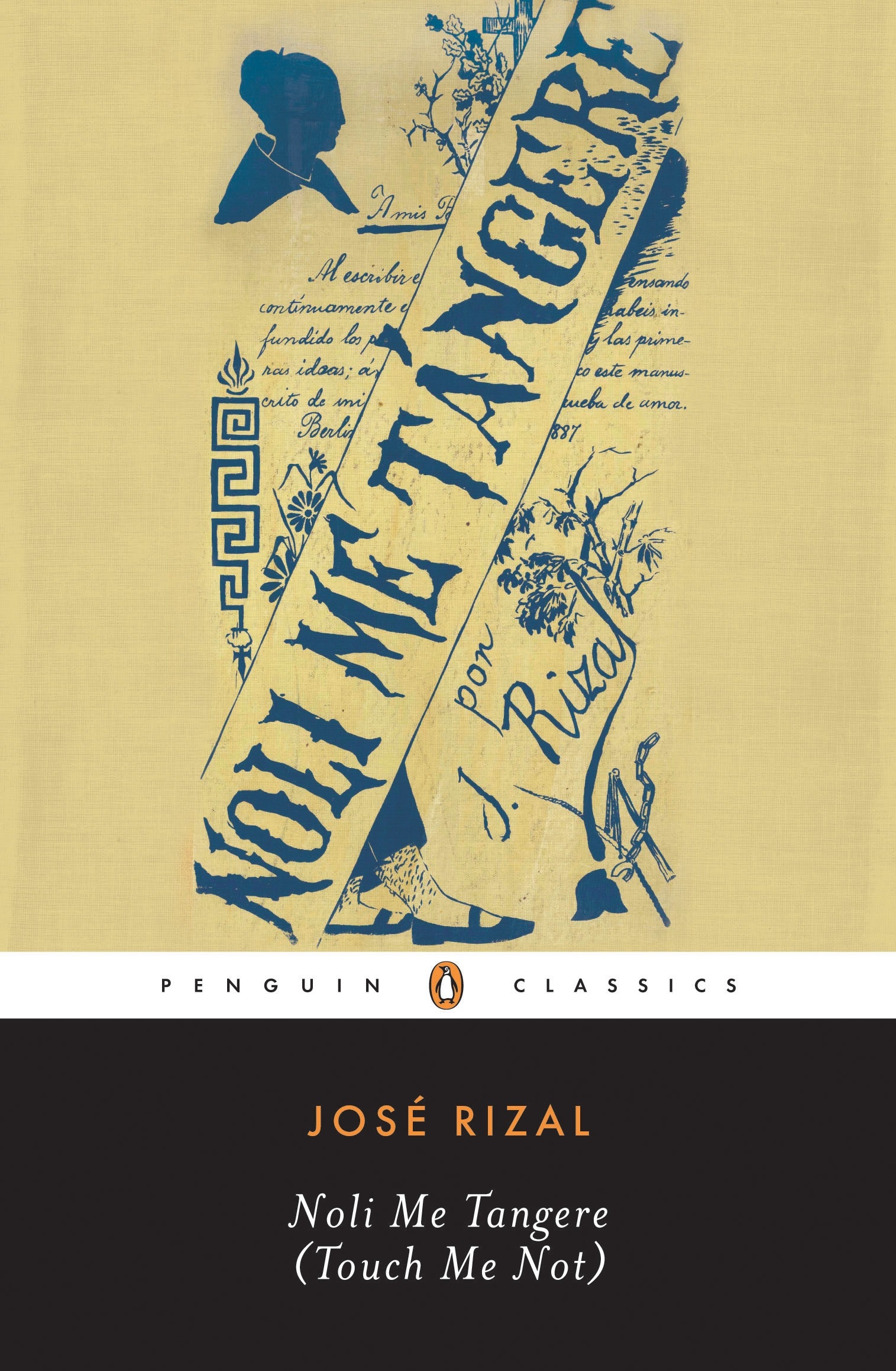
Book 105, the Philippines: "Noli Me Tangere" by José Rizal

In case you haven't heard of José Rizal, well, he was a freakin' genius, that's who he was. Look him up. Lived in Spain's most backwater colony in the 19th century but nonetheless learned 22 languages; found employ as "an ophthalmologist, sculptor, painter, educator, farmer, historian, playwright and journalist"; while also dabbling in "architecture, cartography, economics, ethnology, anthropology, sociology, dramatics, martial arts, fencing and pistol shooting".

Oh, and he did that all before he was executed at the age of 35 on 30 December 1896, thus igniting the Philippine Revolution. Way more than just a martyr: he was one of the great modern thinkers of Asia, in the league of Sun Yat-Sen and Tagore. Amazing. 


The way he fomented his ideas, of course, was through his novels, which are studied by every kid in the Philippines today (in English or Tagalog translation from the original Spanish). And the wonderful thing is that the Noli ages well: because he published it in Europe for the benefit of those who didn't know about colonial abuses, what he does is he provides a thorough ethnographic sketch of his homeland at the time, which is just as fascinatingly foreign to us 21st century people as it would've been to the Iberians. 

Y'see, seems that the Philippines was a friarocracy - its priests outranked the Spanish colonial officers in practice if not on paper. Rizal (an atheist!) highlights the crazy hypocrisy that this birthed: sales of indulgences, inflated fees for sermons in languages the laity can't understand, an utter lack of interest in uplifting the population in any way through education, and a sense of being an invulnerable caste - you don't tip your hat to them in the street, they excommunicate you, and the rest of the sheep-like population looks upon you with scorn.

No idea if the Franciscans and Dominicans and Jesuits were really as nasty as described in the book, but absolute power corrupts absolutely, so I've a feeling the answer's yup. 

There's deep shades of Uncle Tom's Cabin here: from the stock characters (the noble hero Don Crisostomo Ibarra, the virtuous heroine María Clara, the evil priests Father Dámaso and Fray Sibyla, the revolutionary Elías) to the sheer purpleness of the prose when tragedy strikes. But there's also a Dickensian joy in descriptions of the follies of people (Doña Victorina, who pretends to be Spanish and murders the language whenever she speaks it, and takes it all out on her actually Spanish husband by pulling the false teeth from his mouth). Also maybe a Wilkie Collins-esque touch of melodrama - the nail-biting death scenes, the apparition of the ragged nun on the convent rooftop - and remember, Rizal, the genius bugger, probably read all these guys and digested them.

Lor, no wonder the Philippines is so creative. If only our country was founded on the bulletwound of a polymath poet. One last note: this book is good, but it ain't light reading - might be a while till I move on to the sequel, El Filibusterismo.


View Around the World in 80 Books!!! in a larger map

Representative quote: "You're right, Elías, but man is a creature of circumstance. I was blind then, disgusted, what did I know! Now misfortune has ripped off my blinders. Solitude and the misery of prison have shown me. Now I see the horrible cancer gnawing at this society, rotting its flesh, almost begging for a violent extirpation. They opened my eyes, they made me see the sores and forced me to become a criminal! And so, just what they wanted, I will become a subversive, but a true subversive. I will call together all the downtrodden people, everyone who feels a heart beating in his heart, those how sent you to me... No, I won't be a criminal, you aren't a criminal when you fight for your country, just the opposite! For three centuries we have held out our hand to them, asked them for love, eager to call them brothers, and how do they answer us? With insults and mocking, denying us even the status of human beings. There is no God, no hope, no humanity, nothing more than the rights of power!"

Next book:  Henrique de Senna Fernandes's The Bewitching Braid, from Macau.

Monday, September 10, 2012

Singapore (and Malaysian) Comix!!!

So I spent last-last weekend at the Singapore Toy, Game and Comic Convention. Awesome fun, even if you're not an otaku. You could spend hours just checking out the hordes of cosplayers.


Only dared to ask one for a photo. She plays Jaafar, an assassin. She had daggers hidden in her sleeves! (And yes, I'm wearing cat ears. I had to blend in, somehow.)

But regarding books! I ended up spending some of my hard-earned money on some local/regional comics, which I've already finished:


It's all good stuff: Sir Fong's Adventures Vol. 4 by Otto Fong (zany sci fi adventures with actual science lessons embedded in them), When I Was a Kid by Boey Chee Ming (quirky Malaysian memoir of growing up in Johor) and Loti Vol. 1 by Troy Chin (a chronicle of a Singaporean kid's year in Primary 2).

I was hoping to spend even more, after my friend Mayo Martin advertised the release of the following graphic texts by Epigram:


But alas, it turned out these were just previews - just a few pages long, given out for free to tempt folks into buying the real thing. Which I'm gonna.

The books are:

Ten Sticks and One Rice by Koh Hong Teng and Oh Yong Hwee
The Girl Under the Bed by Dave Chua and Xiao Yan
Scenegapore by Prudencio Miel

By the way, I ended up giving my cat ears to a little girl at a Hari Raya party I went to that night.


I mean, look at how well it goes with that dress. She's pimpin' it, homies.  Awesome.


Sunday, September 2, 2012

The Substation Fairy Tales/Eat, Pray, Love

On the advice of my Filipino friends, I've decided to do Noli Me Tangere, the first novel by José Rizal, of which El Filibusterismo is the sequel. As Vicente Garcia Groyon said,  "The Fili is tighter and leaner, but as it's a sequel, it's best to start with the Noli." (I love how we abbreviate these highfalutin Latin titles to make them sound Southeast Asian!)

In the meantime, I'd like to promote a new book I've got coming out, The Crocodile Prince. I don't have the cover, yet, but here's the publicity info for the launch!


The Substation Fairytales: Stories in the End 
Book Launch and Birthday Party 
Sunday 30 September 2012, 2pm-4pm 
The Substation Theatre 
45 Armenian Street
Admission: Free

After the publication of The Substation’s first book, Several Islands by Ho Rui An, comes not one but three books to add to your bedside reading collection. As the title suggests, these are fairytales – but not quite your regular tales of the damsel in distress and knight in shining armour. These are modern tales of love, identity, and belonging… not mere romantic pizzazz, but some of the things that really matter at the end of it all.

The three writers this year are Tania De Rozario, Bani Haykal and Ng Yi-Sheng, artists with different creative styles and interpretations of a modern fairytale. Tania’s story, Reasons for the Rain, is a poignant tale of serendipity and chance, of two strangers crossing paths in the concrete jungle. Bani’s modernist play, the artist and his subject, is shrouded in mystery from the outset, dealing with darker themes that the reader has to unravel. Yi-Sheng’s fable, The Crocodile Prince, is about a boy finding himself in a magical jungle of mystery.

Interest piqued? Come have a chat with the three authors during the combined book launch on Sunday 16 September from 2pm-4pm at the Substation Theatre!

This is held in conjunction with the Substation’s 22nd Birthday Party.
In other news, I'd like to report that I've just read the international feel-good American exotica phenomenon, Eat, Pray, Love by Elizabeth Gilbert.

It's good. I've read loads of critiques of it, but as a writer, and as a person who's going through some relationship oddness himself, and as someone who's just curious about travel and the world - I think rather well of it.

What's terribly interesting is the bits of the book that didn't make it into the movie (which I admittedly enjoyed), because they're the bravest portions of the text. Gilbert actually finds that kundalini blue light inside of herself, encounters all-encompassing bliss, while in her ashram in India - a moment that would infuriate both Christians and atheists watching it on the screen (they showed her frustrations with meditation instead, not the fact that she was actually able to overcome them).

Gilbert's reporting, from a cynical agnostic viewpoint, on the fact that guided spiritual transcendence is a very real phenomenon in our world, and that it is healing, and that it is non-denominational. And that might feed into Orientalism, but it's a genuine part of her journey. I respect that.

I also respect the fact that she acknowledges the imperfections of each place she visits: how the magnificent food of Sicily is counterbalanced by the horrific way the Mafia have abused the governance of the island; how Bali's apparent serenity belies a violent, bloody history, and the presence of absolutely good people who may be driven to cheat you.

Of course I also decided a while ago that anyone creating bestsellers must be doing something right. But anyhow, don't snub this book just because it's popular. It's worth a flip.